Acceleration by the Numbers: Applying Newton’s Second Law
Students use force, mass, and acceleration data to apply F = ma, calculate unknown quantities, and explain how net force determines an object’s acceleration.
Illustrations are auto-generated and may be placeholders. They can be refreshed to match the narration.
From Net Force to Acceleration
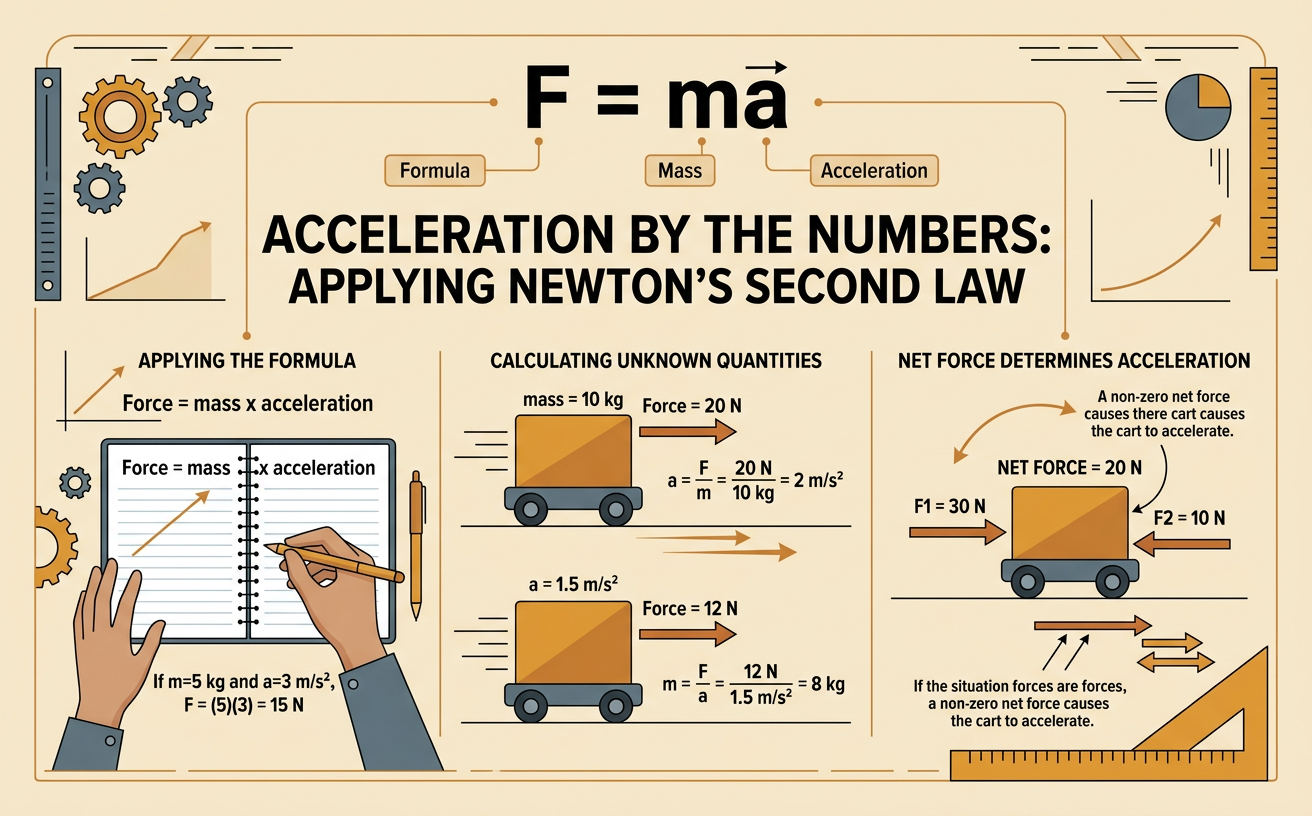
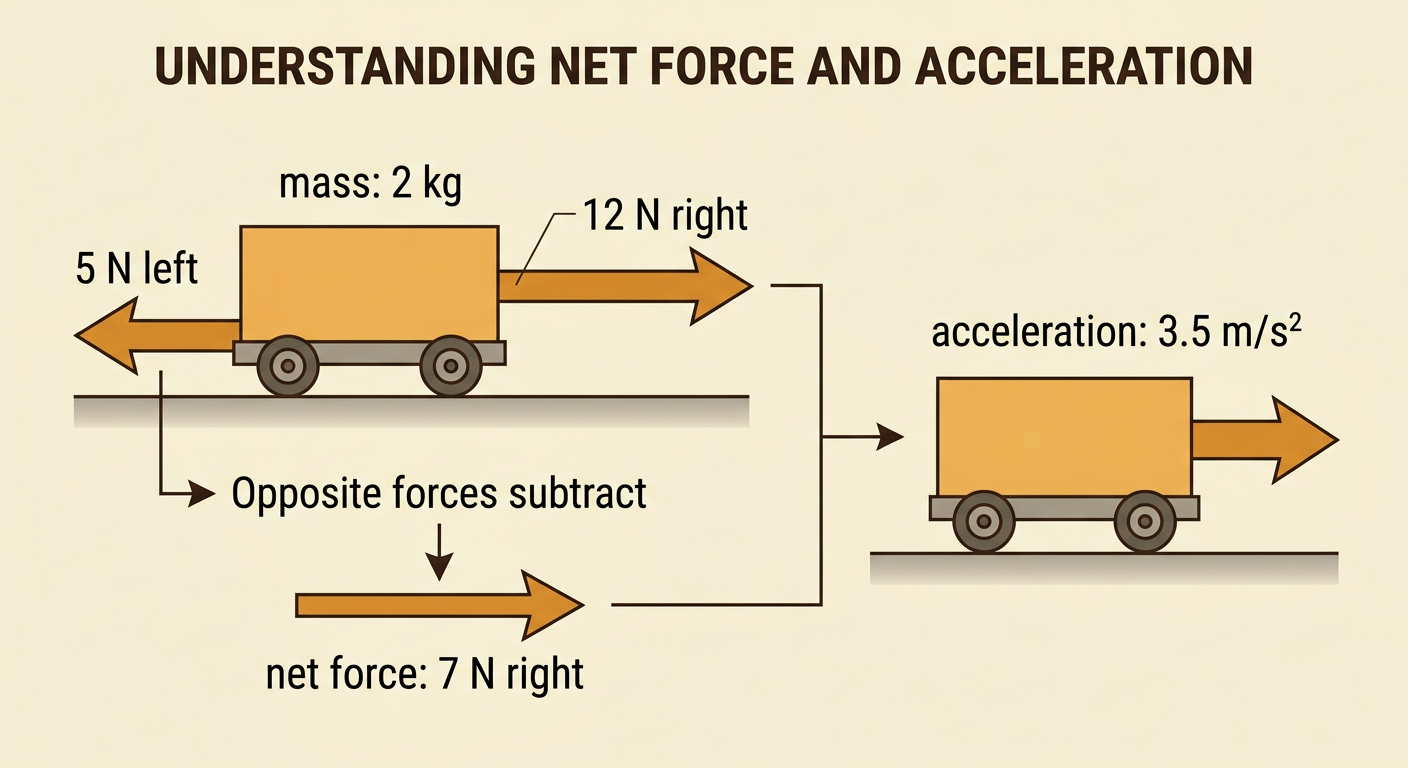
An object’s acceleration depends on the net force acting on it. Net force is the vector sum of all forces, so direction matters. Forces in opposite directions subtract from one another. Suppose a cart is pushed with 12 newtons to the right while friction exerts 5 newtons to the left. The net force is 12 N − 5 N = 7 N to the right. Because the net force is not zero, the cart accelerates to the right. If the cart’s mass is 2 kilograms, its acceleration is 3.5 meters per second squared. A balanced net force of 0 N would produce no acceleration, although the cart could still move at constant velocity. In an investigation, force sensors and motion sensors can provide evidence connecting net force to changes in motion.
Understanding F = ma
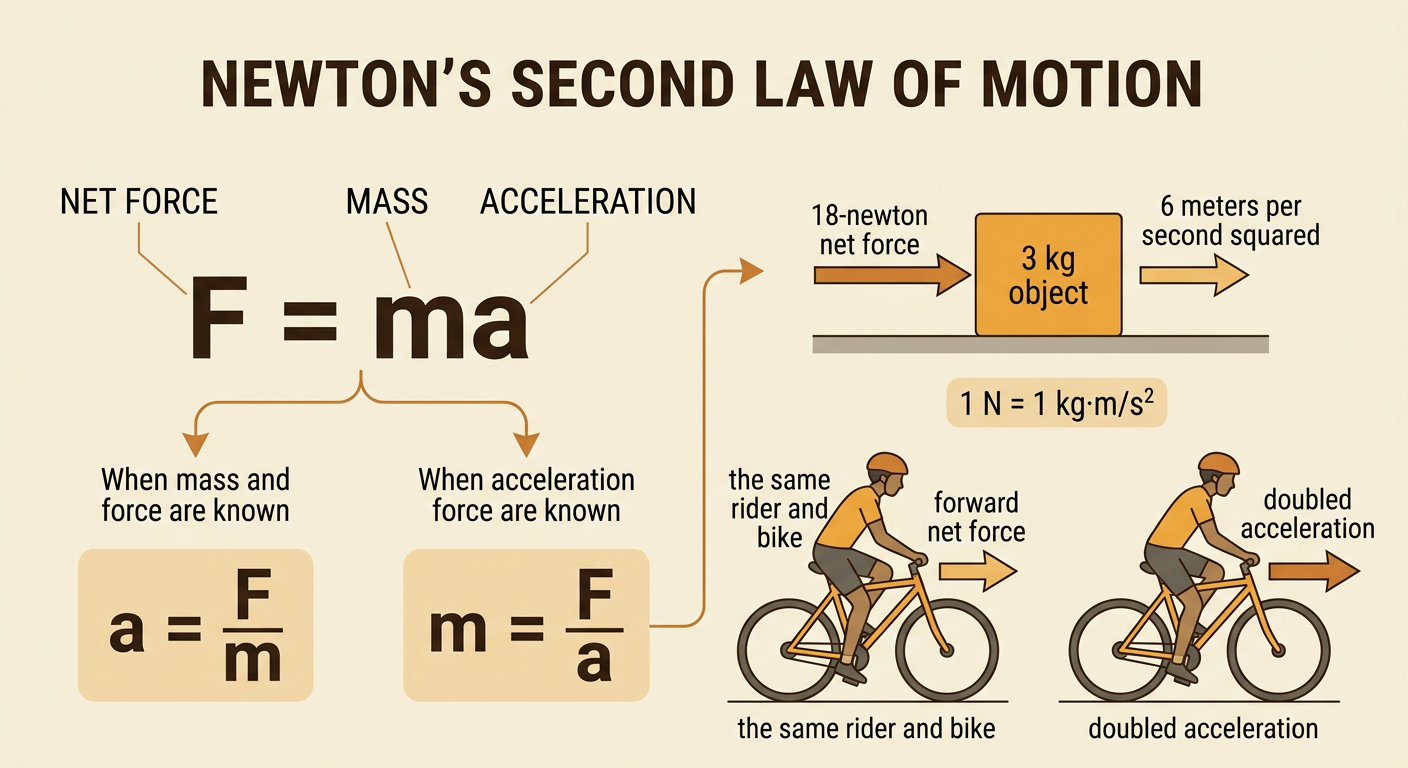
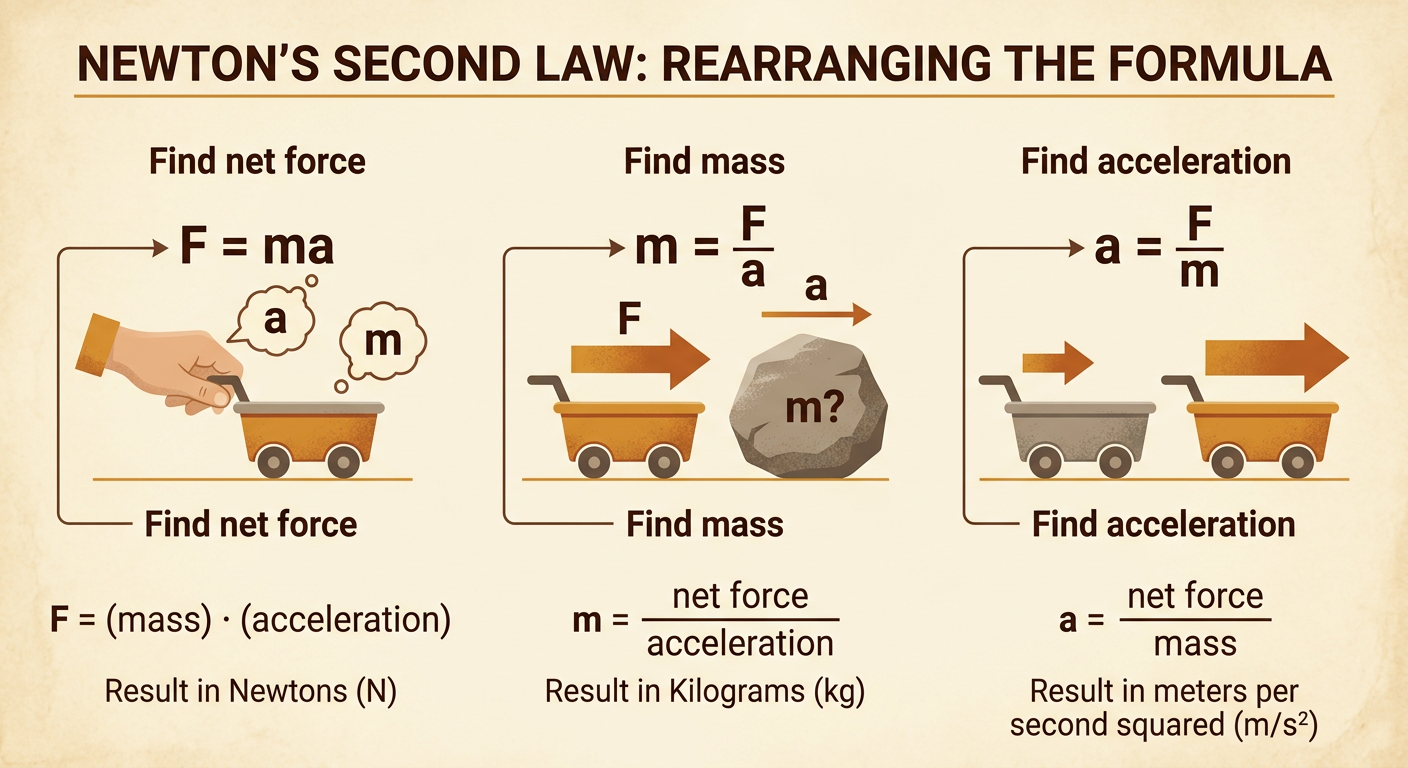
Newton’s second law is written as F = ma, where F is net force in newtons, m is mass in kilograms, and a is acceleration in meters per second squared. The equation states that net force equals mass multiplied by acceleration. It can also be rearranged as a = F/m or m = F/a. For example, a 3-kilogram object acted on by a net force of 18 newtons has an acceleration of a = 18 N/3 kg = 6 m/s2. The unit newton is defined so that 1 N = 1 kg·m/s2. Use the net force rather than one individual force in the equation. When mass stays constant, acceleration is directly proportional to net force: doubling the net force doubles the acceleration.
Keeping Mass Constant
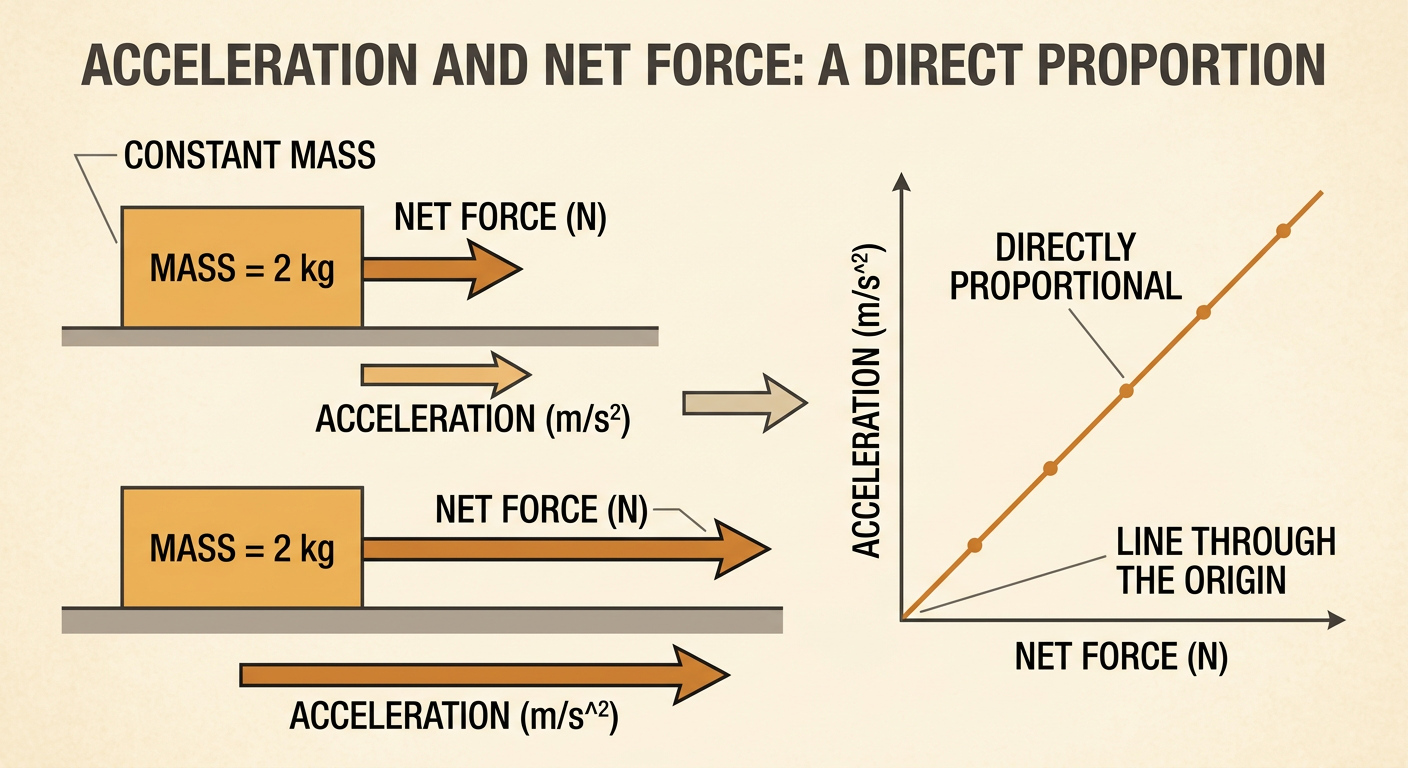
To test how net force affects acceleration, keep the cart’s mass constant and change only the net force. Imagine a 2-kilogram cart tested with net forces of 2 N, 4 N, 6 N, and 8 N. Using a = F/m, the accelerations are 1 m/s2, 2 m/s2, 3 m/s2, and 4 m/s2. The ratio F/a equals 2 kilograms in every trial. A graph with net force on the horizontal axis and acceleration on the vertical axis forms a straight line through the origin. This pattern shows a directly proportional relationship. If the net force triples while mass remains unchanged, the acceleration also triples. A fair investigation should use the same cart, track, measurement method, and starting conditions in every trial so force is the only changed variable.
Keeping Net Force Constant
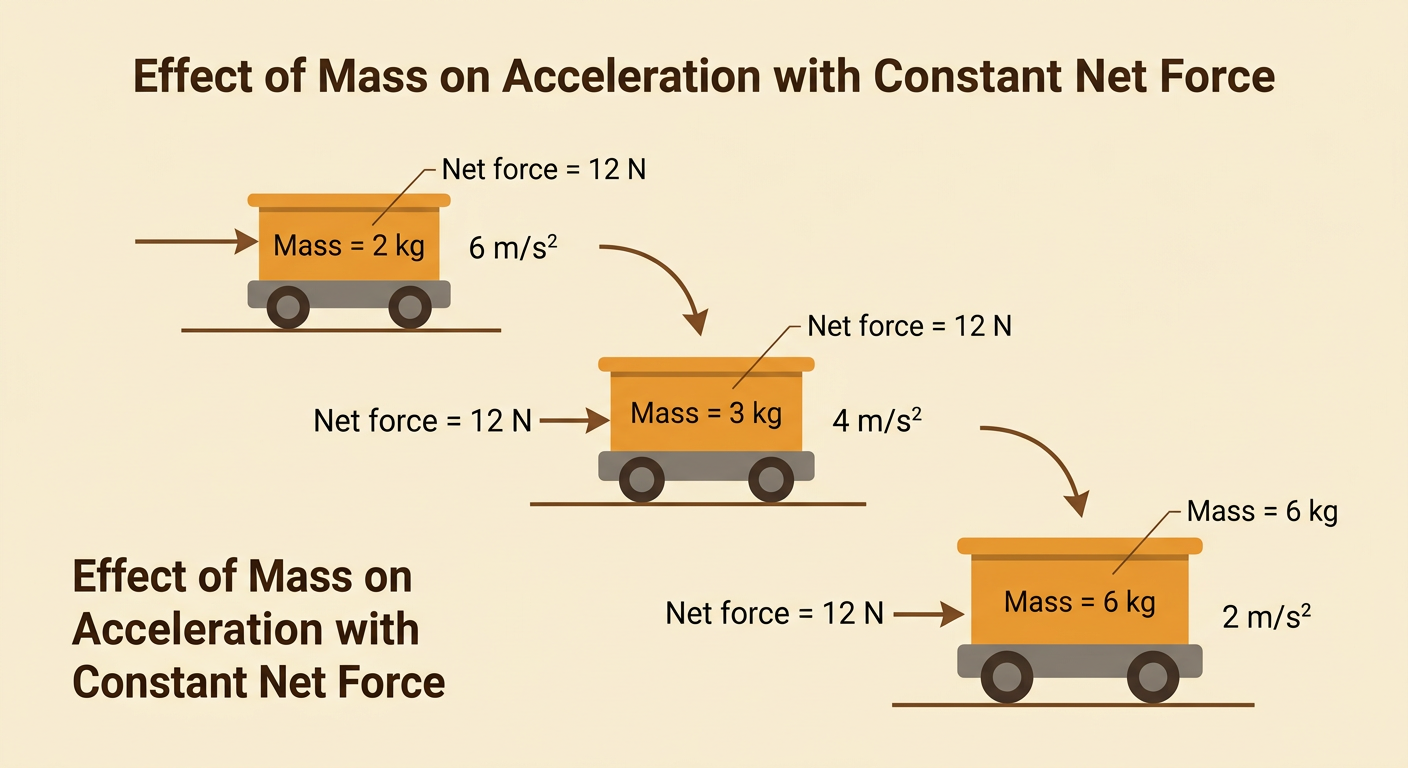
To investigate how mass affects acceleration, keep the net force constant while changing the object’s mass. Suppose the net force is always 12 N. A 2-kilogram cart accelerates at 6 m/s2, a 3-kilogram cart accelerates at 4 m/s2, and a 6-kilogram cart accelerates at 2 m/s2. As mass increases, acceleration decreases because a = F/m. Doubling the mass cuts the acceleration in half when net force stays unchanged. This is an inverse relationship, not a direct proportional relationship. In every trial, the product ma remains 12 N. To make the test fair, students could add measured masses to the same cart and adjust the pull until a force sensor reads 12 N. Repeated measurements help reduce the effect of random errors.
Calculating Force, Mass, and Acceleration
Begin each calculation by identifying the known quantities, selecting the correct form of Newton’s second law, and including units. To find force, multiply: a 5-kilogram object accelerating at 3 m/s2 needs a net force of F = 5 kg × 3 m/s2 = 15 N. To find mass, divide force by acceleration: an object experiencing 20 N and accelerating at 4 m/s2 has m = 20 N/4 m/s2 = 5 kg. To find acceleration, divide force by mass: a 24-newton net force on a 6-kilogram object produces a = 24 N/6 kg = 4 m/s2. Check whether the answer is reasonable. For the same mass, a larger force should produce a larger acceleration. For the same force, a larger mass should produce a smaller acceleration.
Explaining Results with Evidence
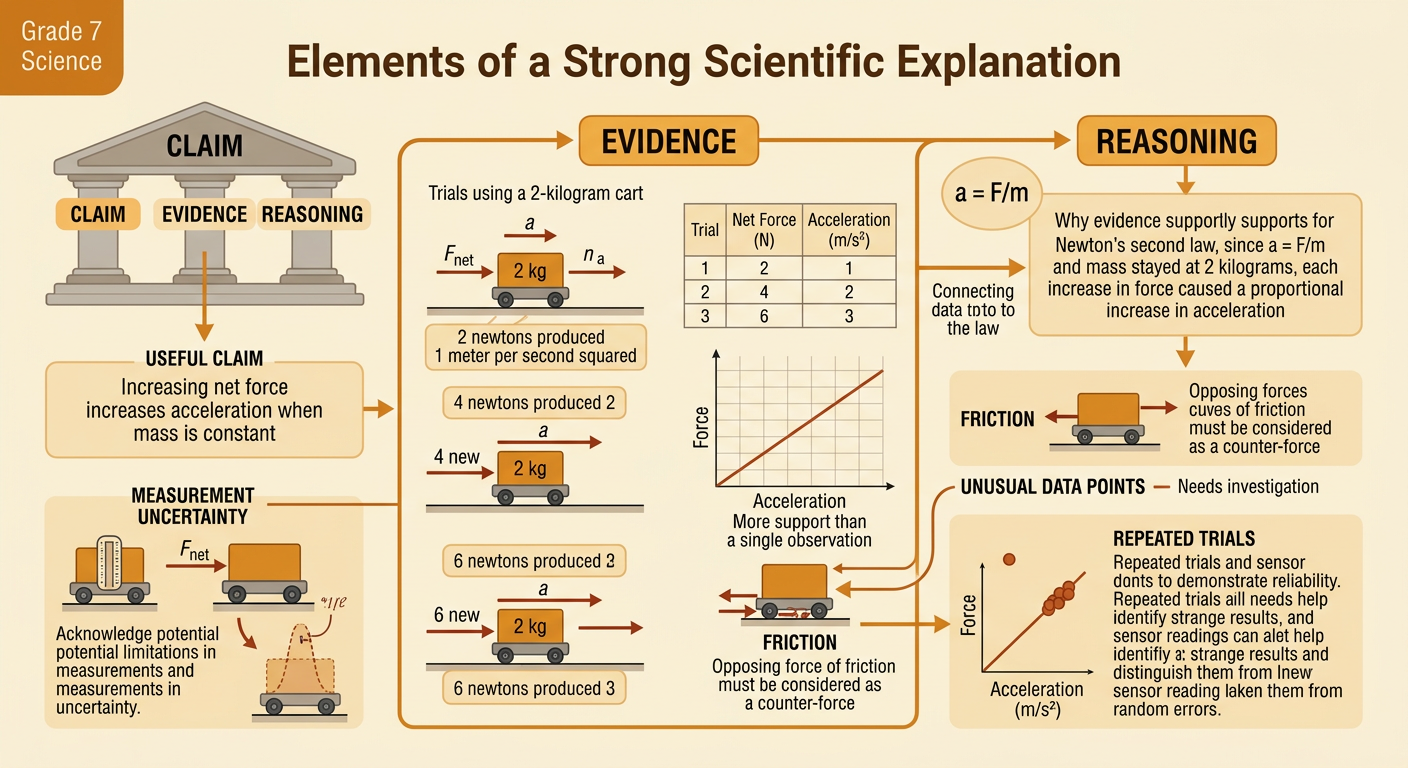
A strong scientific explanation includes a claim, evidence, and reasoning. Consider results from a cart investigation and calculations using F = ma. A claim might state, “Increasing net force increases acceleration when mass is constant.” Evidence could include several trials: a 2-kilogram cart accelerated at 1 m/s2 with 2 N, 2 m/s2 with 4 N, and 3 m/s2 with 6 N. A graph of the measurements and the calculated values provide two sources of supporting evidence. The reasoning connects them: because a = F/m and mass remained 2 kilograms, each increase in force caused a proportional increase in acceleration. Students should also discuss measurement uncertainty, friction, and unusual data points. Repeated trials, sensor readings, tables, graphs, and equations make an argument more convincing than a single observation.