Acids, Bases, and Neutralization
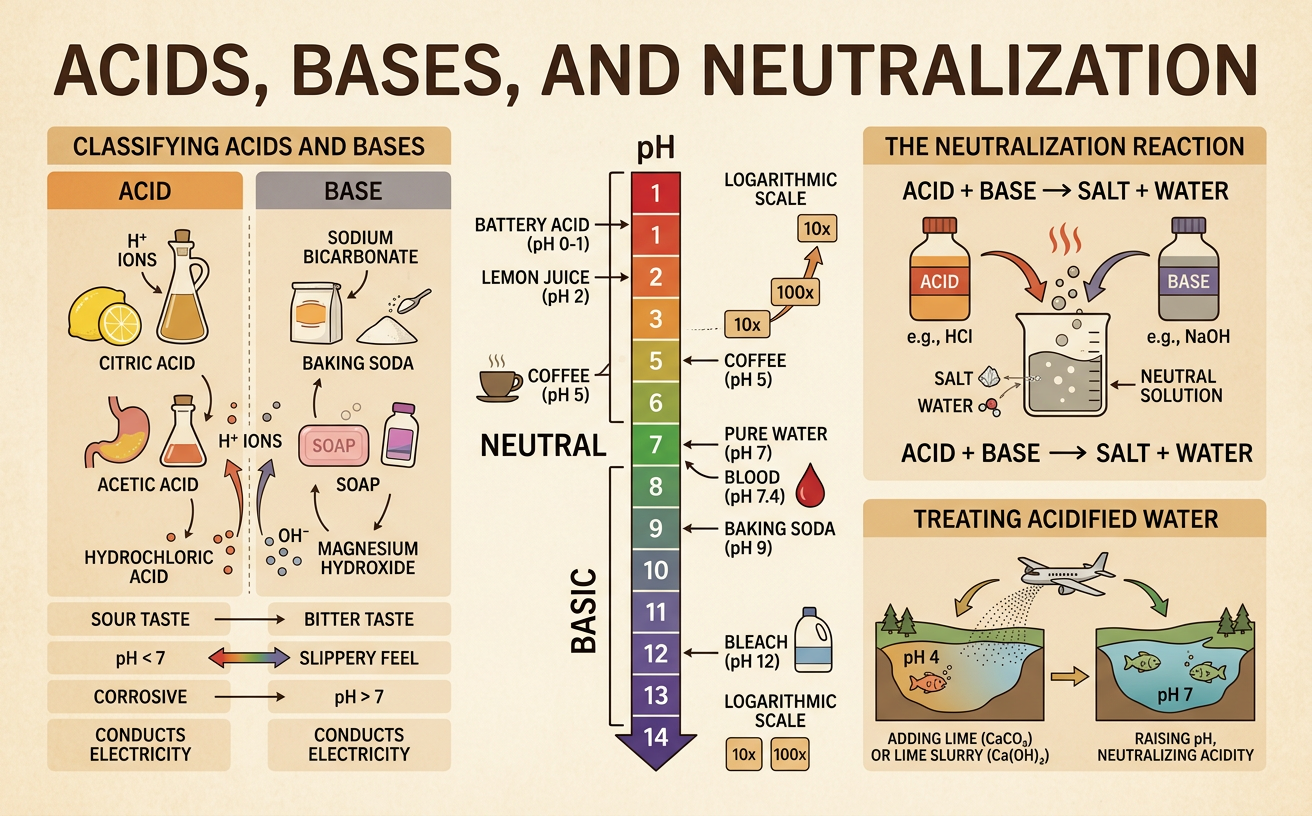
Students classify acids and bases, interpret the logarithmic pH scale, and explain how neutralization can address acidified water.
Illustrations are auto-generated and may be placeholders. They can be refreshed to match the narration.
Properties of Acids and Bases
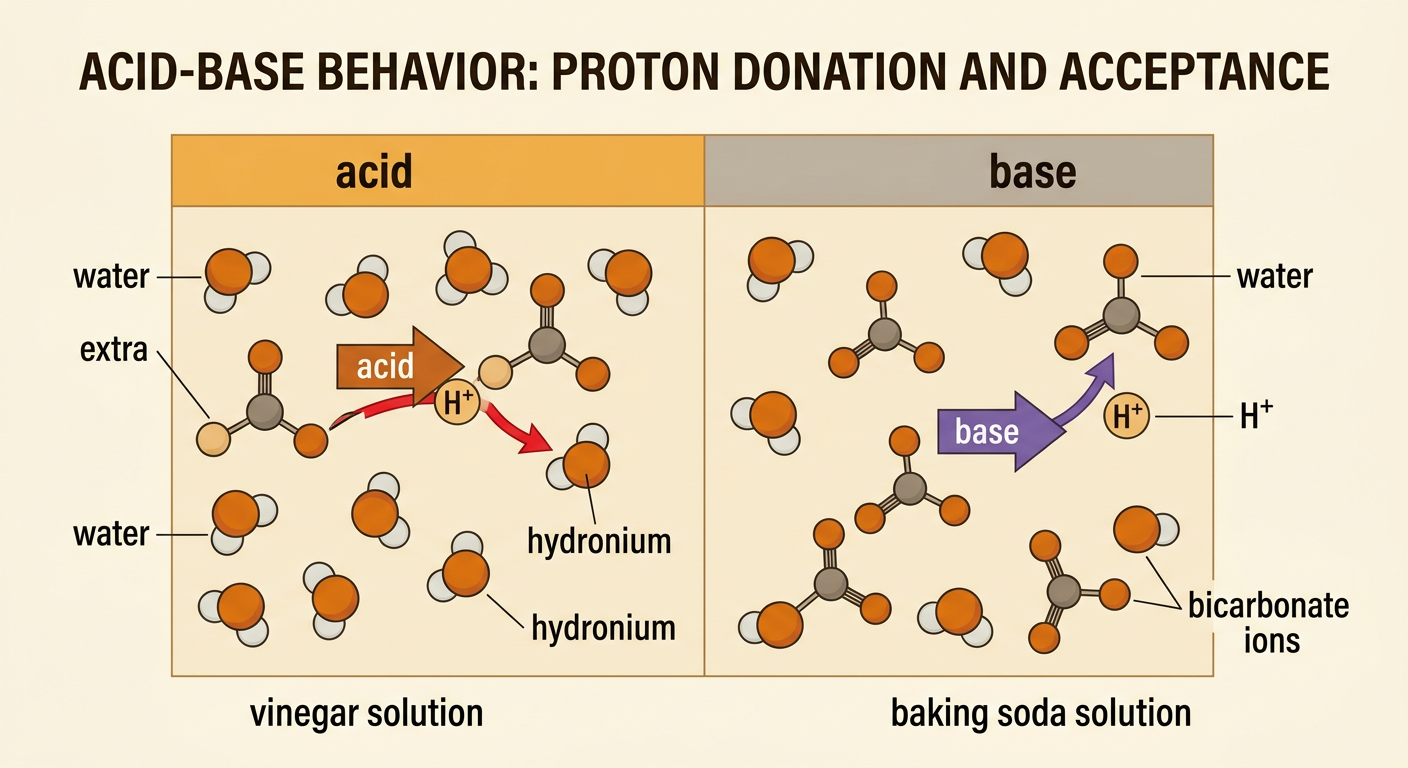
Acids and bases are classified by how they behave in reactions. An acid donates a hydrogen ion, H+, while a base accepts H+. In water, H+ attaches to a water molecule to form hydronium, H3O+. Many bases, such as sodium hydroxide, produce hydroxide ions, OH−, in water. Acids often react with metals or carbonates, and bases often feel slippery, but chemicals should never be touched or tasted to identify them. Vinegar is acidic because its acetic acid can donate H+. A baking soda solution is basic because bicarbonate ions can accept H+. Acids and bases may be strong or weak depending on how completely their particles ionize, and they may be concentrated or dilute depending on how much solute is present.
Reading the pH Scale
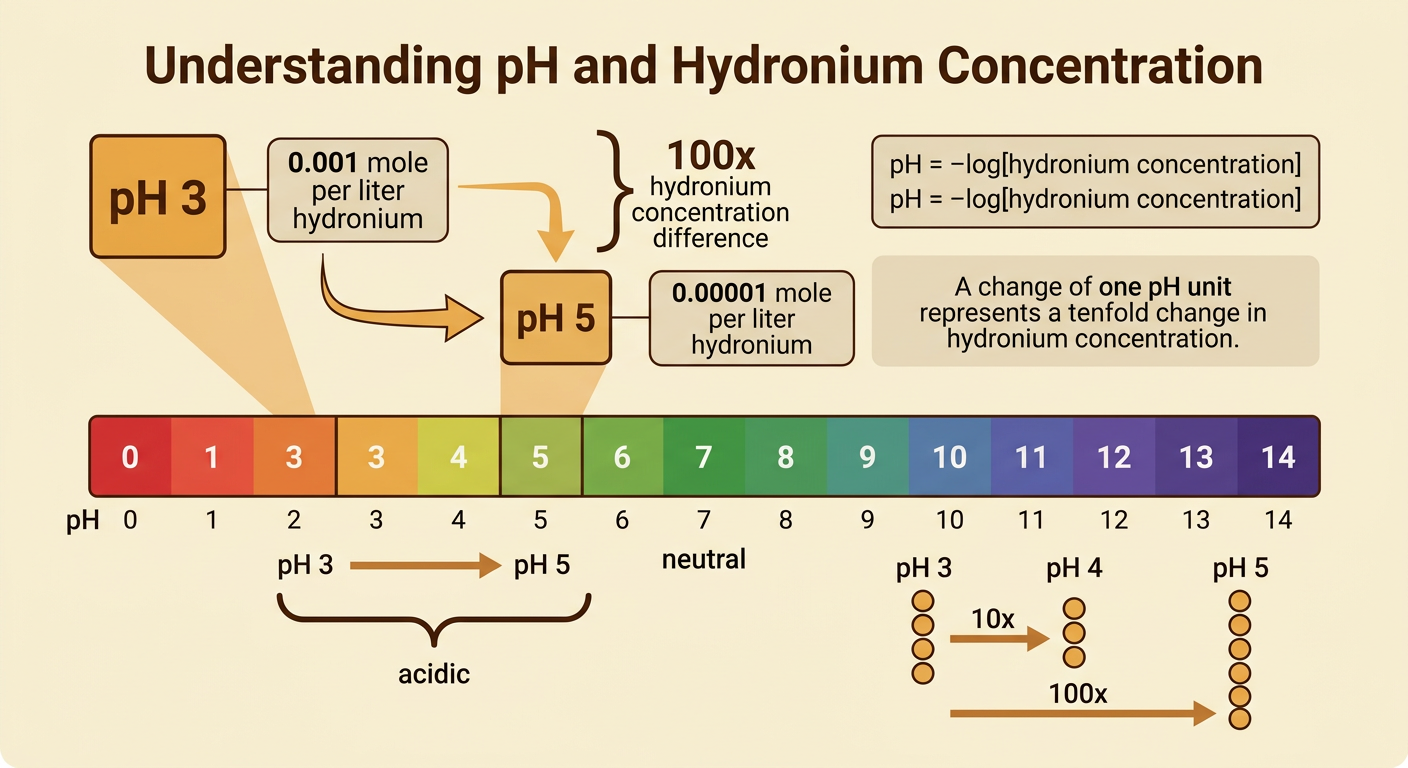
The pH scale describes the hydronium ion concentration of an aqueous solution. It is commonly shown from 0 to 14, with pH 7 neutral at about 25°C. Values below 7 are acidic, and values above 7 are basic. The mathematical relationship is pH = −log[H3O+], where brackets mean concentration in moles per liter. Because the scale is logarithmic, a change of one pH unit represents a tenfold change in hydronium ion concentration. For example, a solution at pH 3 has ten times the hydronium concentration of a solution at pH 4 and one hundred times that of a solution at pH 5. Thus, a two-unit pH change is much larger chemically than it may appear on a number line.
Using Indicators to Classify Solutions
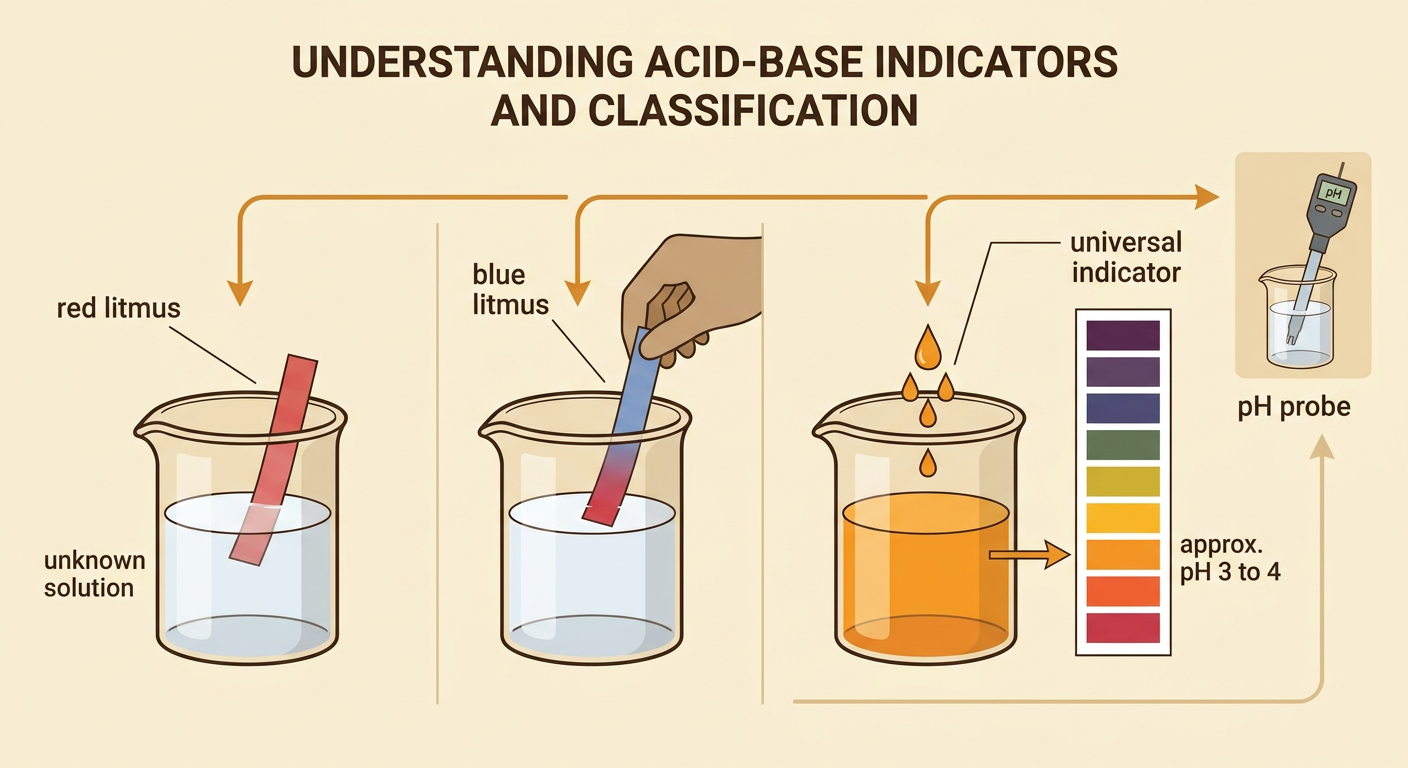
An acid-base indicator is a substance that changes color over a particular pH range. Indicators provide evidence for classifying a solution, but most do not give an exact pH. Blue litmus paper turns red in an acid, while red litmus paper turns blue in a base. Universal indicator uses a mixture of dyes to show a wider range of colors: red or orange usually indicates an acid, green indicates a near-neutral solution, and blue or purple indicates a base. Suppose an unknown clear solution turns blue litmus red and makes universal indicator orange. These observations support the conclusion that the solution is acidic, likely around pH 3 or 4. For more precise evidence, students can compare the color with a reference chart or use a calibrated electronic pH probe.
Modeling a Neutralization Reaction
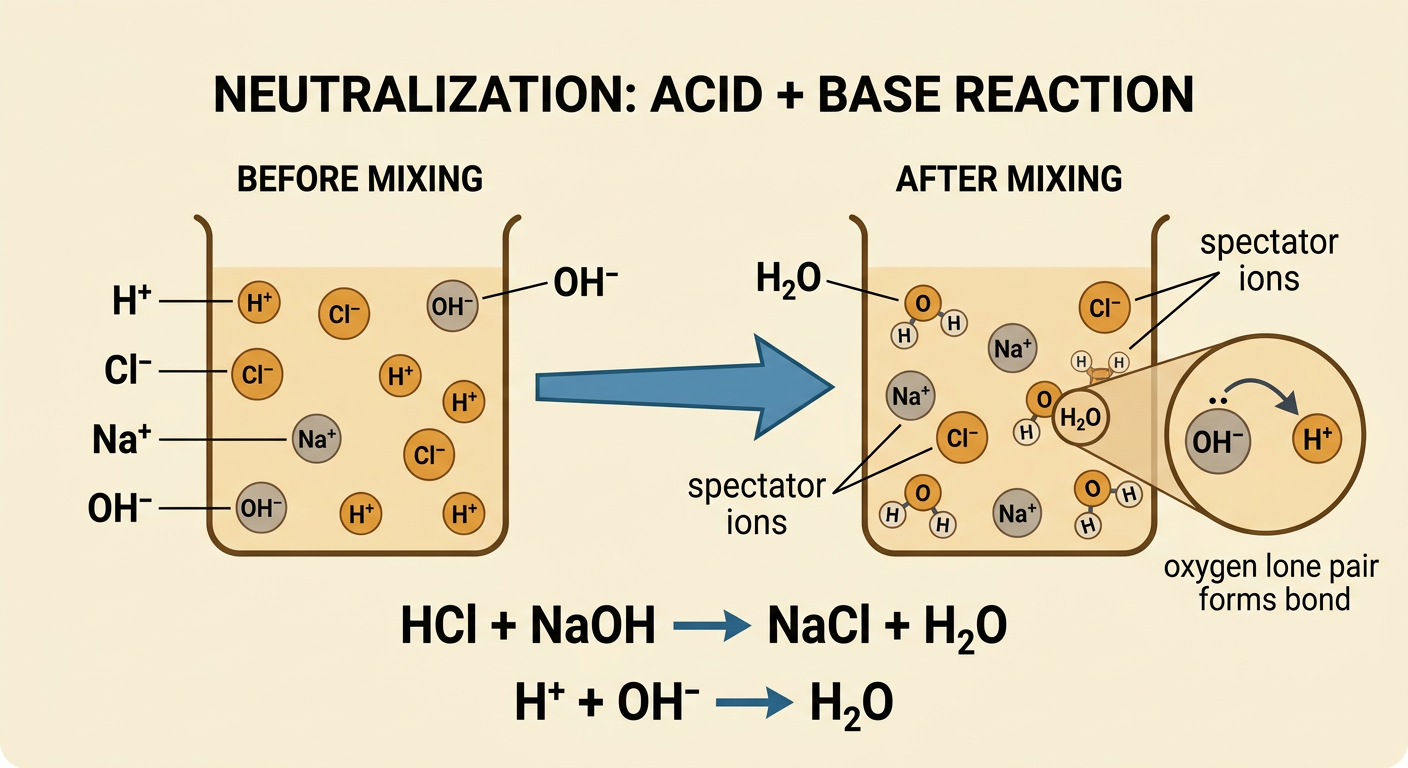
Neutralization occurs when an acid and a base react to form water and an ionic compound called a salt. For example, hydrochloric acid reacts with sodium hydroxide according to HCl + NaOH → NaCl + H2O. In water, the reactants separate into H+, Cl−, Na+, and OH− ions. The central change is H+ + OH− → H2O; sodium and chloride are spectator ions because they remain unchanged. At the particle level, an oxygen atom in OH− uses a lone pair of electrons to bond with H+. Oxygen attracts electrons strongly because of its position on the periodic table, helping explain why hydroxide accepts the proton. If equal reacting amounts of a strong acid and strong base are mixed, the final solution can approach pH 7, though actual pH depends on amounts and concentrations.
Evaluating Treatment of Acidified Water
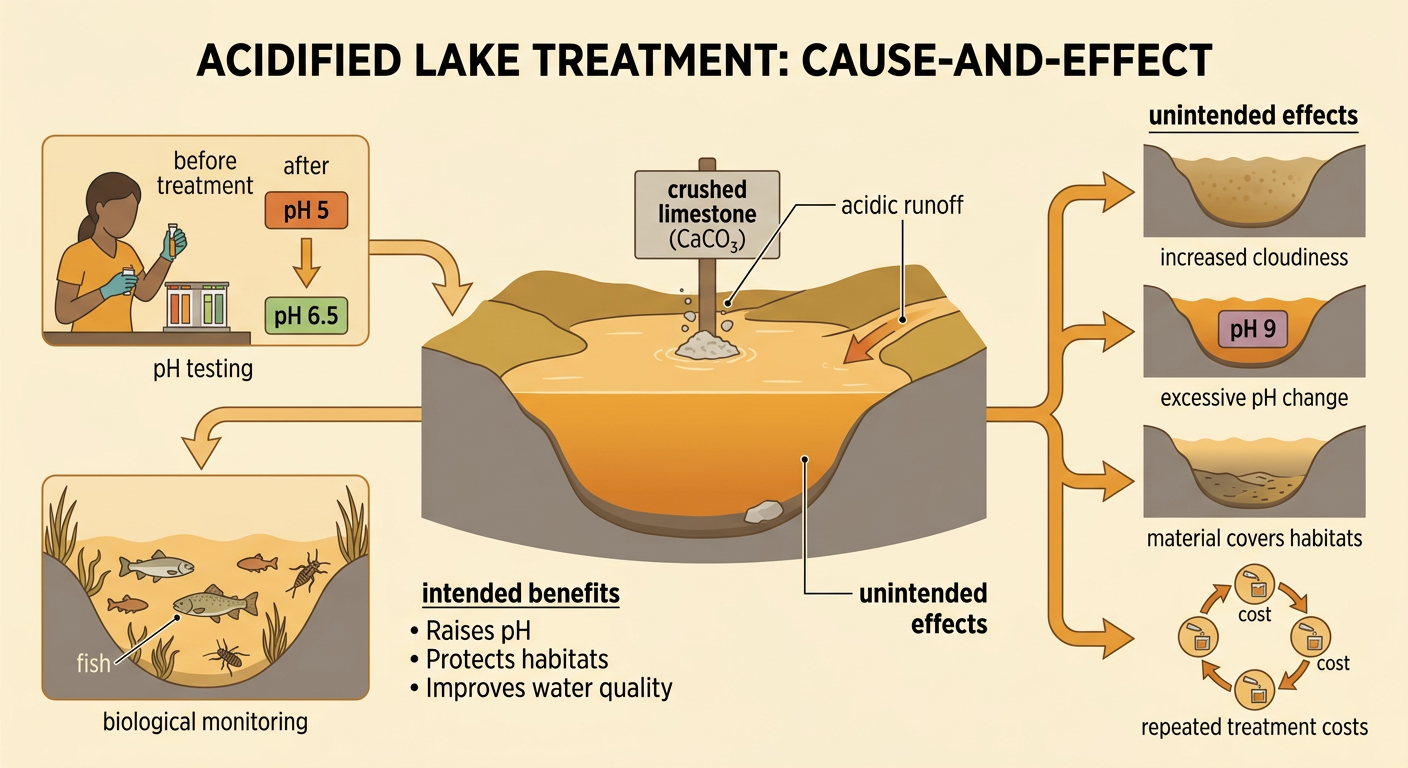
Communities sometimes add crushed limestone, calcium carbonate, to lakes or streams that have become too acidic. Carbonate reacts with acid, reducing excess H+ and raising pH. For example, managers might treat a lake at pH 5 to move it toward a range that better supports fish and aquatic insects. The intended outcomes include protecting habitats and improving water quality. However, treatment can also have unintended consequences. Adding too much material may raise pH excessively, increase cloudiness, cover bottom habitats, or change the water’s calcium concentration. Treatment may also be temporary if acid drainage or acidic runoff continues entering the water. A sound public policy should require measured doses, repeated pH testing, biological monitoring, cost analysis, and input from residents, scientists, industries, and Indigenous communities. Policymakers should compare neutralization with preventing pollution at its source rather than judging success from pH alone.