Acids, Bases, and the pH Scale
Students relate hydrogen ion concentration to the logarithmic pH scale, classify substances as acidic or basic, and interpret environmental pH data.
Illustrations are auto-generated and may be placeholders. They can be refreshed to match the narration.
Properties of Acids and Bases
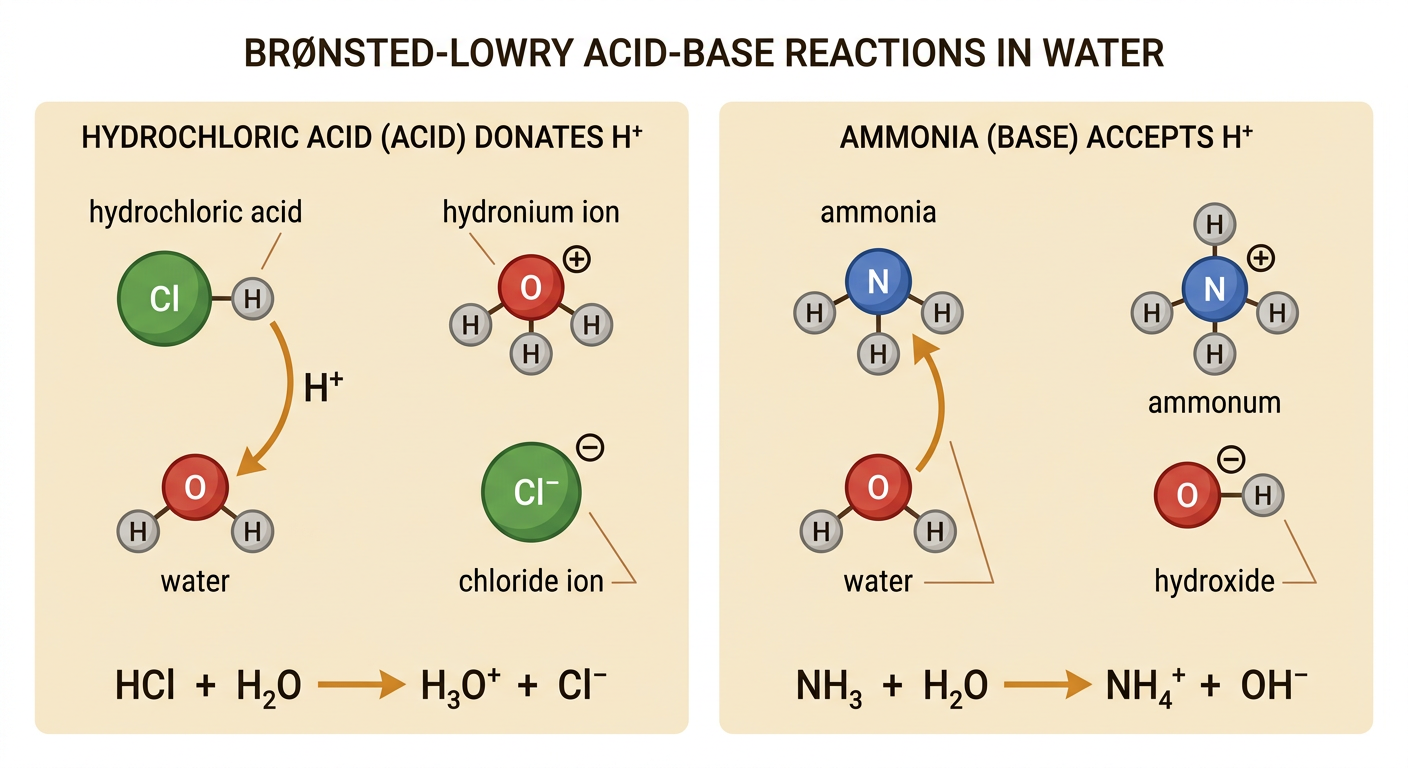
Acids and bases can be identified by their behavior in water. A Brønsted-Lowry acid donates a hydrogen ion, H+, while a Brønsted-Lowry base accepts H+. Acidic solutions often react with metals and turn blue litmus red. Basic solutions may feel slippery and turn red litmus blue, but substances should never be touched or tasted in a laboratory. For example, hydrochloric acid transfers H+ to water, producing hydronium ions, H3O+. Ammonia acts as a base by accepting H+ from water, producing ammonium ions and hydroxide ions. Strength is not the same as concentration: strength describes how completely an acid or base ionizes, while concentration describes how much solute is present in a given volume. A dilute strong acid can contain less acid than a concentrated weak acid.
Hydrogen Ions and pH
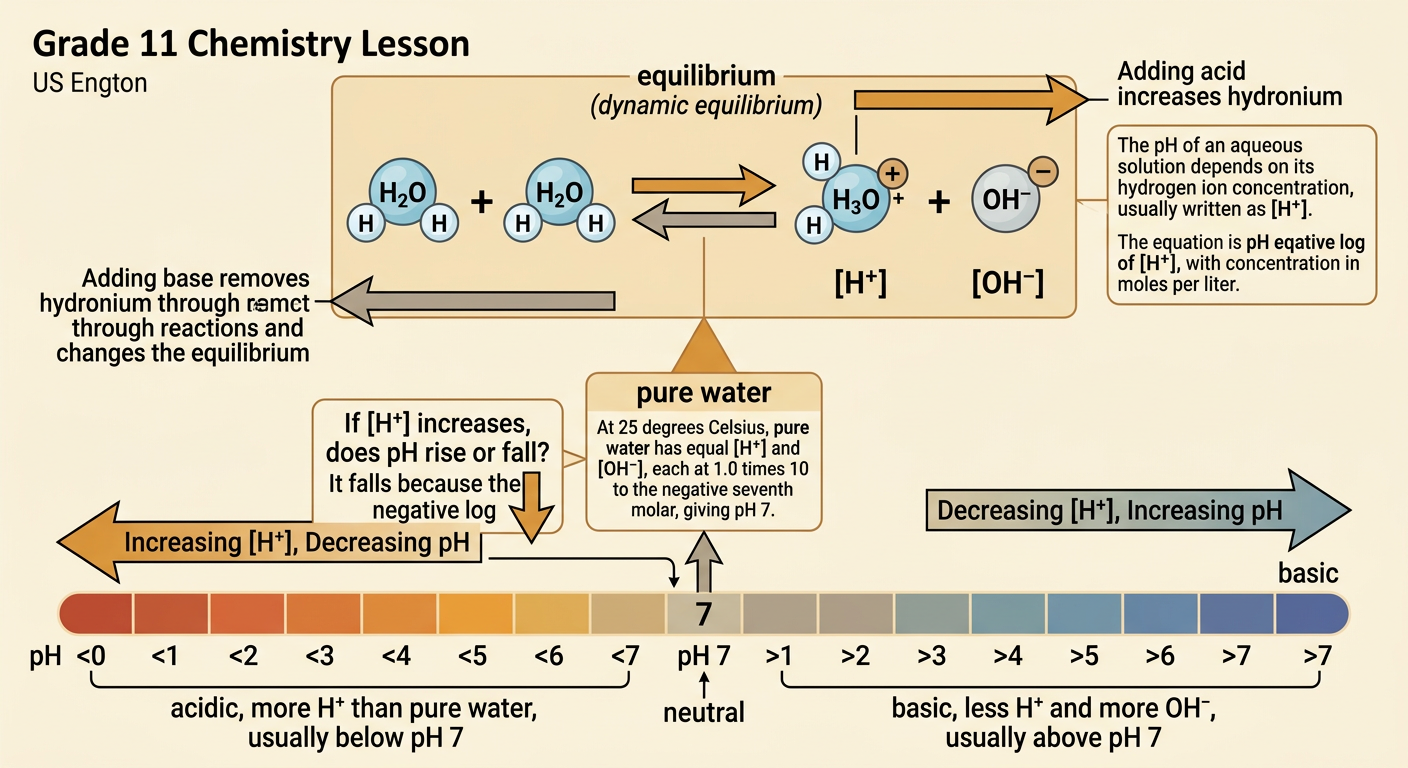
The pH of an aqueous solution is related to its hydronium ion concentration, commonly written as [H+]. The relationship is pH = −log[H+], where concentration is measured in moles per liter. At 25°C, pure water has equal concentrations of H+ and OH−: each is 1.0 × 10^−7 M, so the pH is 7. A solution with more H+ than pure water is acidic and usually has a pH below 7. A solution with less H+ and more OH− is basic and usually has a pH above 7. Water continuously undergoes reversible ionization: two water molecules form H3O+ and OH−, while those ions can recombine. Adding an acid shifts this chemical system toward greater hydronium concentration; adding a base removes hydronium and changes the equilibrium.
Calculating pH from Concentration
To calculate pH, substitute the hydrogen ion concentration into pH = −log[H+]. Suppose a solution has [H+] = 1.0 × 10^−3 M. Then pH = −log(1.0 × 10^−3) = 3.0, so the solution is acidic. If the concentration is not an exact power of ten, a calculator is useful. For [H+] = 2.5 × 10^−5 M, pH = −log(2.5 × 10^−5) ≈ 4.60. The reverse calculation uses the exponential form [H+] = 10^−pH. For example, a solution with pH 8.0 has [H+] = 10^−8 M. Report pH with appropriate precision: the number of digits after the decimal in pH should match the number of significant figures in the concentration.

Reading the Logarithmic Scale
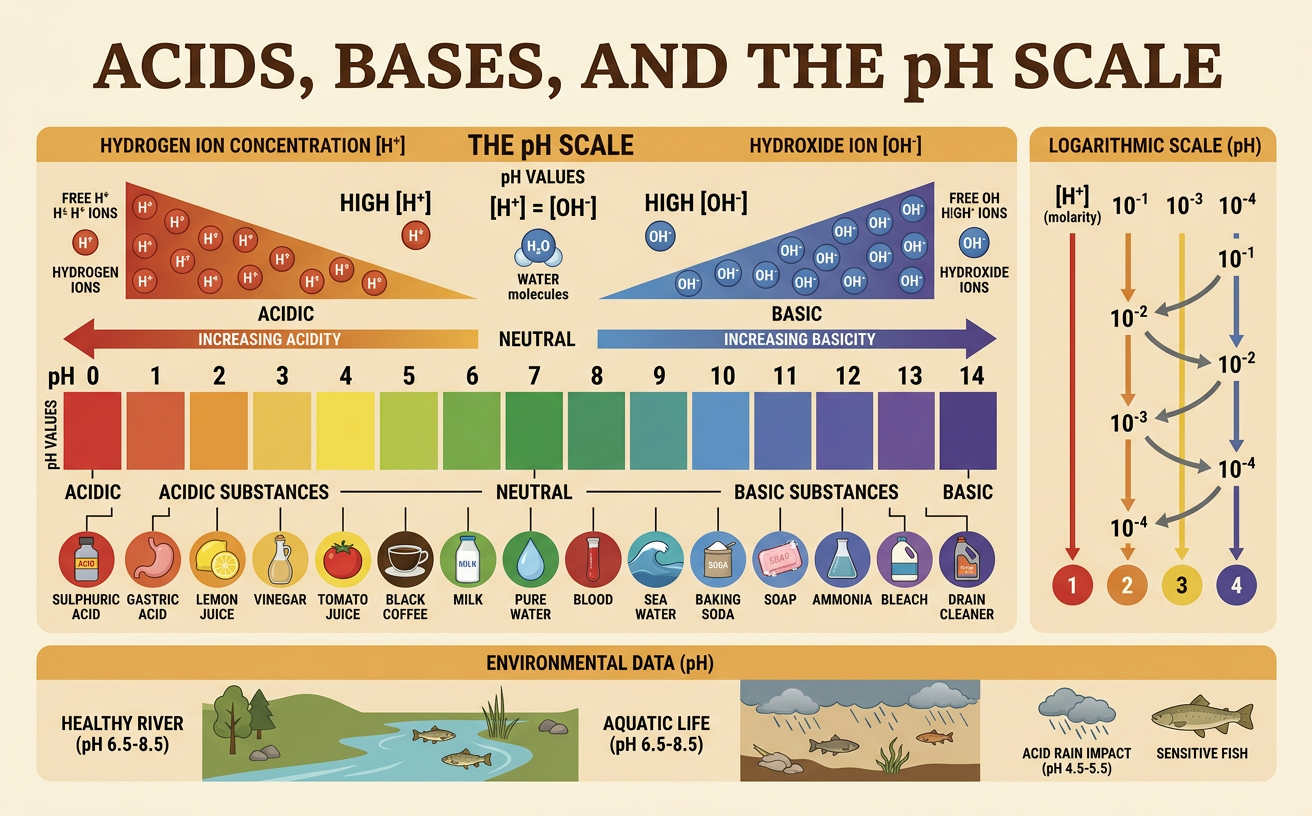
The pH scale is logarithmic, not linear. A change of one pH unit represents a tenfold change in hydrogen ion concentration. A solution at pH 3 has ten times the [H+] of a solution at pH 4 and 100 times the [H+] of a solution at pH 5. Therefore, pH 2 is not merely a little more acidic than pH 6; it has 10,000 times the hydrogen ion concentration. Lower pH values correspond to greater [H+], so the numerical directions are opposite. Common substances help show the range: lemon juice is often near pH 2, pure water is near pH 7 at 25°C, and household ammonia may be near pH 11. Actual values vary with concentration, temperature, and composition, so examples should be treated as approximate rather than fixed.

Indicators and Neutralization
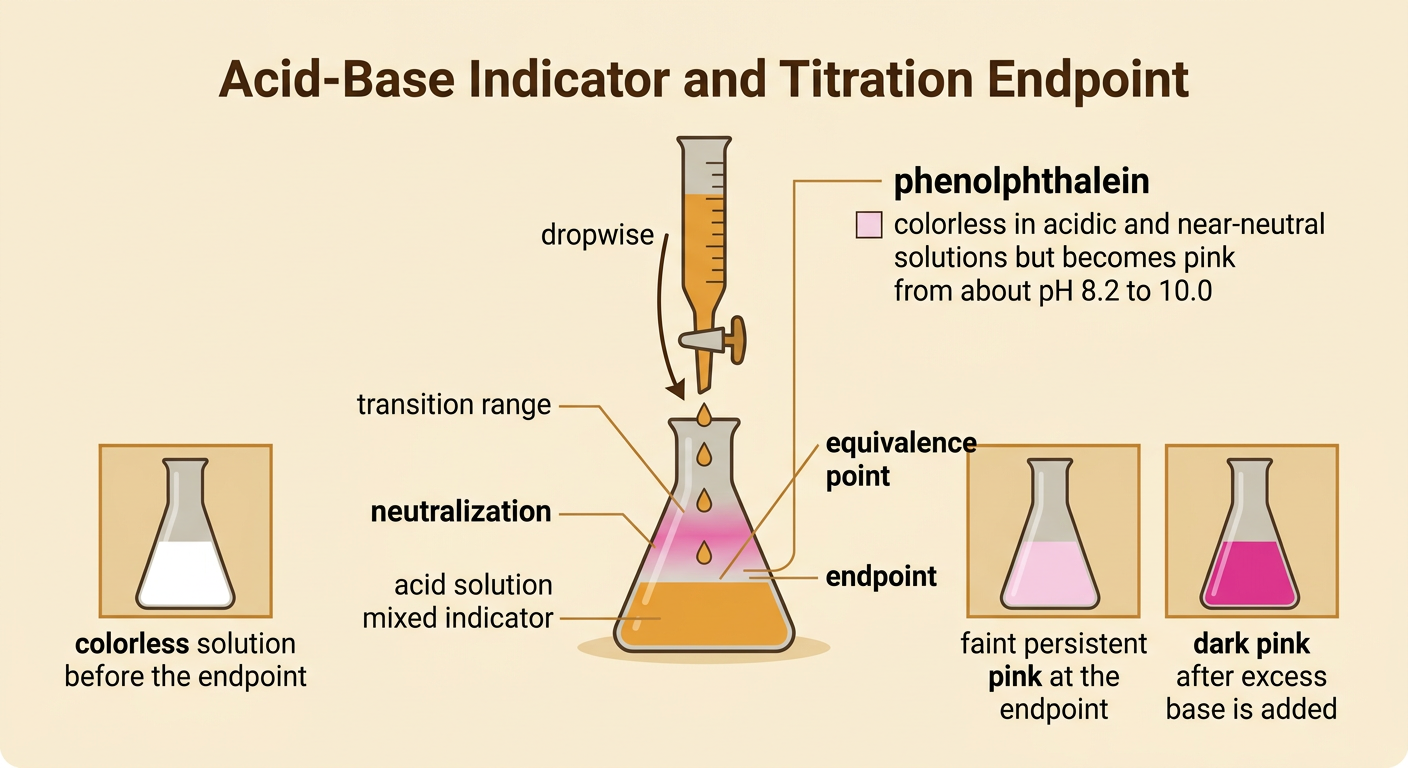
An acid-base indicator is a substance whose molecular forms have different colors at different pH values. An indicator changes color over a limited transition range, so it estimates pH rather than giving an exact value. For example, phenolphthalein is colorless in acidic and near-neutral solutions but turns pink in the approximate pH range of 8.2 to 10.0. During neutralization, H+ from an acid reacts with OH− from a base to form water: H+ + OH− → H2O. In a titration, a base of known concentration can be added gradually to an acid until the endpoint is observed. The indicator should be selected so its transition range is near the equivalence point. Adding too much base shifts the system past equivalence, so careful dropwise addition improves the design and accuracy of the procedure.
Interpreting Environmental pH Data
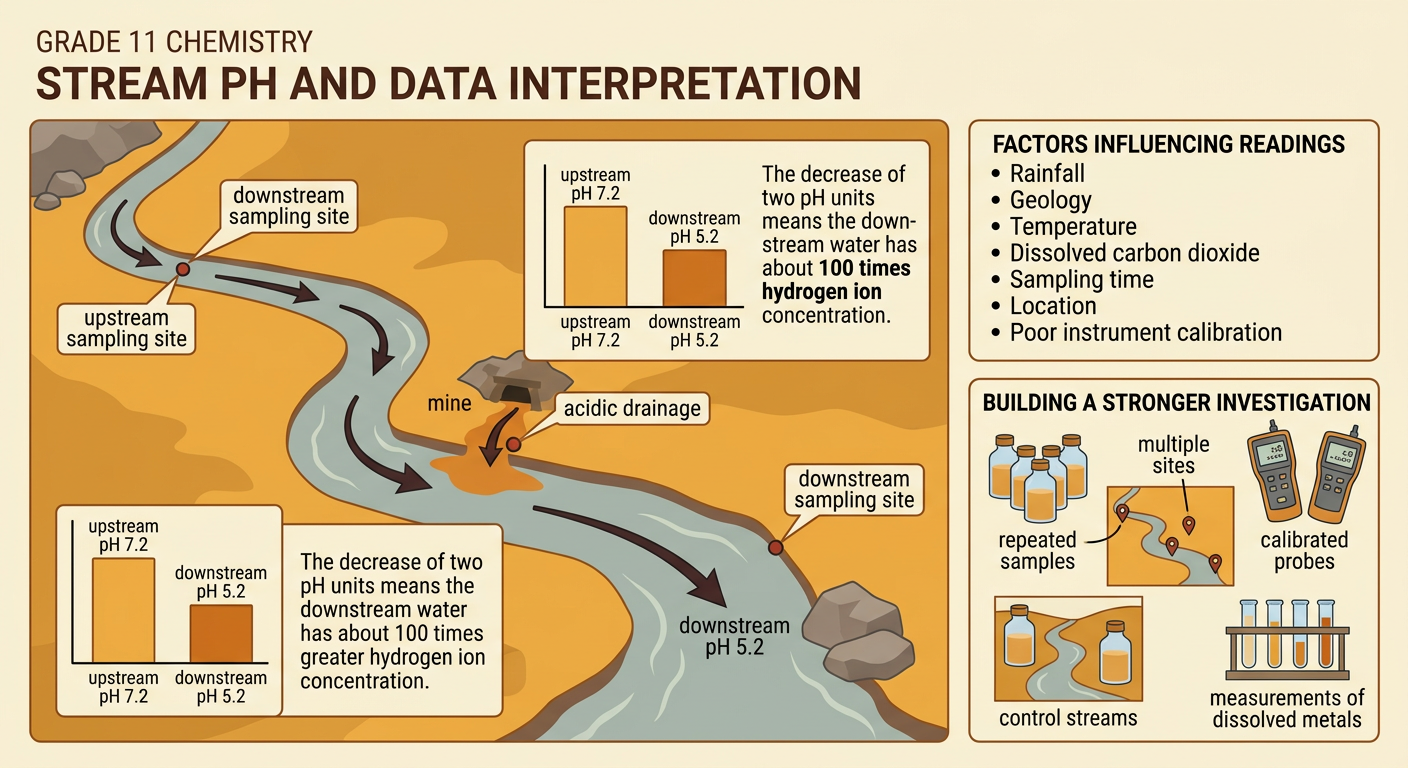
Environmental pH data can reveal changes in water or soil, but a sound conclusion must combine numerical evidence with information about sampling conditions. Imagine that a stream has an average pH of 7.2 upstream from a mine and 5.2 downstream. The two-unit decrease means the downstream water has about 100 times greater hydrogen ion concentration. This evidence supports the claim that acidic drainage may be affecting the stream, especially if repeated measurements show the same pattern. However, pH alone does not prove the mine caused the change. Rainfall, geology, temperature, dissolved carbon dioxide, instrument calibration, sampling time, and location can influence results. A stronger investigation would include multiple sites, repeated samples, calibrated probes, control streams, and measurements of dissolved metals. An evidence-based argument should state the claim, cite the data, explain the logarithmic relationship, and acknowledge these limitations.