
Acids, Bases, and the pH Scale
Students identify characteristic properties of acids and bases, interpret the pH scale, use indicators safely, and explain neutralization in terms of interacting ions.
Illustrations are auto-generated and may be placeholders. They can be refreshed to match the narration.
Properties and Safe Handling
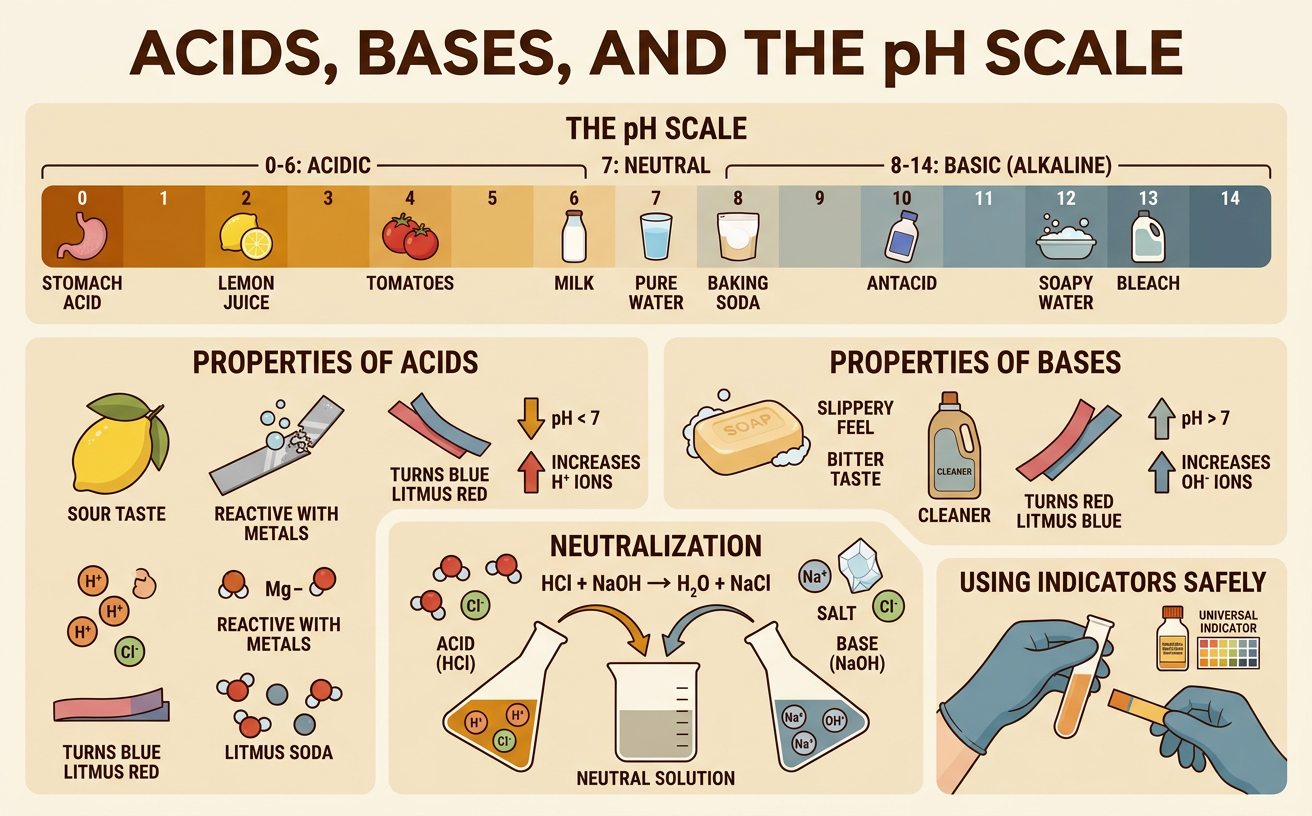
Acids and bases are groups of substances with recognizable chemical behaviors. Acids often react with certain metals and may taste sour, while bases may feel slippery and taste bitter. Students should never identify laboratory substances by touching or tasting them because concentrated acids and bases can cause serious burns. Instead, scientists use safe tests and measuring tools. Lemon juice and vinegar are familiar acidic materials. Baking soda solution and household ammonia are basic materials. These everyday examples are relatively dilute, but they still require careful handling. In a laboratory, students should wear goggles, follow directions, and immediately report spills. A substance cannot be classified reliably by appearance alone because an acid, a base, and pure water may all look like clear, colorless liquids.

Acidic and Basic Ions
When an acid dissolves in water, it increases the concentration of hydrogen ions, commonly represented as H+. When a base dissolves in water, it increases the concentration of hydroxide ions, represented as OH−, or removes hydrogen ions from the solution. These ions help explain the different behaviors of acids and bases. Hydrochloric acid, for example, separates into hydrogen and chloride ions in water. Sodium hydroxide separates into sodium and hydroxide ions. Strong and weak describe how completely an acid or base forms ions in water, not how concentrated the solution is. A dilute strong acid may contain less acid overall than a concentrated weak acid. Keeping strength and concentration separate prevents incorrect comparisons of chemical solutions.
Reading the pH Scale
The pH scale describes how acidic or basic a water-based solution is. At room temperature, a pH of 7 is neutral, values below 7 are acidic, and values above 7 are basic. Each whole-number change represents a tenfold change in hydrogen ion concentration. Therefore, a solution with pH 3 is ten times more acidic by this measure than a solution with pH 4 and one hundred times more acidic than a solution with pH 5. Lemon juice is commonly near pH 2, pure water is near pH 7, and a baking soda solution is around pH 8 or 9. Actual values can vary with concentration, temperature, and composition, so pH is measured rather than guessed.
Indicators and pH Measurement
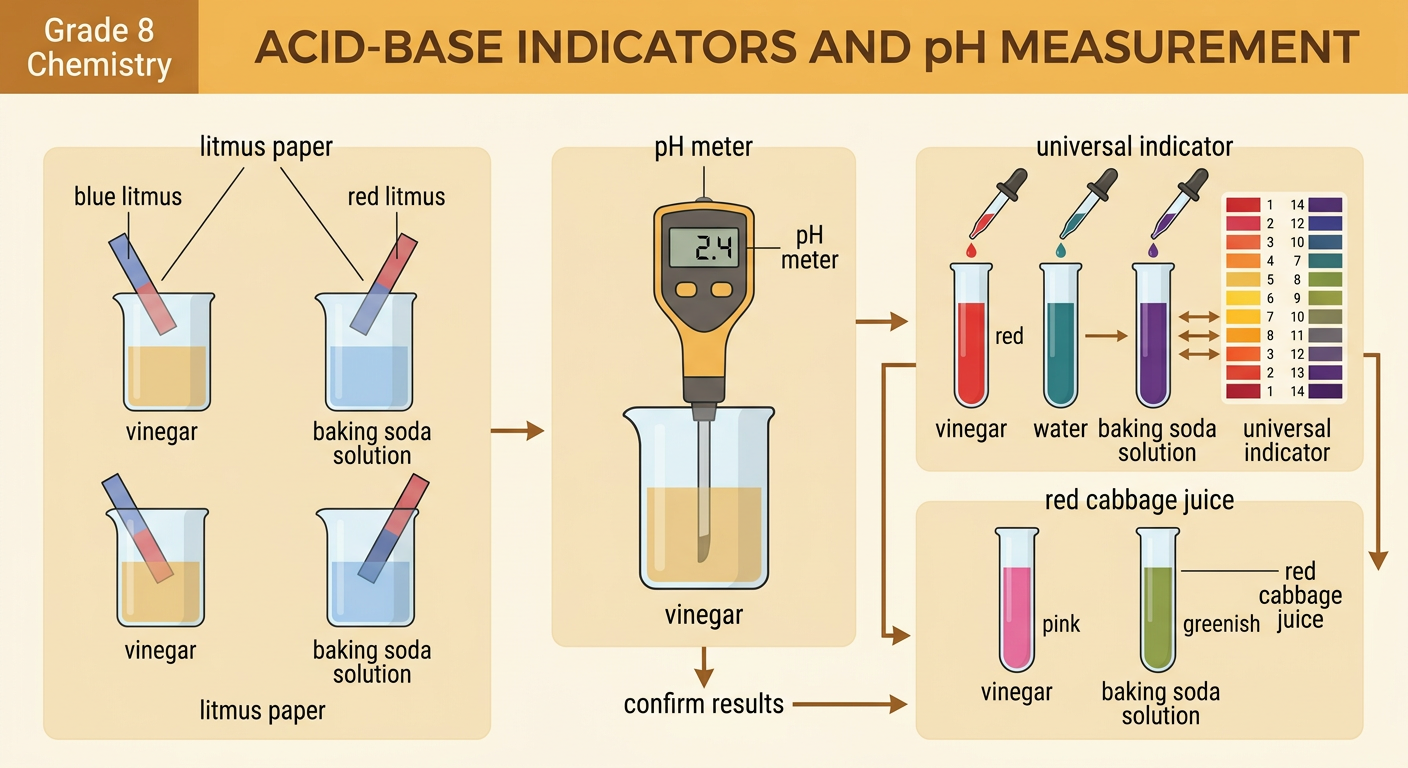
An acid-base indicator changes color depending on the pH of a solution. Litmus paper gives a simple classification: blue litmus turns red in acid, while red litmus turns blue in base. Universal indicator produces several colors that can be compared with a chart to estimate pH. Red cabbage juice is a natural indicator that may appear pink in an acid and greenish in a base. A pH meter gives a more precise numerical measurement when it is calibrated and used correctly. For example, students could test equal samples of water, vinegar, and baking soda solution, record the indicator colors, and compare those observations with pH-meter readings. Using multiple forms of evidence makes the classification more dependable.
Neutralization and Applications
Neutralization occurs when an acid and a base react to form water and an ionic compound called a salt. At the particle level, hydrogen ions from the acid combine with hydroxide ions from the base to make water molecules. For example, hydrochloric acid and sodium hydroxide can react to produce water and sodium chloride. Neutralization does not always result in a final pH of exactly 7 because the amounts and strengths of the reactants matter. This chemistry has practical uses. Antacid tablets contain bases that react with excess stomach acid, and farmers may add crushed limestone to reduce soil acidity. In a classroom investigation, an acid or base should be added slowly while pH is monitored to avoid passing the desired endpoint.
