Add and Subtract Fractions with Like Denominators
Students use visual models and equations to add and subtract fractions with the same denominator, including answers greater than one.

Illustrations are auto-generated and may be placeholders. They can be refreshed to match the narration.
Review Fractions as Parts of a Whole
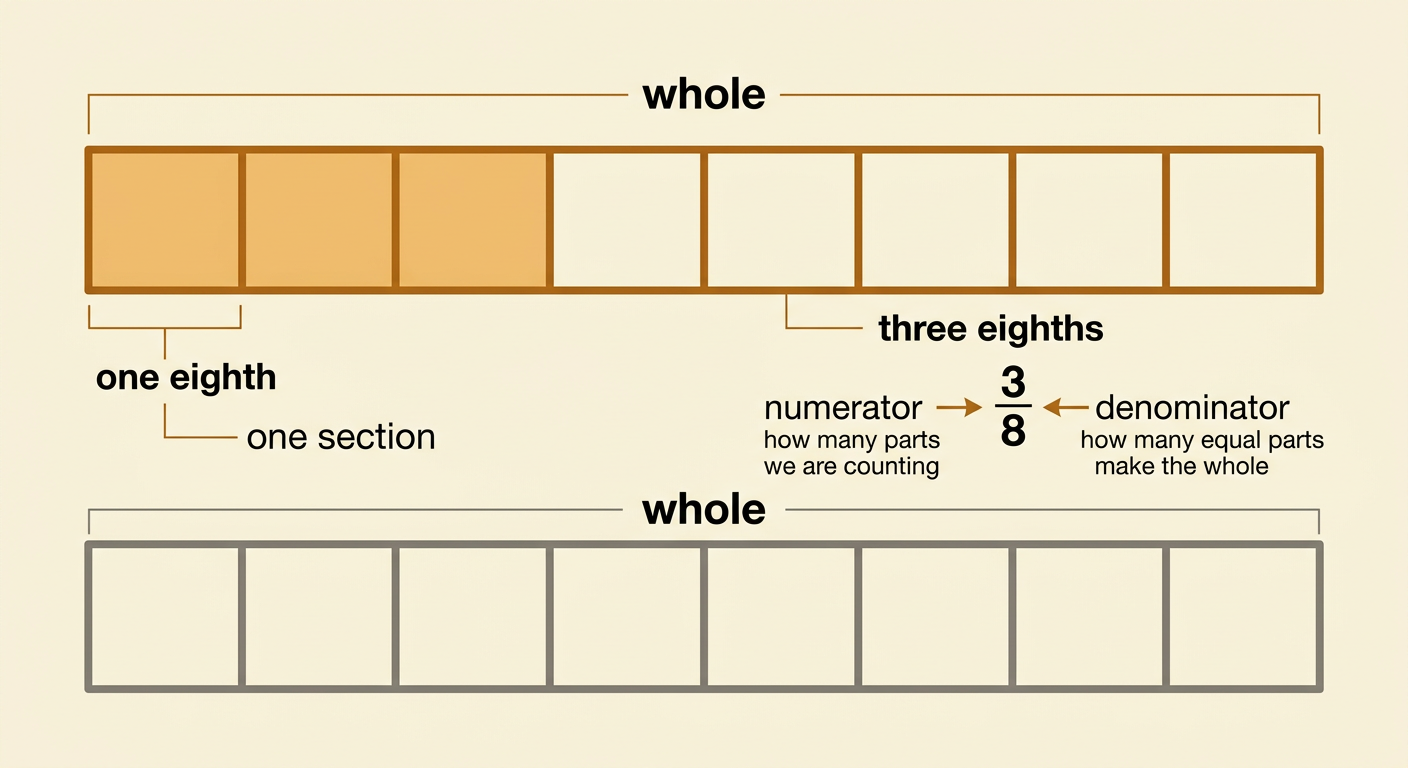
A fraction names equal parts of one whole. The denominator tells how many equal parts make the whole, and the numerator tells how many of those parts are being counted. In 3/8, the whole is divided into 8 equal parts, and 3 parts are counted. The size of the whole matters. Three eighths of one same-size rectangle can be compared with other eighths of that rectangle. Fractions can be added or subtracted easily when their denominators are alike because the pieces are the same size. For example, 2/6 and 5/6 both count sixth-size pieces. Before working with fractions, check that the models refer to equal-size wholes and that each whole is divided into the same number of equal parts.
Model Joining Fractional Parts
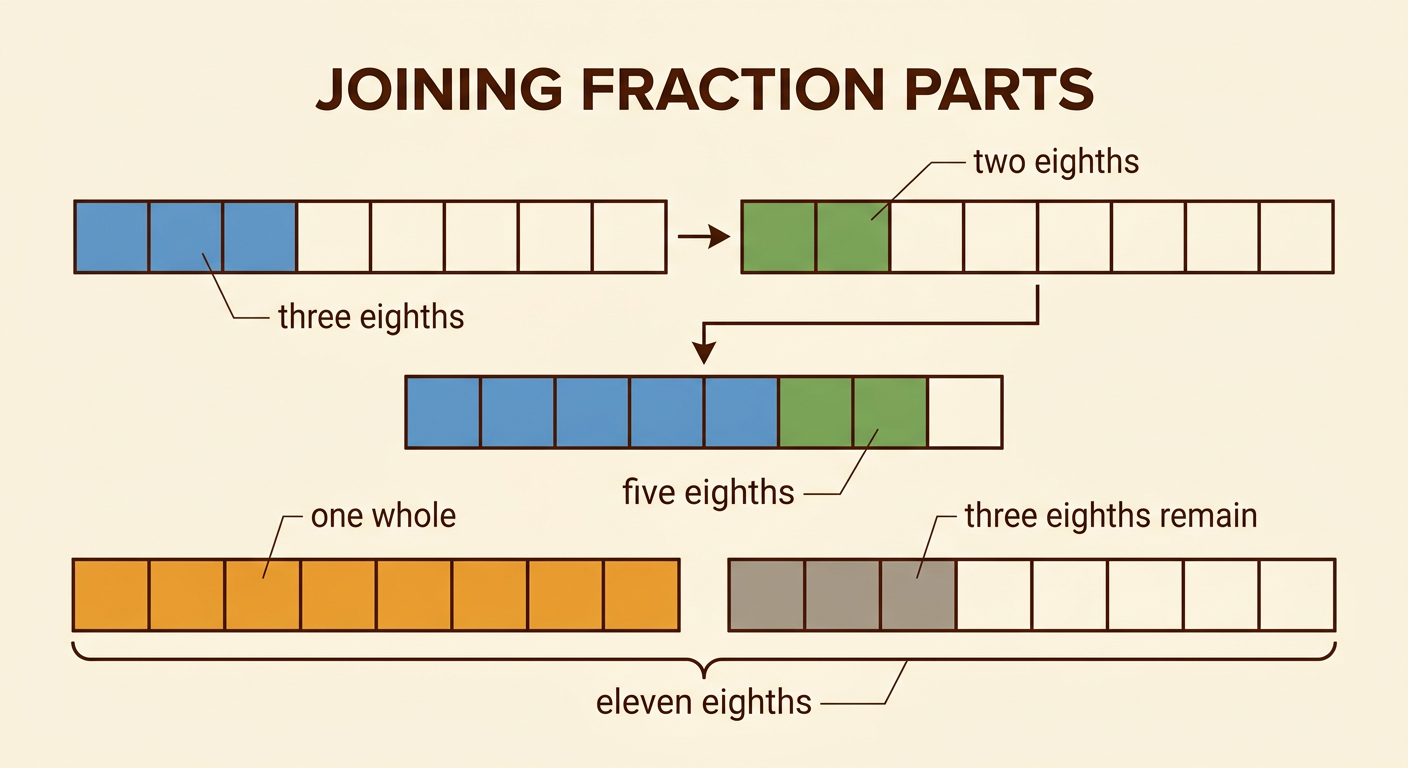
Adding fractions means joining parts that refer to the same whole. When the denominators are the same, join the parts and count how many equal-size pieces there are altogether. Suppose Mia colors 3/8 of a strip blue and then colors 2/8 of the same strip green. The strip now has 5 shaded eighths, so 3/8 + 2/8 = 5/8. The denominator remains 8 because the size of each piece has not changed. Only the number of pieces changes. A model can also show a sum greater than one. If you join 6/8 and 5/8, you have 11 eighths. Eight eighths fill one whole, with 3/8 left over. Therefore, 11/8 is equal to 1 3/8.
Write Fraction Addition Equations
A fraction addition equation records the parts being joined. First, check that the denominators are the same. Then add the numerators and keep the common denominator. For example, 4/10 + 3/10 = 7/10 because four tenth-size pieces joined with three tenth-size pieces make seven tenth-size pieces. Do not add the denominators: the pieces remain tenths. Sometimes the sum is greater than one. For example, 5/6 + 4/6 = 9/6. One whole contains 6/6, so 9/6 can be separated into 6/6 + 3/6. This equals 1 3/6, which can also be named 1 1/2. An equation, a fraction model, and a number line should all represent the same joining action and the same total.

Model Separating Fractional Parts
Subtracting fractions means separating or removing parts from an amount. When the denominators are alike, subtract the numerators and keep the denominator because the size of each part stays the same. Suppose a pan contains 7/8 of a tray of cornbread. If 3/8 of the whole tray is eaten, remove three eighth-size pieces from the seven available pieces. Four eighths remain, so 7/8 − 3/8 = 4/8. A model can also begin with more than one whole. If a ribbon is 10/6 yards long and 4/6 yard is cut off, then 6/6 yard remains. The equation is 10/6 − 4/6 = 6/6, and 6/6 equals one whole. Check subtraction by adding the removed part to the remaining part.

Solve and Explain Fraction Problems
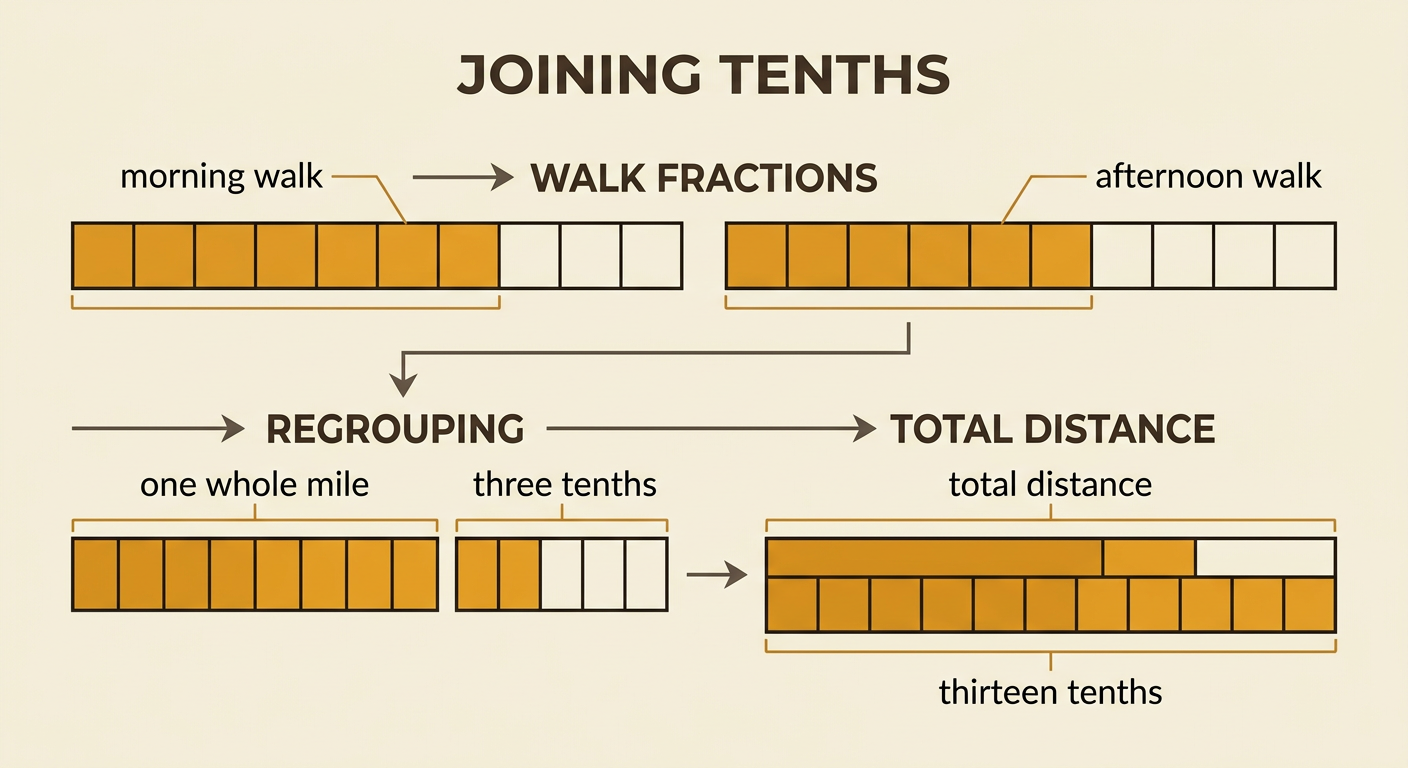
To solve a fraction word problem, decide whether the situation joins parts or separates parts. Identify the whole, check that the fractions have the same denominator, and write an equation. Then use a model or reasoning to find and explain the answer. For example, Luis walked 7/10 mile in the morning and 6/10 mile in the afternoon. The distances are joined, so 7/10 + 6/10 = 13/10 miles. Ten tenths make one whole mile, with 3/10 mile left. Luis walked 1 3/10 miles altogether. A strong explanation tells what the numerator and denominator mean: thirteen counts the tenth-mile parts, while ten shows the number of equal tenths in one mile. Finally, check whether the answer makes sense. Because two positive distances were joined, the total must be greater than either distance alone.