Add and Subtract Multi-Digit Whole Numbers
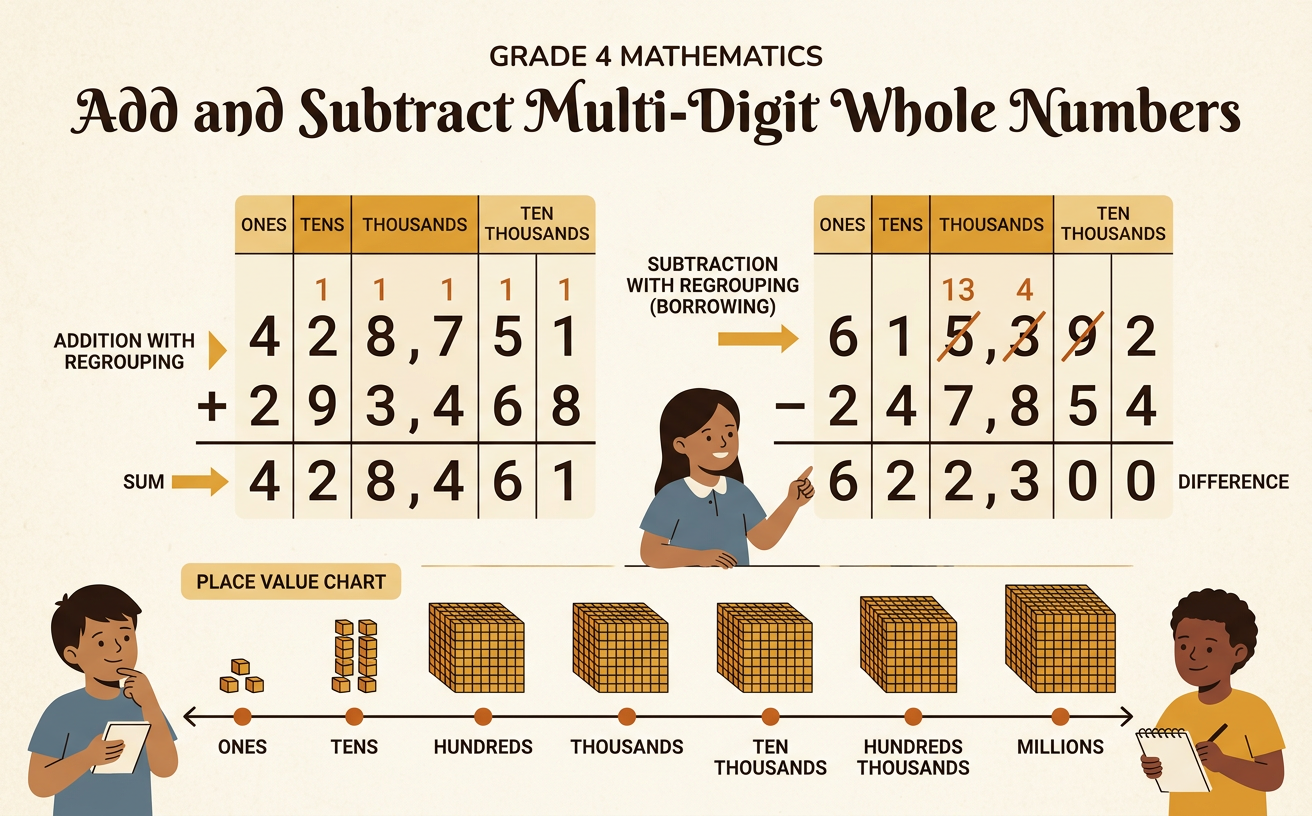
Students use place-value reasoning and the standard algorithms to accurately add and subtract whole numbers up to 1,000,000.
Illustrations are auto-generated and may be placeholders. They can be refreshed to match the narration.
Review Place Value
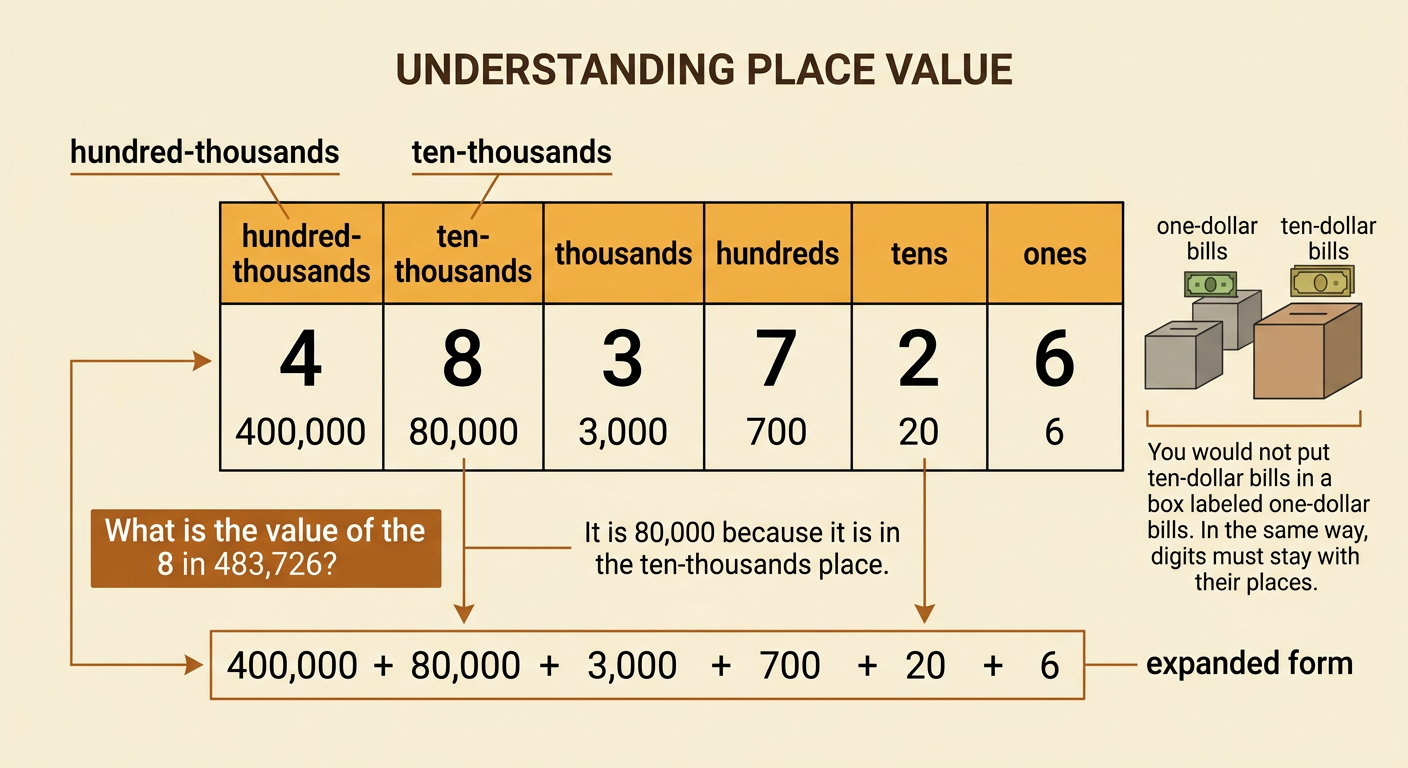
Every digit in a whole number has a value based on its position. From right to left, the places are ones, tens, hundreds, thousands, ten-thousands, and hundred-thousands. In 483,726, the digit 4 is in the hundred-thousands place, so its value is 400,000. The 8 means 80,000, the 3 means 3,000, the 7 means 700, the 2 means 20, and the 6 means 6. The expanded form is 400,000 + 80,000 + 3,000 + 700 + 20 + 6. Understanding these values helps you combine or separate the correct amounts when adding and subtracting. Before calculating, read each number carefully and identify the place of every digit.
Align Digits by Place
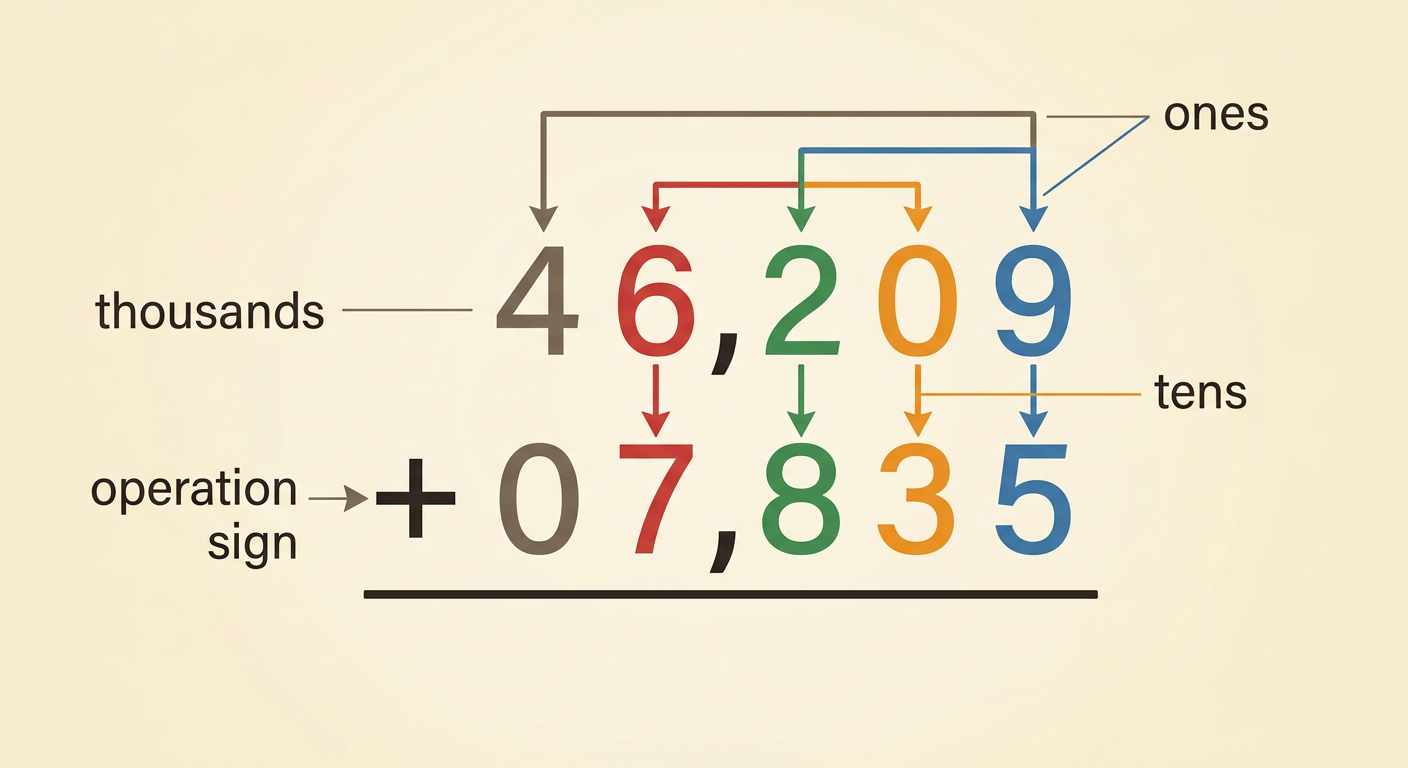
Before adding or subtracting, write the numbers vertically so digits with the same place value line up. Ones belong under ones, tens under tens, and so on. For example, to add 46,209 and 7,835, place the 5 under the 9 because both are ones digits. Place the 3 under the 0 because both are tens digits. The thousands digits, 6 and 7, also line up. Since 7,835 has no ten-thousands digit, you can think of it as 07,835. Draw the operation sign to the left and a line below the numbers. Correct alignment prevents you from accidentally adding or subtracting digits with different place values.
Add with Regrouping
Add from right to left, beginning with the ones. Find 268,457 + 146,386. In the ones column, 7 + 6 = 13, so write 3 and regroup 1 ten. In the tens column, 1 + 5 + 8 = 14, so write 4 and regroup 1 hundred. In the hundreds column, 1 + 4 + 3 = 8. In the thousands column, 8 + 6 = 14, so write 4 and regroup 1 ten-thousand. Next, 1 + 6 + 4 = 11, so write 1 and regroup 1 hundred-thousand. Finally, 1 + 2 + 1 = 4. The sum is 414,843. Regroup whenever a column totals 10 or more.

Subtract with Regrouping
Subtract from right to left. Find 642,315 − 278,469. You cannot subtract 9 from 5, so regroup 1 ten as 10 ones. Then 15 − 9 = 6. The tens digit is now 0, so regroup 1 hundred and calculate 10 − 6 = 4. Continue in the same way: regroup to find 12 − 4 = 8 in the hundreds column, 11 − 8 = 3 in the thousands column, and 13 − 7 = 6 in the ten-thousands column. In the hundred-thousands column, calculate 5 − 2 = 3. The difference is 363,846. When regrouping, reduce the digit you borrow from by 1 and add 10 to the digit in the next place to the right.

Solve and Check
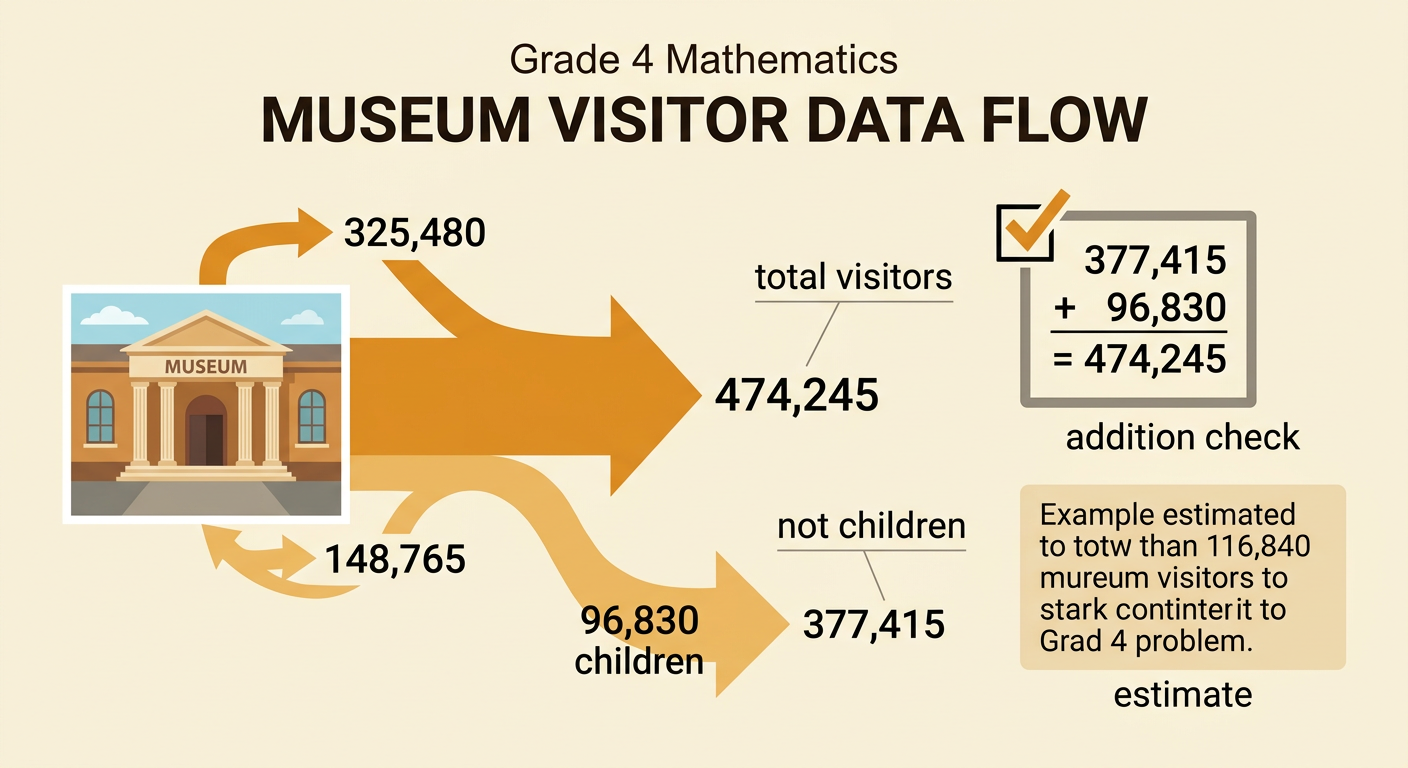
First decide whether the problem asks you to combine amounts or find a difference. A museum had 325,480 visitors in the first half of the year and 148,765 in the second half. Add to find 474,245 visitors for the year. If 96,830 of those visitors were children, subtract to find the number who were not children: 474,245 − 96,830 = 377,415. Check subtraction by adding the difference and the amount subtracted. Since 377,415 + 96,830 = 474,245, the subtraction is correct. You can also estimate to see whether an answer is reasonable. Rounding gives about 474,000 − 97,000 = 377,000, which is close to 377,415. Always reread the question, label the answer, and use an inverse operation or estimation to check.