
Add and Subtract Multi-Digit Whole Numbers
Students use place-value reasoning and the standard algorithms to accurately add and subtract multi-digit whole numbers.
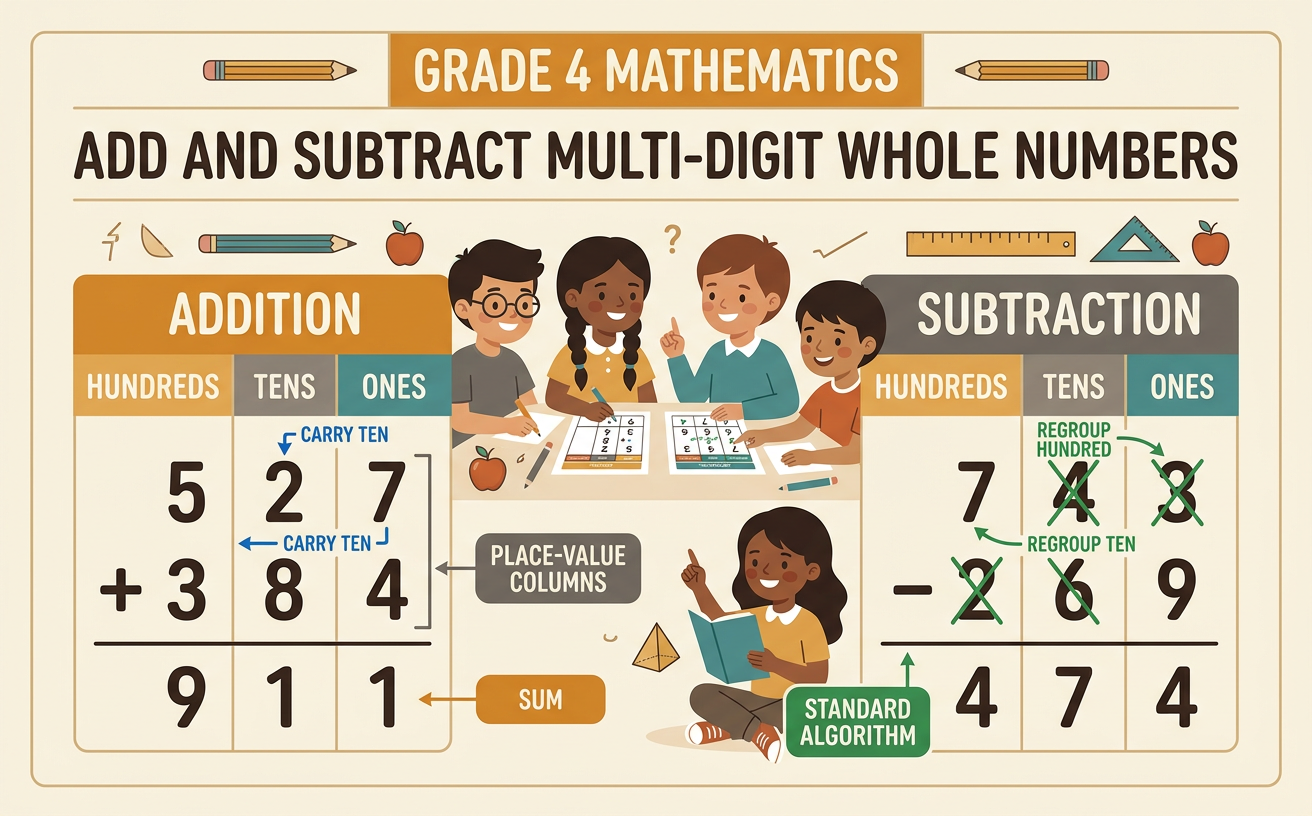
Illustrations are auto-generated and may be placeholders. They can be refreshed to match the narration.
Place-Value Review
The value of a digit depends on its place. In 48,372, the 4 means 40,000, the 8 means 8,000, the 3 means 300, the 7 means 70, and the 2 means 2. Each place is ten times the value of the place to its right. When adding or subtracting, write numbers vertically so digits with the same place value line up. Ones must be under ones, tens under tens, and so on. For example, to prepare 48,372 and 6,915 for addition, place the 5 under the 2 in the ones column and the 1 under the 7 in the tens column. Correct alignment helps you combine only values that belong in the same place.

Model Addition with Regrouping
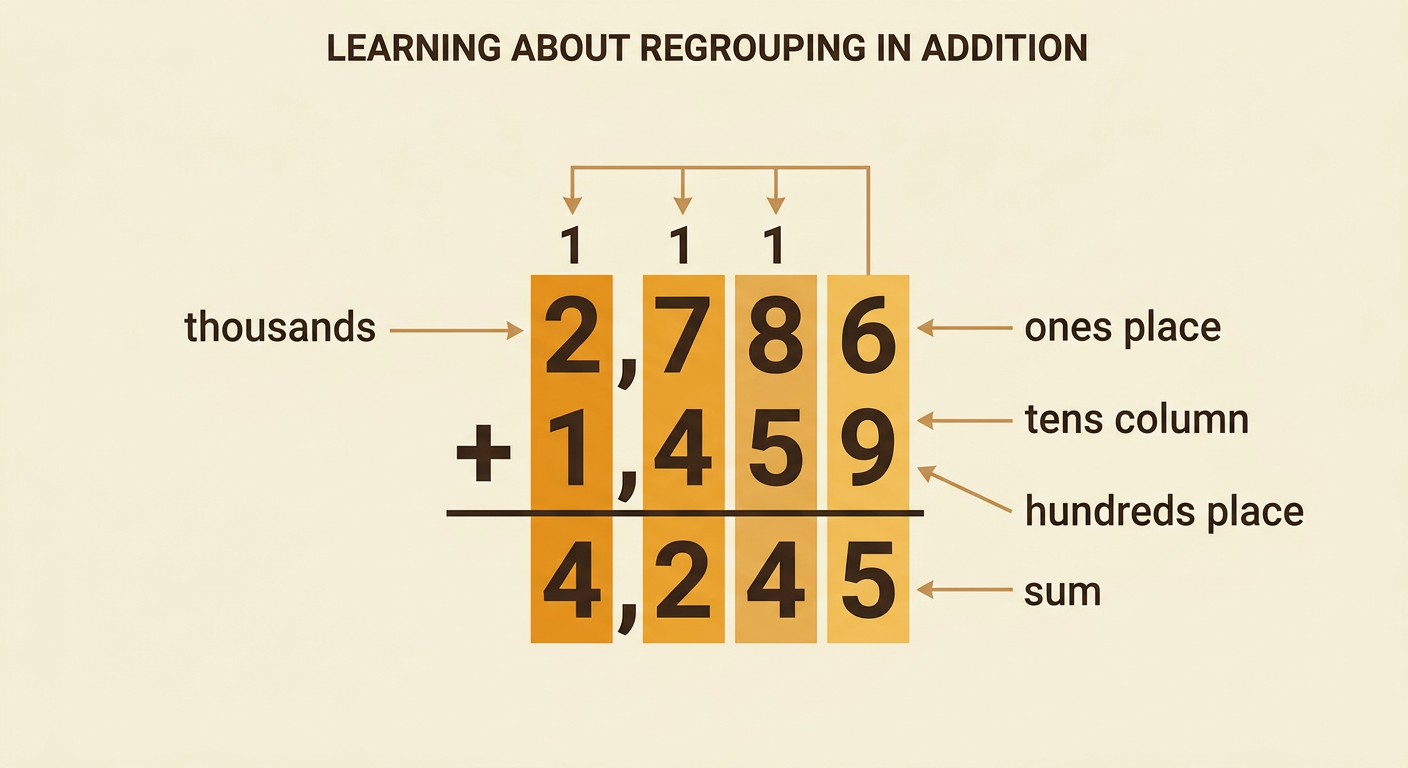
Regroup when the sum in a place is 10 or more. Add 2,786 and 1,459 by starting in the ones place. Six plus 9 equals 15, so write 5 in the ones place and regroup 1 ten. In the tens place, add 8 plus 5 plus the regrouped 1. The sum is 14, so write 4 and regroup 1 hundred. Next, 7 plus 4 plus 1 equals 12. Write 2 in the hundreds place and regroup 1 thousand. Finally, add 2 plus 1 plus 1 to get 4 thousands. The sum is 4,245. Regrouping does not change the total value; it trades 10 units in one place for 1 unit in the place to the left.
Practice the Addition Algorithm
Use the standard addition algorithm one column at a time, moving from right to left. Find 36,847 plus 25,968. In the ones column, 7 plus 8 equals 15, so write 5 and regroup 1. In the tens column, 4 plus 6 plus 1 equals 11, so write 1 and regroup 1. In the hundreds column, 8 plus 9 plus 1 equals 18. Continue in the same way through the thousands and ten-thousands columns. The exact sum is 62,815. Estimate to decide whether the answer is reasonable. Rounding the addends to the nearest thousand gives 37,000 plus 26,000, or 63,000. Since 62,815 is close to 63,000, the exact sum is reasonable.

Model Subtraction with Regrouping
Regroup when the top digit in a column is less than the digit below it. Subtract 18,756 from 52,403. In the ones column, 3 is less than 6, but the tens digit is 0. Regroup 1 hundred from the 4 hundreds as 10 tens. Then regroup 1 of those tens as 10 ones. Now subtract 13 minus 6 to get 7 and 9 minus 5 to get 4. In the hundreds column, regroup 1 thousand so 3 hundreds become 13 hundreds. Subtract 13 minus 7 to get 6. Next, regroup 1 ten-thousand so 1 thousand becomes 11 thousands. Subtract 11 minus 8 to get 3, then 4 minus 1 to get 3. The difference is 33,647.

Solve and Check
Solve each problem carefully, then check your work. For example, subtract 37,589 from 84,206. Align the digits by place value, begin with the ones, and regroup as needed. The difference is 46,617. You can check subtraction with addition because addition and subtraction are inverse operations. Add the difference, 46,617, to the number that was subtracted, 37,589. The sum is 84,206, which matches the original starting number, so the subtraction is correct. You can also estimate: 84,000 minus 38,000 is about 46,000, which is close to 46,617. A strong check uses both place-value reasoning and the inverse operation. If the check does not work, review the alignment, regrouping, and arithmetic in each column.
