Add and Subtract Within 20 Using Objects and Drawings
Students solve simple addition and subtraction story problems within 20 by using counters, drawings, and equations with a symbol for the unknown number.

Illustrations are auto-generated and may be placeholders. They can be refreshed to match the narration.
Warm-Up Number Story
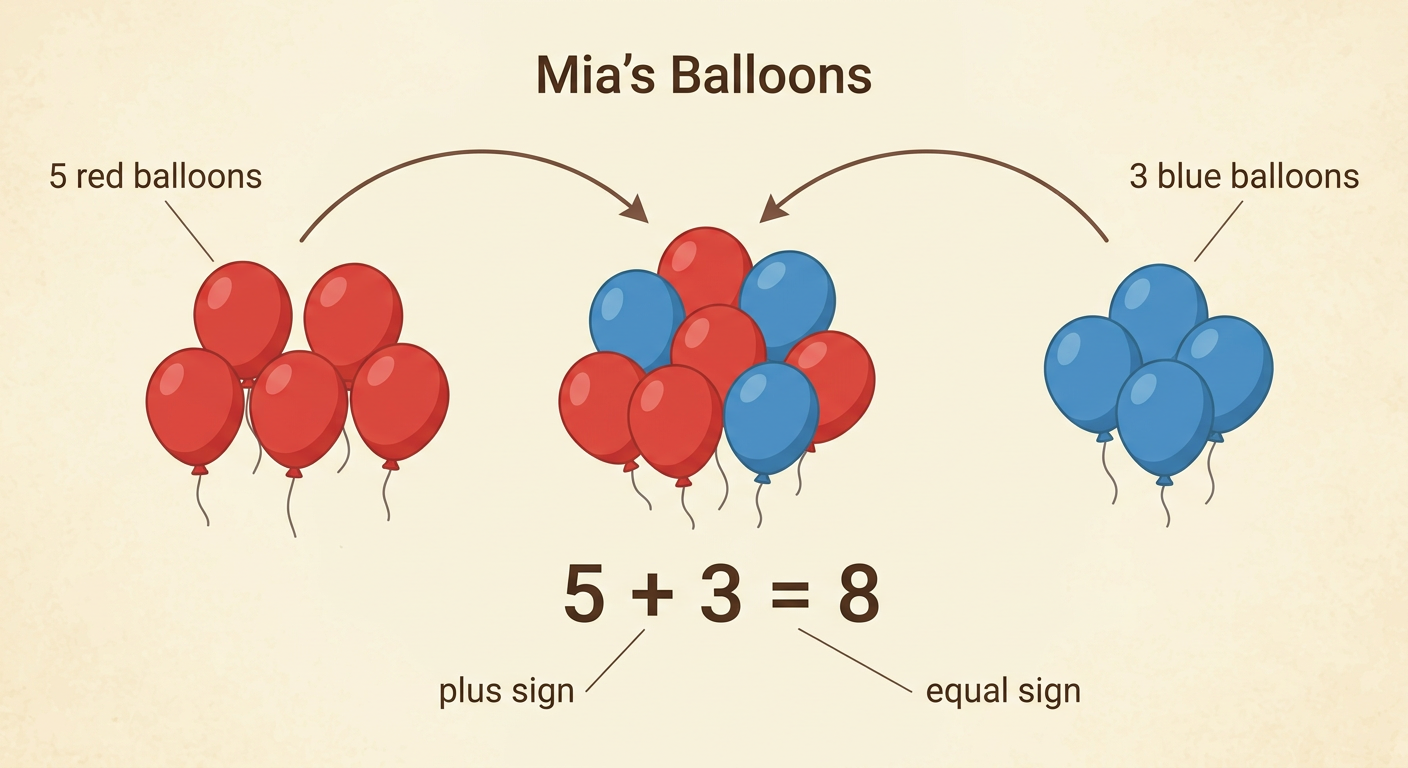
Listen to this number story: Mia has 5 red balloons. Her friend gives her 3 blue balloons. How many balloons does Mia have now? Think about what happens in the story. Mia gets more balloons, so we add. Hold up 5 fingers, and then hold up 3 more fingers. Count all the fingers: 1, 2, 3, 4, 5, 6, 7, 8. Mia has 8 balloons. We can write 5 + 3 = 8. The plus sign means we are putting amounts together. The equal sign means both sides have the same value. Tell a partner which numbers show the balloons Mia had, the balloons she received, and the total number of balloons.
Model with Counters
Counters can help us act out a story. Noah has 9 toy cars. He gives 4 cars to a friend. How many cars does Noah have left? Place 9 counters in a row. These counters stand for Noah’s 9 cars. Move 4 counters away because Noah gives away 4 cars. Count the counters that remain: 1, 2, 3, 4, 5. Noah has 5 cars left. We can write 9 − 4 = 5. The minus sign tells us that some objects are taken away. Try moving the 4 counters back. Check that the two parts, 5 and 4, make the starting amount of 9. Counters let us see what changes and what stays.

Draw and Write an Equation
A drawing can show the numbers in a story. Ava has 3 apples. Her family needs 8 apples in all. How many more apples does Ava need? Draw 3 circles for the apples Ava has. Keep drawing circles until there are 8 circles. You draw 5 more circles. The unknown number is 5. Write the equation 3 + □ = 8. The box is a symbol for the number we need to find. Since 3 and 5 make 8, write 5 in the box. The completed equation is 3 + 5 = 8. Check your drawing by counting all 8 circles. A picture and an equation show the same story in two different ways.

Guided Story Problems
Solve each story by asking what is unknown. First, 6 birds sit on a fence. Then 7 more birds land. How many birds are there now? Draw 6 birds and 7 more birds, then count 13. Write 6 + 7 = 13. Next, 14 crackers are on a plate. Some are eaten, and 9 remain. How many crackers were eaten? Draw 14 crackers and cross out crackers until 9 remain. You cross out 5, so write 14 − 5 = 9. Finally, some frogs are near a pond. Then 4 more frogs arrive. Now there are 11 frogs. How many frogs were there at first? Use counters to find that 7 + 4 = 11. The unknown can be at the beginning, middle, or end.

Independent Practice
Now solve a story on your own. There are 12 fish in a tank. Some fish hide behind a rock. You can see 8 fish. How many fish are hiding? Decide whether the total or a part is unknown. The total is 12, and one part is 8. Use 12 counters for all the fish. Separate 8 counters for the fish you can see. Count the counters left in the other group. There are 4, so 4 fish are hiding. Draw 12 fish and circle 8 of them, or draw 8 visible fish and 4 hidden fish. Write an equation such as 12 − 8 = 4 or 8 + 4 = 12. Make sure your answer matches the story and is no greater than 20.

Share and Check
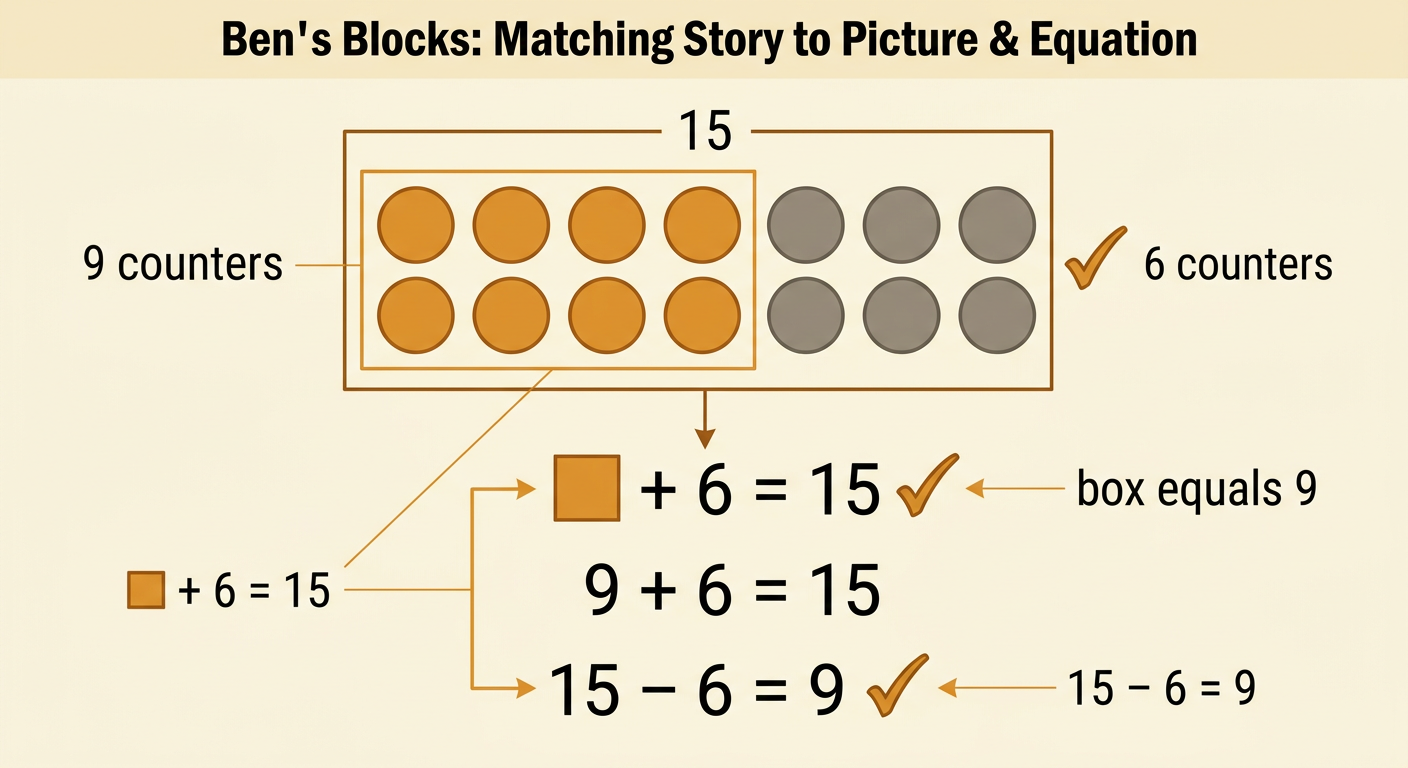
Share how you solved one story. Explain what each number means, how your objects or drawing match the story, and where you placed the unknown symbol. For example, Ben had some blocks. He received 6 more blocks and then had 15 blocks. A student may show 9 counters, add 6 counters, and write □ + 6 = 15. The box equals 9. Check the answer by counting all the counters: 9 and 6 make 15. You can also use subtraction to check: 15 − 6 = 9. Look closely at a partner’s work. Ask, “Does the drawing match the story?” and “Is the equation true?” If something does not match, move the counters, fix the drawing, or change the equation.