
Add Two-Digit Numbers Using Place Value
Students use tens and ones models and place-value strategies to add two-digit numbers within 100.

Illustrations are auto-generated and may be placeholders. They can be refreshed to match the narration.
Place-Value Warm-Up
Two-digit numbers have a tens place and a ones place. In the number 34, the digit 3 means 3 tens, or 30. The digit 4 means 4 ones. Together, 30 and 4 make 34. You can write this as 34 = 30 + 4. Try another number: 52 has 5 tens and 2 ones, so 52 = 50 + 2. When adding two-digit numbers, always notice the value of each digit. Tens are added to tens, and ones are added to ones. Say each number aloud by its parts: 67 is 6 tens and 7 ones. This place-value thinking will help you add accurately.

Model Tens and Ones
Base-ten blocks help us see how numbers are built. A long rod stands for one ten, and a small cube stands for one one. To model 23 + 14, build 23 with 2 tens rods and 3 ones cubes. Then build 14 with 1 tens rod and 4 ones cubes. Combine the tens: 2 tens plus 1 ten equals 3 tens. Combine the ones: 3 ones plus 4 ones equals 7 ones. The model now has 3 tens and 7 ones. That number is 37, so 23 + 14 = 37. Keep tens and ones in separate groups so that the model is easy to count.

Add by Place Value
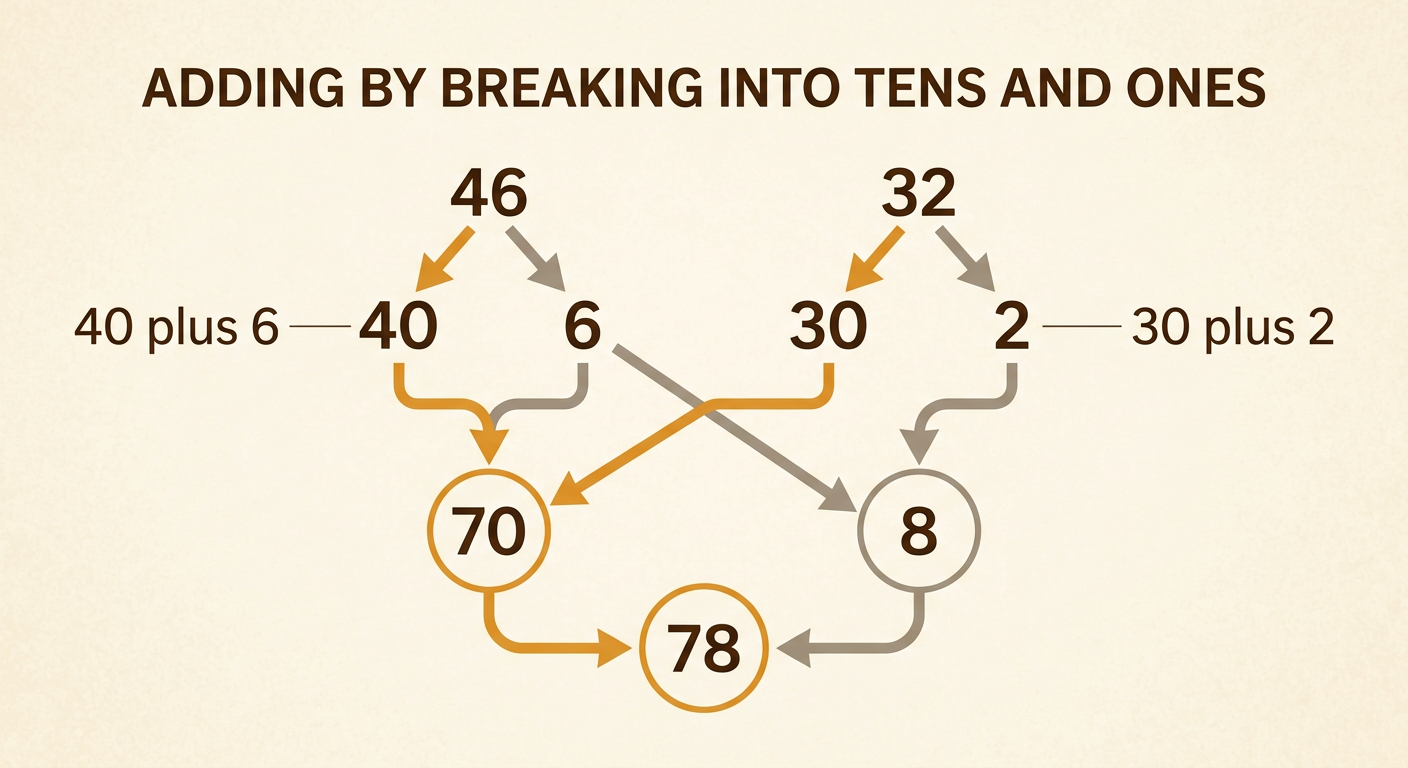
You can add without drawing every block by breaking each number into tens and ones. Find 46 + 32. Break 46 into 40 + 6. Break 32 into 30 + 2. First add the tens: 40 + 30 = 70. Next add the ones: 6 + 2 = 8. Finally combine the two sums: 70 + 8 = 78. Therefore, 46 + 32 = 78. This strategy works because each digit keeps its place value. The 4 in 46 means 40, not 4. You may add the ones first or the tens first. Either way, carefully combine all the tens and ones to find the total.
Solve Together
Sometimes adding the ones makes a new ten. Let us solve 38 + 27. Model 38 as 3 tens and 8 ones. Model 27 as 2 tens and 7 ones. Add the ones: 8 + 7 = 15 ones. Ten of those ones can be bundled to make 1 new ten, with 5 ones left. Now add the tens: 3 tens + 2 tens + 1 new ten = 6 tens. Six tens and 5 ones make 65. Therefore, 38 + 27 = 65. When there are 10 or more ones, always trade 10 ones for 1 ten. The total value stays the same because 10 ones and 1 ten are equal.

Independent Practice
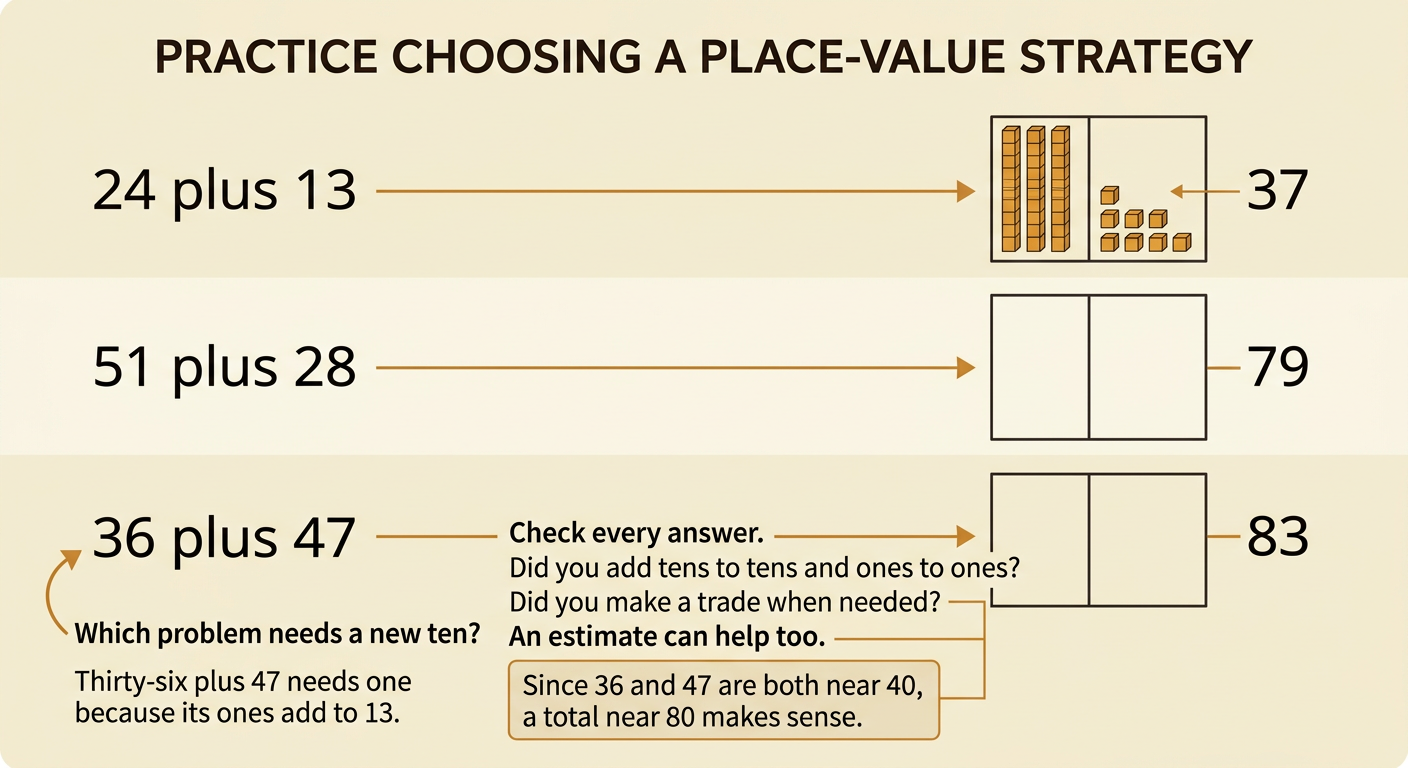
Now use place value to solve each problem. You may draw tens rods and ones cubes, break apart the numbers, or write partial sums. Solve 24 + 13, 51 + 28, and 36 + 47. For example, begin 24 + 13 by adding 20 + 10 = 30 and 4 + 3 = 7. Then combine 30 + 7 to get 37. For a problem such as 36 + 47, remember to check whether the ones make a new ten. After solving, ask yourself: Did I add tens to tens? Did I add ones to ones? Did I trade 10 ones for 1 ten when needed? Estimate each total to decide whether your answer is reasonable.
Exit Check
Show what you know by solving 48 + 26. Break apart each number or draw a base-ten model. First think about the ones: 8 ones + 6 ones = 14 ones. Trade 10 ones for 1 new ten, leaving 4 ones. Then count the tens: 4 tens + 2 tens + 1 new ten = 7 tens. The sum is 7 tens and 4 ones, or 74. Record the equation 48 + 26 = 74. Before finishing, explain why the trade did not change the total. A correct explanation is that 10 ones have the same value as 1 ten. Check that your answer is less than 100 and is reasonable for the two addends.
