
Adding and Subtracting Decimals to Hundredths
Students use place-value models and standard algorithms to add and subtract decimals to the hundredths place in real-world contexts.
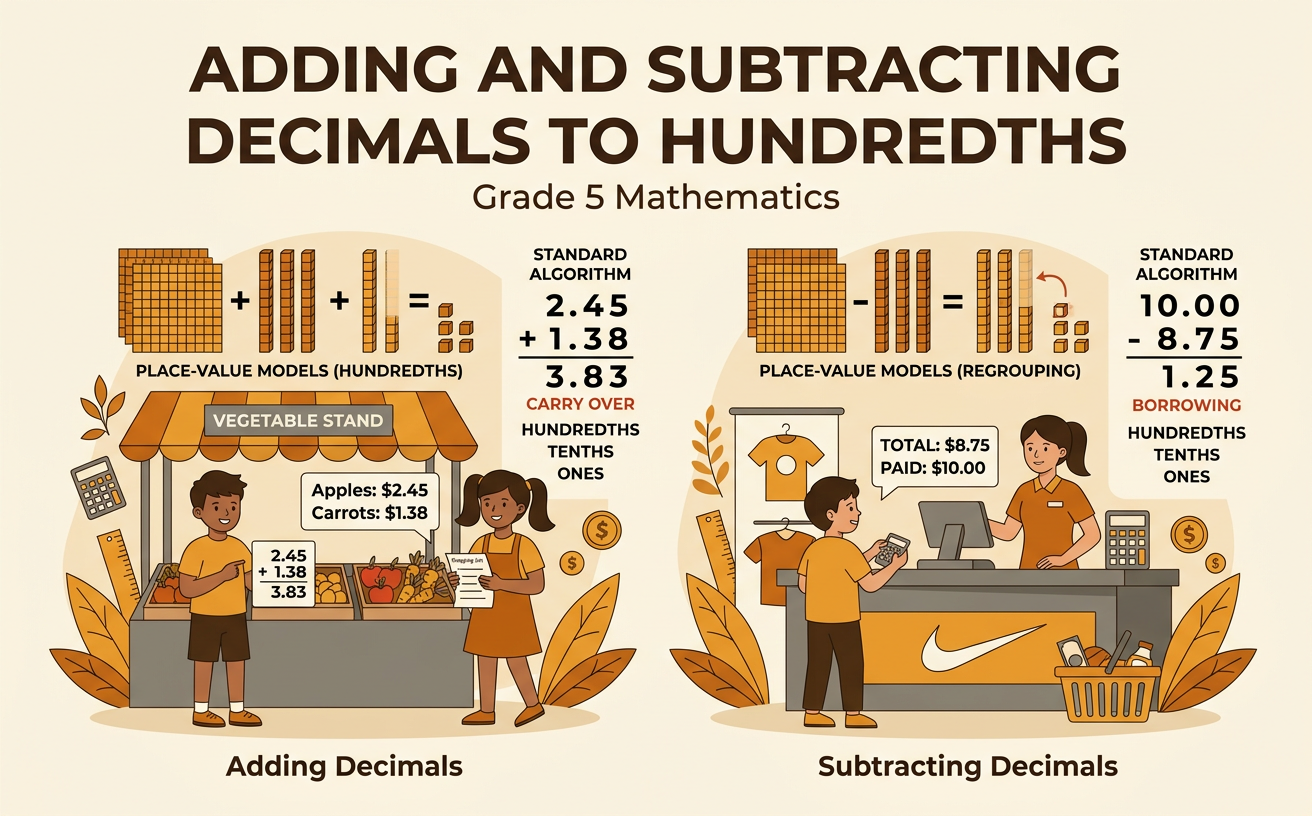
Illustrations are auto-generated and may be placeholders. They can be refreshed to match the narration.
Review Decimal Place Value
A decimal’s value depends on the place of each digit. The decimal point separates whole-number places from places smaller than one. In 3.47, the 3 represents 3 ones, the 4 represents 4 tenths, and the 7 represents 7 hundredths. One tenth equals ten hundredths, so 0.4 is the same as 0.40. A zero can hold a place without changing the value. For example, 2.5 and 2.50 are equal. Reading place values correctly helps you combine digits with the same value when adding or subtracting. Before calculating, name each digit’s place and use zeros when needed to show missing tenths or hundredths.

Model Decimal Addition
Place-value models show why decimal addition works. Find 1.24 + 0.53. Model 1.24 with 1 whole, 2 tenths, and 4 hundredths. Model 0.53 with 5 tenths and 3 hundredths. Combine pieces with the same value. The hundredths combine to make 7 hundredths because 4 + 3 = 7. The tenths combine to make 7 tenths because 2 + 5 = 7. There is still 1 whole. The sum is 1 whole, 7 tenths, and 7 hundredths, or 1.77. Models help you see that ones combine with ones, tenths with tenths, and hundredths with hundredths.

Align Place Values
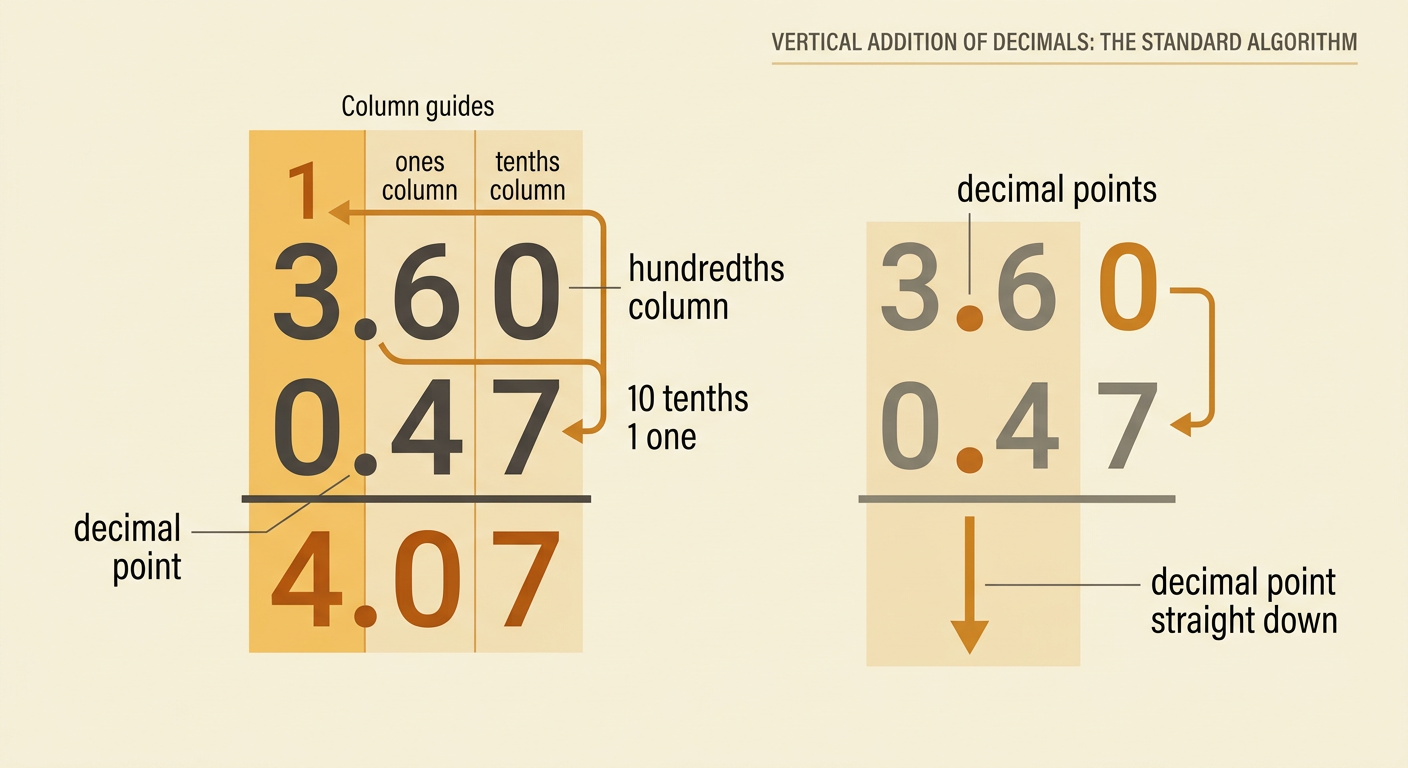
When using the standard addition algorithm, write digits with the same place value in the same column. Place decimal points directly under one another. For 3.6 + 0.47, write 3.6 as 3.60 so both numbers show hundredths. Start at the right. Add the hundredths: 0 + 7 = 7. Add the tenths: 6 + 4 = 10 tenths. Write 0 in the tenths place and regroup 10 tenths as 1 one. Add the ones: 3 + 0 + 1 = 4. Bring the decimal point straight down into the answer. The sum is 4.07. Alignment prevents you from accidentally combining digits with different values.
Subtract Decimals with Regrouping
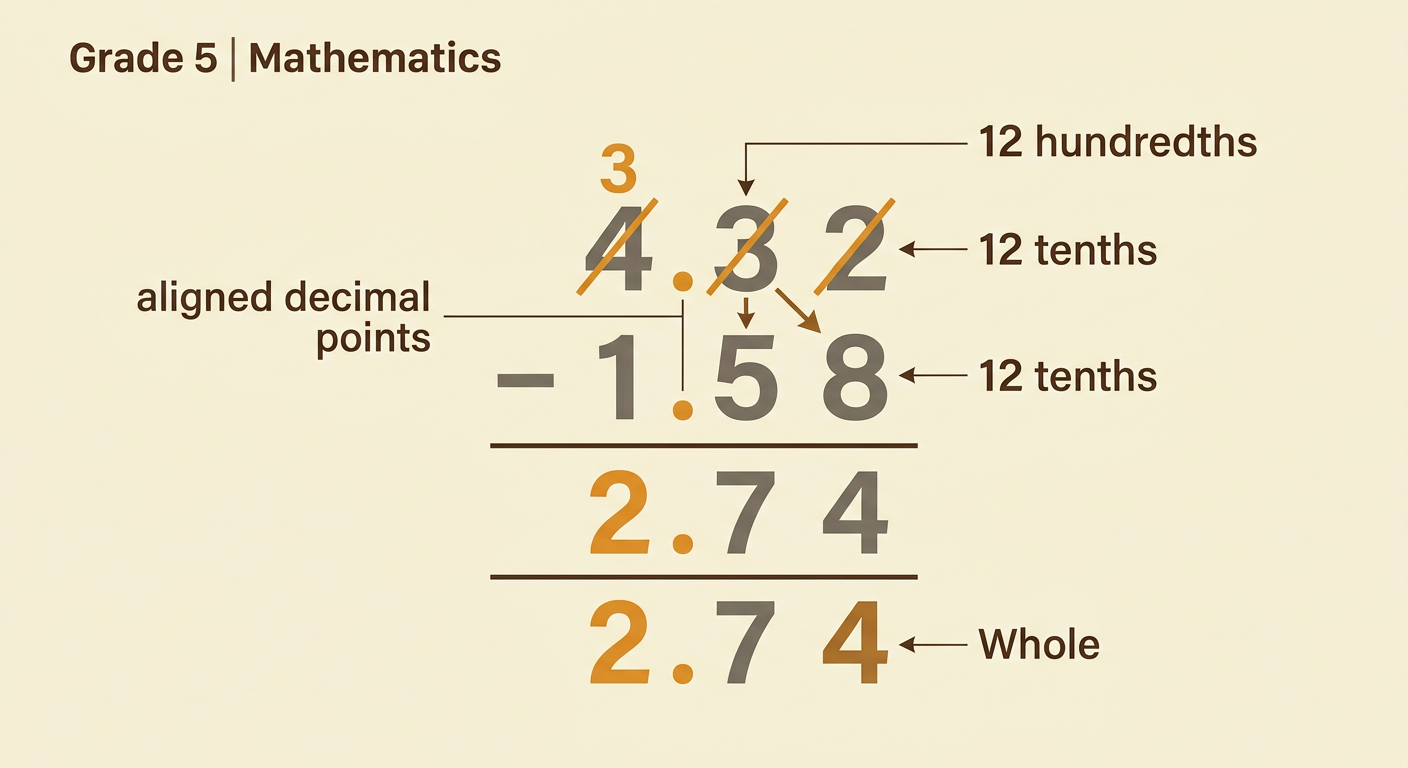
Regroup when the top digit in a place is too small to subtract the bottom digit. Find 4.32 − 1.58. Align the decimal points. In the hundredths place, 2 hundredths cannot subtract 8 hundredths. Regroup 1 tenth as 10 hundredths. The 3 tenths become 2 tenths, and the 2 hundredths become 12 hundredths. Then 12 − 8 = 4. Next, 2 tenths cannot subtract 5 tenths. Regroup 1 one as 10 tenths. The 4 ones become 3 ones, and the 2 tenths become 12 tenths. Then 12 − 5 = 7 and 3 − 1 = 2. The difference is 2.74.
Solve a Real-World Problem
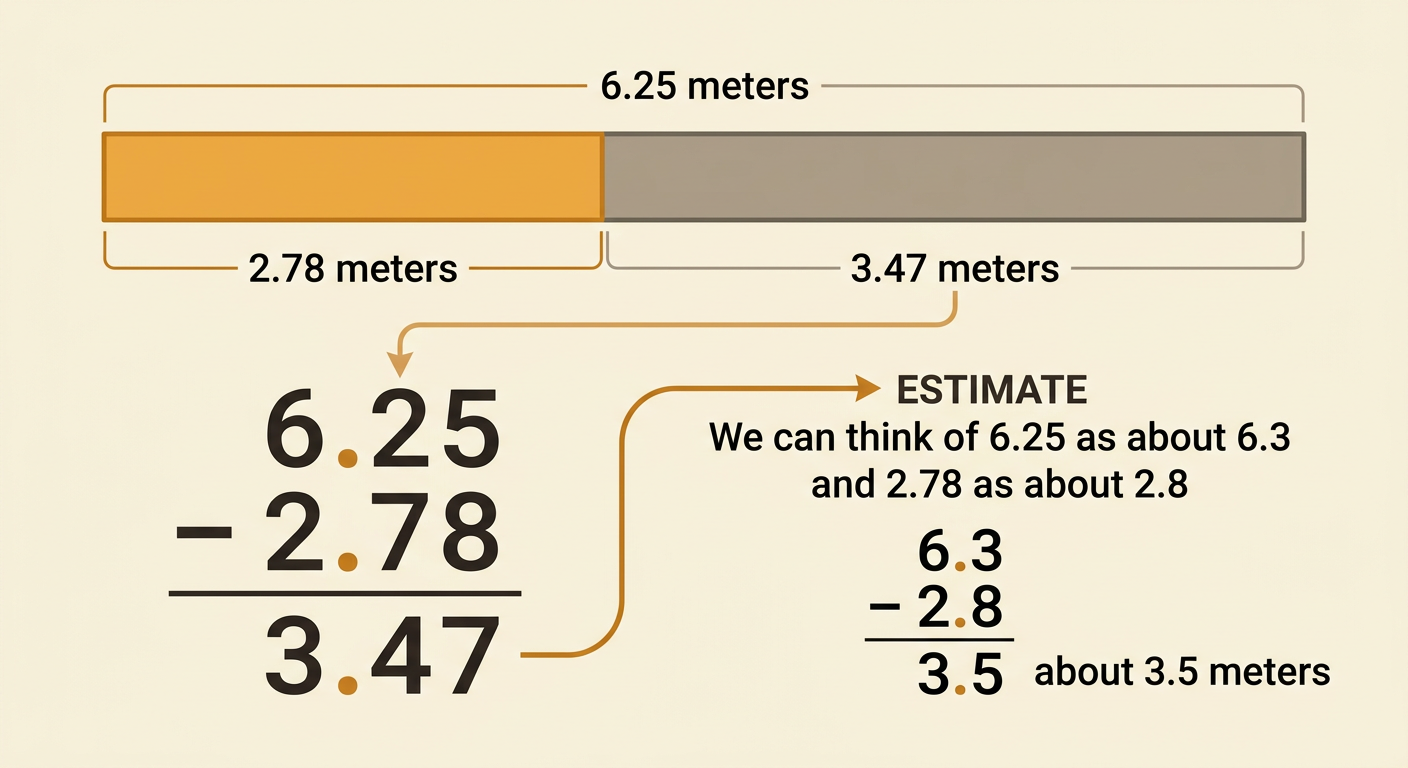
Jordan has 6.25 meters of ribbon and uses 2.78 meters for a project. How much ribbon remains? The word remains tells you to subtract. Write 6.25 − 2.78 with the decimal points aligned. Regroup to subtract the hundredths and tenths. The calculation gives 3.47, so Jordan has 3.47 meters of ribbon left. Include the unit because the number describes a length. You can also estimate before calculating: 6.25 is about 6.3, and 2.78 is about 2.8. The estimated difference is about 3.5 meters. Since 3.47 is close to 3.5, the exact answer is reasonable.
Explain and Check the Solution
A strong solution explains the operation, the place-value steps, and why the answer makes sense. Jordan started with 6.25 meters and used 2.78 meters, so subtraction was appropriate. The aligned calculation gave 3.47 meters. Check a subtraction answer by using the related addition equation. Add the difference and the amount used: 3.47 + 2.78. Add hundredths and regroup, then add tenths and regroup. The sum is 6.25, which matches the original amount. The estimate also supports the answer because 3.47 is close to 3.5. If the addition check had not returned 6.25, you would need to inspect the alignment, regrouping, and arithmetic.
