Adding and Subtracting Polynomials
Students combine like terms to add and subtract polynomial expressions and explain how the result remains a polynomial.
Illustrations are auto-generated and may be placeholders. They can be refreshed to match the narration.
Identify Polynomial Terms
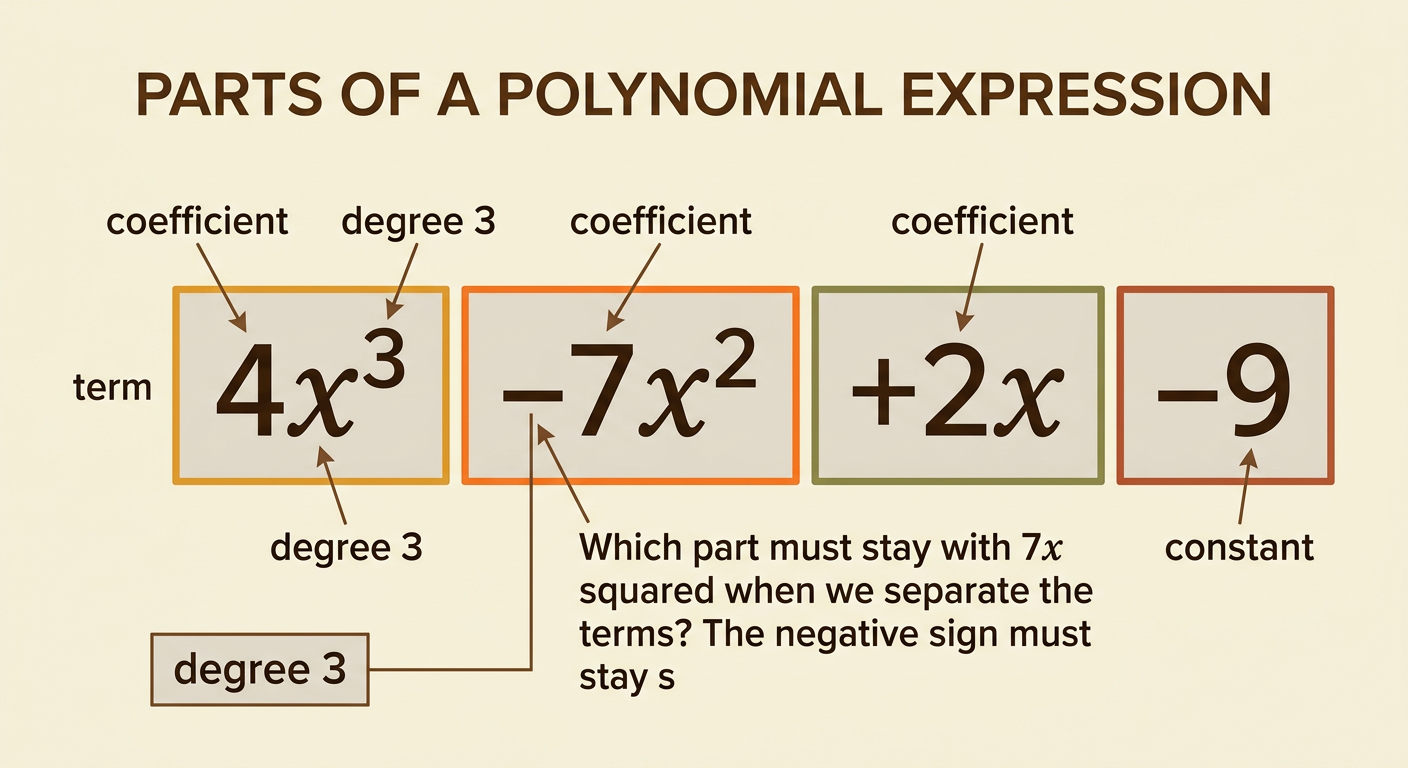
A polynomial is an expression made of terms that are added or subtracted. Each term contains a number, a variable raised to a whole-number exponent, or both. In 4x³ − 7x² + 2x − 9, the terms are 4x³, −7x², 2x, and −9. The sign before a term belongs to that term. The number multiplying a variable is its coefficient, so the coefficient of −7x² is −7. A term without a variable is a constant. The degree of a term is its exponent, and the greatest term degree is the degree of the polynomial. This polynomial has degree 3. Recognizing each complete term, including its sign, helps prevent errors when polynomials are added or subtracted.
Review Like Terms
Like terms have exactly the same variable parts, including the same variables raised to the same exponents. Their coefficients may be different. For example, 3x² and −5x² are like terms because both have x² as the variable part. They combine to make −2x² because 3 + (−5) = −2. However, 3x² and 3x are not like terms because their exponents differ. Also, 2xy and 2x are not like terms because their variables differ. All constants are like terms, so 6 and −10 combine to make −4. To simplify 4x² + 3x − x² + 5x + 2, group matching terms. Then 4x² − x² = 3x² and 3x + 5x = 8x, giving 3x² + 8x + 2.

Add Polynomials
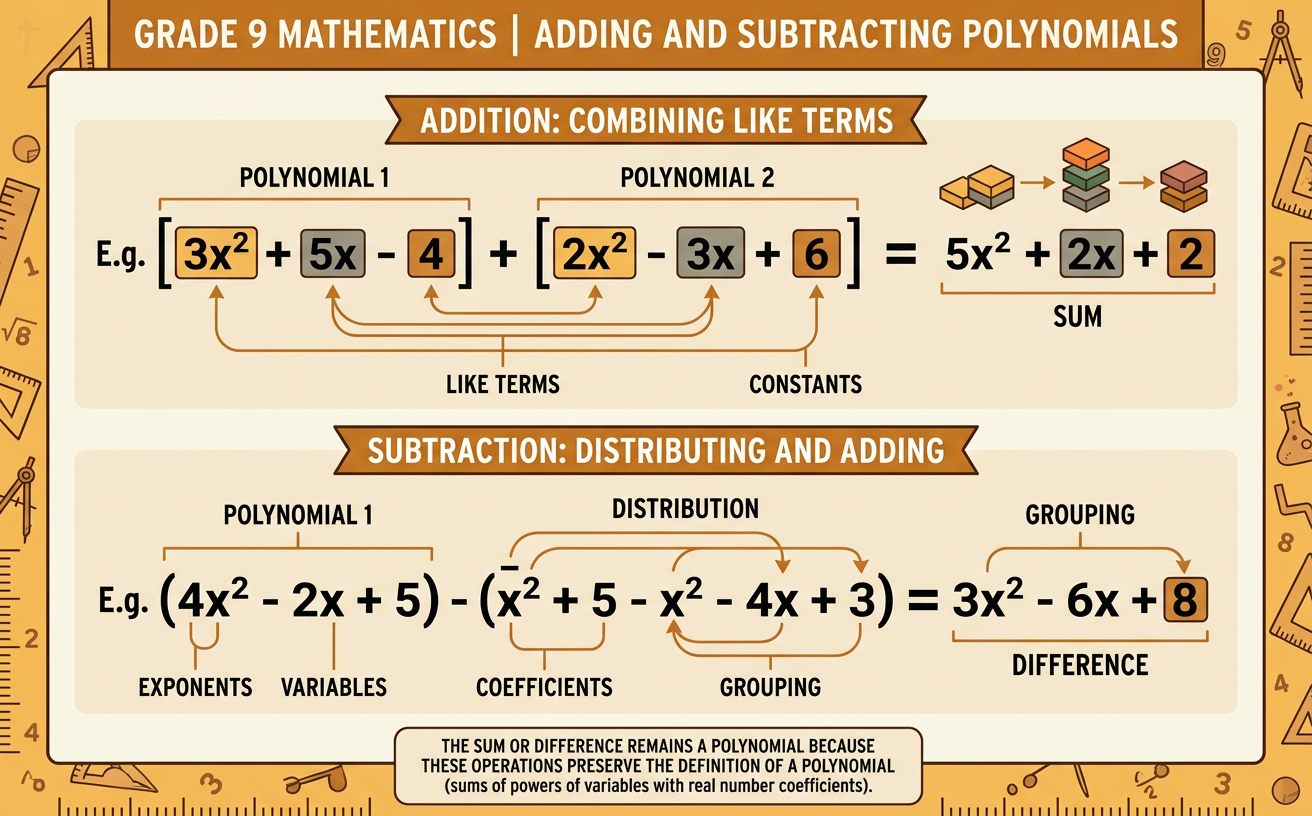
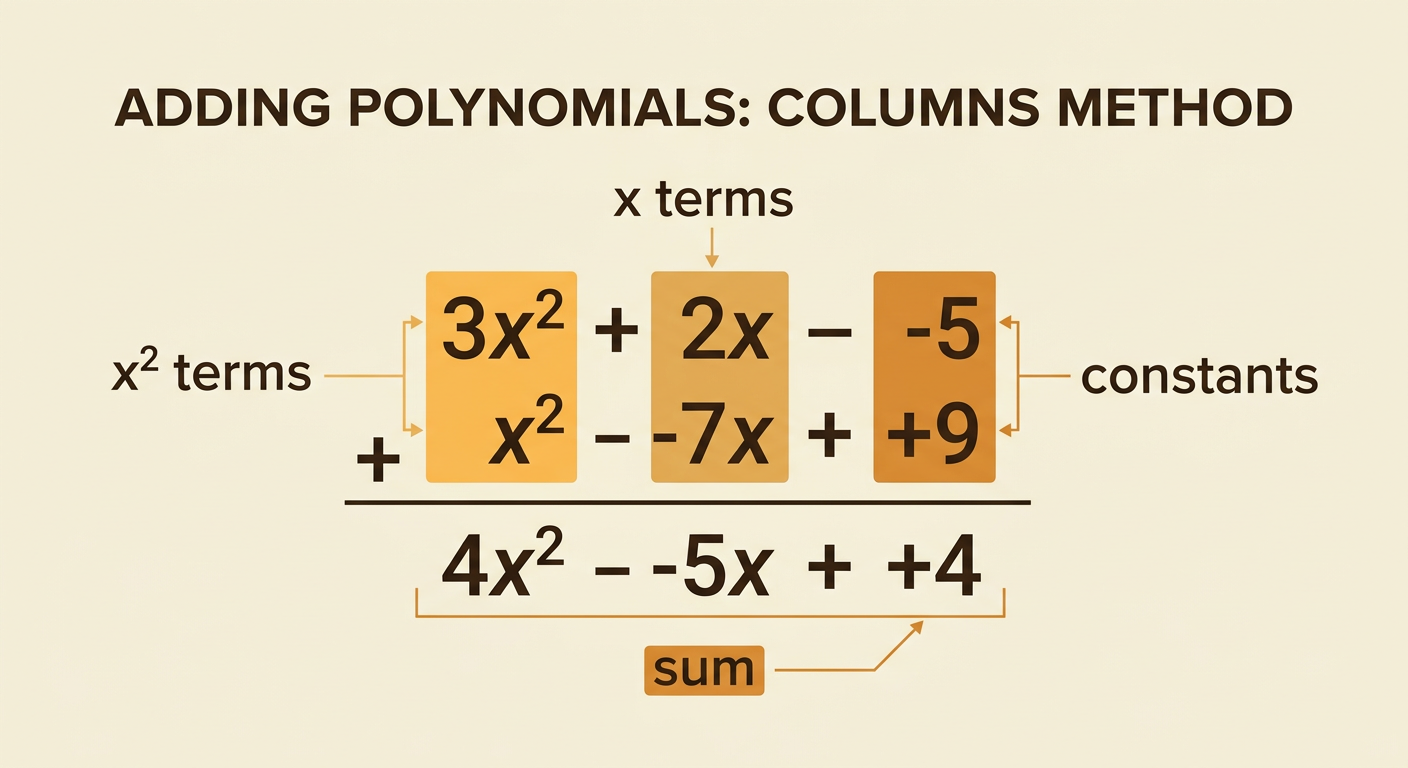
To add polynomials, combine all like terms. One reliable method is to write the polynomials in standard form and align terms with the same powers. Consider (3x² + 2x − 5) + (x² − 7x + 9). First combine the x² terms: 3x² + x² = 4x². Next combine the x terms: 2x − 7x = −5x. Finally, combine the constants: −5 + 9 = 4. The sum is 4x² − 5x + 4. You may also remove the parentheses and group like terms horizontally. Either method gives the same result. Because adding coefficients produces new real-number coefficients while the variable exponents stay whole numbers, the sum is still a polynomial.
Subtract Polynomials
To subtract a polynomial, add the opposite of every term in the polynomial being subtracted. This means the subtraction sign changes the sign of each term inside the second set of parentheses. For example, consider (5x² − 3x + 4) − (2x² + x − 6). Distribute the negative sign to rewrite the expression as 5x² − 3x + 4 − 2x² − x + 6. Now combine like terms. The x² terms give 5x² − 2x² = 3x². The x terms give −3x − x = −4x. The constants give 4 + 6 = 10. Therefore, the difference is 3x² − 4x + 10. Changing every sign in the second polynomial is essential.

Check and Explain Results
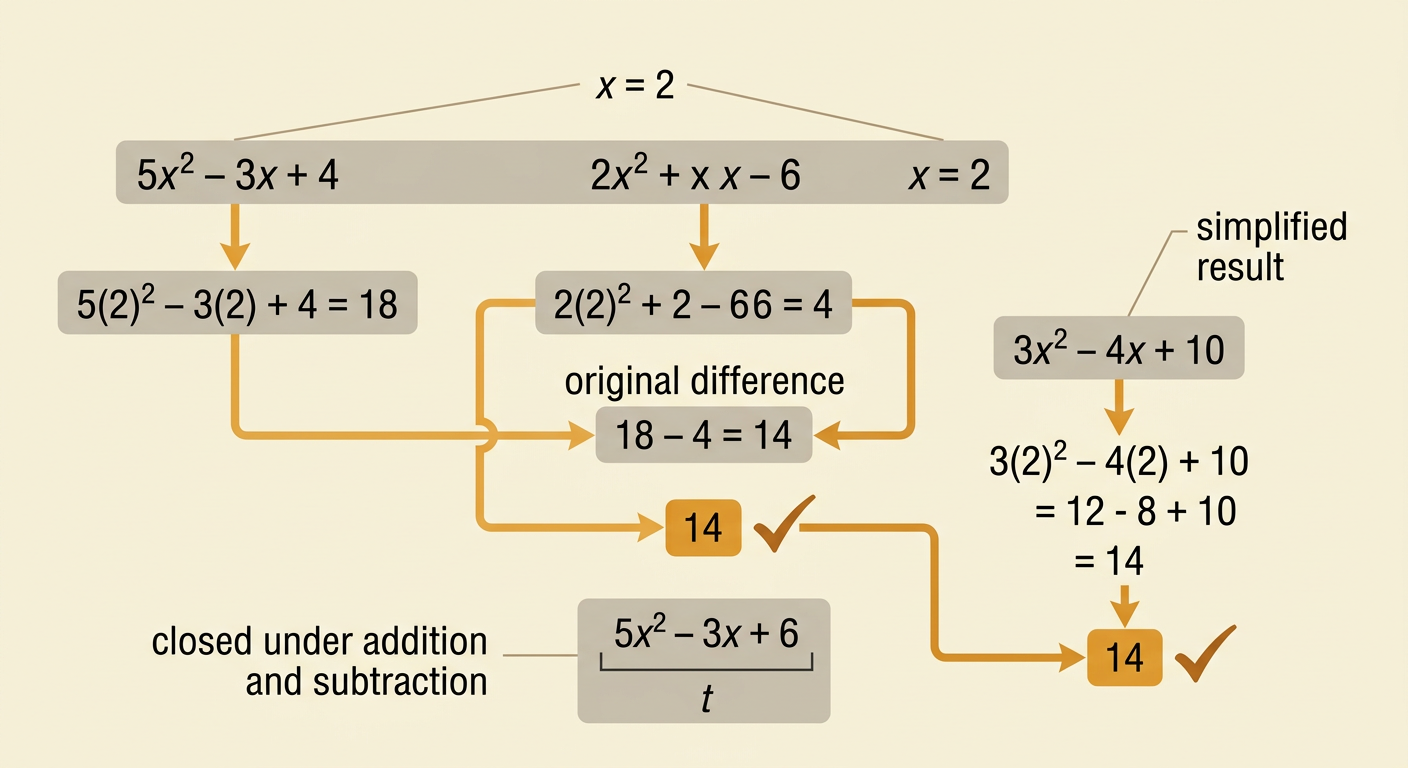
Check a result by confirming that all like terms were combined and that no unlike terms were combined. You can also substitute a number for the variable in both the original expression and the simplified result. For the subtraction example, let x = 2. The first polynomial, 5x² − 3x + 4, equals 18, and the second polynomial, 2x² + x − 6, equals 4. Their difference is 14. The simplified result, 3x² − 4x + 10, also equals 14 when x = 2. This agreement supports the calculation. The result remains a polynomial because addition and subtraction only change or combine coefficients; they do not create negative or fractional variable exponents. Polynomials are therefore closed under addition and subtraction.