
Adding and Subtracting Rational Numbers
Students use number lines and real-world contexts to add and subtract positive and negative rational numbers.

Illustrations are auto-generated and may be placeholders. They can be refreshed to match the narration.
Review Opposites and Absolute Value
Rational numbers include integers, fractions, and decimals that can be written as a ratio of two integers. Opposites are the same distance from zero but lie on different sides of zero. For example, 4 and −4 are opposites. Their sum is zero, so they form an additive inverse pair. Absolute value tells a number’s distance from zero, without considering direction. Therefore, |4| = 4 and |−4| = 4. On a number line, numbers increase as you move right and decrease as you move left. Compare −2 and −5: −2 is greater because it is farther to the right. Opposites and absolute value help you understand both the direction and size of a rational number before using it in addition or subtraction.

Model Rational Number Addition
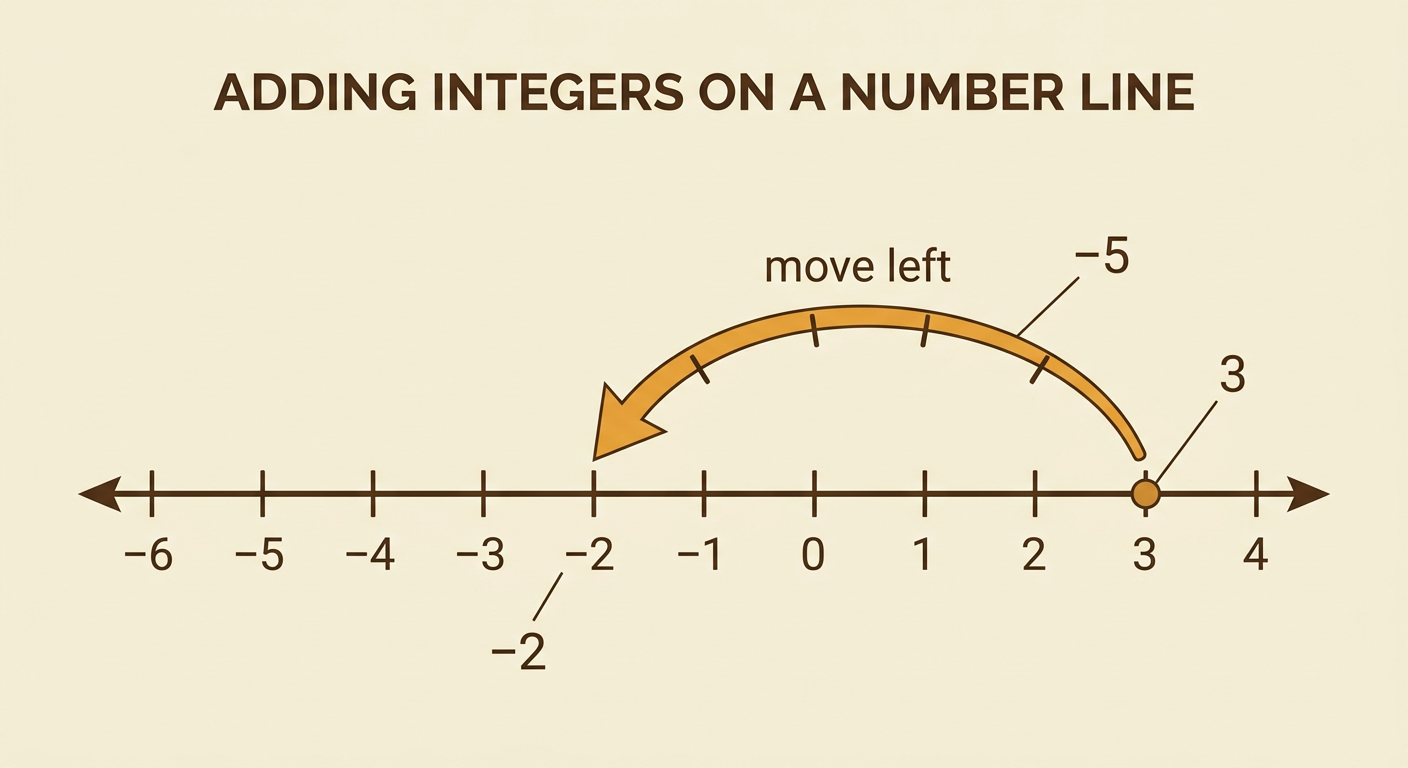
To add rational numbers on a number line, begin at the first addend. Move right to add a positive number and left to add a negative number. For 3 + (−5), start at 3 and move 5 units left. You land at −2, so 3 + (−5) = −2. When the addends have the same sign, add their absolute values and keep that sign. For example, −2 + (−4) = −6. When they have different signs, subtract the smaller absolute value from the larger absolute value and use the sign of the number with the greater absolute value. In 3 + (−5), the difference between 5 and 3 is 2. Since −5 has the greater absolute value, the sum is −2.
Rewrite Subtraction as Adding the Opposite
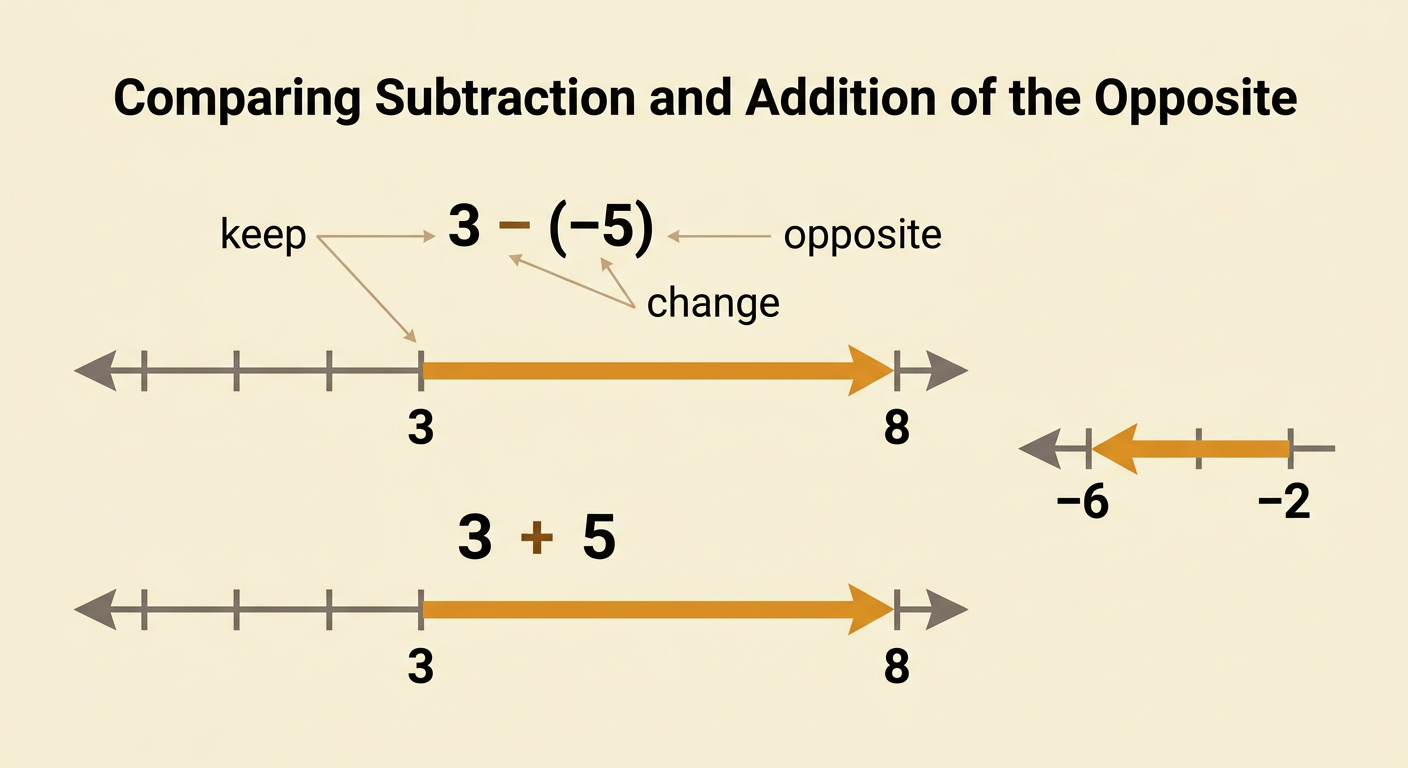
Every subtraction expression can be rewritten as addition of the opposite. Use the rule a − b = a + (−b). This means you keep the first number, change subtraction to addition, and replace the second number with its opposite. For example, −2 − 4 becomes −2 + (−4). Start at −2 and move 4 units left, landing at −6. Therefore, −2 − 4 = −6. If the number being subtracted is negative, its opposite is positive. For example, 3 − (−5) becomes 3 + 5, which equals 8. Be careful to change the sign of only the number being subtracted. After rewriting the expression, use the addition rules or a number line to find the sum.
Practice with Fractions and Decimals
The same addition and subtraction rules apply to fractions and decimals. For fractions, first find a common denominator when needed. Consider −3/4 + 1/2. Rewrite 1/2 as 2/4, giving −3/4 + 2/4 = −1/4. The negative fraction has the greater absolute value, so the answer is negative. For decimals, align the decimal points before calculating. For example, 2.6 − 4.1 can be rewritten as 2.6 + (−4.1). The numbers have different signs, so subtract their absolute values: 4.1 − 2.6 = 1.5. Since −4.1 has the greater absolute value, the result is −1.5. You can check both answers on a number line by starting at the first number and moving according to the second number’s sign and size.

Apply Operations to Real-World Situations
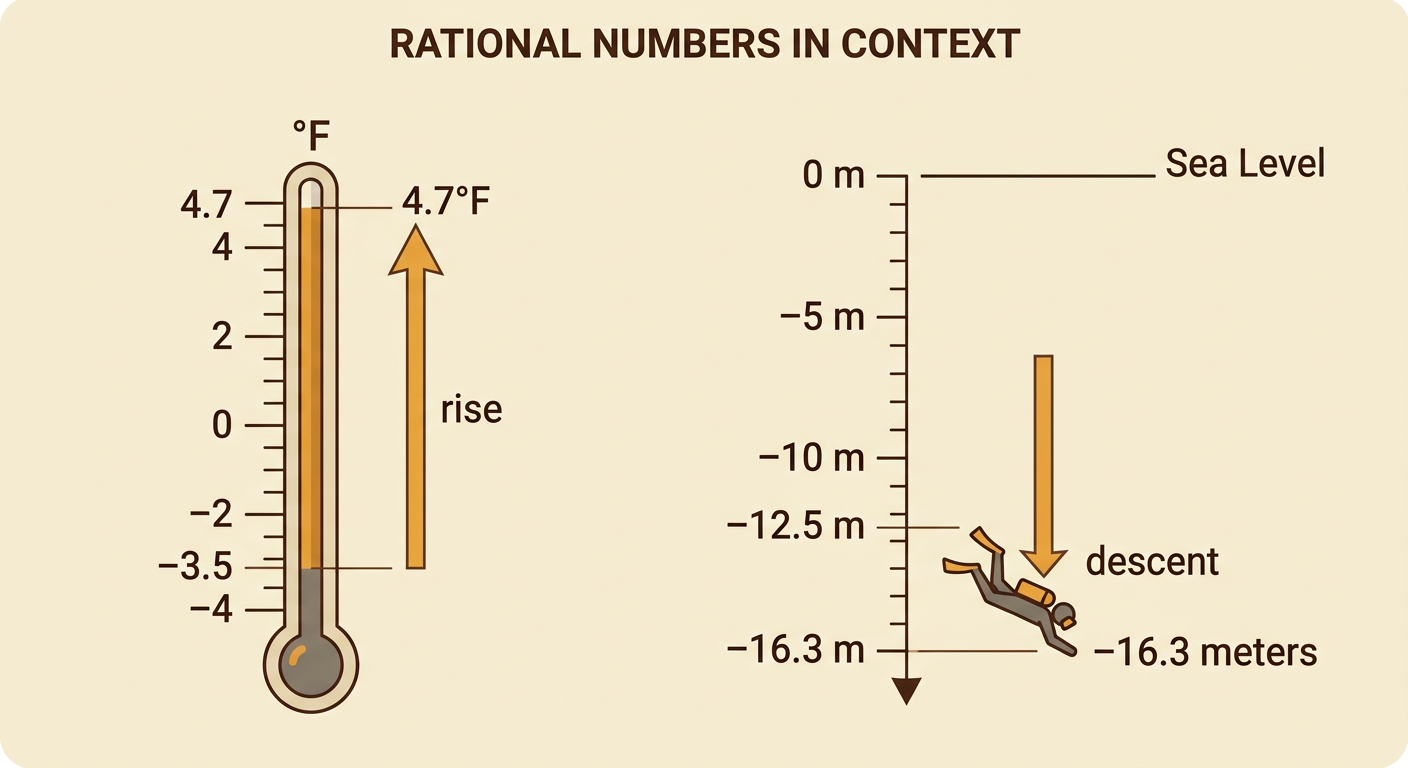
Positive and negative rational numbers can represent changes in temperature, elevation, money, and other quantities. First identify what positive and negative values mean in the situation. Suppose the temperature is −3.5°F in the morning and rises 8.2°F by afternoon. A rise is positive, so calculate −3.5 + 8.2 = 4.7. The afternoon temperature is 4.7°F. Now suppose a diver is at −12.5 meters relative to sea level and descends another 3.8 meters. A descent is negative, so calculate −12.5 + (−3.8) = −16.3. The diver is 16.3 meters below sea level. Always include units and interpret the sign in your answer. A negative result may mean below zero, below sea level, a debt, or a decrease, depending on the context.
Complete an Exit Check
Use what you learned to solve three exit-check problems. First, find −6 + 9. Start at −6 and move 9 units right to get 3. Second, find 4.5 − 7. Rewrite the expression as 4.5 + (−7), then move 7 units left to get −2.5. Third, a bank account balance is −$12.75, and a deposit of $20 is made. A deposit is positive, so calculate −12.75 + 20 = 7.25. The new balance is $7.25. Check each result by asking whether its sign and size are reasonable. A positive move larger than a negative starting value should cross zero. Before finishing, explain this key idea in your own words: subtracting a rational number means adding its opposite.
