Adding Fractions with Unlike Denominators
Students use equivalent fractions and common denominators to add fractions with unlike denominators and explain their reasoning.

Illustrations are auto-generated and may be placeholders. They can be refreshed to match the narration.
Review Like Denominators
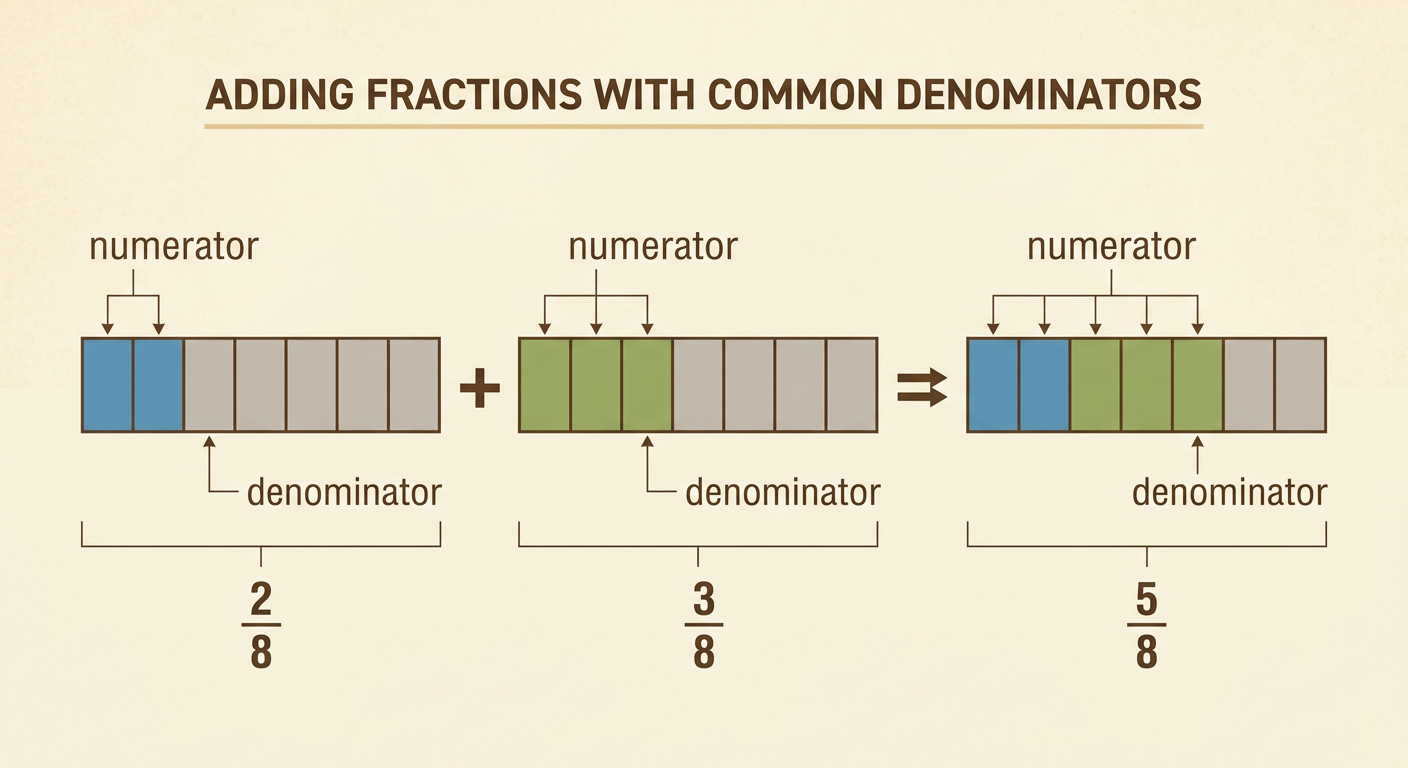
A fraction’s denominator tells how many equal parts make one whole. Its numerator tells how many of those parts are counted. When fractions have the same denominator, their pieces are the same size, so you can add the numerators and keep the denominator. For example, consider 2/8 + 3/8. Both fractions count eighths. Add 2 + 3 to get 5, and keep the denominator 8. Therefore, 2/8 + 3/8 = 5/8. Do not add the denominators because the size of each piece does not change. A number line or fraction bar can show this clearly: two eighths combined with three more eighths make five eighths. This idea will help you add fractions whose denominators are different.
Find a Common Denominator
Fractions with unlike denominators name pieces of different sizes. Before adding them, find a common denominator so both fractions count equal-size pieces. One useful choice is the least common multiple of the denominators. To add 1/3 + 1/4, list multiples of each denominator. Multiples of 3 include 3, 6, 9, and 12. Multiples of 4 include 4, 8, and 12. The least number in both lists is 12, so 12 is the least common denominator. Both thirds and fourths can be divided into twelfths. You could use another common multiple, such as 24, but 12 usually makes the work easier. Finding a common denominator does not change the fractions yet; it identifies the equal-size parts you will use.

Create Equivalent Fractions
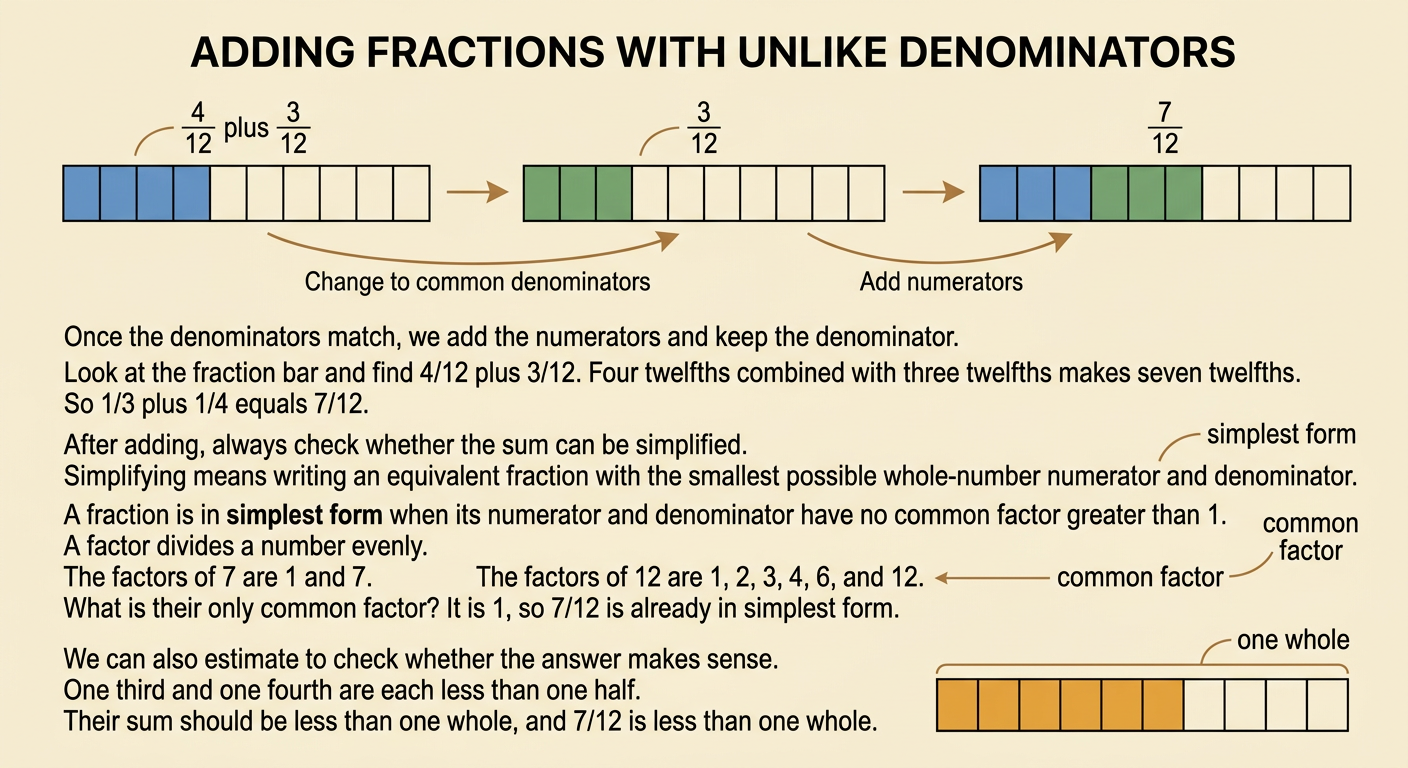
Equivalent fractions name the same amount even though they use different numerators and denominators. To create an equivalent fraction, multiply the numerator and denominator by the same number. Continue with 1/3 + 1/4 and use the common denominator 12. Multiply 1/3 by 4/4 because 3 × 4 = 12. This gives 4/12. Multiply 1/4 by 3/3 because 4 × 3 = 12. This gives 3/12. Multiplying by 4/4 or 3/3 does not change the fraction’s value because each multiplier equals 1. Now the problem is 4/12 + 3/12. The fractions still represent the original amounts, but they are written with equal-size pieces, so they are ready to be added.

Add and Simplify
Once the fractions have a common denominator, add the numerators and keep the denominator. For 1/3 + 1/4, the equivalent-fraction form is 4/12 + 3/12. Add 4 + 3 to get 7, and keep 12 as the denominator. The sum is 7/12. Always check whether the answer can be simplified. A fraction is in simplest form when its numerator and denominator have no common factor greater than 1. The factors of 7 are 1 and 7, while the factors of 12 are 1, 2, 3, 4, 6, and 12. Their only common factor is 1, so 7/12 is already in simplest form. Also estimate: 1/3 and 1/4 are each less than 1/2, so a sum less than 1 is reasonable.
Solve a Real-World Problem
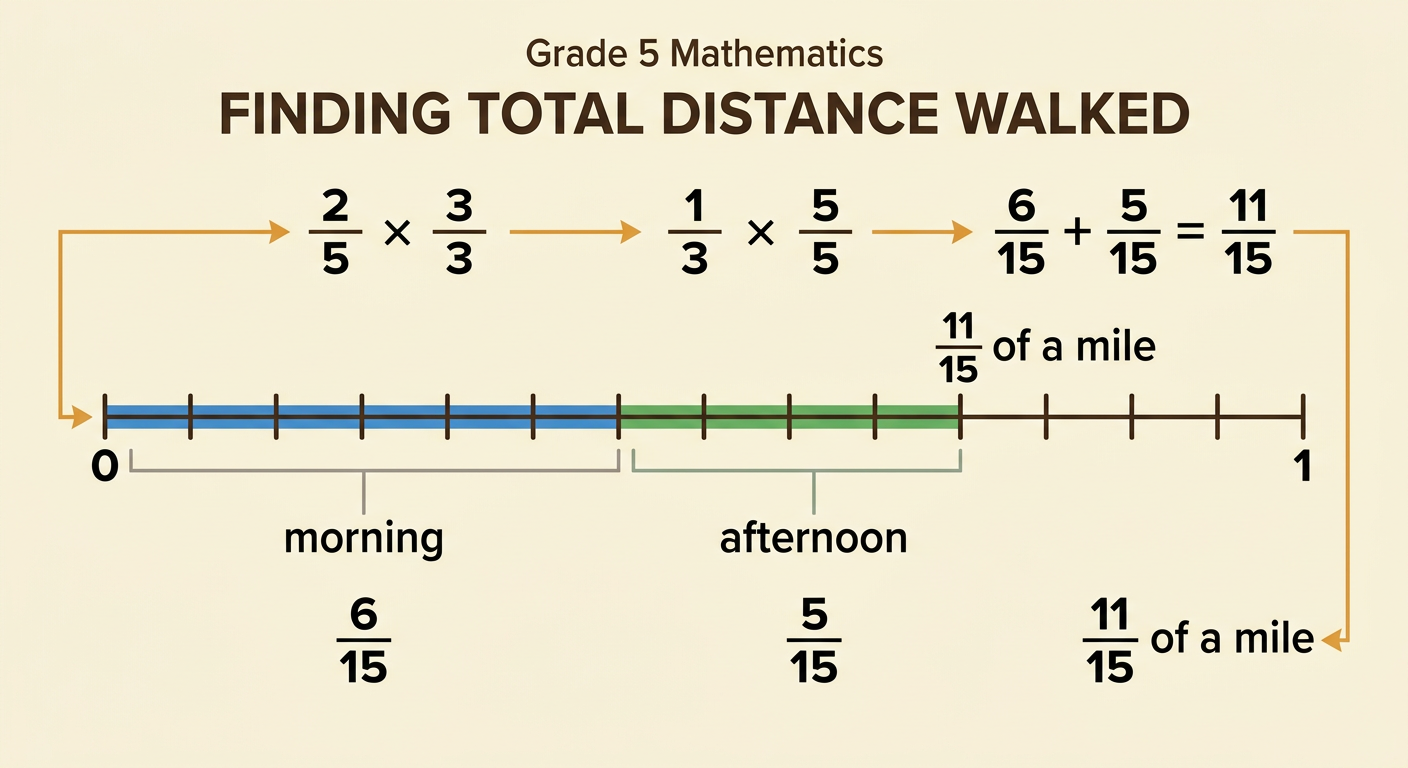
Maya walked 2/5 of a mile in the morning and 1/3 of a mile in the afternoon. How far did she walk altogether? The denominators 5 and 3 are unlike, so find a common denominator. The least common multiple of 5 and 3 is 15. Rewrite 2/5 as 6/15 by multiplying by 3/3. Rewrite 1/3 as 5/15 by multiplying by 5/5. Now add: 6/15 + 5/15 = 11/15. The fraction 11/15 is in simplest form because 11 and 15 have no common factor greater than 1. Maya walked 11/15 of a mile altogether. This answer is reasonable because 2/5 is less than 1/2 and 1/3 is less than 1/2, so their sum should be less than 1 mile.