Air Is Matter: It Takes Up Space and Has Mass
Students investigate trapped air with a syringe and compare the mass of an inflated and deflated ball to gather evidence that air is matter.
Illustrations are auto-generated and may be placeholders. They can be refreshed to match the narration.
What Counts as Matter?
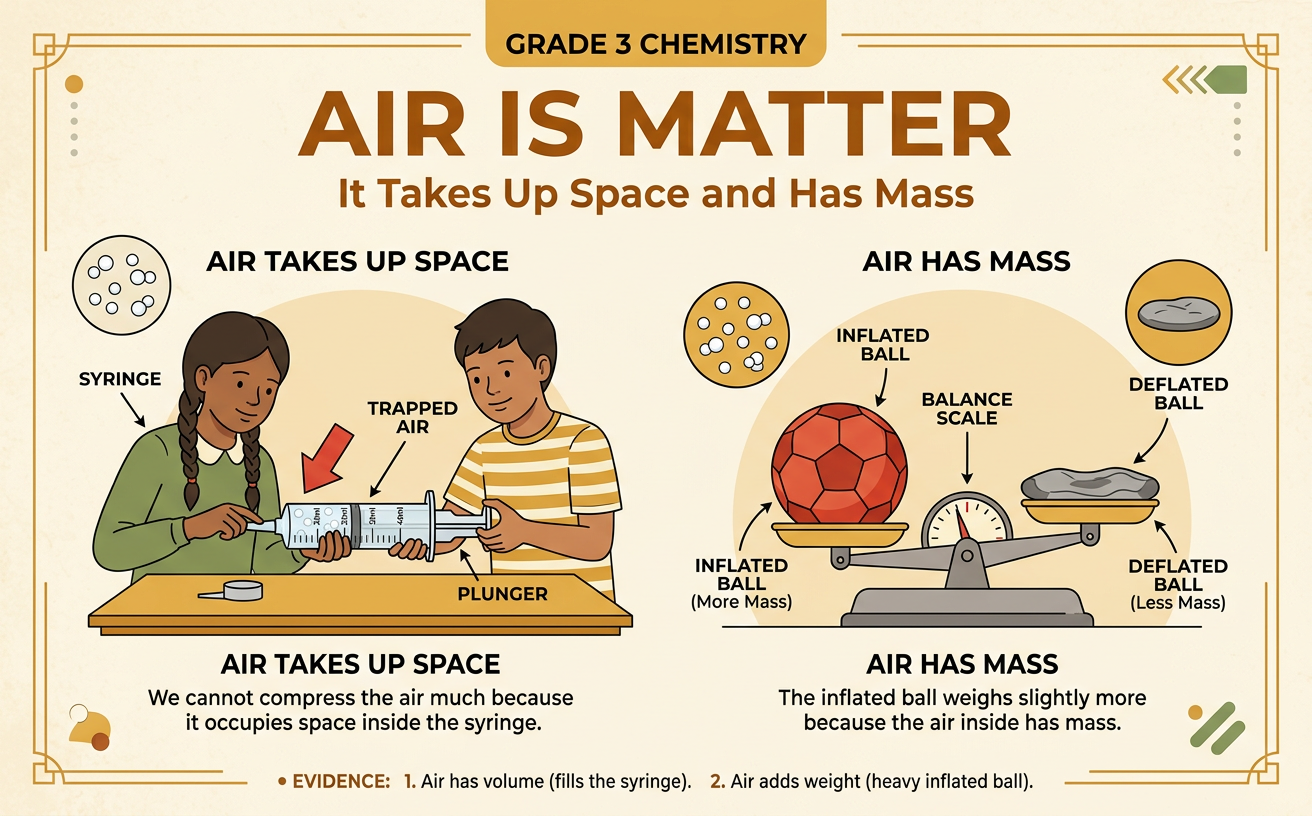
Matter is anything that takes up space and has mass. Mass tells how much matter is in an object and can be measured in grams. Solids, liquids, and gases are all forms of matter. A book is a solid, water is a liquid, and air is a mixture of gases. Air can be hard to notice because it is usually invisible. However, invisible does not mean nonexistent. Think about an empty balloon. When you blow air into it, the balloon grows larger. The added air fills space inside the balloon. The balloon also gains a small amount of mass. These observations give clues that air is matter, just like the materials that are easier to see and touch.

Predicting Air’s Properties
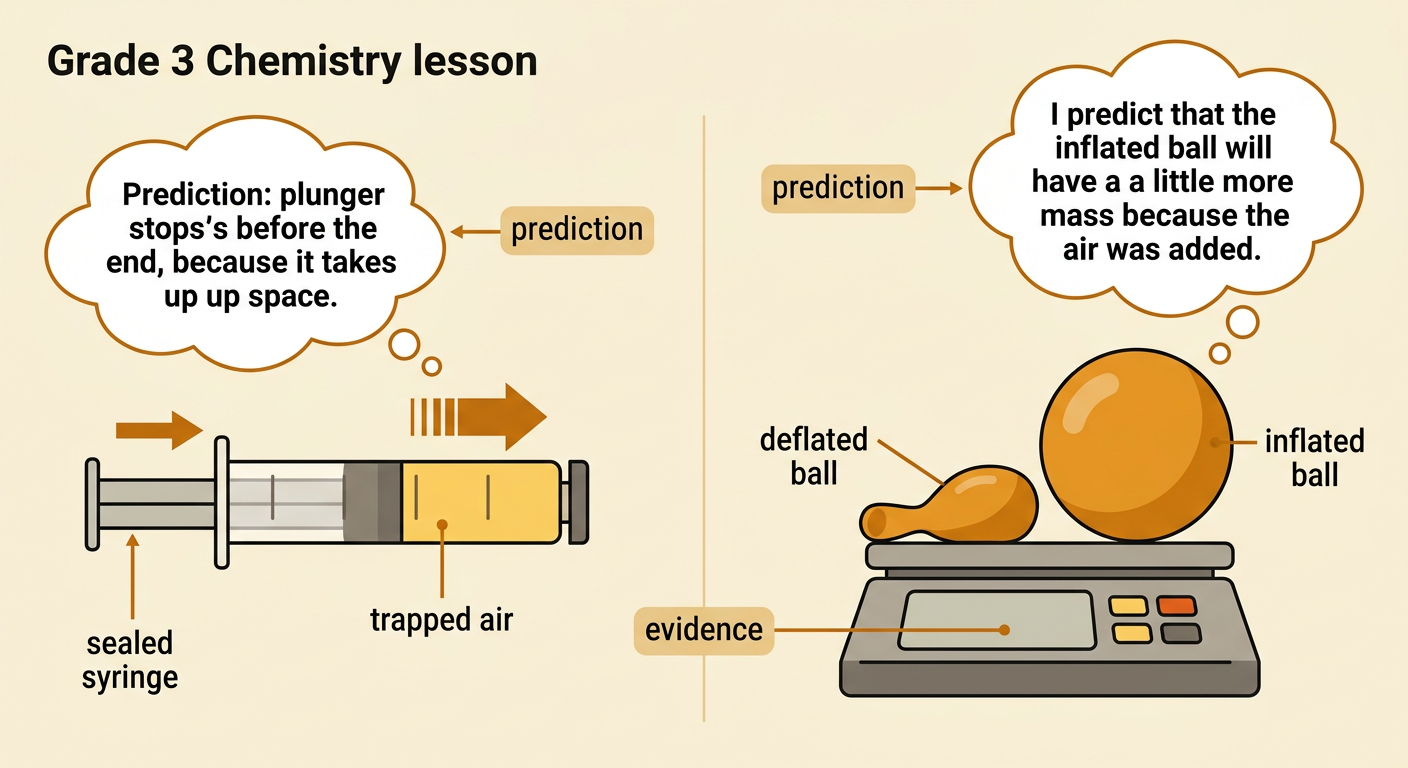
A prediction states what you think will happen before a test. It should be based on something you already know or have observed. Imagine a syringe with its tip sealed and air trapped inside. What will happen if you push the plunger? You might predict that the plunger will stop because the trapped air takes up space. Now think about measuring a ball before and after it is inflated. You might predict that the inflated ball will have slightly more mass because air was added. Record each prediction before investigating. Do not change it after seeing the results. A prediction does not have to be correct to be useful. Scientists compare predictions with evidence to learn whether their ideas are supported.
Testing Whether Air Takes Up Space
Use a clean plastic syringe without a needle. Pull the plunger back so air enters the barrel. Seal the syringe tip tightly with a cap or a finger, and gently push the plunger. The plunger moves a little, but it becomes harder to push. It does not reach the end because air is trapped inside. The air is squeezed into a smaller space, but it does not vanish. Release the plunger, and it moves back as the compressed air spreads out again. For comparison, leave the tip open and push. Air escapes through the opening, so the plunger can move much farther. These results are observable evidence that air takes up space. Use gentle pressure and never use a syringe with a needle.

Comparing Mass With and Without Air
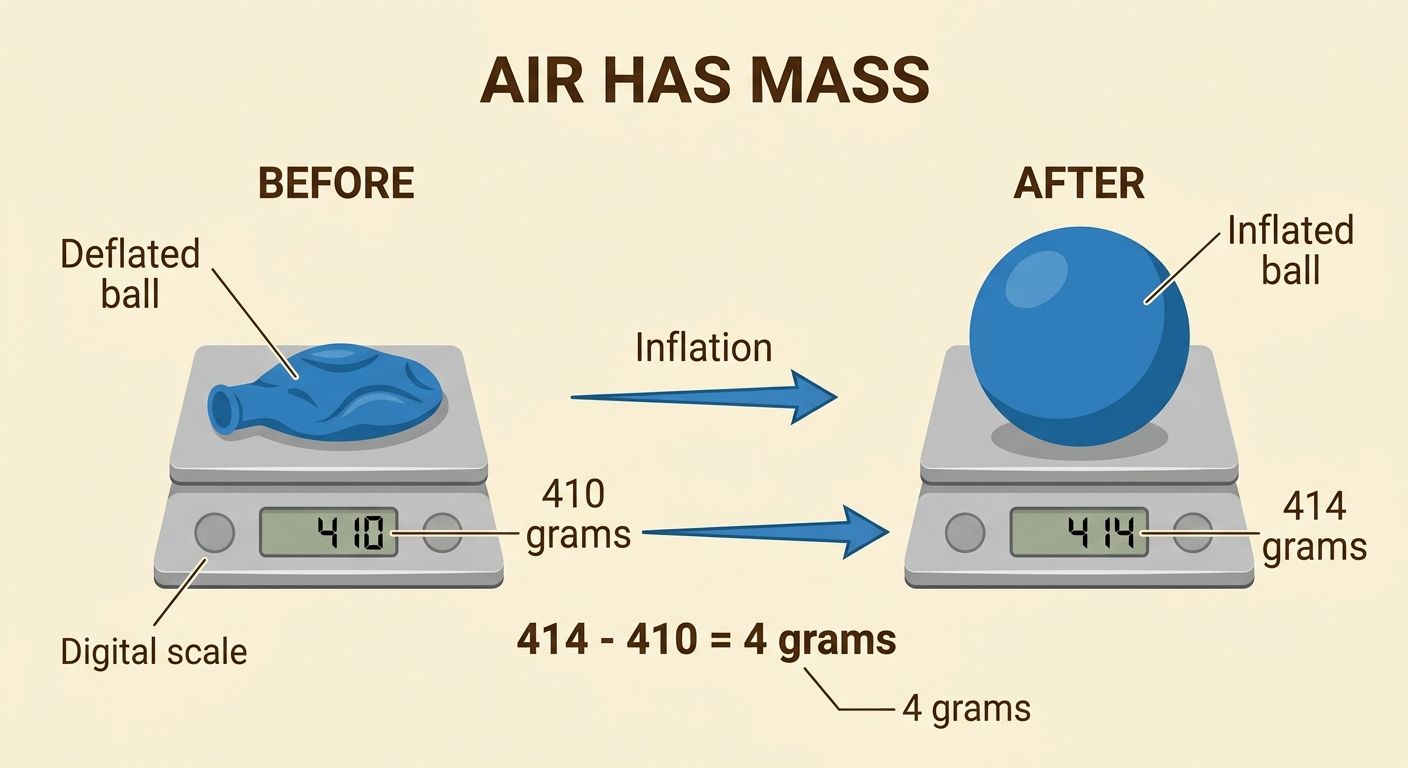
A sensitive digital scale can help test whether air has mass. First, place a deflated ball on the scale and record its mass in grams. Next, inflate the same ball and measure it again on the same scale. Keep other conditions the same: use the same ball, scale, and units. The inflated ball should have a slightly greater mass because air was added. For example, if the deflated ball measures 410 grams and the inflated ball measures 414 grams, the difference is 4 grams. Subtract 410 from 414 to find the change. The exact difference may be small, so repeat each measurement and check that the scale starts at zero. A greater mass after inflation is evidence that air has mass.
Making an Evidence-Based Claim
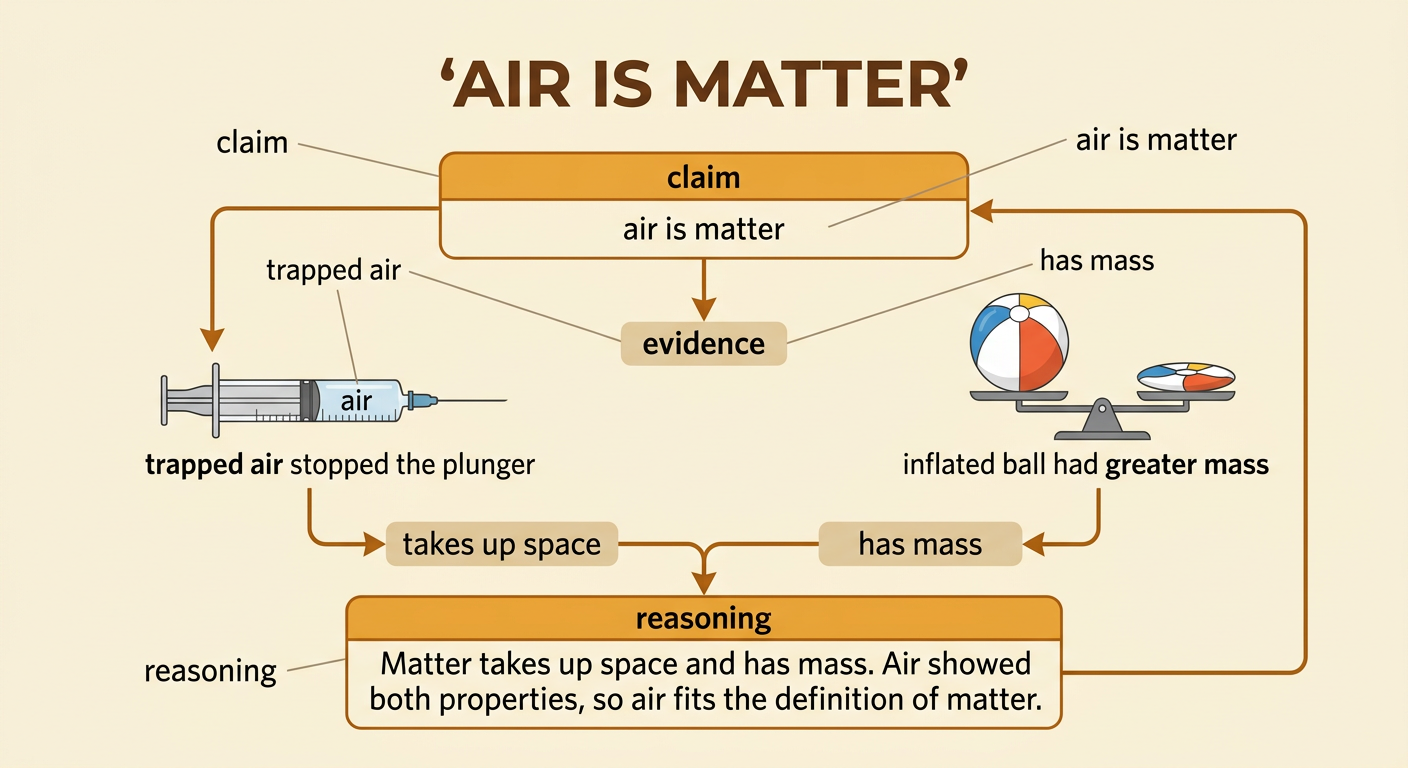
A strong scientific explanation includes a claim, evidence, and reasoning. The claim answers the question: Air is matter. Evidence comes from the investigations. In the sealed syringe, trapped air stopped the plunger from moving all the way, showing that air occupied space. In the ball test, the inflated ball had a greater mass than the deflated ball, showing that added air contributed mass. The reasoning connects the evidence to the definition of matter. Matter takes up space and has mass, and air showed both properties. You can write: “Air is matter because it takes up space and has mass. The syringe test showed that trapped air filled space, and the scale test showed that adding air increased mass.” Using results from both tests makes the argument stronger.