Air Is Matter: It Takes Up Space
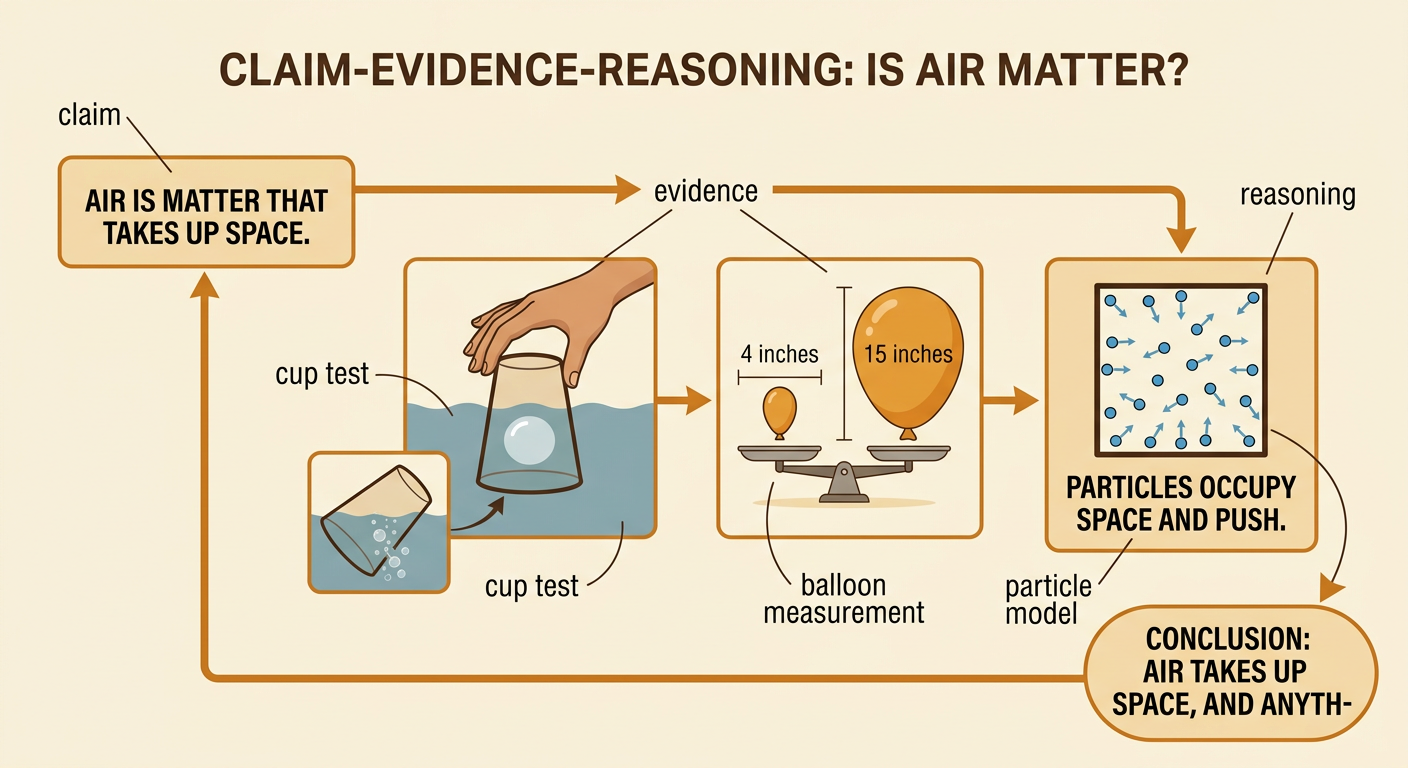
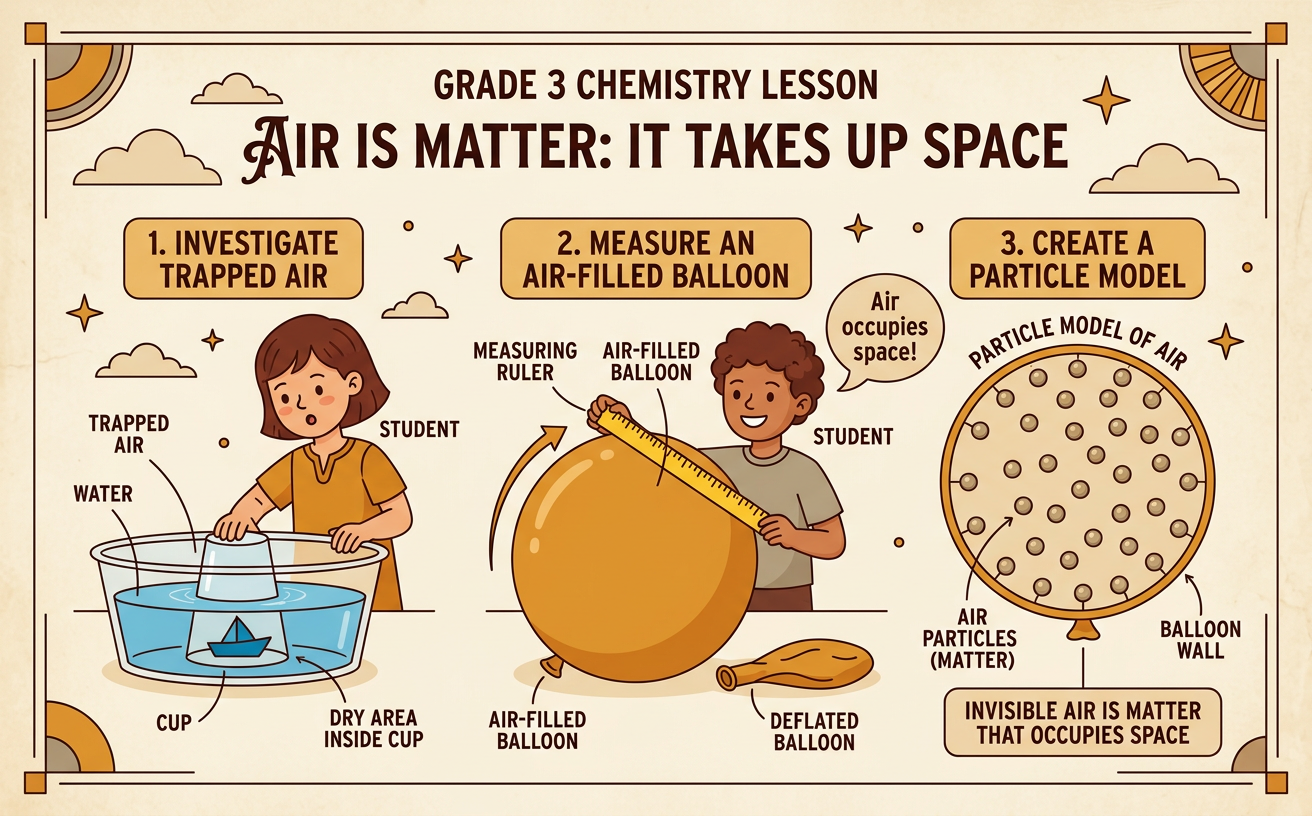
Students investigate trapped air, measure an air-filled balloon, and create a particle model showing that invisible air is matter that occupies space.
Illustrations are auto-generated and may be placeholders. They can be refreshed to match the narration.
Is an Empty Cup Really Empty?
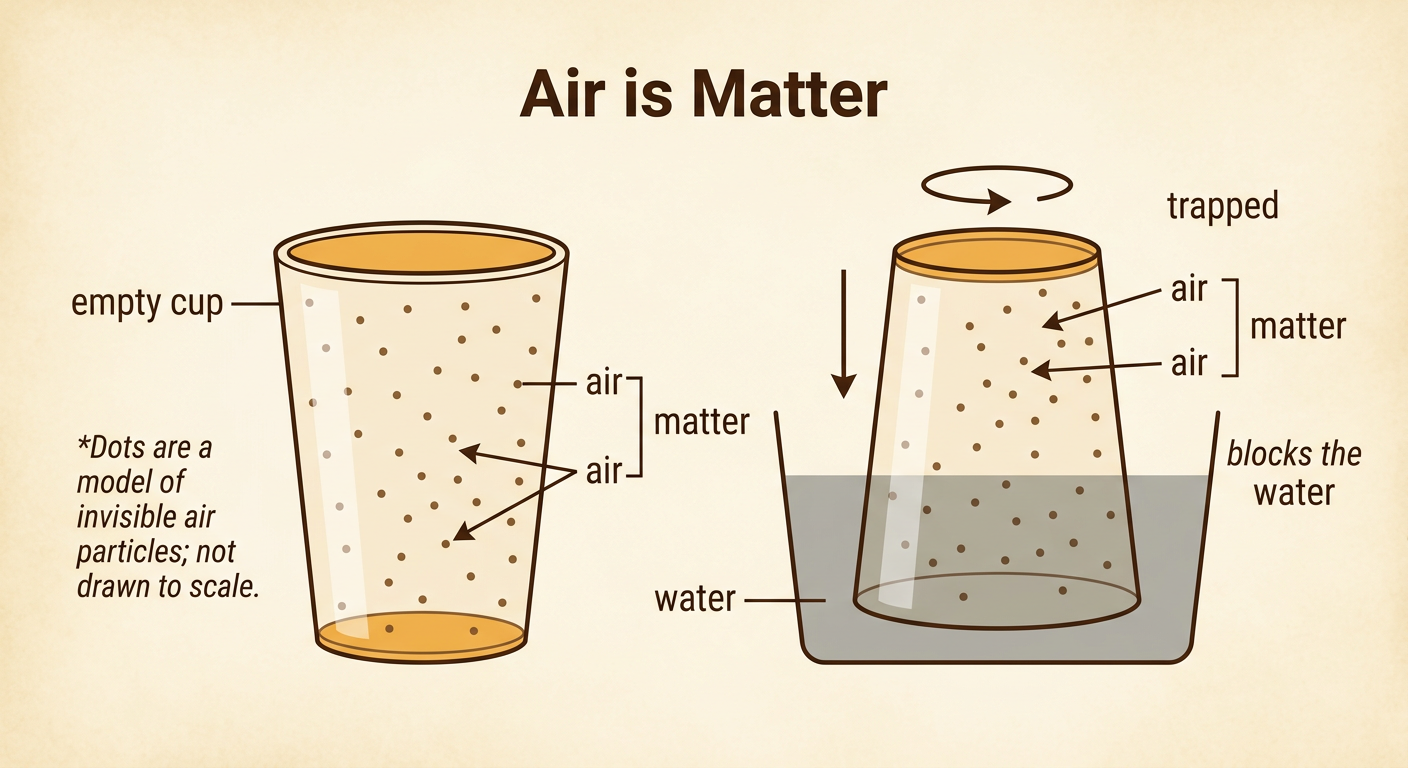
A cup may look empty when it has no water, juice, or other visible material inside. However, the cup contains air. Air is a mixture of gases that surrounds us. We usually cannot see it, but it fills open spaces. Matter is anything that takes up space and has mass, so air is matter. Think about turning an open cup upside down. Air is still inside the cup even though you cannot see it. Ask a partner what evidence could show that the air is there. Take turns sharing ideas, listening carefully, and asking questions. For example, you might suggest putting the upside-down cup into water to find out whether the trapped air prevents water from filling the cup.
Trapping Air in a Cup
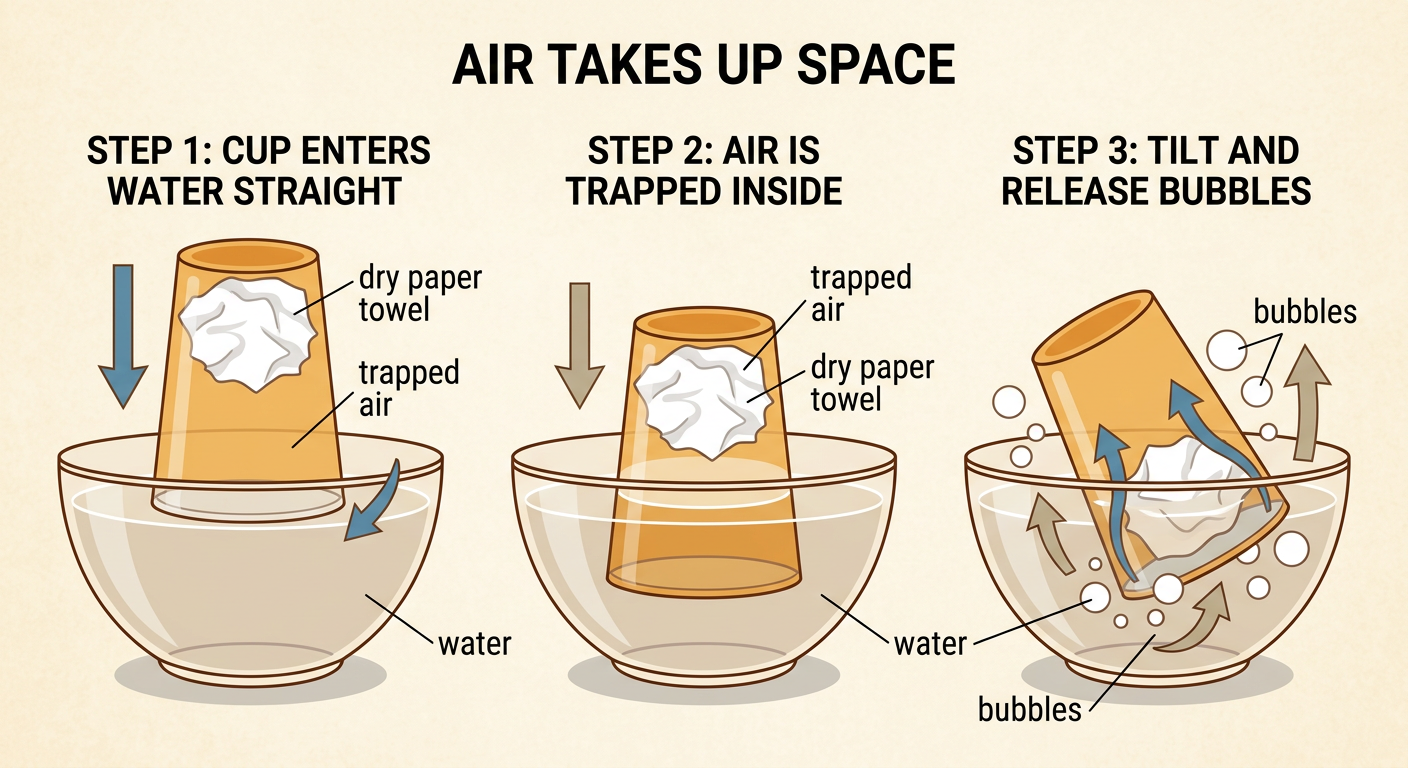
Place a dry piece of paper towel firmly in the bottom of a clear cup. Turn the cup straight upside down and slowly lower it into a bowl of water. Keep the cup level and do not tilt it. The water does not reach the paper towel because air is trapped inside the cup and takes up space. When you lift the cup straight out, the towel should still be dry. Now tilt the cup slightly underwater. Air escapes as bubbles, and water moves into the space the air leaves behind. This is evidence that the cup was not truly empty. Work with your group to describe what you observed. Separate observations, such as “bubbles rose,” from explanations, such as “air escaped from the cup.”
Measuring an Air-Filled Balloon
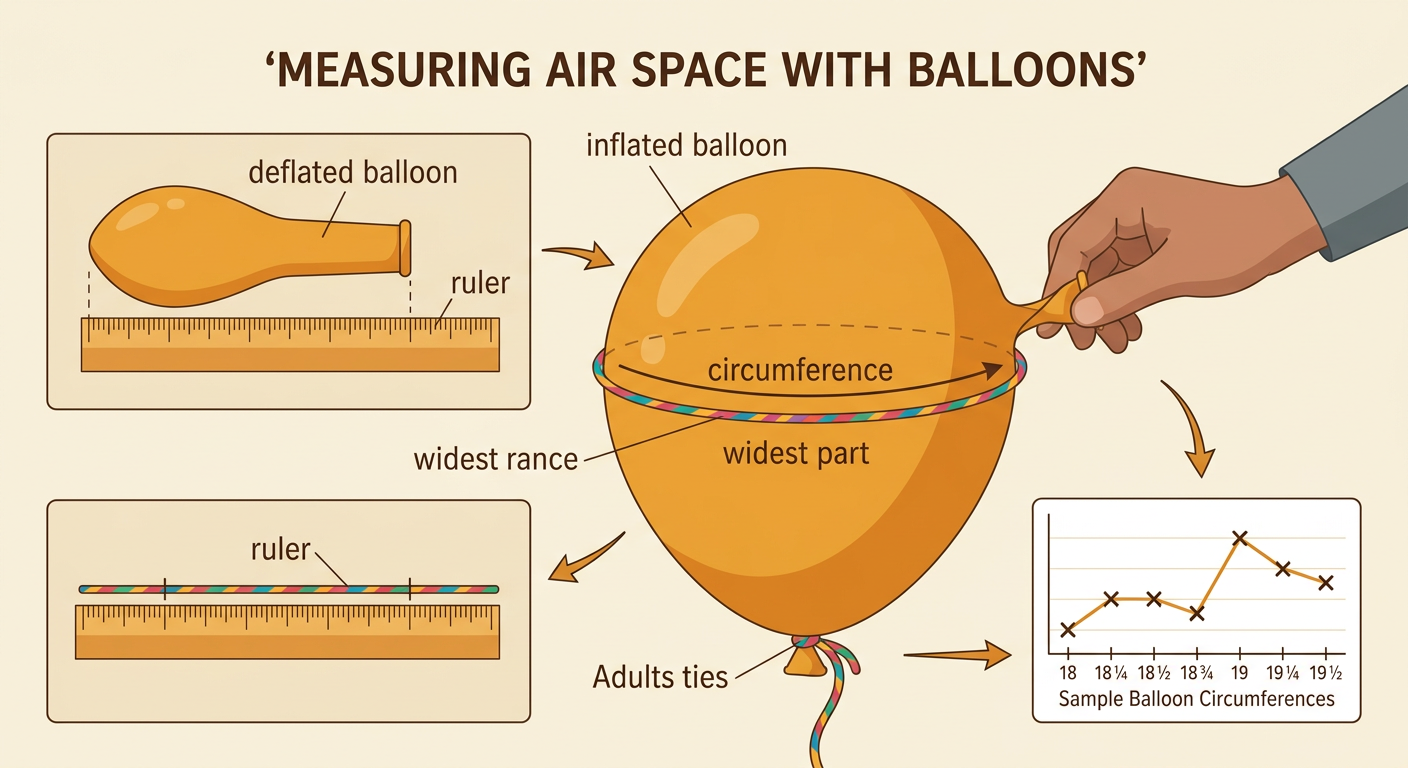
A balloon provides another way to observe the space taken up by air. First, lay a deflated balloon flat and measure its width with a ruler. Then have an adult or teacher inflate and tie it. Wrap a string around the balloon’s widest part, mark where the string meets, and measure that length to the nearest quarter inch. This measurement is the balloon’s circumference. Record each group’s result in a table. For example, groups might measure 18, 18 1/2, 19, and 19 1/4 inches. Display the measurements on a line plot with an X for each balloon. Compare the values and discuss why they may differ. Air entering the flexible balloon pushes its sides outward, so the balloon becomes larger. The increased size shows that the added air occupies space.
Modeling Invisible Air Particles
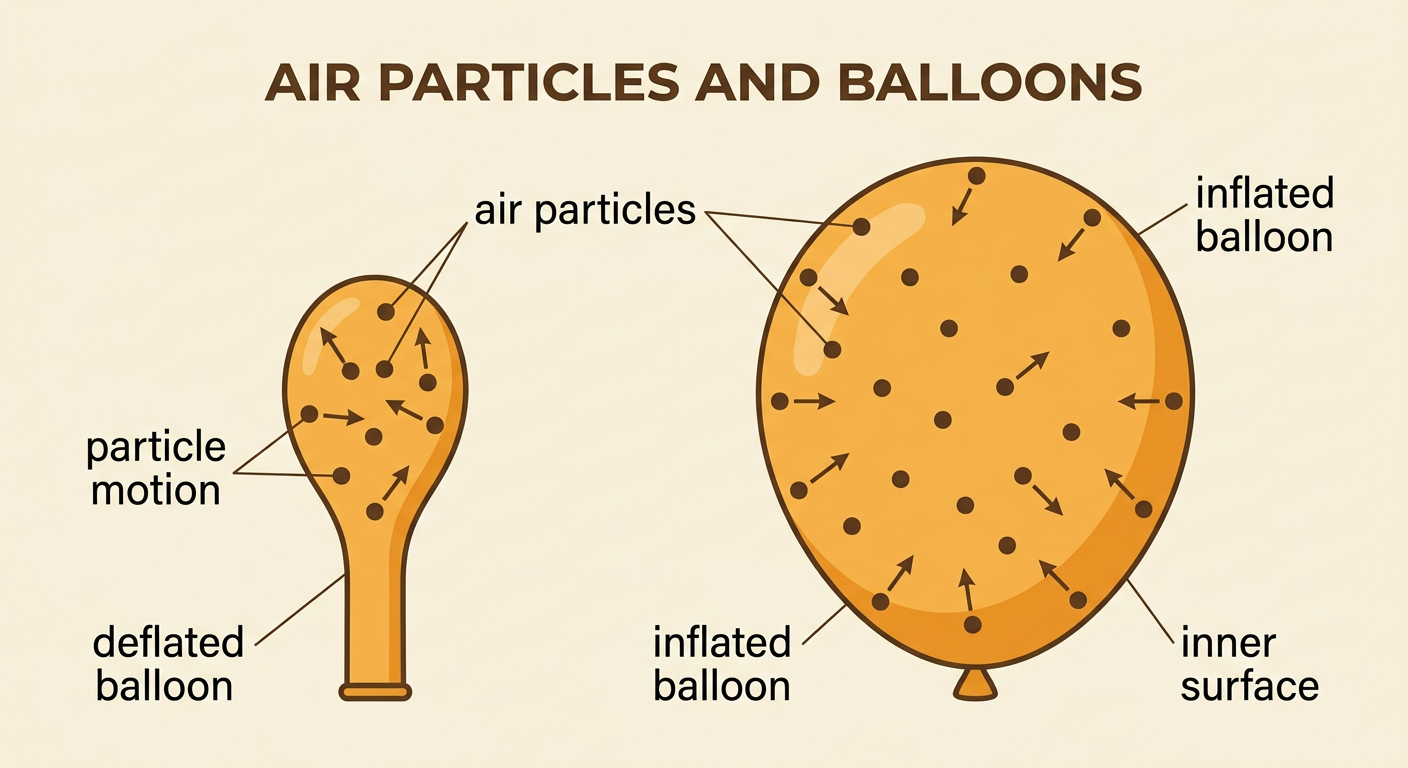
Air is made of particles that are far too small to see without special scientific tools. Scientists use models to explain things that cannot be observed directly. To model air in a balloon, draw many small dots inside a balloon outline. The dots stand for air particles, but they are not the particles’ real size or color. Add arrows in different directions to show that gas particles are always moving. They spread throughout the available space and bump into the balloon’s inner surface. These collisions push on the flexible rubber and help keep the balloon expanded. Compare a model of a deflated balloon with a model of an inflated balloon. The inflated model should show a larger space containing more air particles. Use your model to explain why adding air makes the balloon grow.
Air-Powered Tools Then and Now
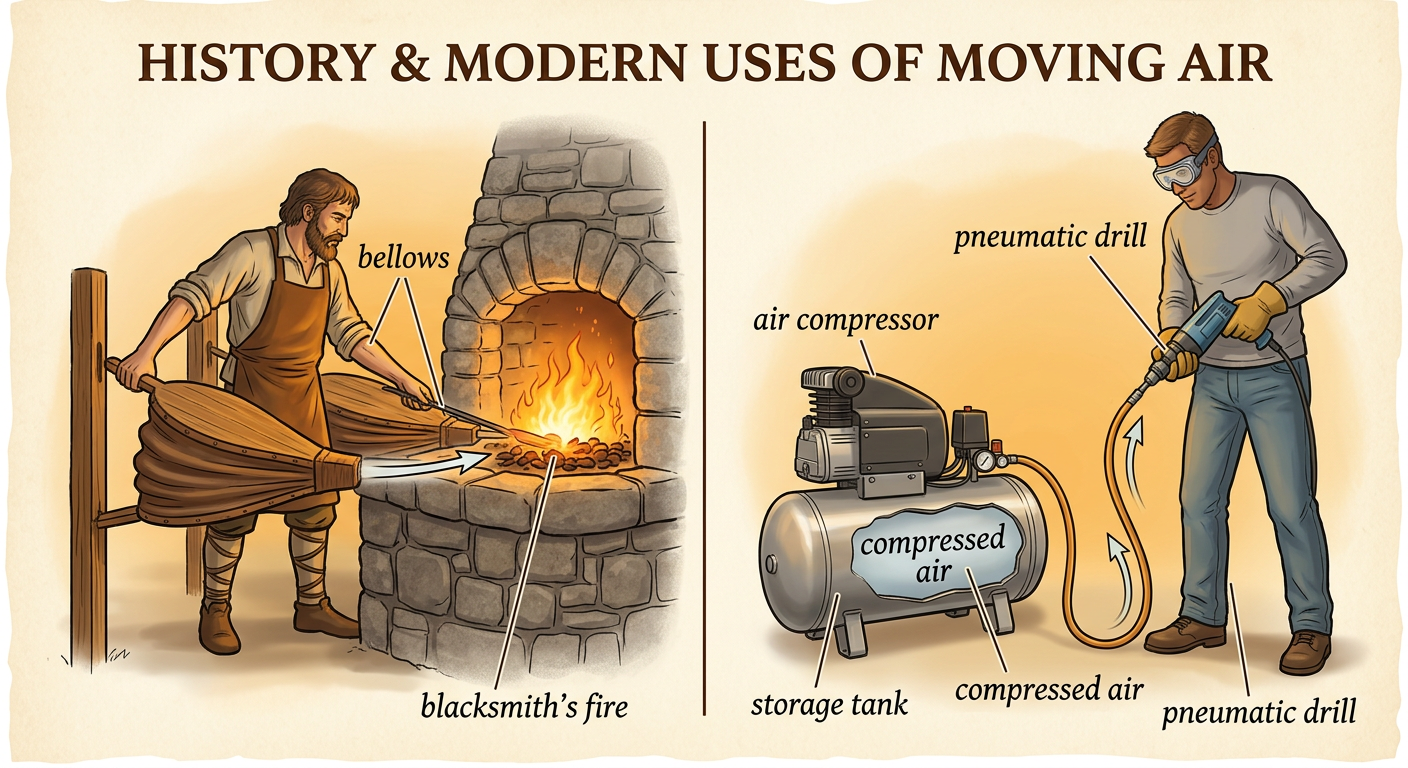
People have used moving air to help do work for a long time. In the past, blacksmiths used hand-operated bellows. Opening the bellows drew in air, and closing them pushed air toward a fire. The extra airflow helped the fuel burn hotter so the blacksmith could heat and shape metal. Today, people still use bellows for some fires, but many modern tools use compressed air. An air compressor squeezes air into a storage tank. The released air can power tools such as pneumatic drills and nailers. These powerful tools must be used only by trained adults with safety equipment. Compare the examples: both direct air to perform a task, but the blacksmith’s bellows were moved by hand, while a modern compressor stores pressurized air and releases it when needed.
Evidence That Air Is Matter
Scientists make claims and support them with evidence. The claim in this investigation is that air is matter that takes up space. One piece of evidence is that trapped air kept water from entering the upside-down cup. When the cup tilted and air escaped, water moved into the space. Another piece of evidence is that a balloon became larger after air was added, and its size could be measured. A particle model explains these observations by showing tiny moving particles spread throughout a container. With your group, create a final explanation using the words claim, evidence, and reasoning. For example: “Air takes up space because it blocks water in a cup and expands a balloon. Materials that occupy space are matter. Therefore, air is matter.” Listen to each group member and use measurements or observations to support your ideas.