
Algebraic Expressions and Factorization
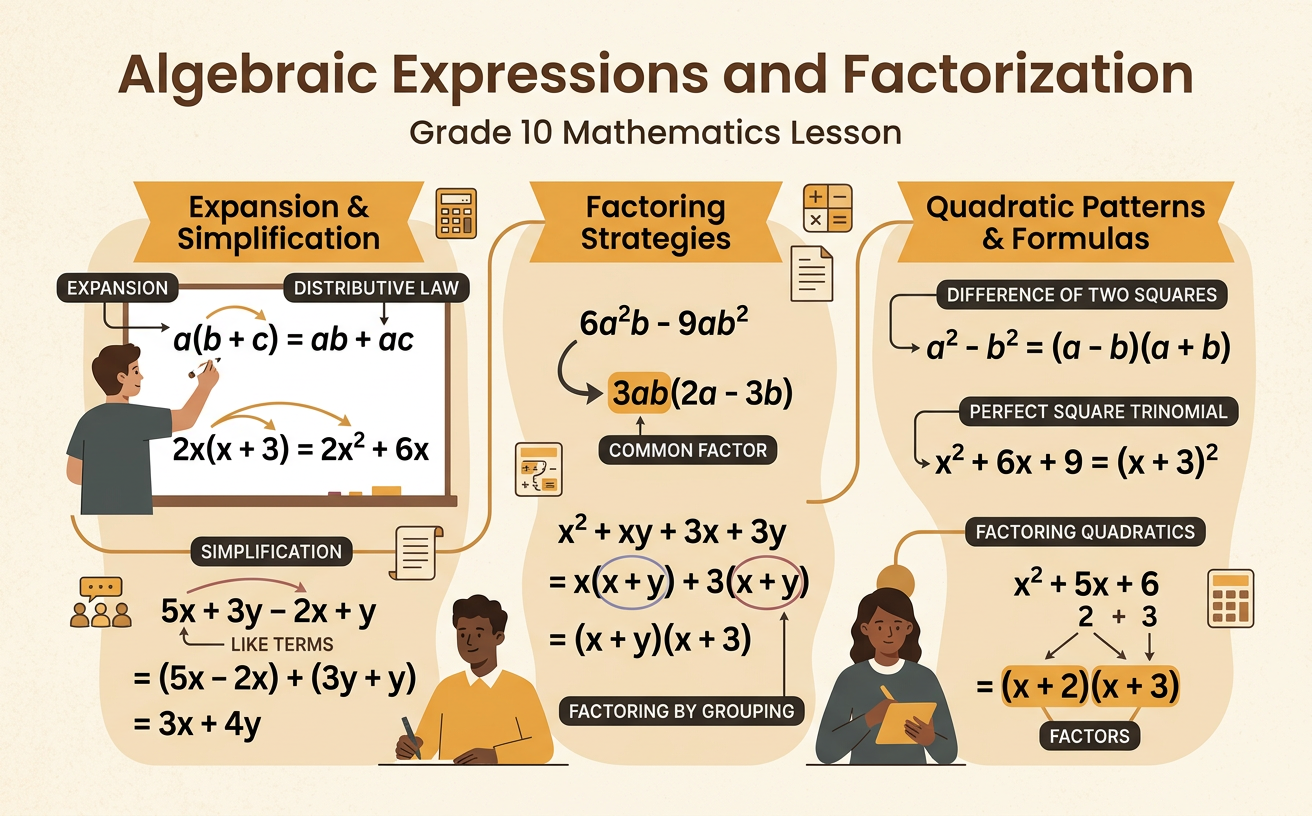
Students expand, simplify, and factor algebraic expressions using common factors, grouping, and quadratic patterns.
Illustrations are auto-generated and may be placeholders. They can be refreshed to match the narration.
Like Terms and Simplification
Like terms have exactly the same variables raised to the same powers. Their numerical coefficients may differ. For example, 5x and -2x are like terms, while 5x and 5x2 are not. To simplify an expression, first remove unnecessary brackets, identify like terms, and then add or subtract their coefficients. Consider 4x + 3y - 2x + 5 - y. Grouping like terms gives (4x - 2x) + (3y - y) + 5, so the simplified expression is 2x + 2y + 5. Terms with different variable parts must remain separate. You can check the simplification by substitution. If x = 2 and y = 3, both the original expression and the simplified expression equal 15. Equal substitution results confirm that the expressions are equivalent.
Expanding Brackets
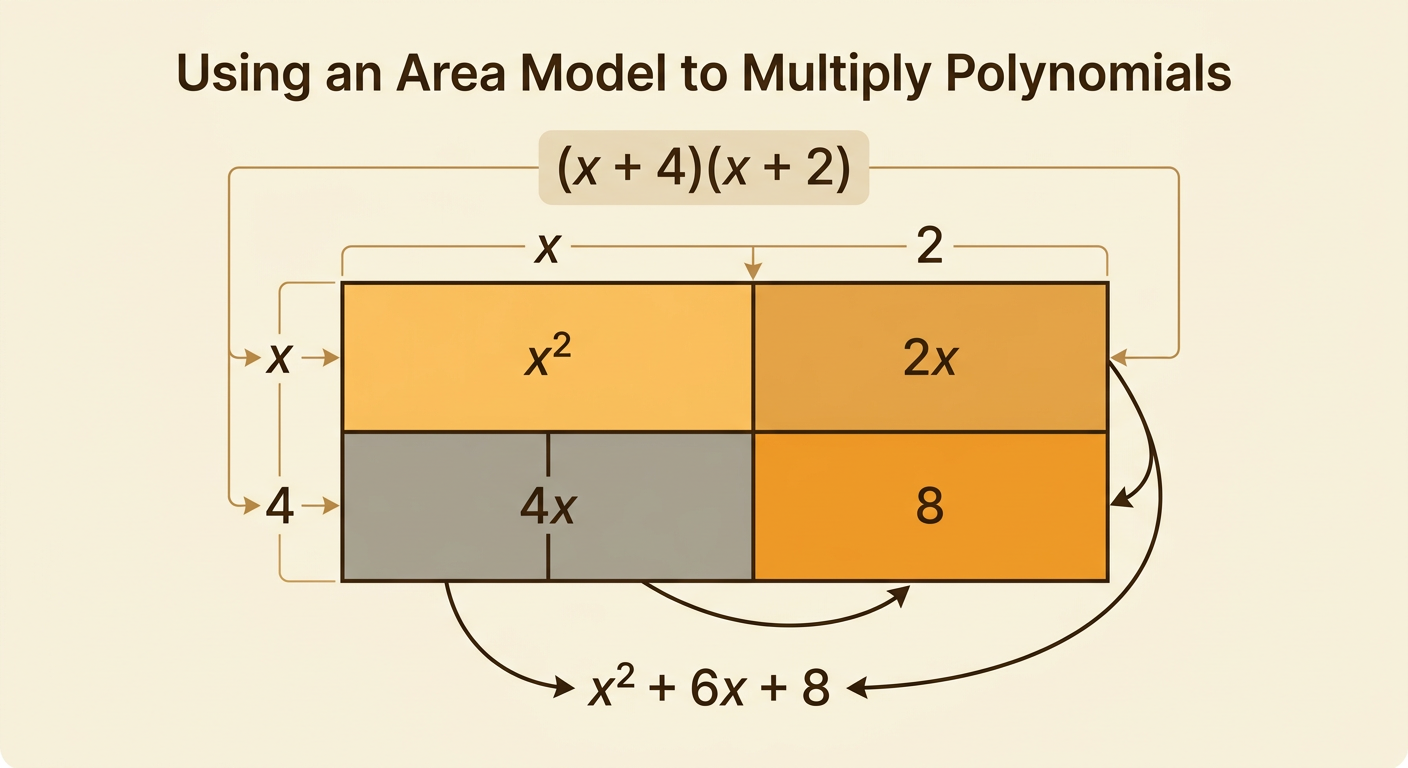
Expanding brackets means multiplying every term inside a bracket by the factor outside it. This uses the distributive property. For example, 3(2x - 5) = 3(2x) - 3(5) = 6x - 15. When two binomials are multiplied, every term in the first bracket must multiply every term in the second. Consider (x + 4)(x + 2). The four products are x(x), x(2), 4(x), and 4(2). Therefore, the expansion is x2 + 2x + 4x + 8, which simplifies to x2 + 6x + 8. Pay close attention to signs: a negative factor changes the sign of each term inside the bracket. For instance, -2(x - 3) expands to -2x + 6, not -2x - 6.
Common-Factor Method
Factorization reverses expansion. In the common-factor method, find the greatest factor shared by every term and place it outside brackets. Divide each original term by that factor to obtain the terms inside the brackets. For example, consider 12x2y + 18xy2. The greatest common numerical factor of 12 and 18 is 6. Both terms also contain x and y, so the greatest common factor is 6xy. Dividing gives 12x2y ÷ 6xy = 2x and 18xy2 ÷ 6xy = 3y. Therefore, 12x2y + 18xy2 = 6xy(2x + 3y). Check the result by expanding: 6xy(2x) + 6xy(3y) = 12x2y + 18xy2. Always choose the greatest common factor to produce the simplest factorization.
Factorization by Grouping
Factorization by grouping is useful when an expression has four terms and pairs of terms share different common factors. Arrange the terms so that each pair can be factored and produces the same bracket. For example, factor ax + ay + bx + by. Group the first two and last two terms: (ax + ay) + (bx + by). Factor each group to obtain a(x + y) + b(x + y). The common binomial factor is now x + y, so the complete factorization is (a + b)(x + y). Grouping also works with numerical coefficients. For 3x2 + 6x + 2x + 4, group to get 3x(x + 2) + 2(x + 2), giving (3x + 2)(x + 2). If the brackets do not match, check the grouping, signs, or term order.
Quadratic Expressions
A quadratic expression has highest variable power 2 and usually has the form ax2 + bx + c, where a is not zero. To factor x2 + bx + c, look for two numbers whose product is c and whose sum is b. For example, in x2 + 7x + 12, the required numbers are 3 and 4 because 3 × 4 = 12 and 3 + 4 = 7. Therefore, x2 + 7x + 12 = (x + 3)(x + 4). Some quadratics follow special patterns. The difference of two squares satisfies a2 - b2 = (a - b)(a + b), so x2 - 25 = (x - 5)(x + 5). Always verify factors by expanding them. If the expansion returns the original quadratic, the factorization is correct.