
Analog and Digital Signals: Sending Information Reliably
Students compare analog and digital signal models to explain why digitized information can be stored, copied, and transmitted more reliably.
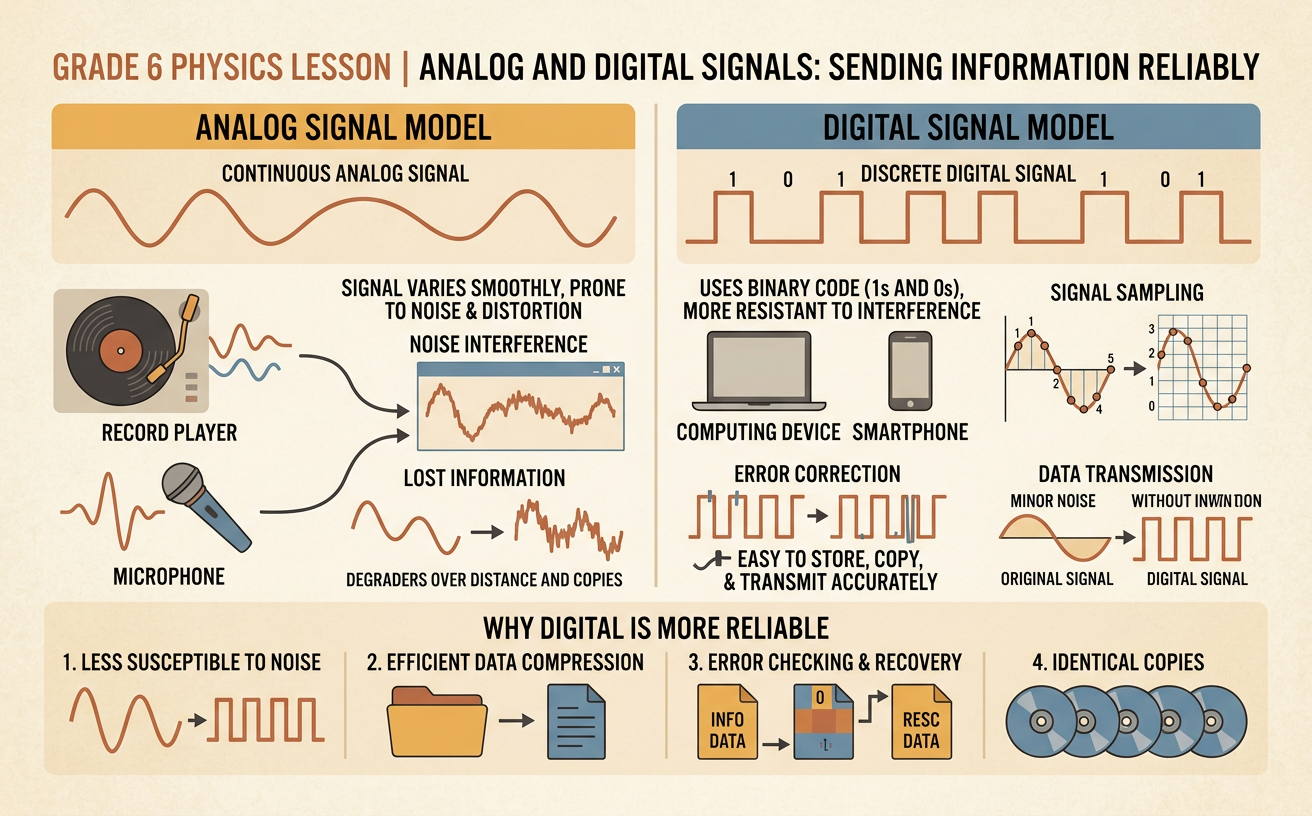
Illustrations are auto-generated and may be placeholders. They can be refreshed to match the narration.
Signals Carry Information
A signal is a changing pattern that carries information from one place to another. Sound, light, radio waves, and electric currents can all act as signals. A sender encodes a message by changing some feature of a signal, and a receiver decodes those changes. For example, during a phone call, a microphone changes the vibrations of your voice into an electrical signal. The phone sends encoded information through a network. At the other end, a speaker uses the received signal to reproduce sound. The signal is not the message itself; it represents the message. Successful communication depends on an agreed-upon code. Both devices must interpret the pattern in the same way. Distance, equipment, and interference can change a signal while it travels, so engineers design communication systems to preserve the encoded information.

Modeling Analog and Digital Signals
An analog signal changes continuously and can have any value within a range. A microphone might produce an analog voltage that closely follows the smooth changes in a voice. A digital signal represents information with separate values, usually binary digits called bits. Each bit is either 0 or 1. To digitize a sound, a device measures, or samples, the analog signal at regular times. It then assigns each sample one of the available number values and records that value as bits. For example, a smooth sound wave might be stored as a sequence such as 011, 101, and 110. The digital model does not include every point of the original wave, but frequent sampling and enough possible values can create an accurate representation. Analog and digital signals can therefore encode the same message in different ways.

Adding Noise to a Transmission
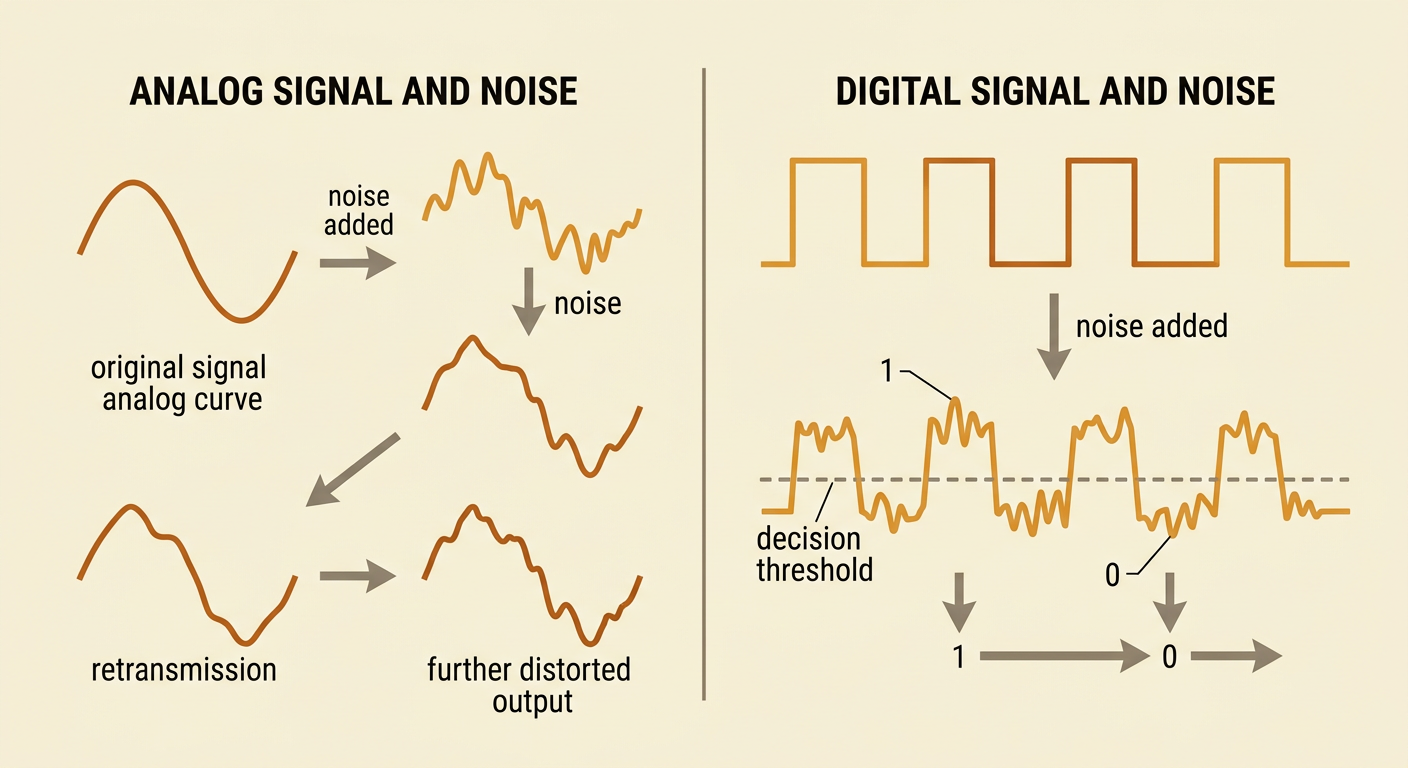
Noise is any unwanted disturbance that changes a signal during transmission or storage. Electrical equipment, weather, weak connections, and other radio signals can add noise. Imagine sending a smooth analog curve through a long cable. Small disturbances change the curve itself, so the receiver may reproduce a slightly distorted message. If that altered analog signal is copied again, the distortion can be copied and increased. A digital transmission also experiences noise, but the receiver usually needs only to decide whether each pulse represents 0 or 1. A slightly weakened high pulse can still be read as 1 if it remains above a decision threshold. A low pulse can still be read as 0 if it remains below that threshold. However, very strong noise can push a pulse across the threshold and cause an error, so digital communication is reliable but not perfect.
Comparing Reconstructed Messages
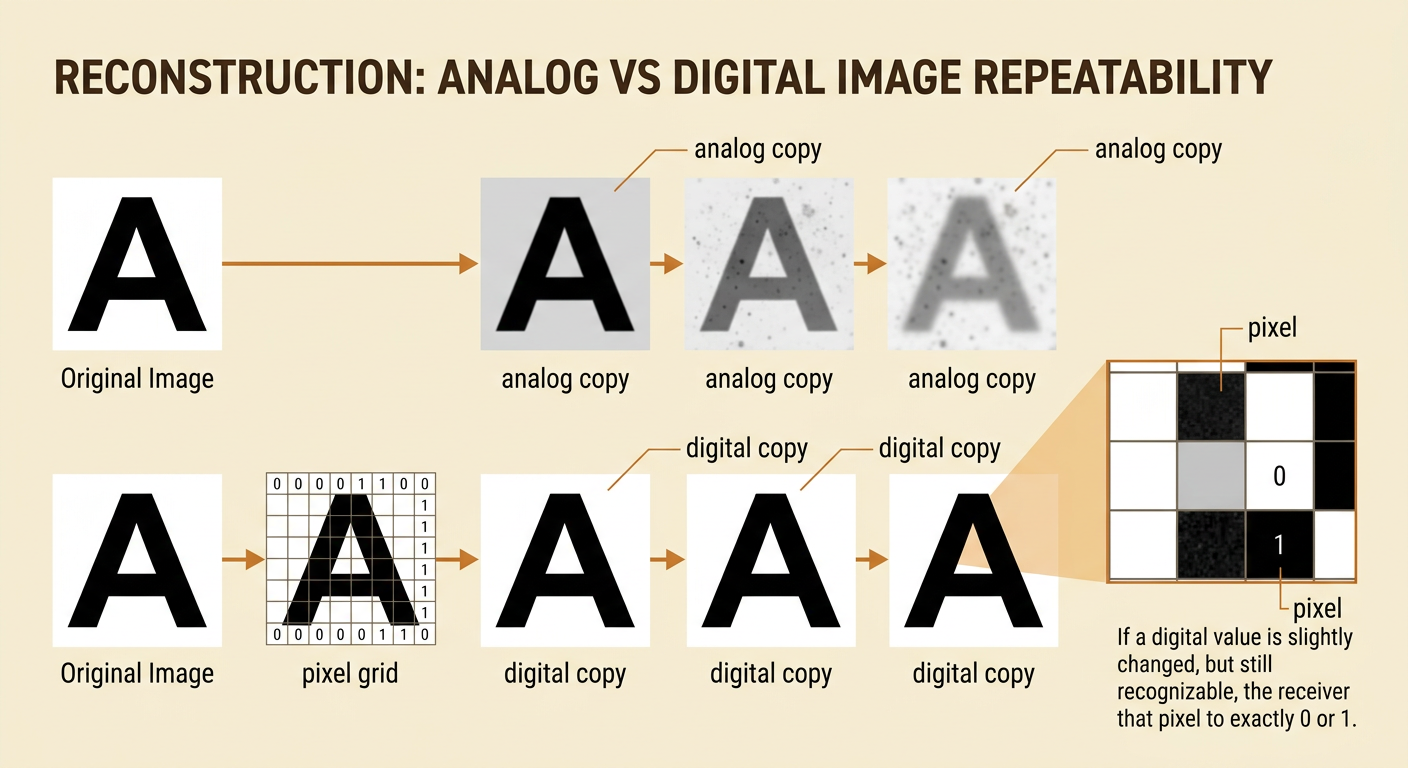
Reconstruction means building a usable message from a received signal. Consider sending a simple image of a black letter A on a white background. In an analog system, the brightness may be represented by every shade along a continuous range. Noise can slightly change many brightness values, making a copied image look faded, spotted, or blurry. In a digital black-and-white image, each pixel is encoded as 0 for white or 1 for black. If the received values remain recognizable, the receiver restores every pixel to exactly 0 or 1. The reconstructed image can then match the encoded image, even when the transmitted pulses were slightly changed. Repeating this process allows many nearly identical digital copies. Strong interference, missing data, or too few pixels can still damage the result. Reliability means resisting ordinary changes, not guaranteeing perfect communication under all conditions.
Evidence for Digital Reliability
Scientific claims should be supported with specific evidence. In the models, analog noise directly changed the curve, and repeated copying kept those changes. Digital pulses were also changed, but the threshold allowed the receiver to recover the original bits when the noise was moderate. These observations support the claim that digitized information can usually be stored, copied, and transmitted more reliably than analog information. Digital systems can also use extra bits to detect or correct some errors. This evidence helps communities evaluate public policies. For example, a policy may require digital emergency alerts to include repeated messages, error checks, and backup transmission systems. Its purpose is to warn people reliably. Implementation requires compatible equipment, maintenance, and public funding. Possible consequences include faster, clearer warnings, but also costs and unequal access for people without updated devices. Decision-makers should weigh both the technical evidence and the effects on the public.
