Analyze and Compare Shapes
Students examine two-dimensional and three-dimensional shapes and compare their defining attributes.

Illustrations are auto-generated and may be placeholders. They can be refreshed to match the narration.
Shape Hunt
Shapes are all around us, even when they are different colors, sizes, or turned in different directions. A flat, or two-dimensional, shape has length and width. A solid, or three-dimensional, shape also has depth and can be held. Look for the shape of an object, not just its color. For example, the face of a wall clock can be a circle, and a door can look like a rectangle. A ball is shaped like a sphere, while a soup can is shaped like a cylinder. Turn your head or move the object. The shape stays the same. During a shape hunt, point to one flat shape and one solid shape. Tell what you notice about each one.
Name Shape Parts
Shape parts help us describe and compare shapes. A flat shape can have straight sides and vertices. A side is a straight part along the outside of a shape. A vertex is a point where two sides meet. The word vertices means more than one vertex. For example, a triangle has three sides and three vertices. Solid shapes can have faces, edges, and vertices. A face is a flat part of a solid shape. An edge is where two faces meet. A cube has six square faces, twelve edges, and eight vertices. Trace a side of a triangle with your finger. Then point to one vertex. On a cube, point to a face, an edge, and a vertex.

Compare Flat Shapes
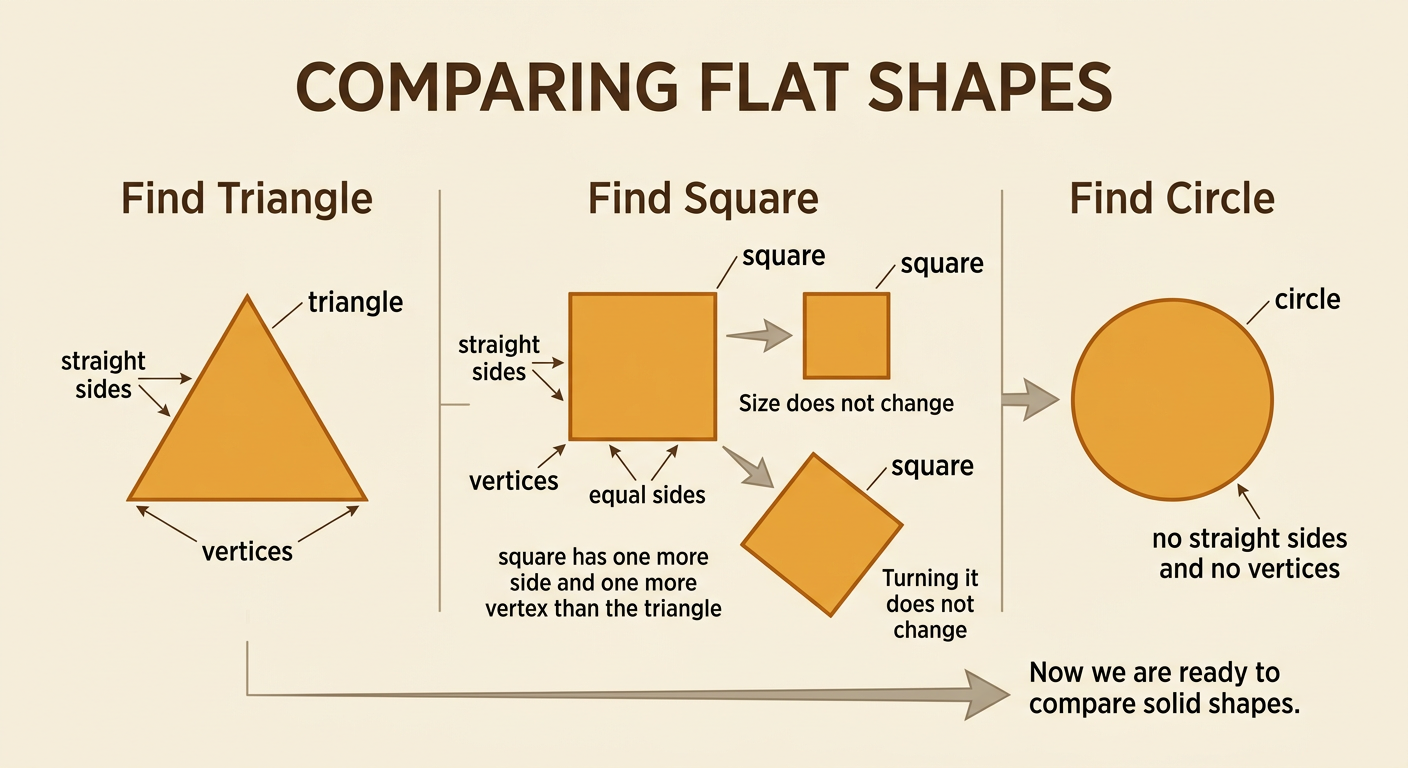
To compare flat shapes, look at their sides and vertices. A triangle has three straight sides and three vertices. A square has four straight sides and four vertices. All four sides of a square are equal in length. Both shapes have straight sides and vertices, but they do not have the same number. A circle is different because it has no straight sides and no vertices. Size and direction do not change a shape. A small square and a large square are both squares. A square that is turned still has four equal sides and four vertices. Compare a triangle and a square. You can say, “Both have straight sides, but the square has one more side and one more vertex.”
Compare Solid Shapes
Solid shapes have depth and take up space. Compare a cube, a cylinder, and a sphere by looking at their parts. A cube has six flat square faces, twelve edges, and eight vertices. It can rest on any face. A cylinder has two flat circular faces and one curved surface. It has no vertices. A sphere has no flat faces and no vertices; its entire surface is curved. A cube and a cylinder are alike because both have flat faces and can stack. A cylinder and a sphere are alike because both have curved surfaces and can roll. For example, a toy block is like a cube, a can is like a cylinder, and a ball is like a sphere. Describe one way two of these shapes are alike.
Sort and Explain
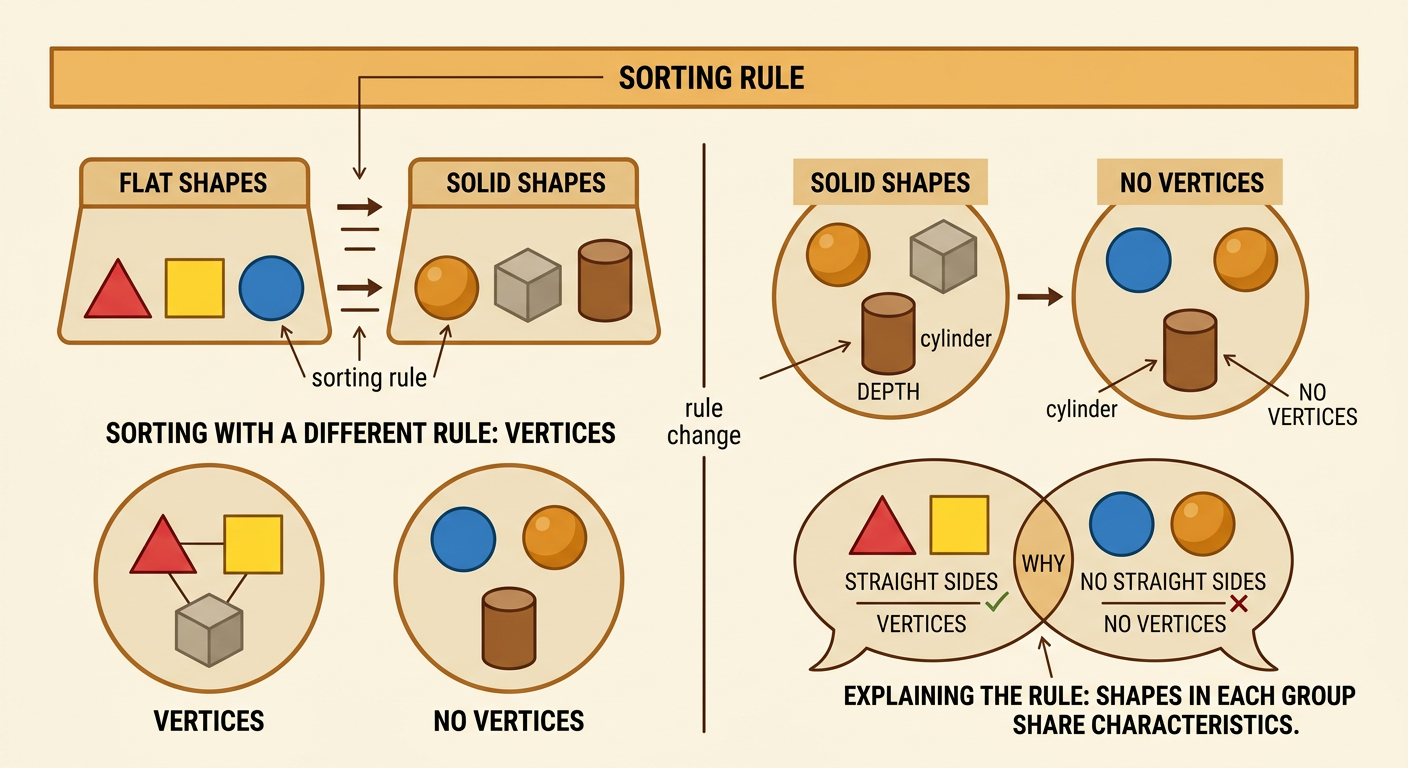
Sorting means putting shapes into groups by a rule. First, decide which attribute you will use. Then check every shape against the same rule. Suppose you have a circle, triangle, square, sphere, cube, and cylinder. One rule is flat shapes and solid shapes. The circle, triangle, and square go in the flat-shape group. The sphere, cube, and cylinder go in the solid-shape group. You can sort the same shapes again using vertices. The triangle, square, and cube have vertices. The circle, sphere, and cylinder have no vertices. After sorting, explain your thinking. You might say, “I put the triangle and square together because both have straight sides and vertices.” A clear explanation names the sorting rule and an attribute the shapes share.