
Analyzing an Author’s Point of View and Purpose
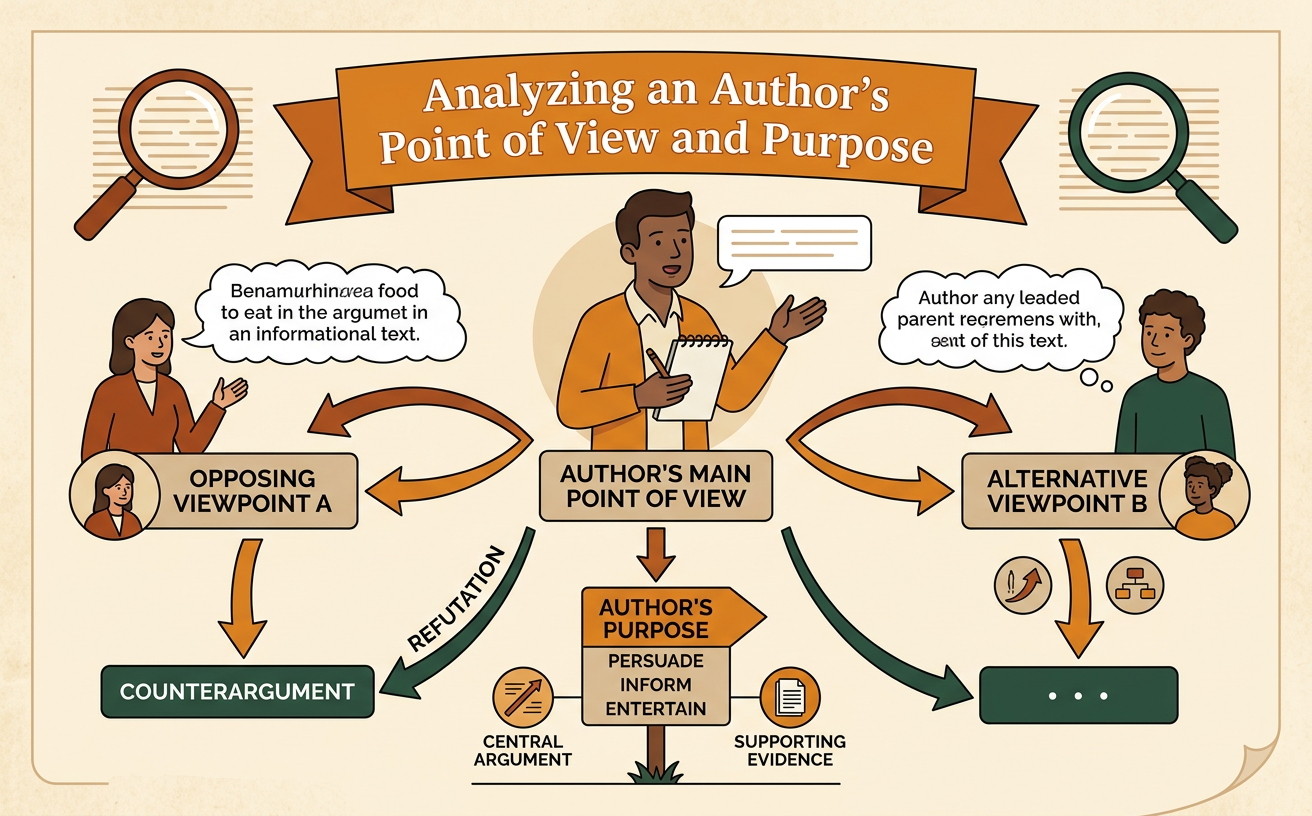
Students identify an author’s point of view or purpose and analyze how the author distinguishes that position from other perspectives in an informational text.
Illustrations are auto-generated and may be placeholders. They can be refreshed to match the narration.
Point of View Versus Purpose
An author’s point of view is the author’s position, attitude, or way of thinking about a topic. An author’s purpose is the reason the author wrote the text, such as to inform, explain, persuade, or entertain. The two ideas are connected but are not the same. Imagine an article arguing that every middle school should have a garden. The author’s point of view is that school gardens are valuable learning spaces. The purpose is to persuade readers to support creating them. Another author might explain how to plant a school garden without arguing that every school needs one. That author’s purpose is to inform, while the point of view may be mostly neutral. Ask, “What does the author believe?” to identify point of view and “What does the author want the reader to think, know, or do?” to identify purpose.

Clues in Word Choice and Tone
Word choice and tone provide clues about an author’s point of view and purpose. Tone is the attitude created by the author’s language. Words such as beneficial, exciting, and essential suggest approval, while wasteful, risky, and unnecessary suggest criticism. For example, an author might write, “A thriving school garden transforms an empty patch of ground into a lively outdoor classroom.” The positive words thriving, transforms, and lively reveal an enthusiastic tone and support the position that gardens improve schools. A different sentence might say, “A garden consumes limited funds and demands hours of upkeep.” The words consumes, limited, and demands create a concerned or critical tone. Readers should also notice repeated words, comparisons, and emotionally charged language. However, one word is not enough evidence. Look for a pattern of language across the text before deciding what the author thinks.

Identifying the Author’s Position
To identify an author’s position, first name the topic and then determine the main claim the author makes about it. A position is more specific than a general topic. “School gardens” is a topic, but “Schools should use gardens to teach science and nutrition” is a position. Next, collect supporting evidence, including facts, examples, expert quotations, and explanations. Suppose an article reports that students measure plant growth during science lessons, taste vegetables they have grown, and practice teamwork while caring for garden beds. These details support a favorable position on school gardens. Also examine which information the author emphasizes or leaves out. State the position in a complete sentence, then cite two or more details that support your conclusion. Avoid guessing based only on the title or your own opinion; the position must be grounded in evidence from the text.

Comparing Other Perspectives
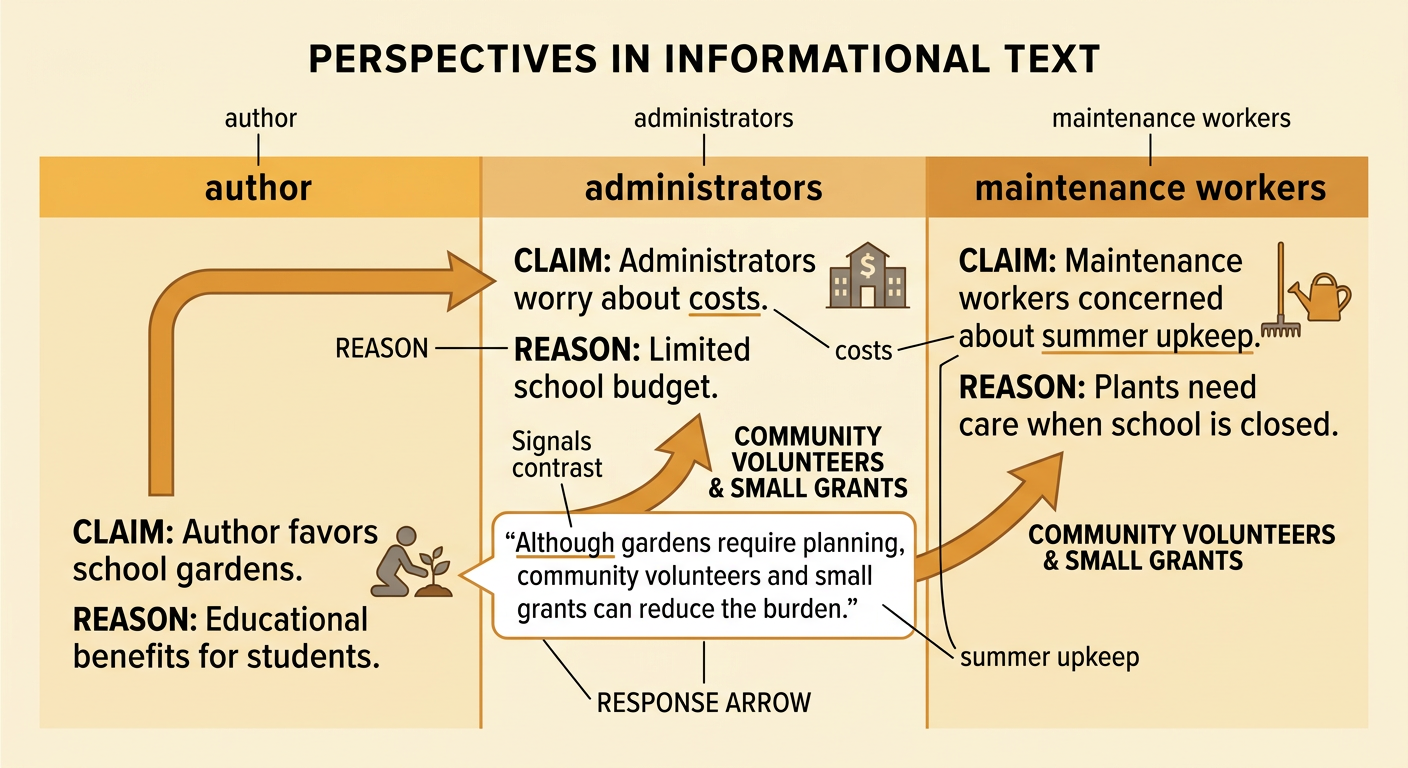
Informational texts often include perspectives that differ from the author’s position. A careful reader identifies who holds each perspective and what reasons support it. In an article favoring school gardens, the author might acknowledge that some administrators worry about costs and that maintenance workers are concerned about summer upkeep. The author may distinguish their own position by responding, “Although gardens require planning, community volunteers and small grants can reduce the burden.” The word although signals a contrast. The author presents the concern but then explains why it should not defeat the proposal. Look for signal words such as however, critics argue, supporters claim, unlike, and on the other hand. Be fair when summarizing each perspective. Do not make an opposing view sound weaker than the text presents it. Comparing claims, reasons, and evidence shows exactly where the author agrees or disagrees with others.
Explaining the Author’s Approach
After identifying the perspectives, explain how the author makes their own position stand apart. Focus on methods, not just the position itself. An author may provide stronger evidence for one side, use approving words for favored ideas, answer counterarguments, quote certain experts, or organize the text so the preferred claim appears last. For example, a school-garden author might first describe concerns about cost, then cite a principal whose garden was funded by a local business, and finally end with students’ improved science scores. This structure acknowledges another perspective, responds with a successful example, and closes with evidence supporting the author’s view. A strong analysis names the method and explains its effect: “The author distinguishes the pro-garden position by answering cost concerns with a real example and ending with achievement data, making the proposal seem practical and beneficial.” Always connect the author’s choices to their purpose.
