
Analyzing Character Development in Literature
Students analyze how an author introduces, develops, and connects complex characters to shape a story or drama.
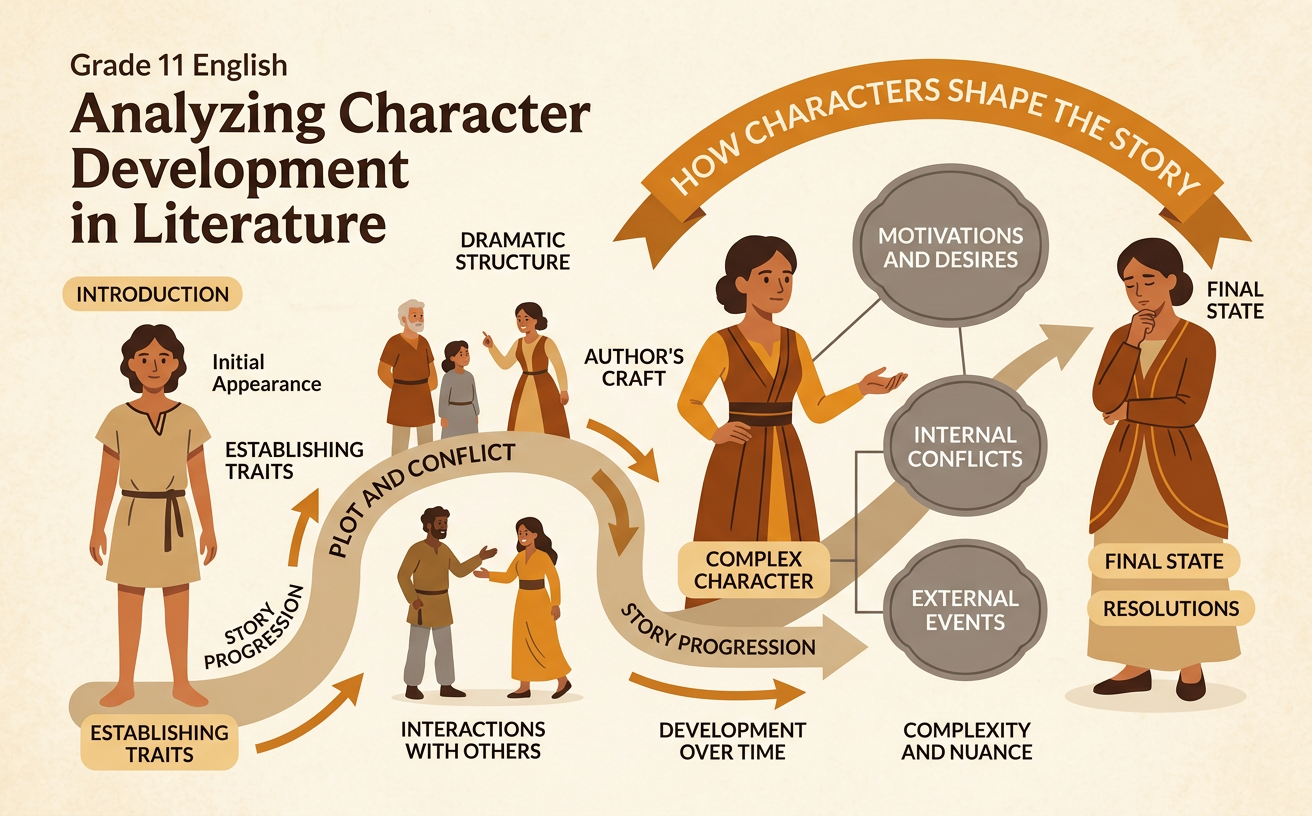
Illustrations are auto-generated and may be placeholders. They can be refreshed to match the narration.
Identify Character Traits and Motivations
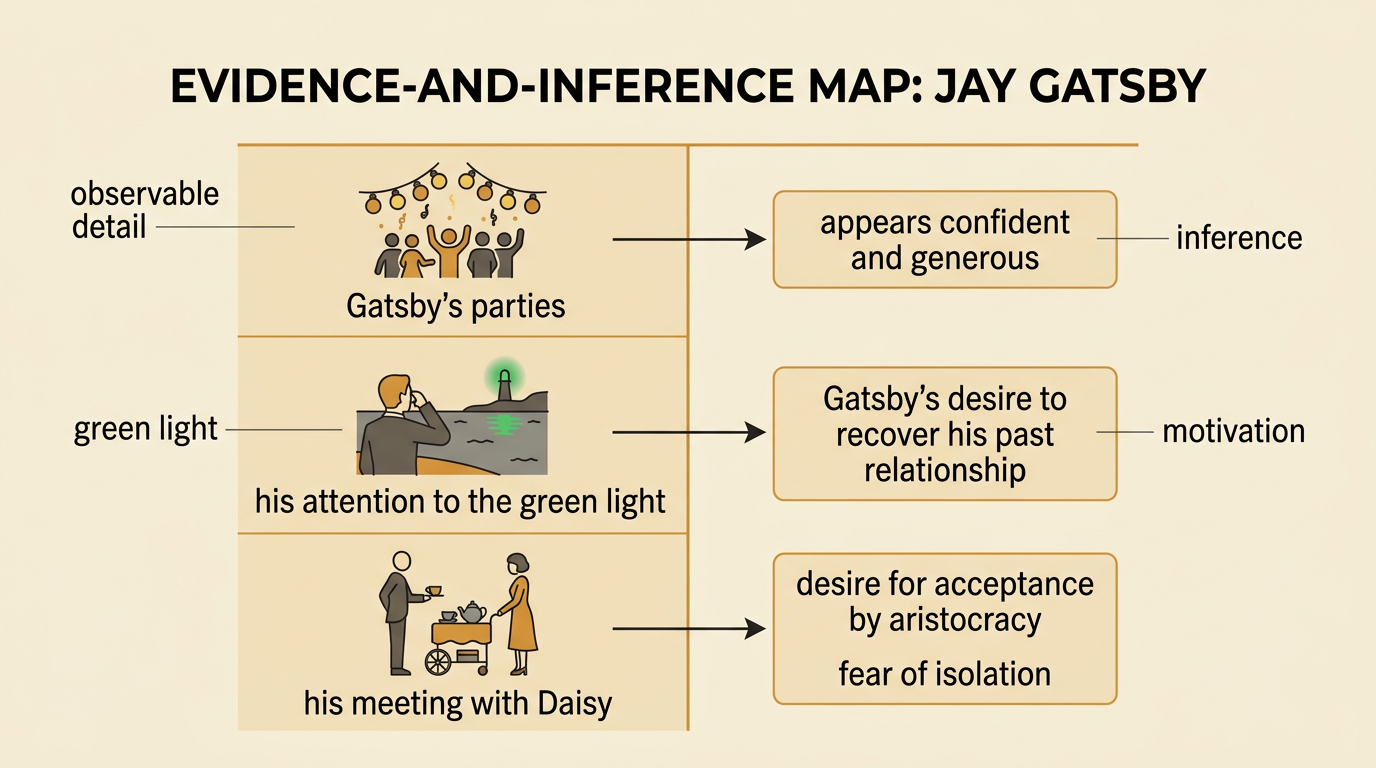
A character trait is a relatively stable quality, such as loyalty, ambition, or insecurity. A motivation is the desire, fear, belief, or need that drives a character’s actions. Identify traits by noticing repeated patterns rather than relying on a single moment. Then infer motivations from the character’s words, decisions, conflicts, and circumstances. In The Great Gatsby, Jay Gatsby appears confident and generous when he hosts elaborate parties. However, his private behavior reveals longing and anxiety. He watches the green light across the bay and arranges a meeting with Daisy, suggesting that his main motivation is to recover their past relationship. This motivation helps explain both his wealth and his carefully created identity. Strong analysis distinguishes evidence from inference: the green light is an observable detail, while Gatsby’s hope of restoring the past is an interpretation supported by several details.
Examine Methods of Characterization
Authors use direct and indirect characterization to shape a reader’s understanding. Direct characterization states a quality openly, often through the narrator’s description. Indirect characterization requires readers to infer qualities from speech, thoughts, effects on others, actions, appearance, and setting. In The Great Gatsby, Nick directly describes Gatsby as having an unusual capacity for hope. Fitzgerald also characterizes Gatsby indirectly through his formal phrase “old sport,” his carefully selected clothing, his mansion, and his nervous behavior before Daisy arrives. These details reveal both his constructed confidence and his underlying insecurity. Consider who supplies each description because a narrator or another character may be biased. Nick’s admiration does not automatically make his judgment objective. By comparing direct statements with indirect evidence, readers can identify tensions between how a character appears, how others describe that character, and what the character’s behavior actually reveals.

Trace Changes and Relationships
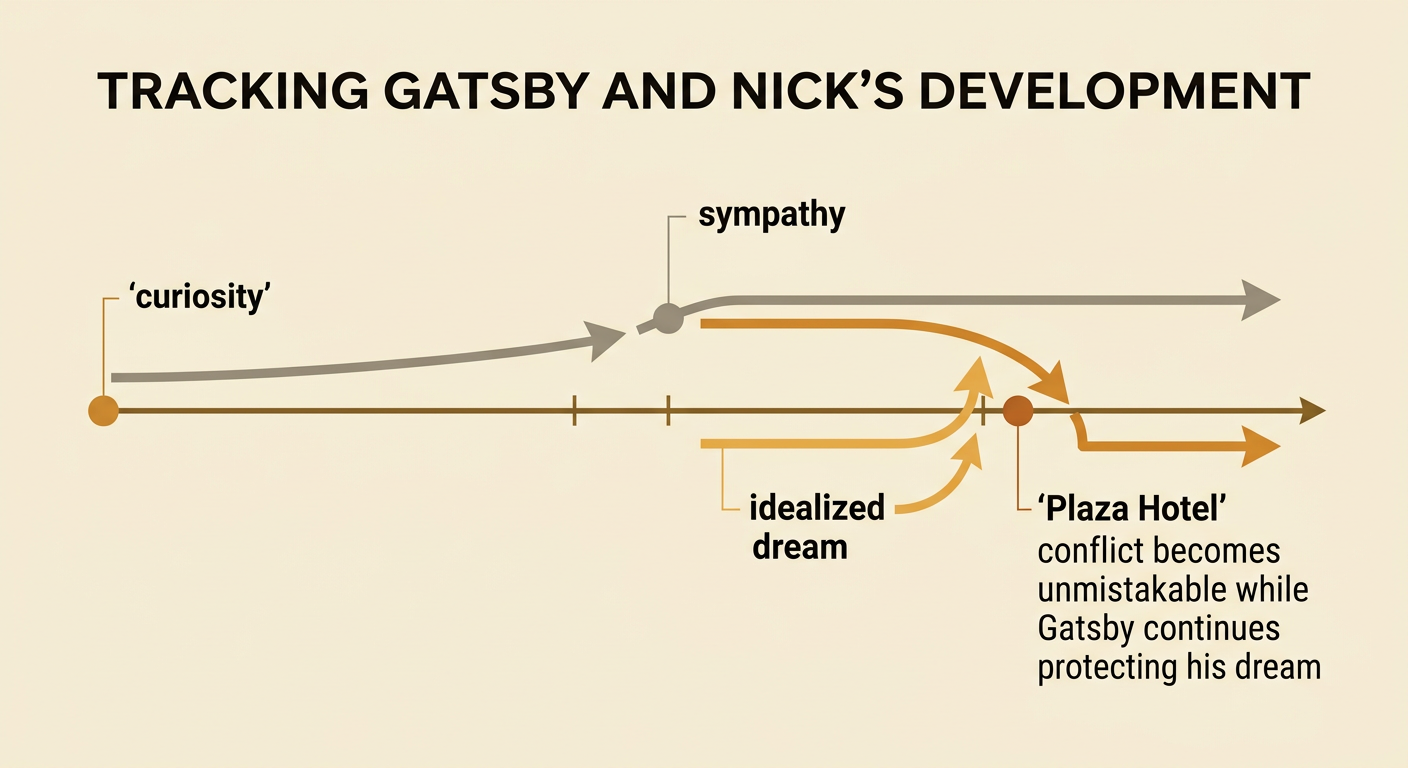
To trace character development, follow a character across major events and record what changes, what remains stable, and why. Pay special attention to relationships because characters often reveal themselves through conflict, loyalty, attraction, or betrayal. In The Great Gatsby, Nick initially responds to Gatsby with curiosity and some skepticism. As Nick learns about Gatsby’s history and observes his devotion to Daisy, his attitude becomes more sympathetic. At the same time, Gatsby’s relationship with Daisy exposes a conflict between his idealized dream and the person Daisy actually is. After the confrontation at the Plaza Hotel, the distance between them becomes clearer, even though Gatsby continues to protect his dream. A useful timeline connects each turning point to new behavior or understanding. This prevents a simple summary of events and shows how interactions cause, reveal, or limit a character’s development.
Analyze the Author’s Choices
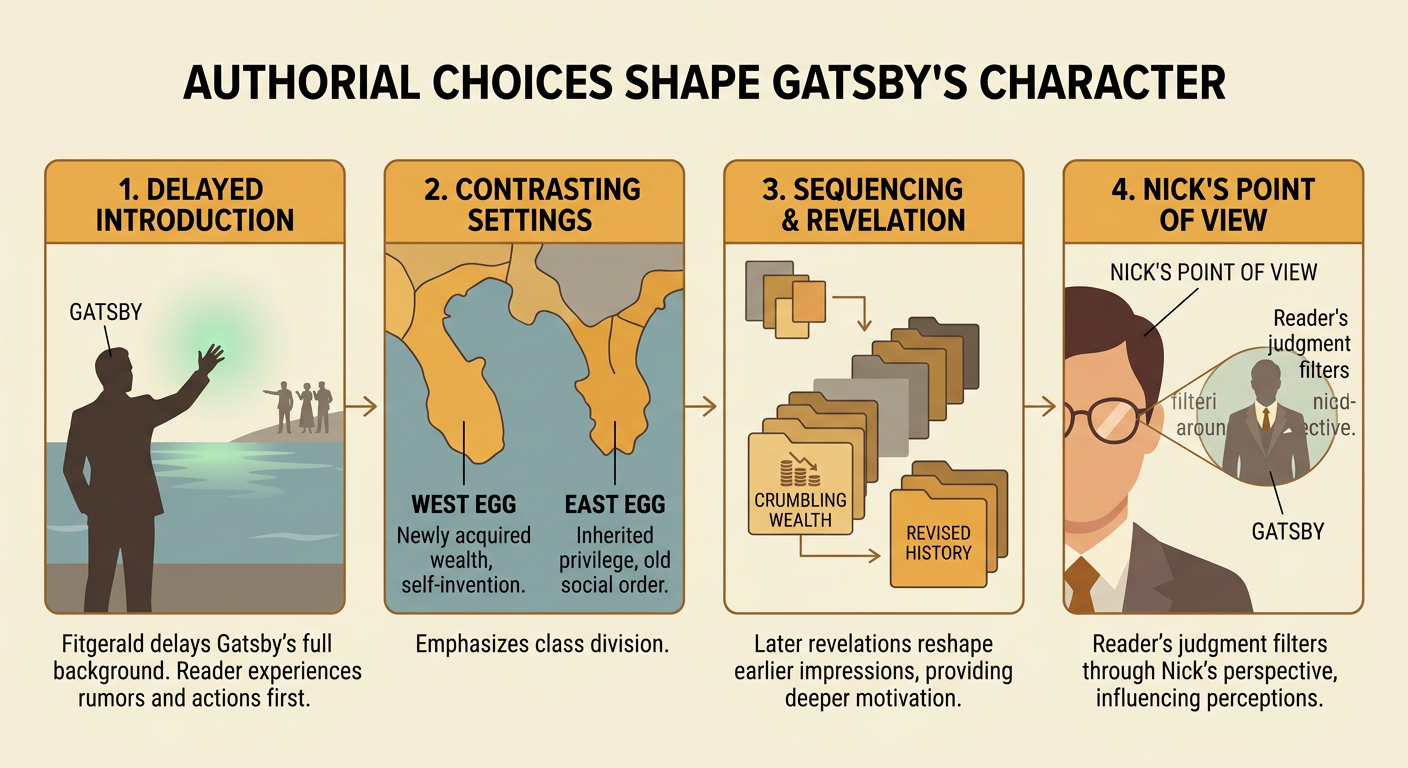
Character development results from deliberate choices about introduction, setting, sequence, point of view, contrast, and pacing. Ask why the author reveals a detail at a particular moment and how a different choice would change the reader’s response. Fitzgerald introduces Gatsby from a distance: readers first hear rumors, observe his parties, and see his mysterious gestures before learning his history. This delayed introduction makes Gatsby seem legendary while encouraging readers to question his identity. The contrast between West Egg and East Egg also connects character to setting, separating newly acquired wealth from inherited privilege. Later revelations about Gatsby’s childhood reorder the reader’s understanding of his ambition. Because Nick narrates the story, Gatsby is filtered through both observation and memory. These choices make Gatsby’s character uncertain and layered, supporting the novel’s larger examination of self-invention, social class, and the American Dream.
Write a Text-Based Interpretation
A strong interpretation makes a debatable claim about how and why a character develops, then supports it with precise evidence and reasoning. Begin with a claim that names the author’s choice and its effect. For example: Fitzgerald delays Gatsby’s true history to show that his confident identity is a fragile performance built around an impossible dream. Support this claim with details such as the early rumors about Gatsby, his later account of inventing himself, and his insistence that the past can be repeated. After each quotation or paraphrase, explain how the evidence supports the claim; do not assume that the connection is obvious. Address complexity by noting evidence that complicates the interpretation, such as Gatsby’s genuine capacity for hope. Conclude by connecting the character analysis to a larger idea in the work, including identity, class, memory, or ambition.
