Analyzing Diction and Tone in Literary Prose
Students analyze how an author’s connotative and figurative word choices establish tone and shape the meaning of a literary passage.

Illustrations are auto-generated and may be placeholders. They can be refreshed to match the narration.
Distinguish Diction from Tone
Diction is an author’s choice of words and phrases. Tone is the attitude toward a subject or audience that those choices create. Readers identify tone by examining patterns rather than relying on one isolated word. For example, compare “The guard walked through the empty hall” with “The guard stalked through the hollow corridor.” “Walked” and “empty” are relatively neutral, while “stalked” suggests threatening, deliberate movement and “hollow” suggests lifelessness or loss. Together, the second sentence creates an ominous tone. Tone should not be confused with mood: tone describes the author’s or narrator’s attitude, while mood describes the feeling produced in the reader. Precise tone words, such as admiring, bitter, anxious, or playful, explain more than broad words such as positive or negative.

Read and Annotate the Passage
Begin by reading a passage once for its literal situation, then reread it to mark striking language. Consider this example: “At dusk, the town folded its shutters and swallowed its songs. Only one window burned above the silent square.” Literally, evening arrives, people close their shutters, the town becomes quiet, and one illuminated window remains. On the second reading, underline vivid verbs such as “folded,” “swallowed,” and “burned.” Circle repeated ideas related to silence, darkness, or isolation. In the margin, record brief observations and questions: Why is the town treated as if it were alive? Does “burned” describe warm light, danger, or both? Avoid assigning a tone too quickly. Annotation gathers evidence first, allowing a defensible interpretation to emerge from the relationships among details.

Examine Connotations and Figurative Language
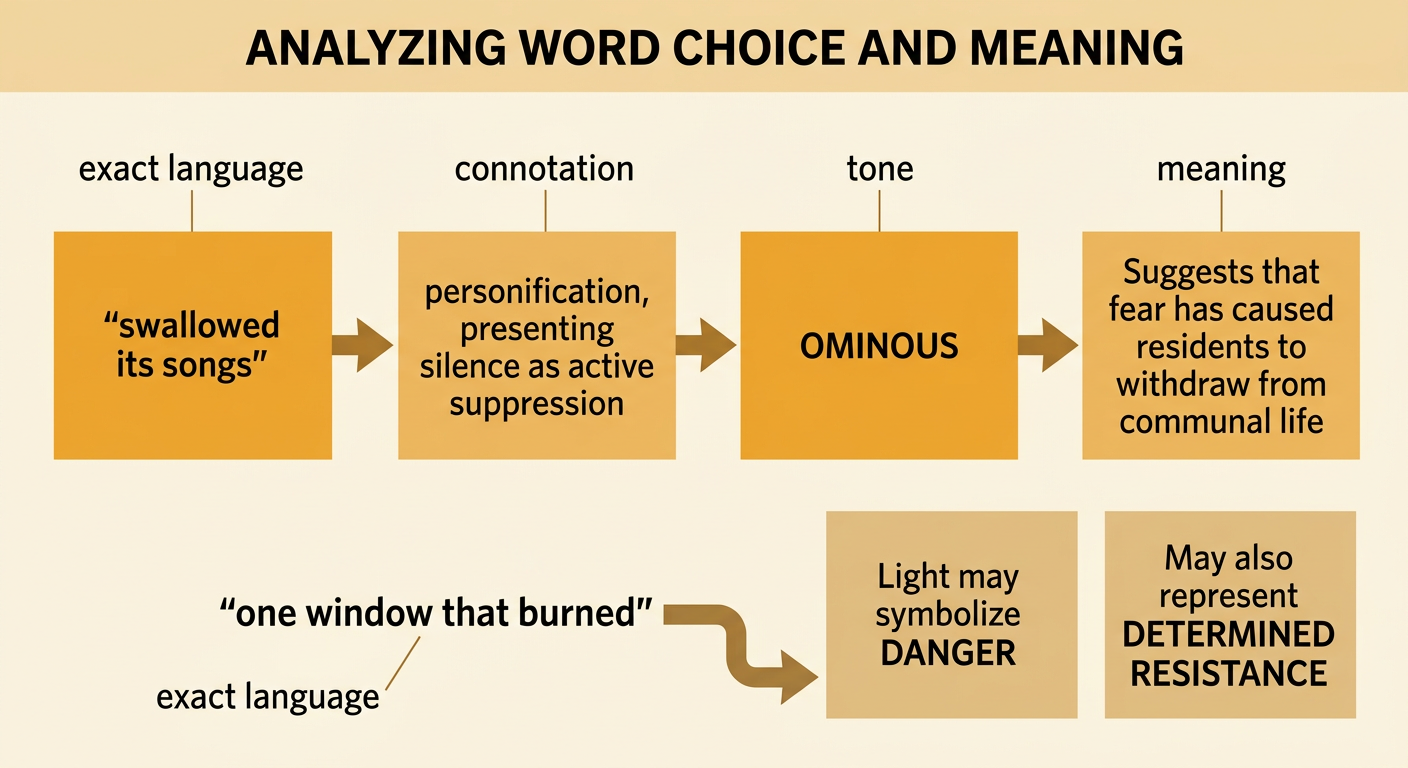
A denotation is a word’s direct dictionary meaning, while a connotation is an associated feeling or idea. Figurative language moves beyond literal meaning to create comparison, emphasis, or imagery. In “the town folded its shutters and swallowed its songs,” the town cannot literally fold or swallow anything; personification gives it human actions. “Folded” may suggest withdrawal or self-protection, while “swallowed” implies that sound is forcibly consumed rather than simply ending. The phrase therefore presents silence as active and unsettling. The word “burned” in “one window burned” literally refers to giving off light or heat, but it can also suggest intensity, destruction, or defiance. Because the word has multiple possible meanings, readers should test each interpretation against the passage’s other details instead of automatically selecting the first dictionary definition.

Trace Shifts in Tone
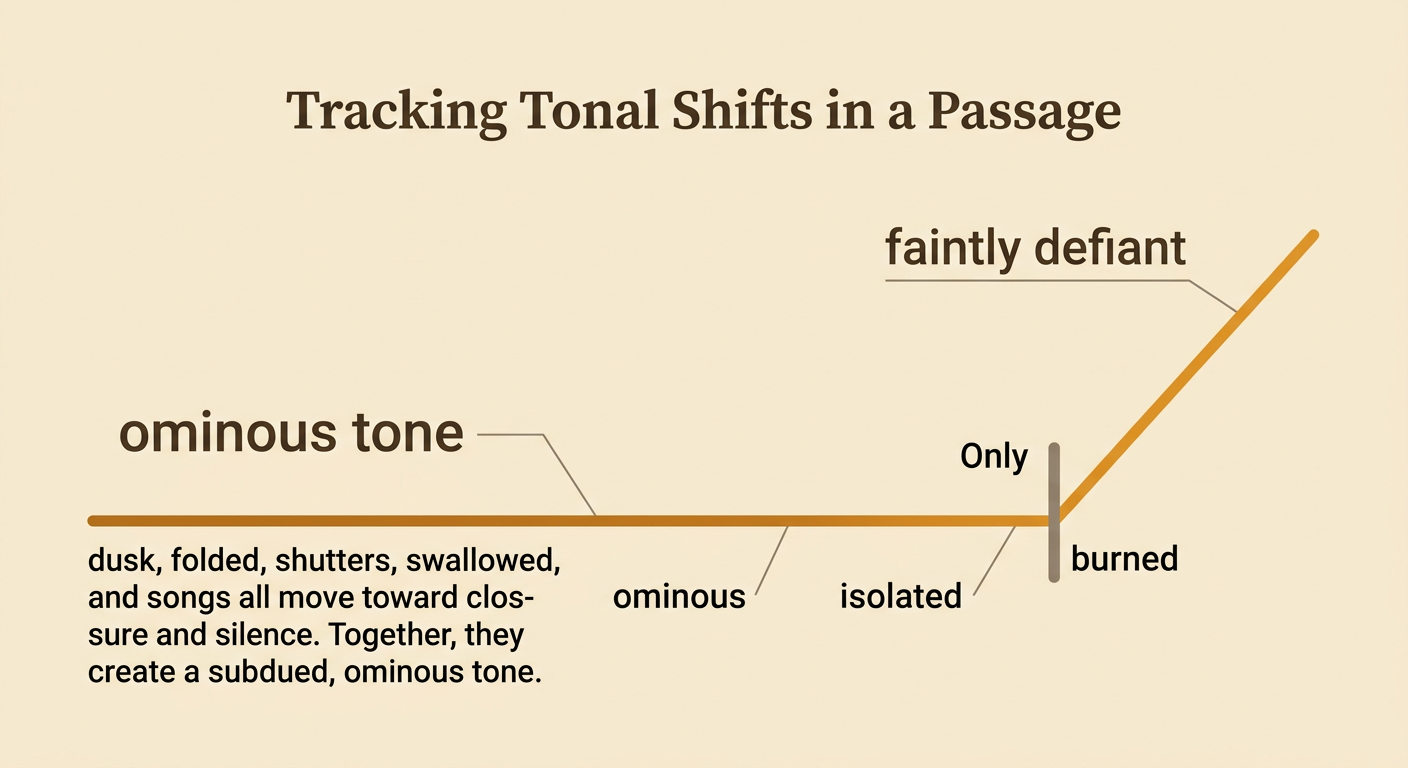
Tone may change within a passage, so track the language in sequence. In the first sentence, “At dusk, the town folded its shutters and swallowed its songs,” the imagery moves toward closure and silence, creating a subdued, ominous tone. The next sentence begins with “Only,” emphasizing isolation: “Only one window burned above the silent square.” Yet “burned” introduces a new intensity. The light may seem threatening, but it may also represent resistance against the surrounding darkness. As a result, the tone can shift from resigned or fearful to tense but faintly defiant. To identify a shift, locate a turning point, note the words before and after it, and describe both attitudes precisely. A strong interpretation also acknowledges ambiguity when the language supports more than one reasonable tonal movement.
Explain the Impact on Meaning
A complete analysis connects a specific word choice to tone and then to the passage’s larger meaning. Do not stop with a statement such as “The word ‘swallowed’ creates a dark tone.” Explain what that darkness suggests. For example: By personifying the town as something that “swallowed its songs,” the narrator presents silence as an active suppression of communal life, establishing an ominous tone and suggesting that fear has caused the residents to withdraw. The final image of one window that “burned” complicates this meaning because the light may symbolize danger or determined resistance. Together, the choices imply that conformity has nearly overtaken the community, but an isolated force remains visible. Effective analysis quotes exact language, names its connotations or figurative function, identifies the tone, and explains how that tone shapes an idea rather than merely summarizing events.