
Analyzing How an Author’s Structural Choices Shape Meaning
Students analyze how choices such as nonlinear chronology, parallel plots, pacing, and shifts in perspective influence a literary text’s meaning and aesthetic impact.
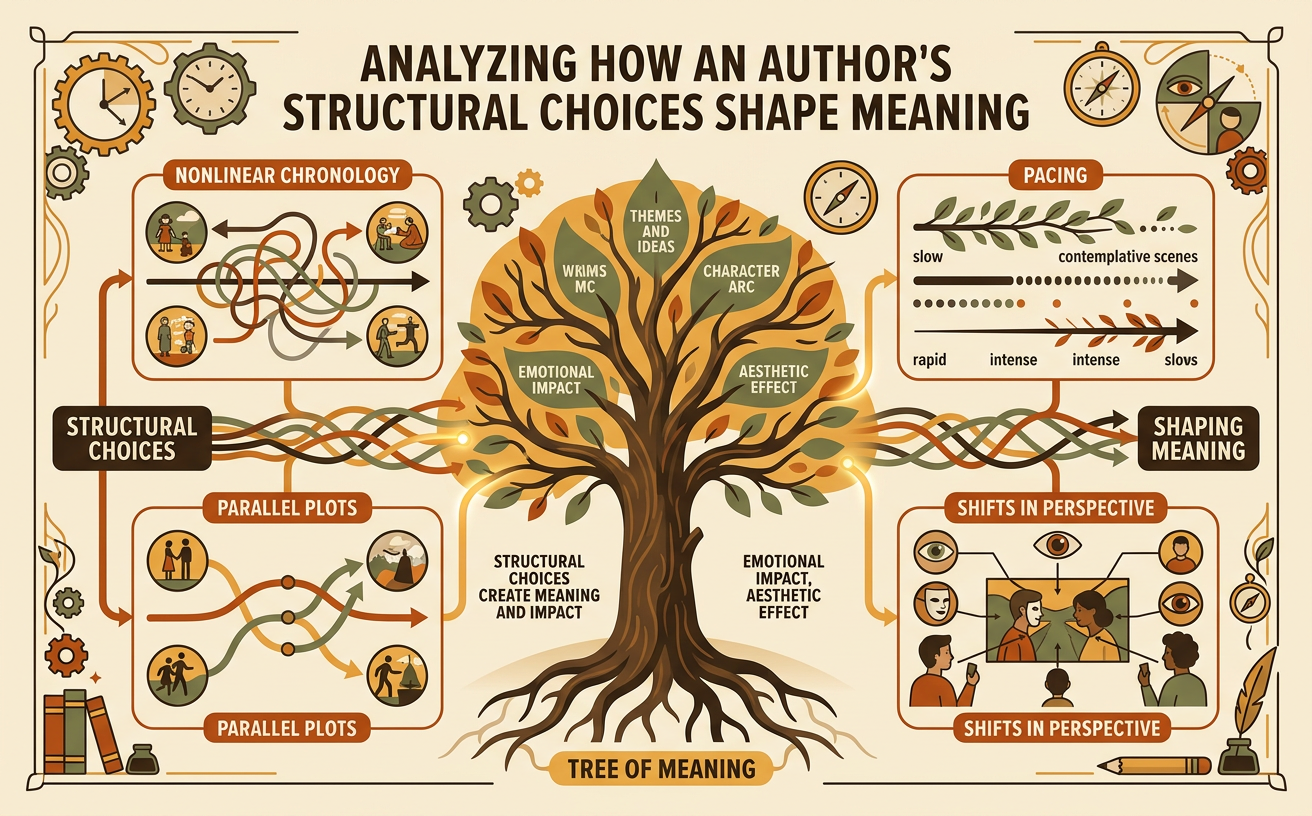
Illustrations are auto-generated and may be placeholders. They can be refreshed to match the narration.
Identify the Text’s Structural Pattern
Begin by mapping how the text is organized rather than simply summarizing what happens. A narrative may follow a linear sequence, move backward and forward in time, use a story within a story, or alternate between parallel plots. Notice divisions such as chapters, scenes, letters, or recurring sections, and ask how they fit together. For example, imagine a novel that alternates between a firefighter searching for a missing brother and the brother surviving alone in the mountains. The plots occur at the same time but do not meet until the final chapter. This parallel structure creates suspense because readers know dangers that each brother cannot see. It also emphasizes their shared determination. Identifying the pattern provides a foundation for explaining how the arrangement of specific parts contributes to the text’s overall meaning and emotional effect.

Examine Chronology and Pacing
Chronology concerns the order in which events are presented, while pacing concerns how quickly or slowly the narrative moves. Authors may interrupt the present with flashbacks, begin near the ending, or skip long periods through summary. They may slow an important moment with detailed description and dialogue or speed through less important events in a few sentences. Suppose a story opens with a student standing before a disciplinary board, then flashes back to the decisions that brought her there. This nonlinear chronology creates a question: What did she do? If the author devotes three pages to the final minute before her decision but summarizes the previous school year in one paragraph, the slow pacing signals that the decision is crucial. Analyze both what the author reveals and when the author reveals it to explain suspense, emphasis, and emotional intensity.

Analyze Shifts in Perspective or Setting
A shift in perspective changes who sees, tells, or interprets events. A shift in setting moves the action to another place or time. Mark where each shift occurs, then compare what information, attitudes, or images become available afterward. For example, one chapter might describe a labor strike through the factory owner’s first-person narration, while the next presents the same day through a worker’s diary. The owner notices lost production and damaged property; the worker notices unsafe conditions and injured friends. Moving from the owner’s office to the crowded factory floor also changes the atmosphere from controlled to chaotic. The paired sections prevent readers from accepting one account as complete. Such shifts may reveal bias, create dramatic irony, develop contrasting moods, or broaden the text’s social world. Focus on how the placement of the shift affects the reader’s judgment.

Connect Structural Choices to Meaning
After identifying a structural choice, explain its effect on the whole text. Avoid stopping at observations such as “the author uses flashbacks.” Instead, connect the choice to a theme, character conflict, reader response, or aesthetic effect. Consider a novel about memory that alternates between a veteran’s present-day life and fragmented scenes from wartime. At first, the fragments seem unrelated. As repeated images connect them, readers experience the veteran’s difficulty assembling a coherent memory. The broken structure therefore supports a theme about trauma and the limits of recollection. It also creates an unsettled aesthetic effect because readers must reconstruct events instead of receiving a smooth account. Use a cause-and-effect chain: name the choice, describe how it shapes the reading experience, and explain the larger idea it develops. This approach turns structural description into literary analysis.

Support a Claim with Textual Evidence
A strong analysis states a specific claim, selects evidence about structure, and explains the connection between them. Evidence may include chapter placement, repeated openings, changes in narrator, time markers, unusually long scenes, or sharp transitions. For example, claim that alternating chapters increase sympathy for two rival athletes. Cite one chapter ending with Maya believing Jordan cheated, followed by a chapter in which Jordan privately admits fear but denies cheating. Then explain that immediate placement matters: readers encounter Jordan’s vulnerability before fully accepting Maya’s accusation. Quote or paraphrase precise details, but do not let evidence stand alone. Commentary should identify the structural feature and its effect on meaning or tone. A useful reasoning sequence is: the author places or arranges this part in a particular way; that arrangement changes what the reader knows or feels; therefore, it supports the larger interpretation.
