
Analyzing How Authors Transform Source Material
Students compare a literary work with its source text to analyze how an author adapts key ideas, characters, or events to create new meaning.
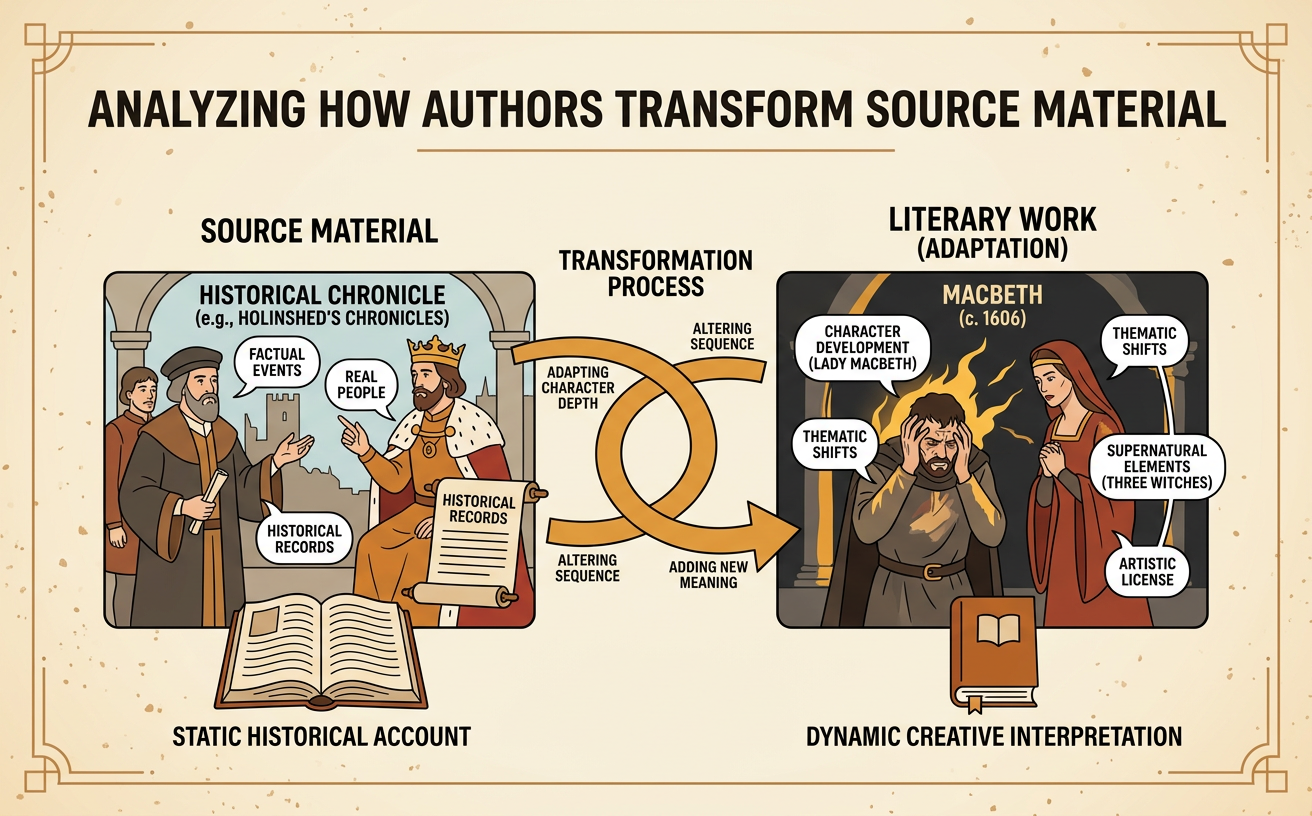
Illustrations are auto-generated and may be placeholders. They can be refreshed to match the narration.
Identify the Source and Adaptation
Begin by identifying the earlier source material and the later work that transforms it. A source may be a myth, poem, folktale, religious story, historical account, or earlier literary work. Record each work’s author, date, genre, and basic plot. Then determine whether the later author directly borrowed important material. For example, William Shakespeare’s Romeo and Juliet draws heavily on Arthur Brooke’s 1562 narrative poem The Tragical History of Romeus and Juliet. Both tell of young lovers from feuding families in Verona whose secret relationship ends in tragedy. However, Shakespeare changes Brooke’s long poem into a stage play. Identifying this relationship establishes the basis for analysis: Brooke’s poem is the source, while Shakespeare’s play is the adaptation that reshapes it for a new audience and purpose.

Compare Shared Elements
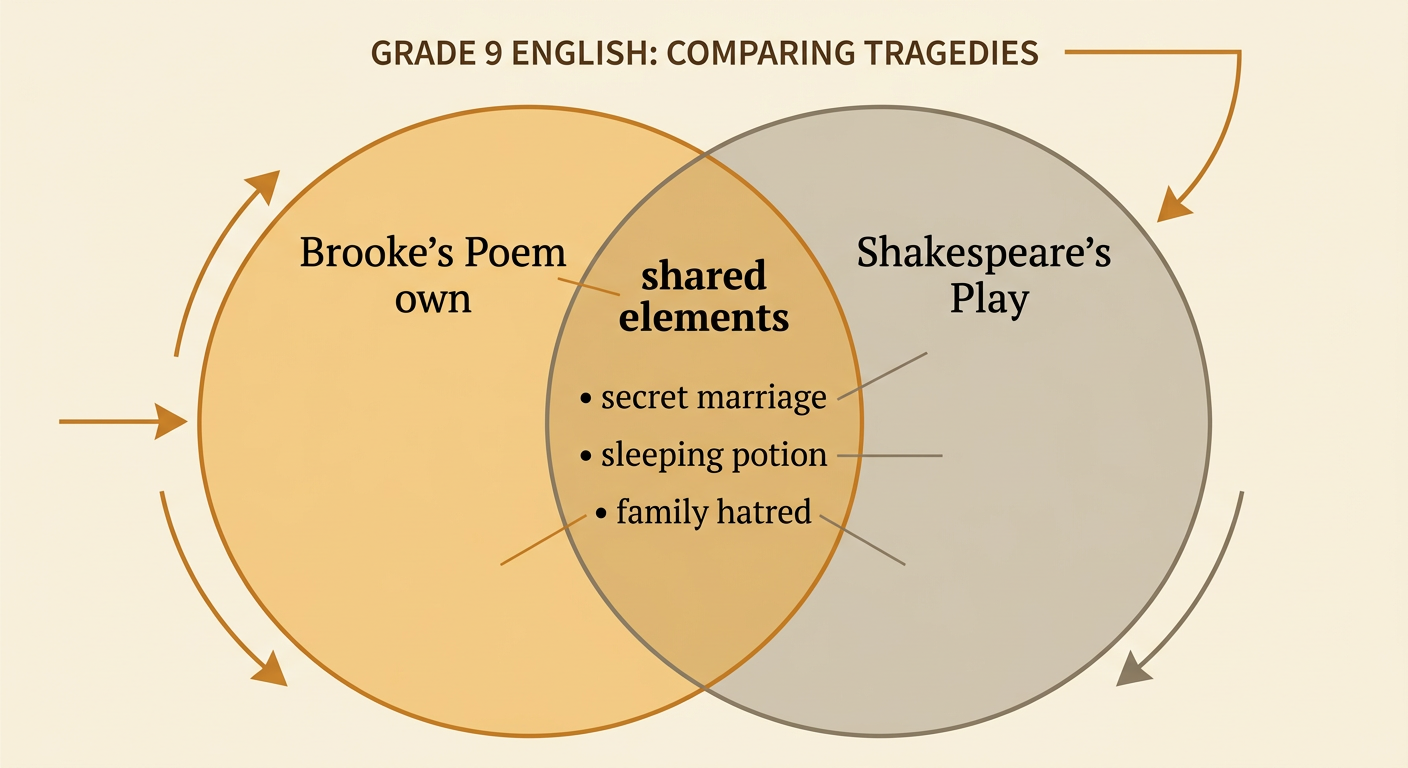
Next, compare the elements that appear in both works. Focus on characters, setting, conflict, plot events, themes, and important images. Shared elements reveal what the later author chose to preserve from the source. Brooke’s poem and Shakespeare’s play both feature lovers from enemy families, a secret marriage arranged by Friar Laurence, Juliet’s sleeping potion, Romeo’s mistaken belief that Juliet is dead, and the lovers’ deaths in the tomb. Both works also explore the destructive effects of family hatred and uncontrolled emotion. Organize these similarities before studying differences so that you do not treat every detail as a transformation. A Venn diagram or comparison chart can help. For example, the secret marriage belongs in the shared area because it drives the conflict in both versions, even though Shakespeare dramatizes the event differently.
Examine the Author’s Changes
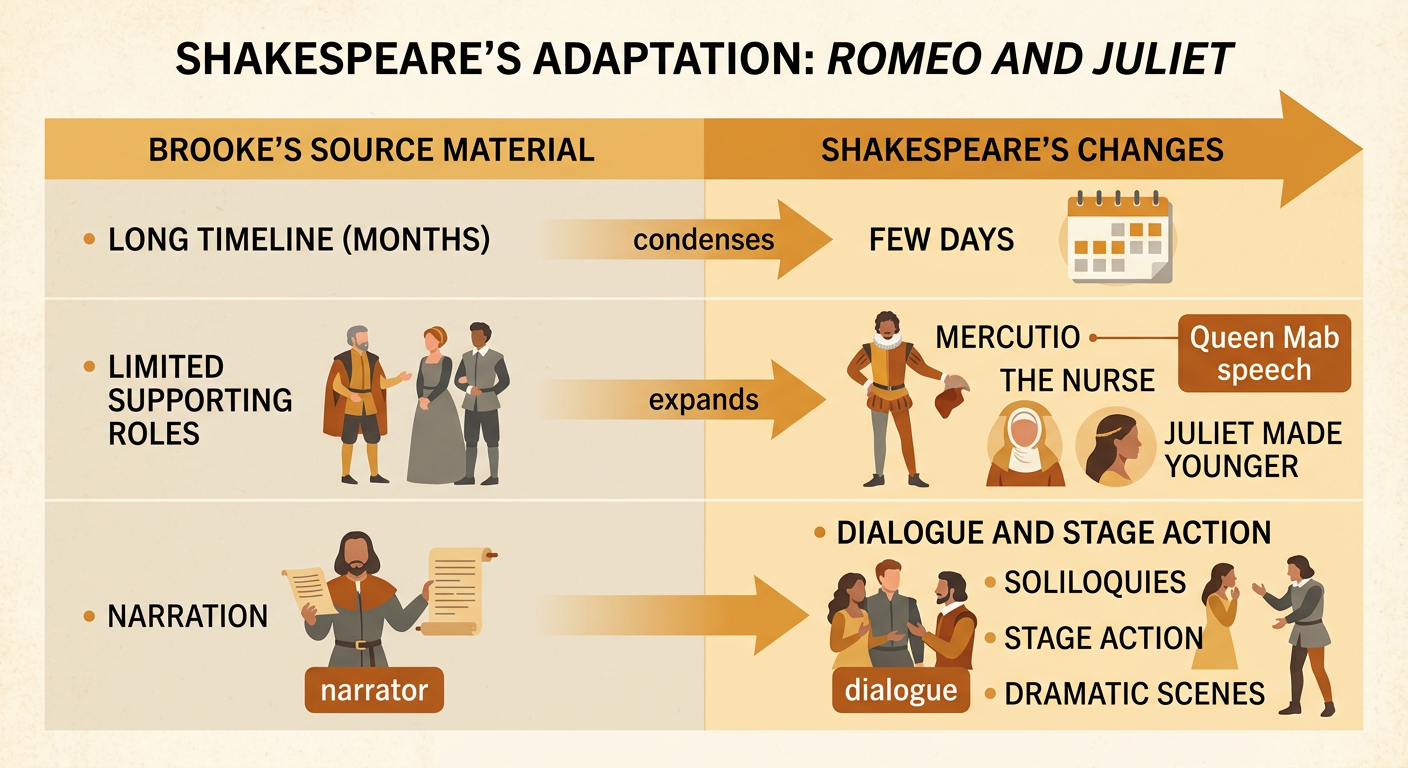
After identifying similarities, examine exactly what the later author adds, removes, condenses, expands, or rearranges. Describe each change precisely rather than simply saying the works are different. Shakespeare compresses the action of Brooke’s poem from many months into only a few days, making the romance and conflict move rapidly. He also makes Juliet younger and gives greater dramatic presence to characters such as Mercutio and the Nurse. Because a play depends on speech and action, Shakespeare replaces Brooke’s narrator with dialogue, soliloquies, stage action, and dramatic scenes. For example, Mercutio’s Queen Mab speech adds imaginative language and reveals his skeptical attitude toward dreams and romantic fantasies. This speech is not merely decorative; it develops a character who has a much larger role in Shakespeare’s version. A change chart can classify each transformation by type.
Analyze the Effects of the Changes
Analysis explains why a change matters. Ask how each transformation affects pacing, characterization, conflict, theme, tone, audience response, or the work’s overall meaning. Shakespeare’s compressed timeline makes Romeo and Juliet’s decisions feel sudden and urgent. Their rapid choices increase suspense while also suggesting that passionate action without reflection can be dangerous. Expanding Mercutio’s role adds humor, energy, and skepticism before his death. His killing then becomes a sharp turning point: the play shifts from playful conflict to irreversible tragedy. Juliet’s younger age can also make the audience more aware of her vulnerability and the adults’ failure to protect her. Connect every claimed effect to specific evidence. Instead of writing, “Shakespeare changes the timeline to make the play better,” explain that the shortened timeline accelerates the plot and strengthens the theme that haste helps turn love and family conflict into catastrophe.

Write a Comparative Analysis
A comparative analysis should make a defensible claim about how and why the author transformed the source. Begin with a thesis that names both works, identifies important changes, and states their effects. Then organize body paragraphs around specific transformations rather than summarizing each work separately. In each paragraph, provide evidence from the source, evidence from the adaptation, and reasoning that explains the significance of the difference. A strong thesis might state: “By compressing Brooke’s timeline and expanding Mercutio’s role, Shakespeare makes Romeo and Juliet more urgent and emphasizes how haste and escalating violence destroy the young lovers.” One body paragraph could compare the original timeline with Shakespeare’s rapid sequence of meetings, marriage, banishment, and death. Conclude by explaining the larger meaning created through these choices. Use accurate quotations or details, clear transitions, and citations required by your teacher.
