Analyzing Informational Text Structure
Students identify how an author organizes ideas in an informational text and explain how a section contributes to the development of the whole text.

Illustrations are auto-generated and may be placeholders. They can be refreshed to match the narration.
Recognizing Common Text Structures
Informational text structure is the way an author organizes ideas. A description structure explains a topic’s features or qualities. A sequence presents events or steps in order. Cause and effect connects reasons with results. Compare and contrast shows similarities and differences. Problem and solution introduces a difficulty and possible answers. For example, an article might explain that a long drought dried forest plants and that a lightning strike then started a wildfire. The fire spread quickly because the plants were dry. This passage mainly uses cause and effect: drought and lightning are causes, while the wildfire is the effect. Authors may use more than one structure in a text, so look at how the ideas are connected rather than relying only on the topic.

Identifying Signal Words
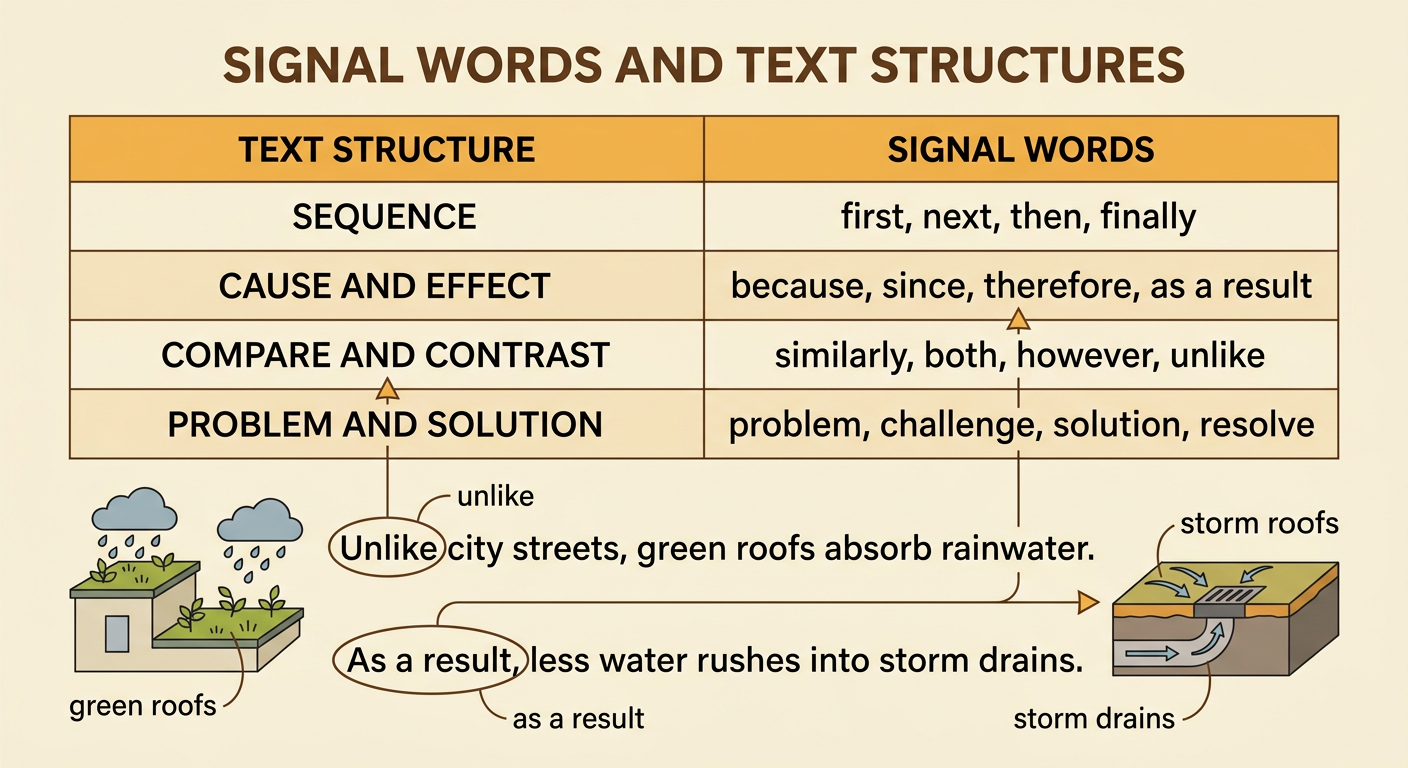
Signal words are clues that can help you recognize a text structure. Sequence passages may use first, next, then, and finally. Cause-and-effect passages often include because, since, therefore, and as a result. Compare-and-contrast passages may use similarly, both, however, and unlike. Problem-and-solution passages may include problem, challenge, solution, and resolve. For example, consider: “Unlike city streets, green roofs absorb rainwater. As a result, less water rushes into storm drains.” The word unlike signals a contrast, while as a result signals cause and effect. Signal words are helpful, but they do not prove the structure by themselves. Read the surrounding sentences and decide how the ideas connect. Sometimes an author shows a relationship without using an obvious signal word.
Mapping the Organization of Ideas
A text map is a visual plan that shows the order and relationship of ideas. Begin by naming the topic and writing the main idea of each paragraph or section in a short phrase. Then connect the phrases with arrows, branches, or another pattern that matches the structure. Imagine an article about starting a school garden. The first section explains that students have limited access to fresh food. The second proposes a garden as a solution. The third lists steps for choosing a site, preparing soil, and planting seeds. A useful map would show a problem leading to a solution, followed by a sequence of steps. Mapping prevents you from treating every detail as equally important. It also makes changes in structure easier to notice and helps reveal how the author develops the central idea.

Analyzing a Section’s Purpose
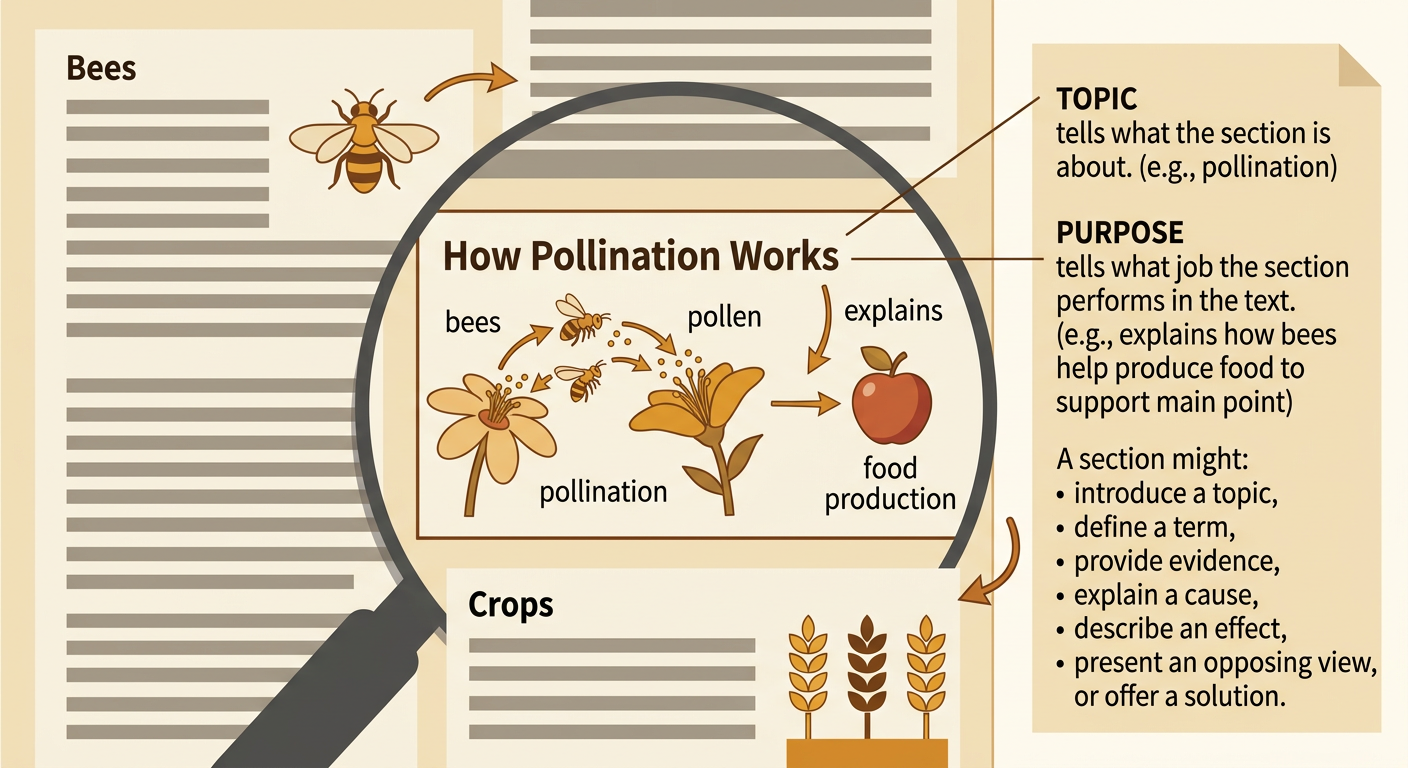
A section’s topic tells what it is about, but its purpose tells what job it performs in the text. A section may introduce a topic, define an important term, provide evidence, explain a cause, describe an effect, present an opposing view, or offer a solution. Suppose an article argues that bees are important to food production. One section explains pollination: as bees move between flowers, they carry pollen that helps many plants produce fruits and seeds. The section’s topic is pollination. Its purpose is to explain the process that connects bee activity to food production. To analyze purpose, ask, “Why did the author include this section here?” Then use a precise verb in your answer, such as introduces, explains, supports, contrasts, or concludes. Support your answer with details from the section.
Explaining Its Contribution to the Whole Text
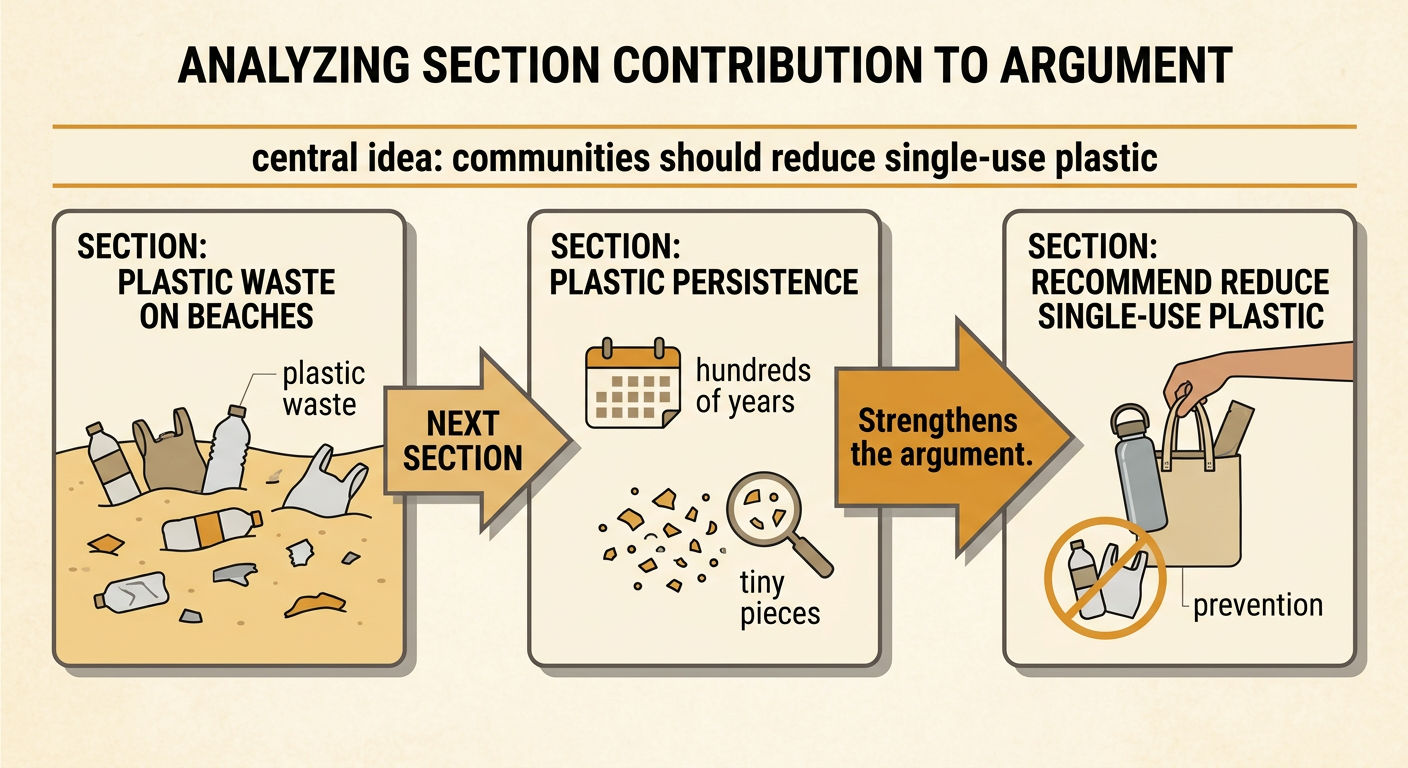
After identifying a section’s purpose, explain how it contributes to the entire text. Think about what readers understand because the section is included and what would be missing without it. For example, an article may claim that communities should reduce single-use plastic. An early section describes plastic waste on beaches. A later section explains that many plastics remain in the environment for hundreds of years and can break into tiny pieces. This later section contributes by showing why the problem lasts and why cleanup alone is not enough. It strengthens the article’s case for reducing plastic use. A complete explanation connects the section, the text’s organization, and the central idea: “By explaining how long plastic remains in the environment, the section develops the problem and supports the author’s argument that prevention is necessary.”