Analyzing Informational Text Structure
Students identify how an author organizes an informational text and explain how major sections develop ideas and contribute to the text as a whole.

Illustrations are auto-generated and may be placeholders. They can be refreshed to match the narration.
Recognizing Common Text Structures
Authors organize informational texts in ways that help readers connect ideas. Common structures include description, sequence, cause and effect, compare and contrast, and problem and solution. A description text explains the features of a topic. A sequence presents events or steps in order. Cause and effect connects reasons with results. Compare and contrast shows similarities and differences. Problem and solution identifies an issue and explains possible responses. For example, an article about coral reefs might first describe reef habitats, then explain how warmer oceans cause coral bleaching, and finally present solutions such as reducing pollution. A text can use more than one structure. To identify the main structure, ask what relationship connects most of the important ideas and why that organization helps the author explain the topic.

Finding Structural Signal Words
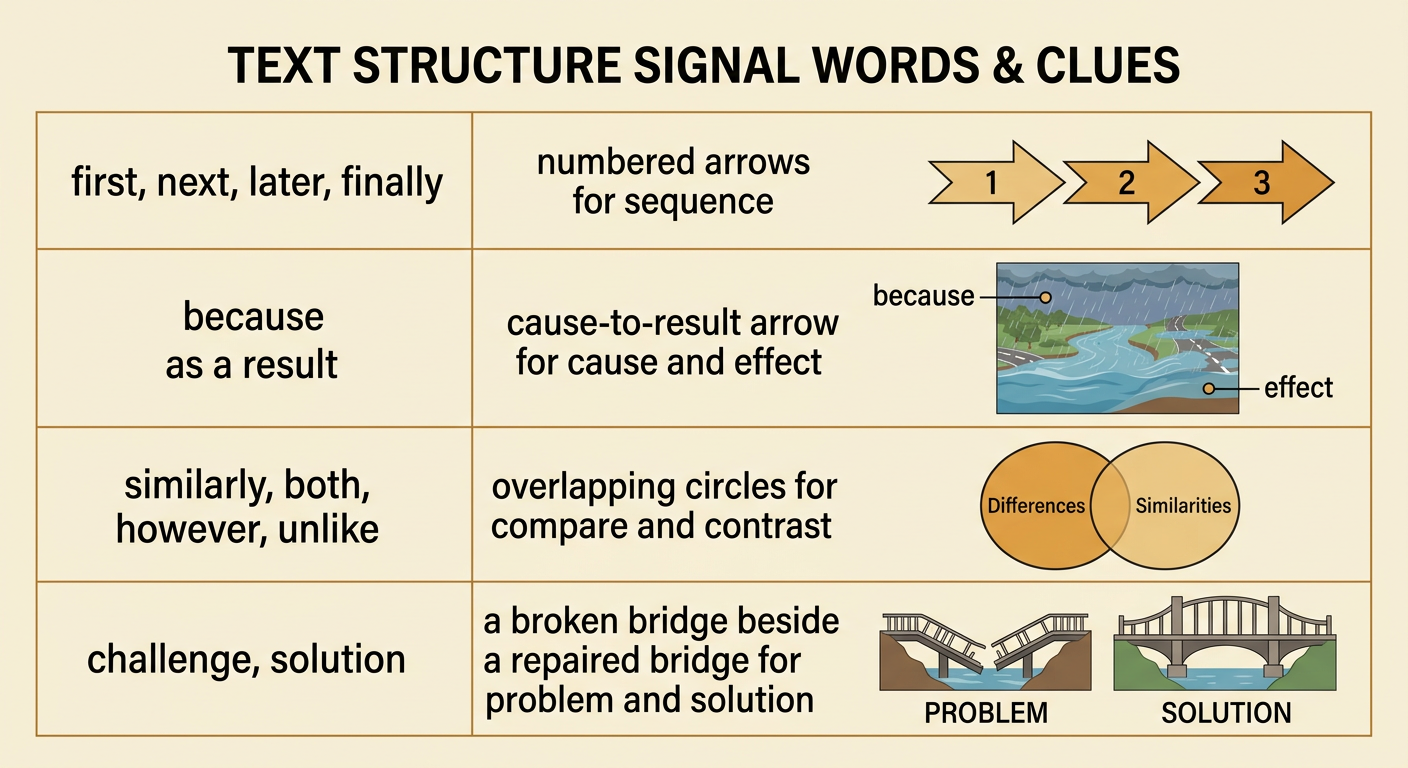
Signal words are clues that reveal how ideas are connected, although they do not prove a structure by themselves. Sequence words include first, next, later, and finally. Cause-and-effect signals include because, therefore, as a result, and leads to. Compare-and-contrast signals include similarly, both, however, and unlike. Problem-and-solution texts may use challenge, problem, solution, or resolve. In a passage stating, “Because heavy rain filled the river, the water rose above its banks. As a result, nearby roads flooded,” the phrases because and as a result point to cause and effect. Readers should also examine the meaning of the sentences. The word first might introduce the first benefit in a list rather than a sequence of events. Use signal words together with the relationships among details to determine the structure accurately.
Mapping the Text’s Major Sections
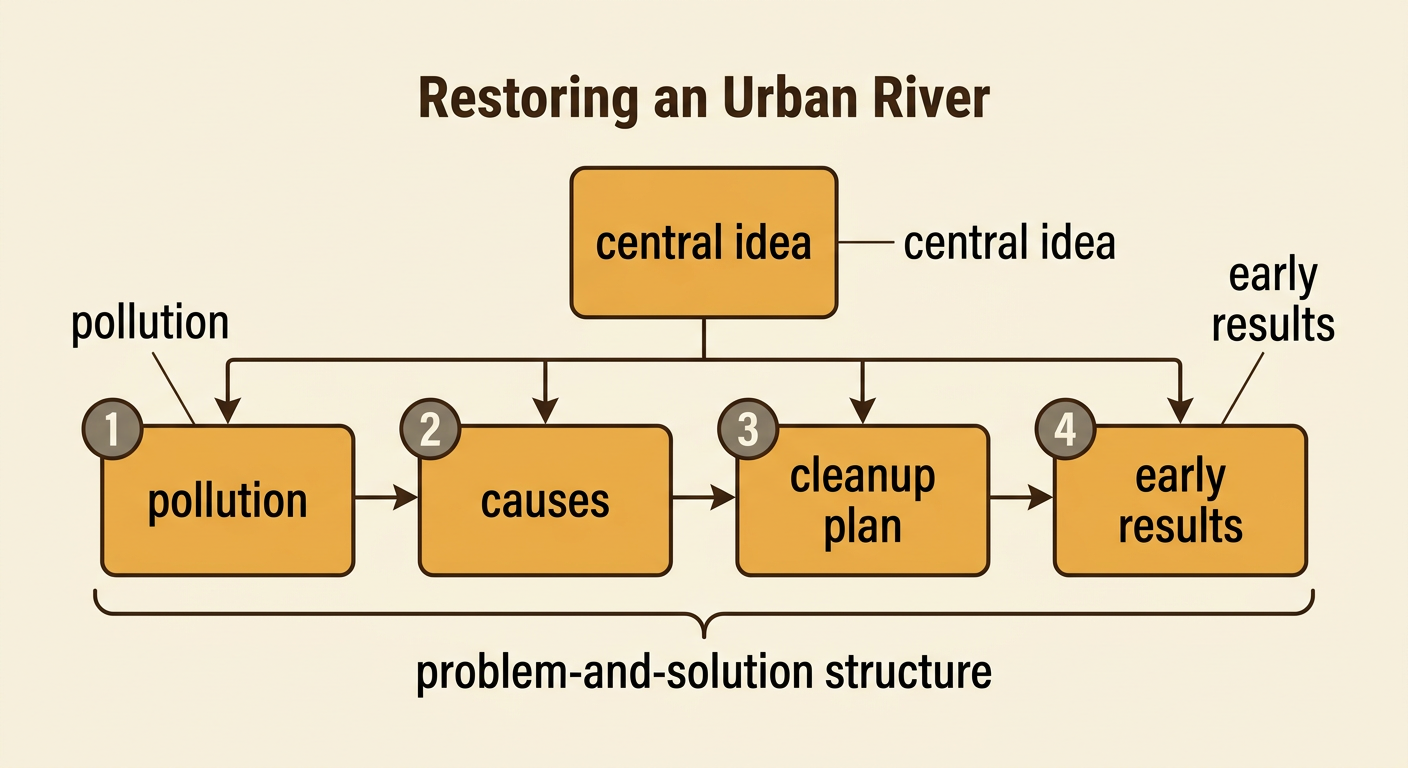
A structure map shows how the major sections of a text work together. Begin by dividing the text at headings, topic shifts, or changes in purpose. Write the central idea at the top, then summarize each major section in one short sentence. Finally, draw arrows or add notes to show how the sections connect. Imagine an article titled “Restoring an Urban River.” Section one describes the river’s pollution, section two explains its causes, section three presents a cleanup plan, and section four reports early results. On a map, these sections form a problem-to-solution path. The first section establishes why action is needed, while later sections explain the response and its effects. Mapping prevents readers from treating every paragraph as equally important and makes the author’s overall organizational plan easier to see.
Explaining How Ideas Develop
To analyze structure, explain not only what each section says but also what it adds to the developing ideas. A section may introduce a topic, define a key term, provide evidence, explain causes, offer a contrast, or show results. Consider an article about sleep. The opening section states that many middle school students do not get enough sleep. The next section explains how sleep supports memory and attention. A third section presents survey data about students’ sleep habits, and the final section suggests consistent bedtimes and reduced screen use. The idea develops from identifying a concern, to explaining its importance, to supporting it with evidence, and finally to proposing responses. Ask, “What would the reader fail to understand if this section were removed?” The answer often reveals that section’s contribution to the whole text.

Writing a Structure Analysis
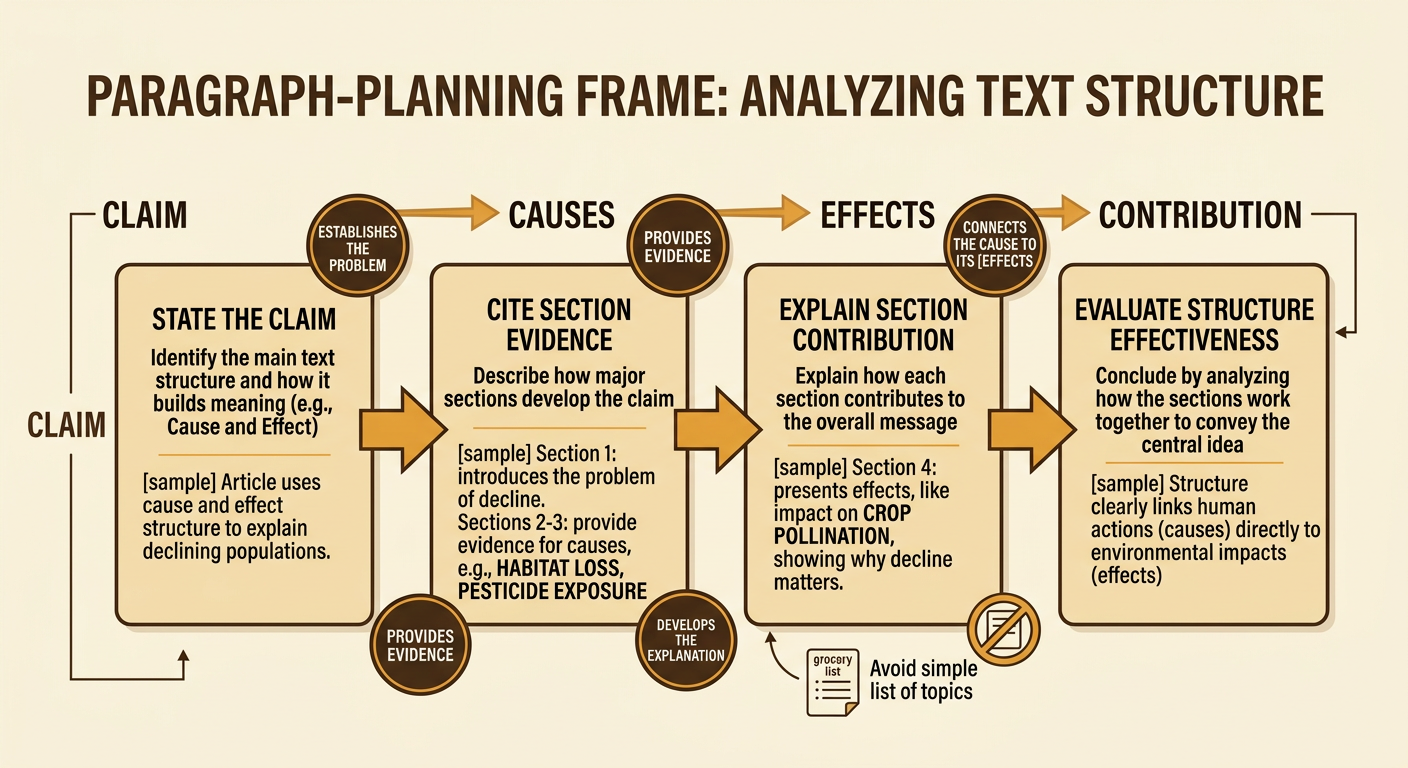
A strong structure analysis names the overall structure, cites evidence from major sections, and explains how those sections develop the author’s ideas. Begin with a claim: “The author mainly uses cause and effect to explain the decline of honeybee populations.” Next, describe how sections support that structure: “The first section introduces the decline, while the second and third sections explain causes such as habitat loss and pesticide exposure.” Then explain the contribution to the whole: “The final section describes effects on crop pollination, showing why the decline matters.” Avoid simply listing topics. Use phrases such as establishes the problem, develops the explanation, provides evidence, or connects the cause to its consequences. End by explaining why the organization is effective. The goal is to show how the text’s arrangement guides the reader’s understanding.