
Analyzing Nonlinear Narrative Structure
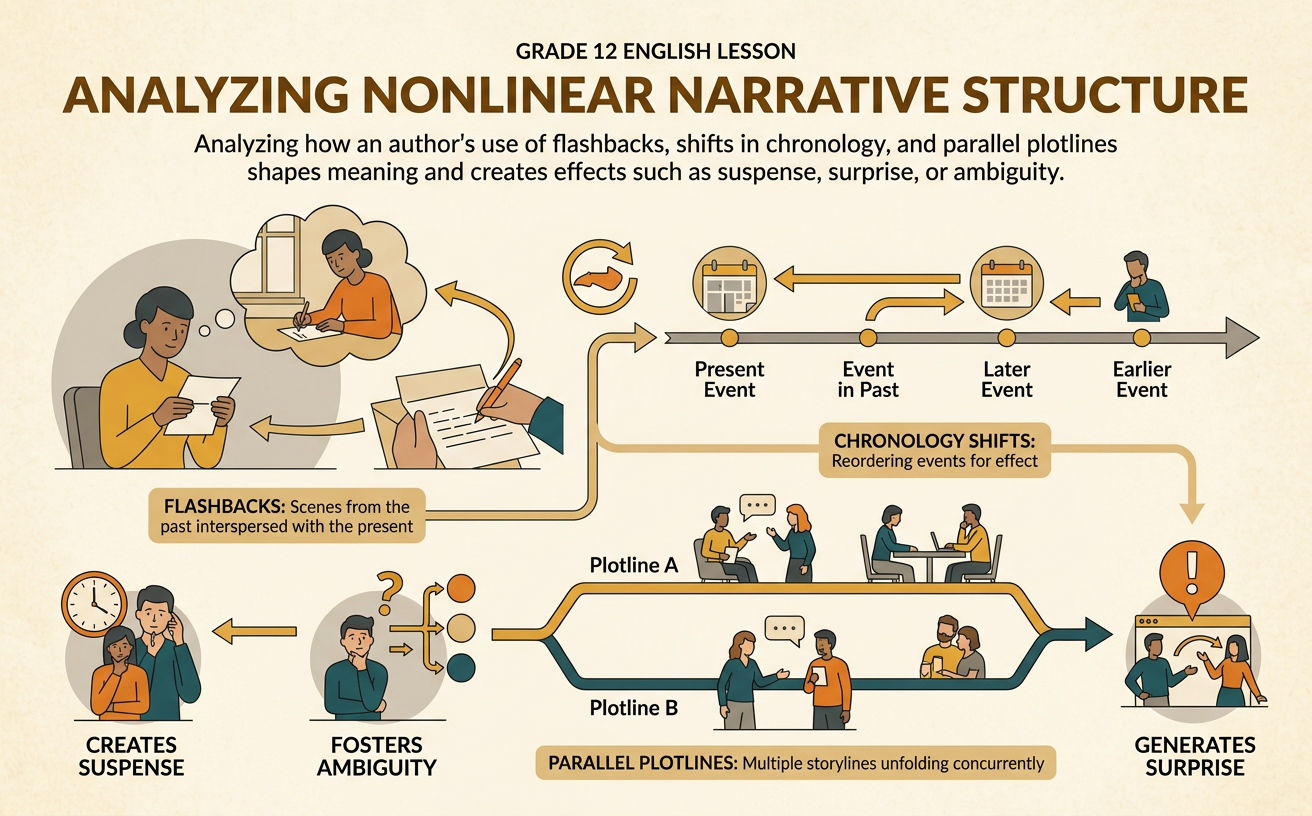
Students analyze how an author’s use of flashbacks, shifts in chronology, and parallel plotlines shapes meaning and creates effects such as suspense, surprise, or ambiguity.
Illustrations are auto-generated and may be placeholders. They can be refreshed to match the narration.
Review Chronological and Nonlinear Structures
A chronological narrative presents events mainly in the order they occur, moving from earlier causes to later consequences. A nonlinear narrative rearranges that order through flashbacks, flash-forwards, repeated scenes, or parallel plotlines. Authors choose nonlinear structures to control what readers know and when they know it. For example, imagine a story that opens with Maya standing outside a burned house. The next section returns to the previous morning, when she noticed a damaged electrical outlet but said nothing. A final section returns to the fire. The flashback delays the cause of the disaster, creating suspense and revealing Maya’s guilt gradually. When analyzing structure, distinguish the chronological sequence of events from the order in which the author presents them. This distinction helps explain how arrangement, rather than plot alone, shapes meaning and emotional impact.

Map the Sequence of Events
To analyze a nonlinear narrative, create two sequences: story order and presentation order. Story order lists events according to when they happen in the fictional world. Presentation order lists them as readers encounter them. Suppose a story presents these scenes: Jordan loses a championship race, Jordan remembers refusing help from a coach, and Jordan later returns to practice. In story order, the refusal comes first, the loss comes second, and the return comes third. In presentation order, the loss appears first, followed by the flashback and then the return. Comparing the two maps reveals that the author begins with failure before explaining its cause. This choice encourages readers to question why Jordan lost and makes the flashback feel like an answer. Record chapter numbers, dates, setting changes, and repeated events so that the map remains supported by textual evidence.

Identify Key Structural Shifts
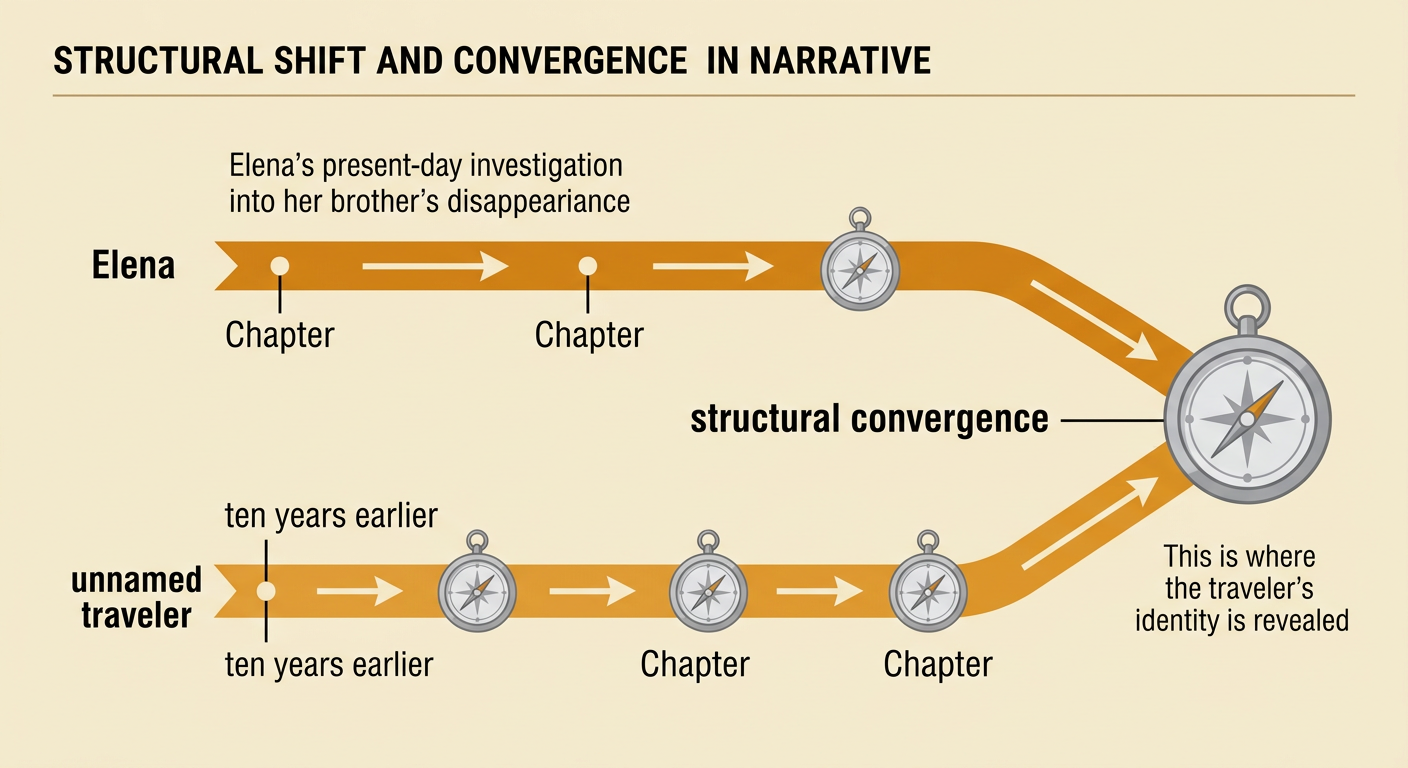
A structural shift occurs when a narrative changes time, setting, narrator, point of view, or plotline. Look for signals such as dates, section breaks, changes in verb tense, repeated images, or phrases like “years earlier.” Not every shift has equal importance, so identify those that change a reader’s understanding. For example, one plotline may follow Elena investigating her brother’s disappearance, while alternating chapters follow an unnamed traveler ten years earlier. When a repeated silver compass reveals that the traveler is Elena’s brother, the parallel plots become connected. That structural convergence is more significant than an ordinary scene change because it revises the reader’s assumptions about the traveler’s identity and fate. Mark where each shift begins and ends, identify the device used, and summarize what new information becomes available. This creates a foundation for analyzing the author’s purpose.
Analyze Effects on Meaning and Audience
After locating a structural choice, explain its effect rather than merely naming it. Ask what information is withheld, repeated, contrasted, or reinterpreted. A flashback may explain motivation, while a flash-forward may create dread. Alternating plotlines can highlight similarities or differences between characters, and an unresolved time shift can produce ambiguity. For example, a story might show a judge confidently delivering a guilty verdict, then shift to the defendant’s childhood memory of being taught never to confess. Readers may initially interpret the defendant’s silence as proof of guilt. The later memory offers another explanation: silence may reflect fear or learned behavior. By delaying this context, the author makes readers experience the same uncertainty as the judge and invites them to question quick judgments. Connect structure to meaning by tracing how the reader’s interpretation changes before and after the shift.

Write a Structure-Based Analysis
A strong structure-based analysis makes a specific claim, cites structural evidence, and explains how the arrangement shapes meaning and aesthetic impact. Begin by naming the author’s choice and its location. Then describe what readers know before the shift, what they learn afterward, and how that change produces an effect. For example: “By opening with the burned house and delaying Maya’s discovery of the damaged outlet until a flashback, the author turns the fire into a mystery and gradually reveals Maya’s guilt.” Support this claim with details from both scenes. Avoid summary that only retells events. Instead, use reasoning such as “Because the cause is withheld, readers initially focus on the disaster; when the flashback supplies the cause, the opening scene gains emotional weight.” Conclude by connecting the local shift to the text’s broader idea, such as responsibility, memory, or self-deception.
