
Analyzing Rhetorical Appeals in a Persuasive Speech
Students identify ethos, pathos, and logos in a persuasive speech and evaluate how these appeals advance the speaker’s purpose.

Illustrations are auto-generated and may be placeholders. They can be refreshed to match the narration.
Define Purpose and Rhetorical Appeals
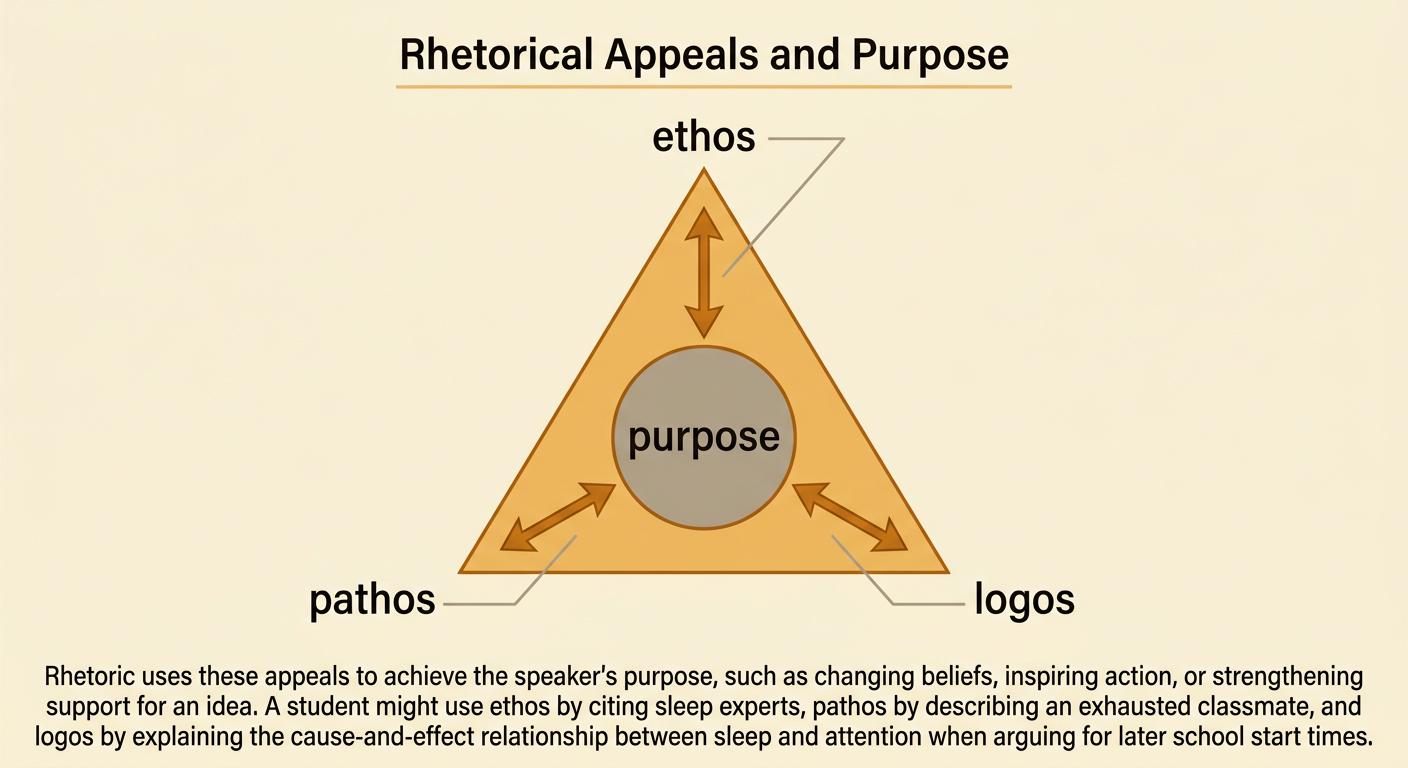
A speaker’s purpose is the result the speaker wants to achieve, such as changing an audience’s belief or inspiring action. Rhetoric is the strategic use of language to accomplish that purpose. Ethos builds trust by presenting the speaker as credible, knowledgeable, or fair. Pathos appeals to emotions, values, or hopes. Logos appeals to reason through facts, examples, statistics, and logical connections. Imagine a student arguing for a later school start time. The student uses ethos by citing sleep researchers, pathos by describing an exhausted classmate struggling to focus, and logos by explaining that more sleep can improve attention. These appeals often work together. Identifying an appeal is only the first step; strong analysis explains how the appeal affects the intended audience and advances the speaker’s purpose.
Read and Annotate the Speech
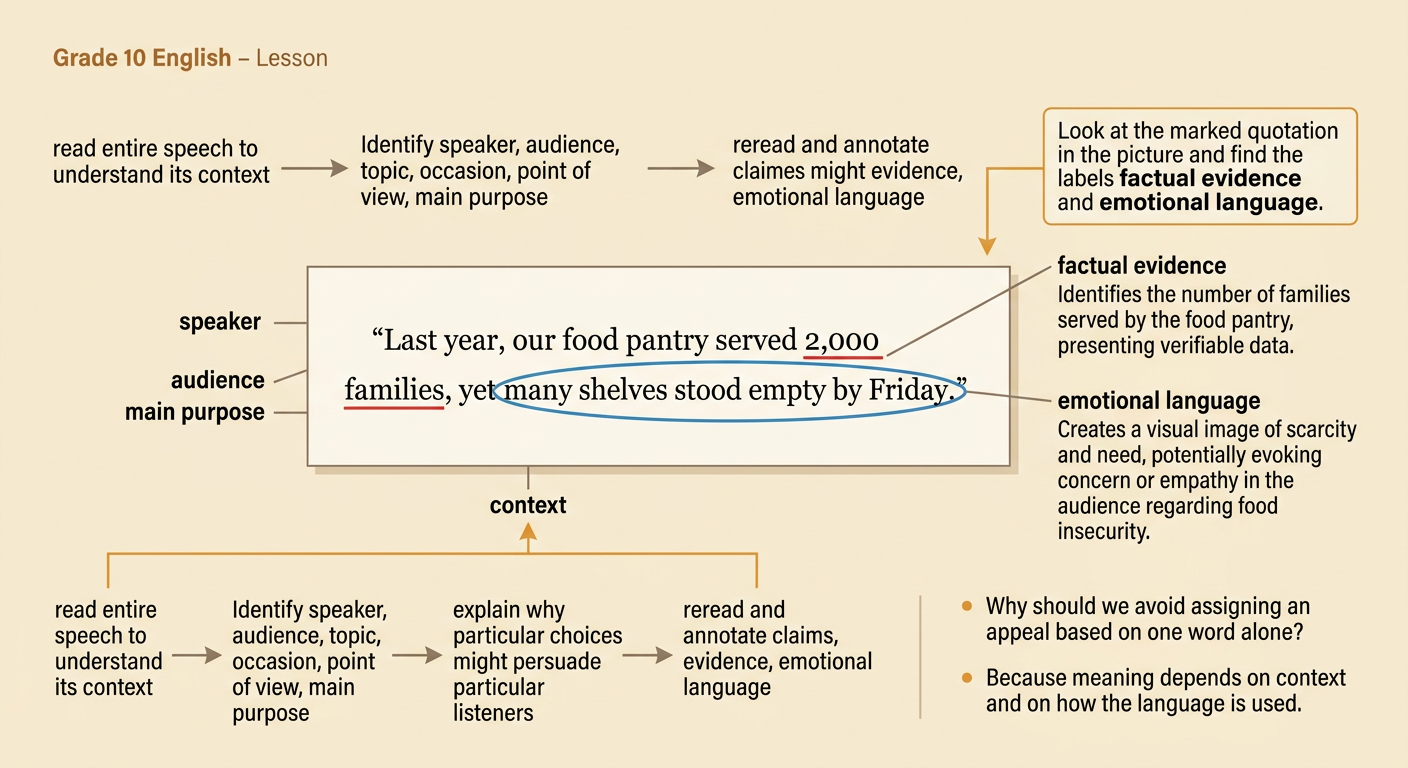
Before labeling rhetorical appeals, read the entire speech to understand its context. Identify the speaker, audience, topic, occasion, point of view, and main purpose. Then reread and annotate words, claims, evidence, and emotional language that seem designed to influence listeners. For example, consider this statement from a speech supporting a community garden: “Last year, our food pantry served 2,000 families, yet many shelves stood empty by Friday.” Underline “2,000 families” as factual evidence and circle “shelves stood empty” as vivid, emotional language. In the margin, write what each choice may cause the audience to think or feel. Do not assign an appeal based on one word alone. Examine the surrounding sentences and ask how the evidence or language supports the speaker’s larger claim that the neighborhood should create the garden.
Identify Ethos, Pathos, and Logos
Classify an appeal by examining how it is meant to persuade. Ethos appears when a speaker establishes expertise, moral character, shared values, or fairness. For example, “As a nurse who has treated asthma for fifteen years, I have seen the effects of polluted air” emphasizes experience and credibility. Pathos appears when language invites an emotional response: “Every child deserves to breathe safely on the playground” may evoke concern and protectiveness. Logos appears when the speaker uses evidence and reasoning: “Air-quality readings exceeded recommended levels on twelve days last month; therefore, the city should reduce traffic near schools.” One passage can use more than one appeal. The nurse’s experience supports ethos, but the reference to sick patients may also stir pathos. Name the strongest appeal, quote the relevant language, and explain why it fits.

Evaluate the Speaker’s Choices
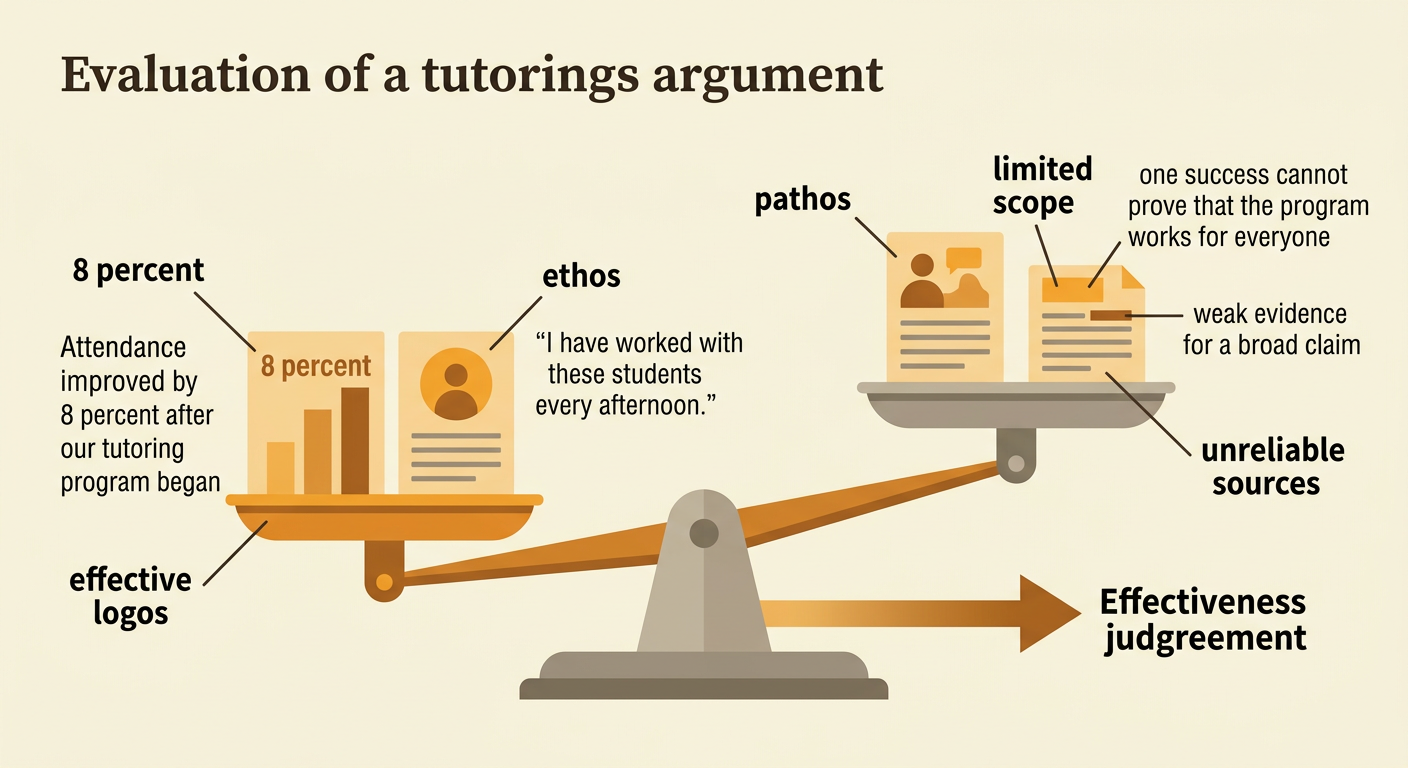
Evaluation asks whether a rhetorical choice is effective, not merely whether it exists. Consider the intended audience, the speaker’s purpose, the quality of the evidence, and the likely response. Suppose a principal tells families, “Attendance improved by 8 percent after our tutoring program began.” The statistic may provide effective logos because families want measurable results. If the principal adds, “I have worked with these students every afternoon,” that detail strengthens ethos by showing direct involvement. However, a dramatic story about one successful student cannot prove that the program works for everyone. It may create pathos, but its limited scope weakens it as evidence. Also watch for choices that undermine persuasion, such as exaggeration, unreliable sources, or insults. Explain both the strength and limitation of an appeal before judging how well it advances the purpose.
Write an Evidence-Based Analysis
An evidence-based analysis makes a clear claim about how rhetoric advances the speaker’s purpose. Begin with a thesis that names the purpose and evaluates the speaker’s strategy. Then present quoted or paraphrased evidence, identify the appeal, and explain its effect on the audience. For example: “To persuade residents to support a community garden, the speaker combines logos and pathos. The statement that the food pantry served ‘2,000 families’ establishes the scale of local need. This statistic gives residents a logical reason to support additional food production. The image of shelves standing empty by Friday also creates concern about neighbors lacking food, making immediate action feel necessary.” Notice that the explanation does more than label appeals. It traces a chain from language to appeal, audience effect, and purpose. End by judging the overall effectiveness of the speaker’s rhetorical choices.
