Analyzing Satire, Sarcasm, and Irony
Students analyze how authors use satire, sarcasm, and irony to communicate implied meanings and critiques that differ from literal statements.

Illustrations are auto-generated and may be placeholders. They can be refreshed to match the narration.
Literal and Implied Meaning
Literal meaning is the direct, dictionary-level meaning of a statement. Implied meaning is the idea or attitude a reader infers from wording, tone, context, and the difference between what is said and what is true. Skilled readers test both possibilities instead of assuming that every sentence is sincere. For example, after waiting two hours for a delayed bus, Maya says, “What wonderfully dependable service.” Literally, she praises the service. However, the long delay and the exaggerated word “wonderfully” show that she really means the service is unreliable. This contrast also reveals her frustration. To identify implied meaning, first paraphrase the statement literally. Then compare that paraphrase with the situation and ask whether the speaker’s words fit the known facts. If they conflict, the author may be using irony, sarcasm, satire, or understatement.

Types of Verbal and Situational Irony
Verbal irony occurs when a speaker’s intended meaning differs from the words spoken. A student who sees rain pouring through an open window might say, “Perfect weather for leaving the window open.” The literal praise communicates the opposite idea: closing the window would have been wiser. Situational irony occurs when an event’s outcome sharply contradicts a reasonable expectation. For example, a school installs an advanced sprinkler system to protect its library, but a broken sprinkler floods the books. Readers expected the protective system to prevent damage, yet it causes damage instead. Not every surprise is situational irony; the outcome must meaningfully reverse or undermine an expectation. To classify irony, ask where the contrast occurs. If it lies between words and intended meaning, it is verbal irony. If it lies between an expected result and the actual result, it is situational irony.

Recognizing Satire and Sarcasm
Satire uses humor, exaggeration, irony, or absurdity to criticize human behavior, institutions, or social problems. Its target is usually broader than one person, and its purpose may include encouraging reflection or change. Imagine a story about a town that creates a Department of Simple Forms, which requires citizens to complete fifty forms before requesting one simple form. The absurd bureaucracy satirizes inefficient government procedures. Sarcasm is a pointed, often mocking remark in which the intended meaning differs from the literal words. When a classmate spills paint across a finished poster and another says, “Brilliant move,” the praise is sarcastic criticism. Satire may contain sarcasm, but the terms are not interchangeable. Ask about scope and purpose: Does the work develop a larger critique through humor? It is likely satire. Does a speaker deliver a cutting opposite-meaning remark? It is likely sarcasm.

Textual Clues and Context
Readers infer nonliteral meaning by combining textual clues with context. Useful clues include exaggeration, understatement, word choice, punctuation, repetition, contradictions, and a mismatch between tone and events. Context includes who is speaking, the speaker’s relationship to others, what has already happened, and what the audience knows. For example, after a character accidentally deletes the group’s entire presentation, the narrator observes, “His talent for saving time was unmatched.” The polished praise clashes with an action that created more work. The phrase “was unmatched” is also exaggerated, strengthening the ironic effect. One clue alone may be ambiguous, so readers should gather several pieces of evidence. A reliable analysis identifies the exact words, describes the relevant situation, and explains the mismatch. It also considers alternative interpretations before deciding what the speaker or author most likely means.

Explaining the Author’s Critique
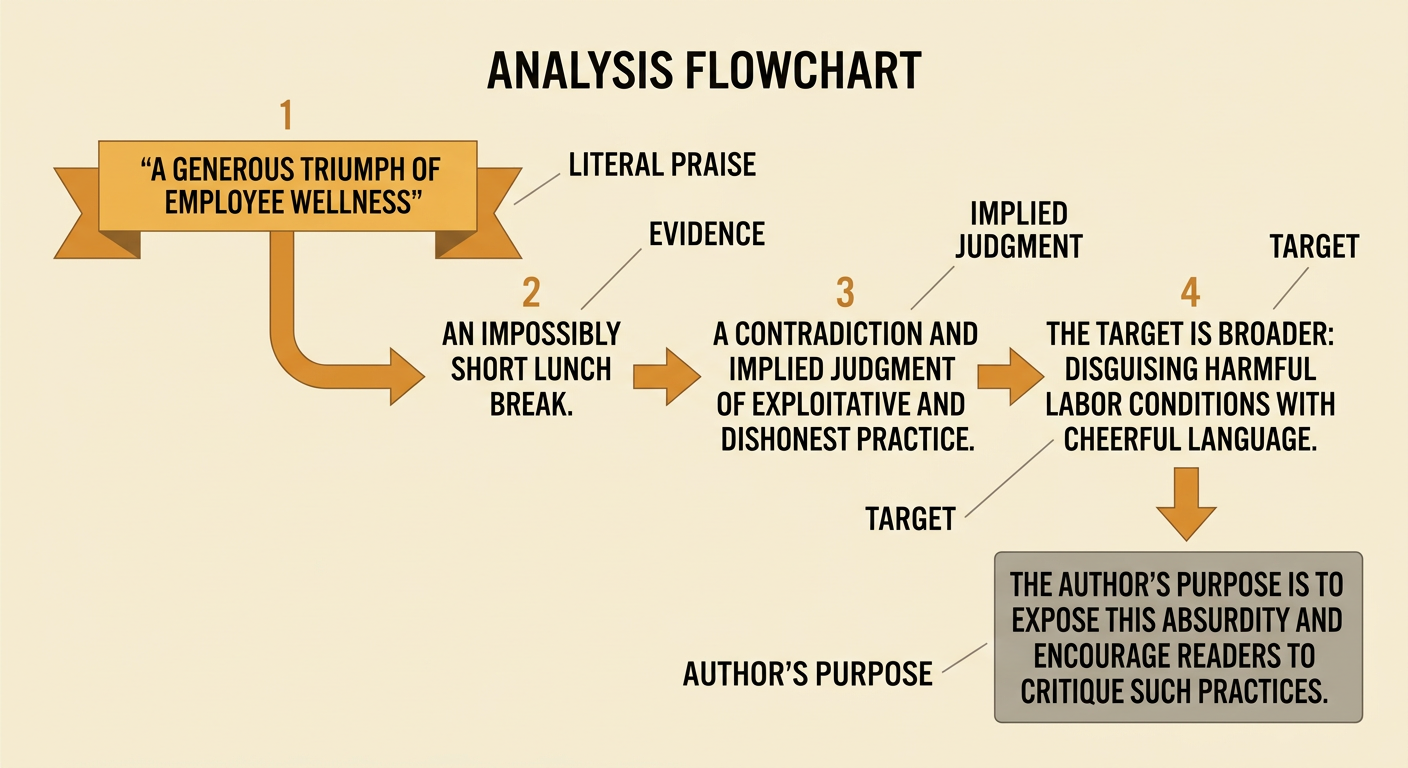
A strong analysis goes beyond naming a device; it explains what the author criticizes and how the device communicates that judgment. Begin with a precise claim about the target, then cite relevant evidence, contrast the literal and implied meanings, and connect that contrast to the author’s purpose. Suppose a narrator describes a company that gives workers a one-minute lunch break as “a generous triumph of employee wellness.” Literally, the policy is praised as generous. In context, the impossibly short break exposes the claim as ironic and exaggerated. The author is likely criticizing companies that use positive public language to disguise harmful labor practices. An effective explanation might state that the inflated praise makes the policy appear absurd, revealing the gap between corporate language and workers’ actual treatment. Avoid vague claims such as “the author uses irony for effect.” Name the target, method, implied judgment, and likely impact on readers.