Analyzing Word Choice and Figurative Language
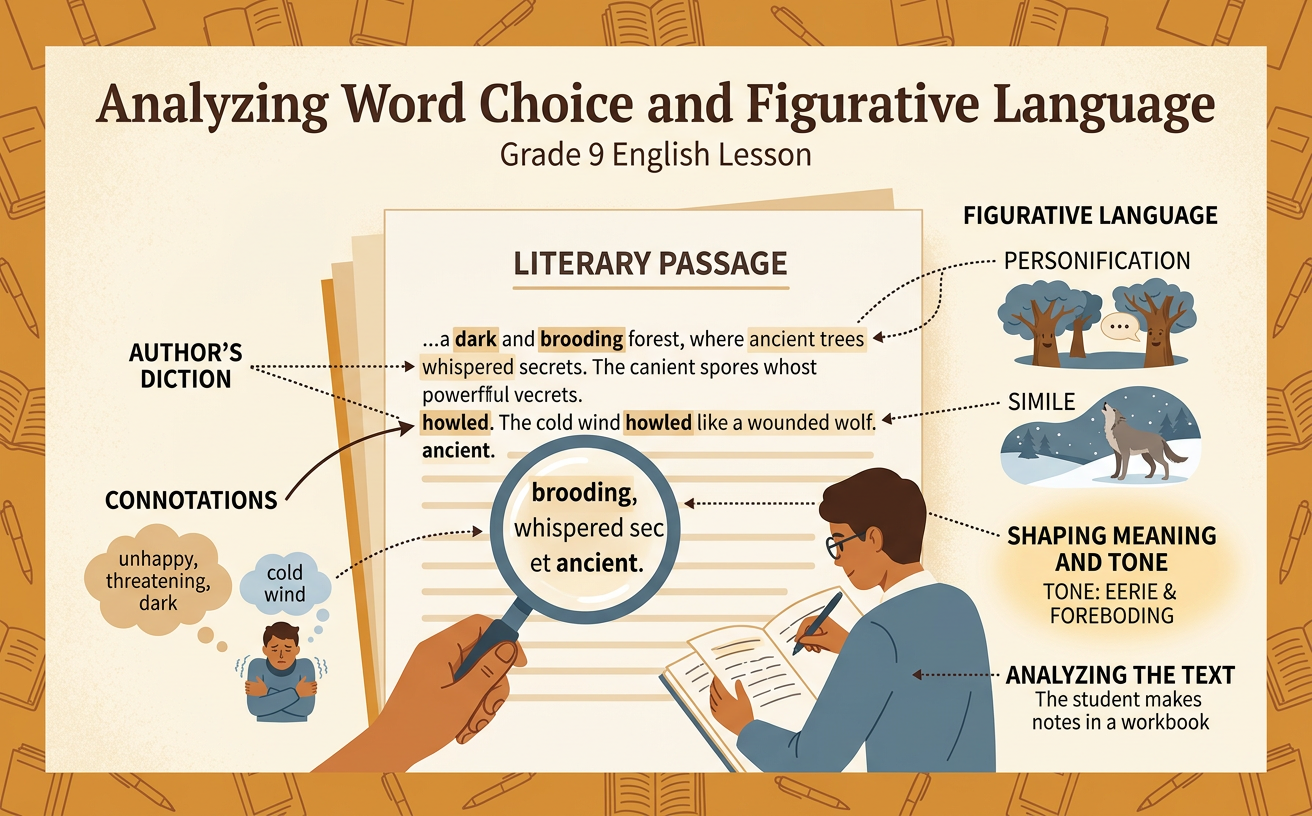
Students analyze how an author’s diction, connotations, and figurative language shape meaning and tone in a literary passage.
Illustrations are auto-generated and may be placeholders. They can be refreshed to match the narration.
Introduce Diction and Connotation
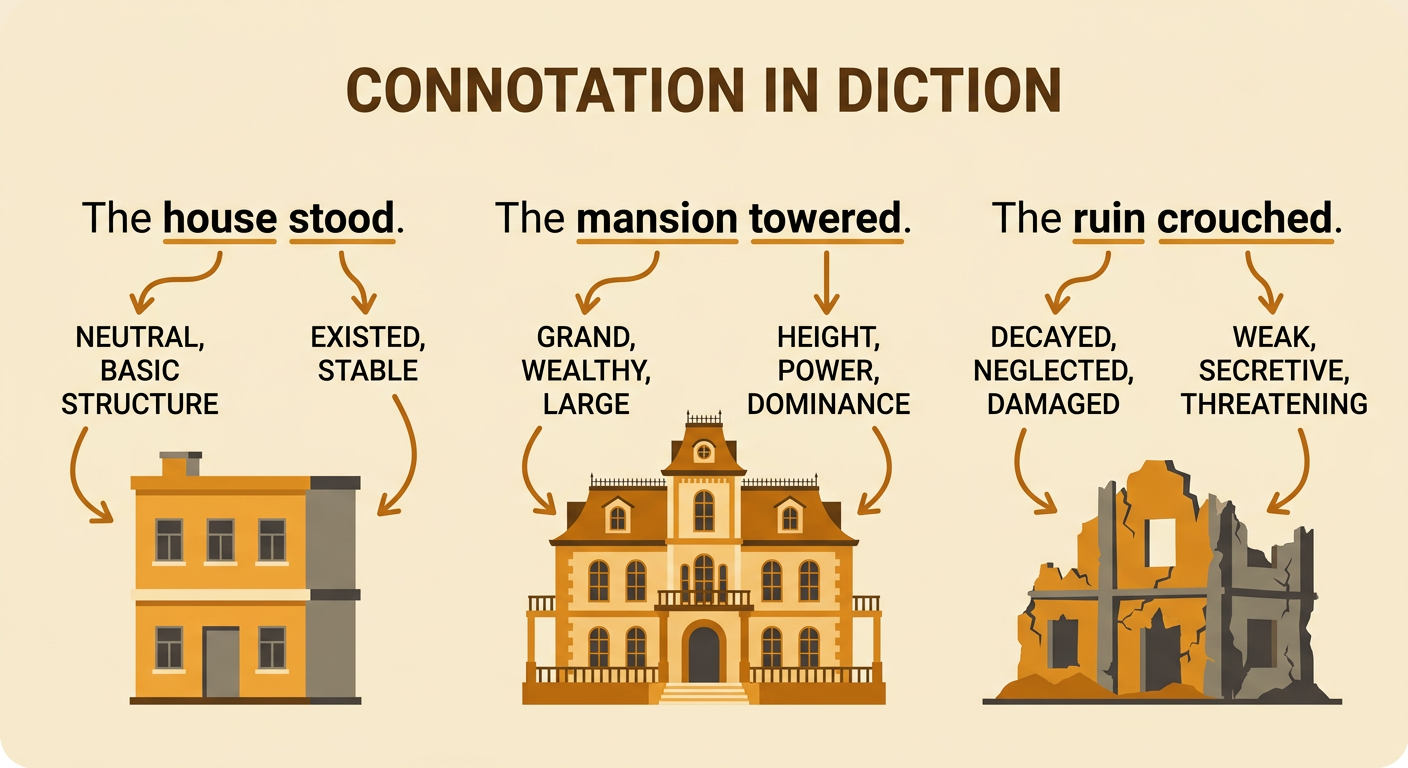
Diction is an author’s choice of words. Authors often select words not only for their dictionary meanings, or denotations, but also for their connotations, the feelings and ideas associated with them. For example, consider three ways to describe an old house: “The house stood on the hill,” “The mansion towered on the hill,” and “The ruin crouched on the hill.” “House” is neutral, “mansion” suggests wealth and grandeur, and “ruin” suggests decay. The verbs also matter. “Stood” is neutral, “towered” conveys power, and “crouched” makes the building seem weak or threatening. These choices guide a reader’s response before the author directly explains anything. When analyzing diction, identify notable words, consider their denotations and connotations, and compare them with possible alternatives. Then explain why the author’s exact choices matter.
Identify Figurative Language
Figurative language communicates more than the literal meanings of words. A simile compares unlike things using “like” or “as,” while a metaphor makes a direct comparison. Personification gives human qualities to something nonhuman. Imagery uses sensory details to help readers imagine a scene. In the sentence “The wind clawed at the shutters like an impatient animal,” “clawed” personifies the wind because wind cannot literally use claws. The phrase “like an impatient animal” is a simile. Together, these choices create an image of violent, persistent motion. To identify figurative language, first ask whether the statement could be literally true. Then locate the comparison, human quality, or sensory detail. Finally, name the device and identify the two things or ideas being connected. Accurate identification prepares you to explain the language’s effect.

Determine Meaning in Context
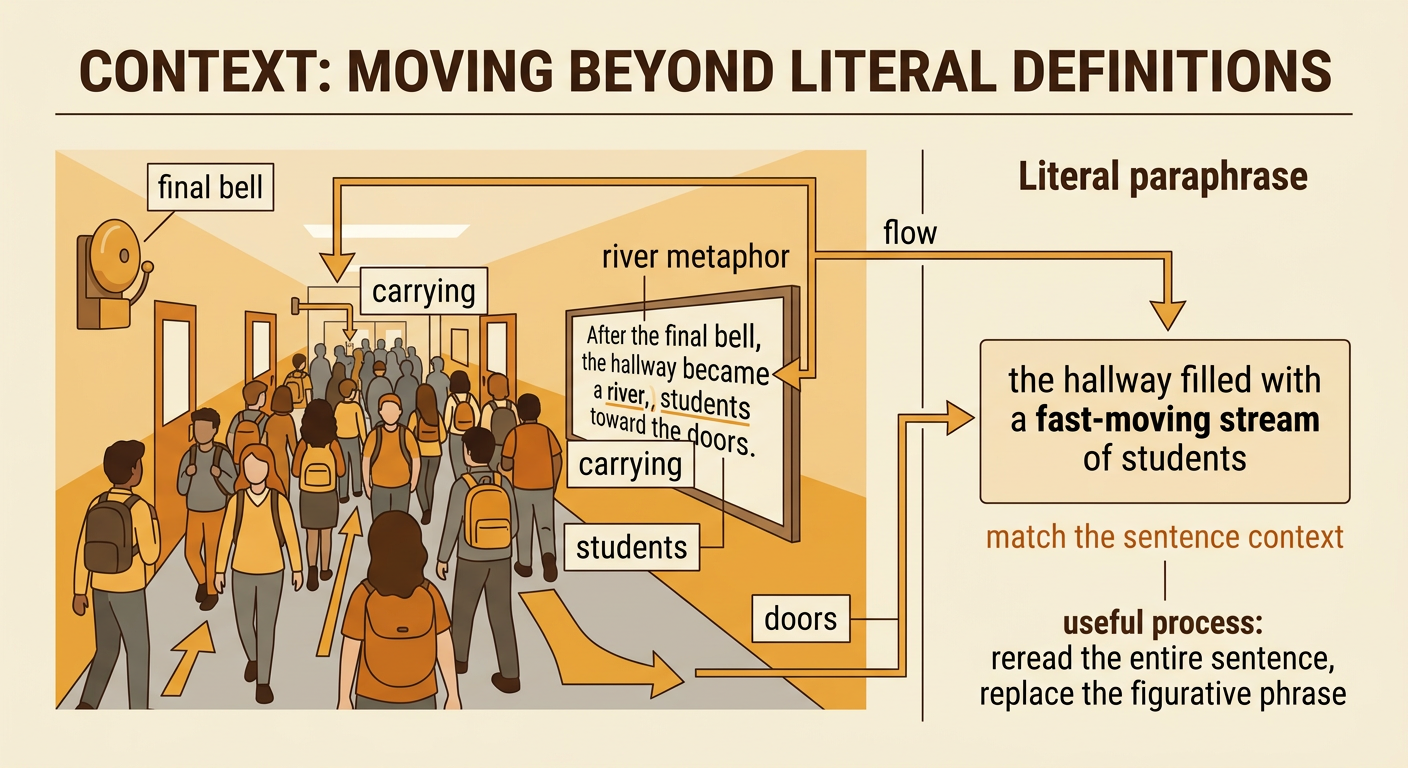
A word or phrase can have a special meaning within a passage, so use context rather than relying only on the first dictionary definition. Examine nearby details, repeated ideas, contrasts, and the situation. Suppose a passage says, “After the final bell, the hallway became a river, carrying students toward the doors.” The hallway does not literally turn into water. The metaphor “became a river” means that many students move together in a strong, continuous flow. The participle “carrying” reinforces the idea that individuals are swept along by the crowd. To determine meaning, reread the full sentence, replace the figurative phrase with a literal paraphrase, and check whether that paraphrase fits the surrounding details. Here, “filled with a fast-moving stream of students” fits the context better than a literal definition involving water.
Analyze Effects on Tone
Tone is the author’s attitude toward a subject, conveyed through language. One word rarely creates tone by itself; readers should examine the cumulative impact of several related choices. Consider: “At dusk, the abandoned playground groaned as rusty swings twisted in the bitter wind.” The words “dusk,” “abandoned,” “groaned,” “rusty,” “twisted,” and “bitter” work together to create an eerie, bleak tone. “Groaned” personifies the playground and suggests pain, while “bitter” makes the wind seem harsh and hostile. If the author replaced these words with “sunset,” “quiet,” “swayed,” and “cool,” the same setting would feel calmer and less threatening. To analyze tone, gather words that share emotional associations, name the attitude they create, and explain how particular words support that description. Use precise tone words such as uneasy, joyful, admiring, bitter, or nostalgic.

Write a Brief Analysis
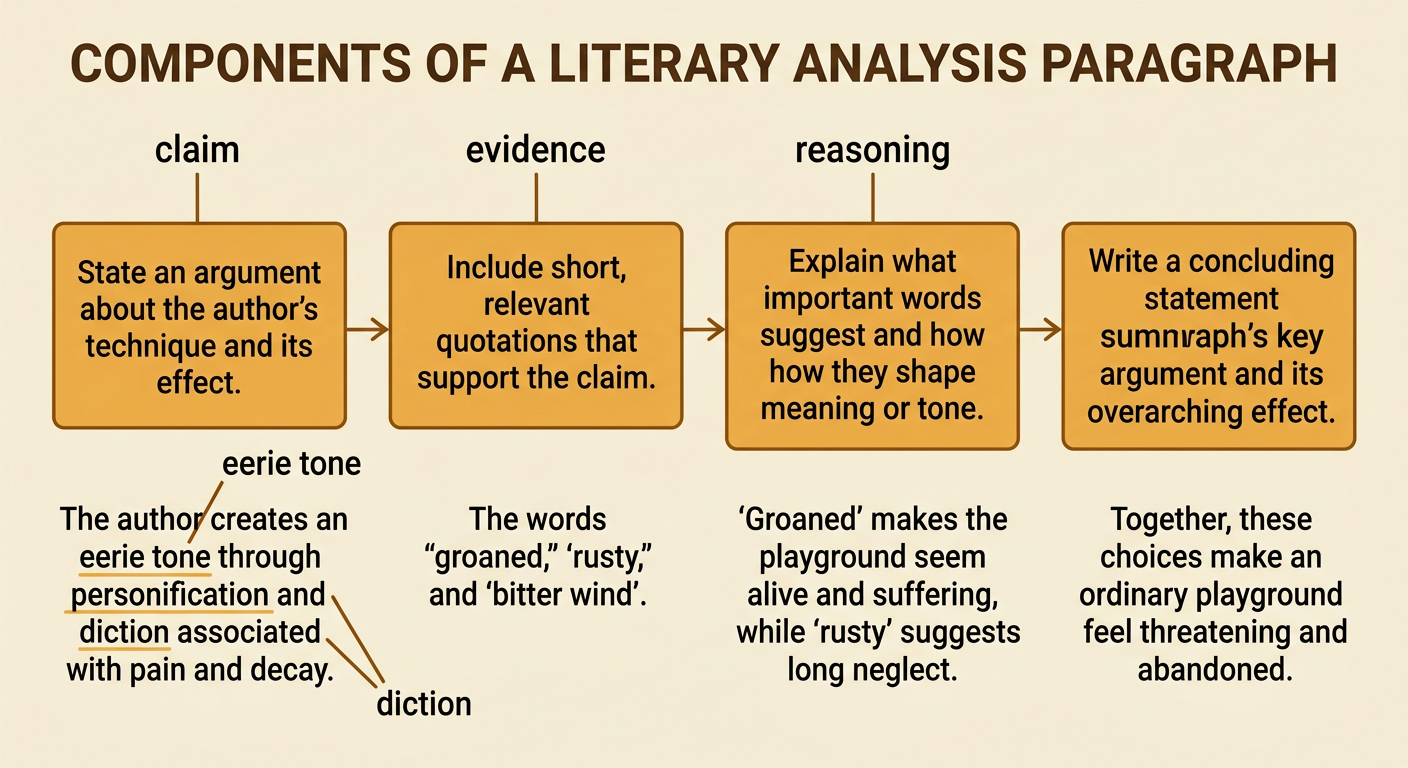
A brief literary analysis should make a clear claim, cite specific language, and explain how the language shapes meaning and tone. Begin by naming the author’s technique and its effect. Then include a short quotation and analyze important words rather than merely summarizing the passage. For example: “The author creates an eerie tone by personifying the playground and choosing words associated with pain and decay. The playground ‘groaned,’ while the swings were ‘rusty’ and moved in a ‘bitter wind.’ ‘Groaned’ makes the setting seem alive and suffering, and ‘rusty’ suggests long neglect. Together, these choices make an ordinary playground feel threatening and abandoned.” This response connects evidence to an interpretation. Before finishing, check that your analysis answers three questions: What language did the author use? What does it suggest in context? How does it affect meaning or tone?