
Analyzing Word Choice and Tone
Students analyze how an author’s specific word choices, figurative language, and connotations shape the meaning and tone of a literary passage.

Illustrations are auto-generated and may be placeholders. They can be refreshed to match the narration.
Define Diction, Connotation, and Tone
Diction is an author’s choice of words and phrases. Connotation is the feeling or idea associated with a word beyond its dictionary definition. Tone is the author’s attitude toward a subject, character, or situation. These ideas work together. For example, “The dog walked toward me” sounds neutral. Replacing “walked” with “stalked” creates a threatening connotation and a tense tone. Replacing it with “bounded” suggests energetic, friendly movement and creates a cheerful tone. The basic action remains similar, but the reader’s impression changes. When analyzing diction, identify a meaningful word, consider its denotation and connotations, and explain how those associations help establish tone. Describe tone precisely with words such as uneasy, admiring, bitter, playful, or hopeful rather than broad words such as good or bad.

Read and Annotate a Short Passage
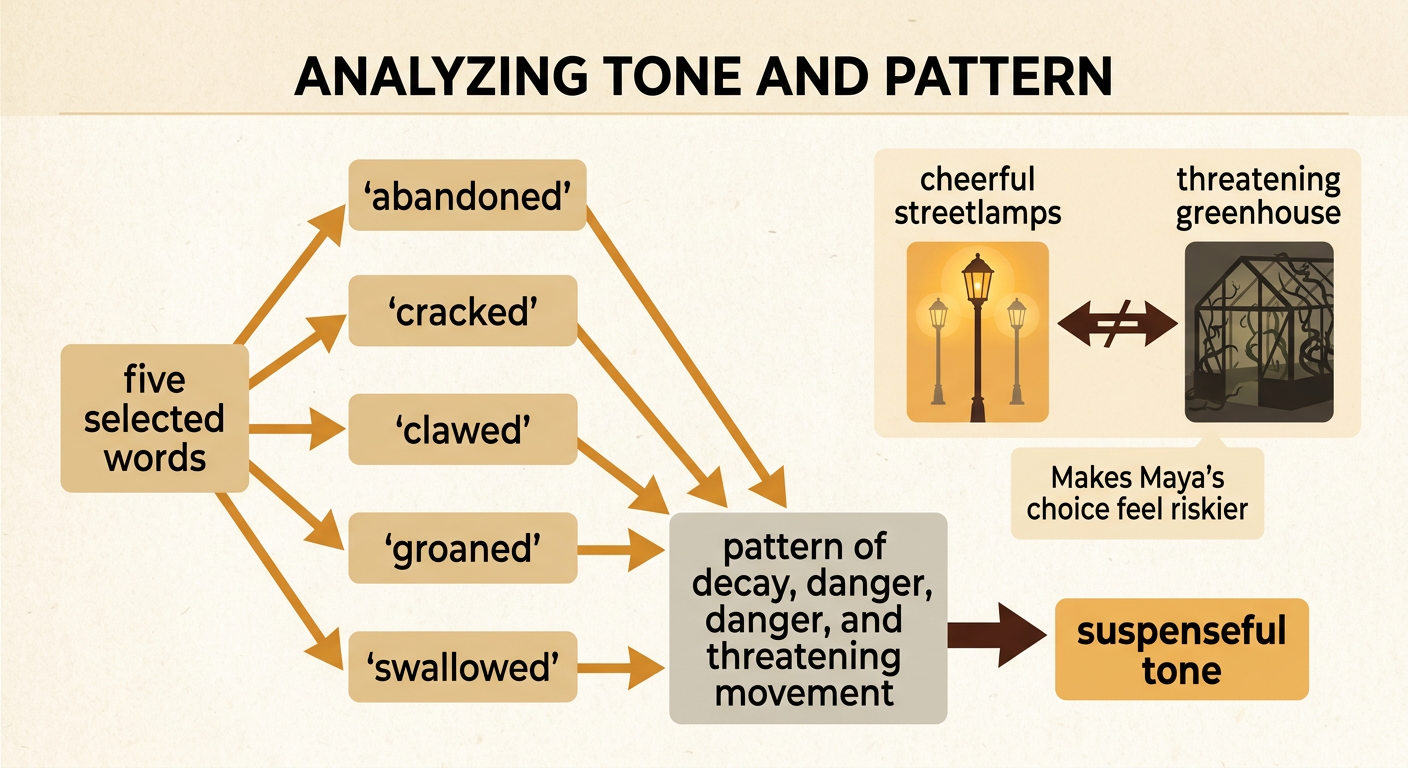
Read this original passage: “At dusk, Maya stood before the abandoned greenhouse. Its cracked panes caught the last light like watchful eyes. Vines clawed at the doorframe. She told herself it was only a building, yet the door groaned as the wind pushed it open. Behind her, cheerful streetlamps flickered on, but ahead the greenhouse swallowed the path. Maya tightened her grip on the brass key and stepped forward.” Annotate words that create strong images or feelings. Circle “watchful eyes,” underline “clawed,” and box “swallowed.” Draw an arrow between “cheerful streetlamps” and “greenhouse” to mark the contrast between safety and danger. In the margin, record your first impression of the tone, such as “uneasy and suspenseful.” Annotations should identify evidence you can examine, not merely decorate the passage.

Examine Key Words and Phrases
Examine each marked expression closely. “Clawed” literally describes scratching with claws, but the vines do not have animal claws. This personification makes the plants seem alive and aggressive. “Swallowed the path” is also figurative because a greenhouse cannot actually eat. The metaphor suggests that darkness is consuming Maya’s safe route. The simile “like watchful eyes” compares the cracked panes to eyes, creating the feeling that Maya is being observed. Authors may also use allusions. If the passage said Maya felt “like David facing Goliath,” the reference would compare her challenge to the biblical story of a smaller opponent confronting a giant. For every key phrase, determine its meaning in context, identify any figurative technique or allusion, and list the ideas or emotions it suggests.

Connect Word Choice to Tone
Tone is created by a pattern of choices, not usually by one isolated word. In the passage, “abandoned,” “cracked,” “clawed,” “groaned,” and “swallowed” form a pattern of decay, danger, and threatening movement. Together, they establish an uneasy, suspenseful tone. The phrase “cheerful streetlamps” briefly suggests comfort, but its contrast with the dark greenhouse makes Maya’s decision feel even riskier. A strong explanation names the tone, cites exact language, and describes the connection. For example: “The author creates a suspenseful tone through threatening personification. The vines ‘clawed’ at the frame and the greenhouse ‘swallowed’ the path, making the setting appear hostile and alive.” Avoid simply stating that a word “creates tone.” Explain what the word suggests and how that suggestion affects the reader’s understanding of the scene.
Revise Diction to Shift Tone
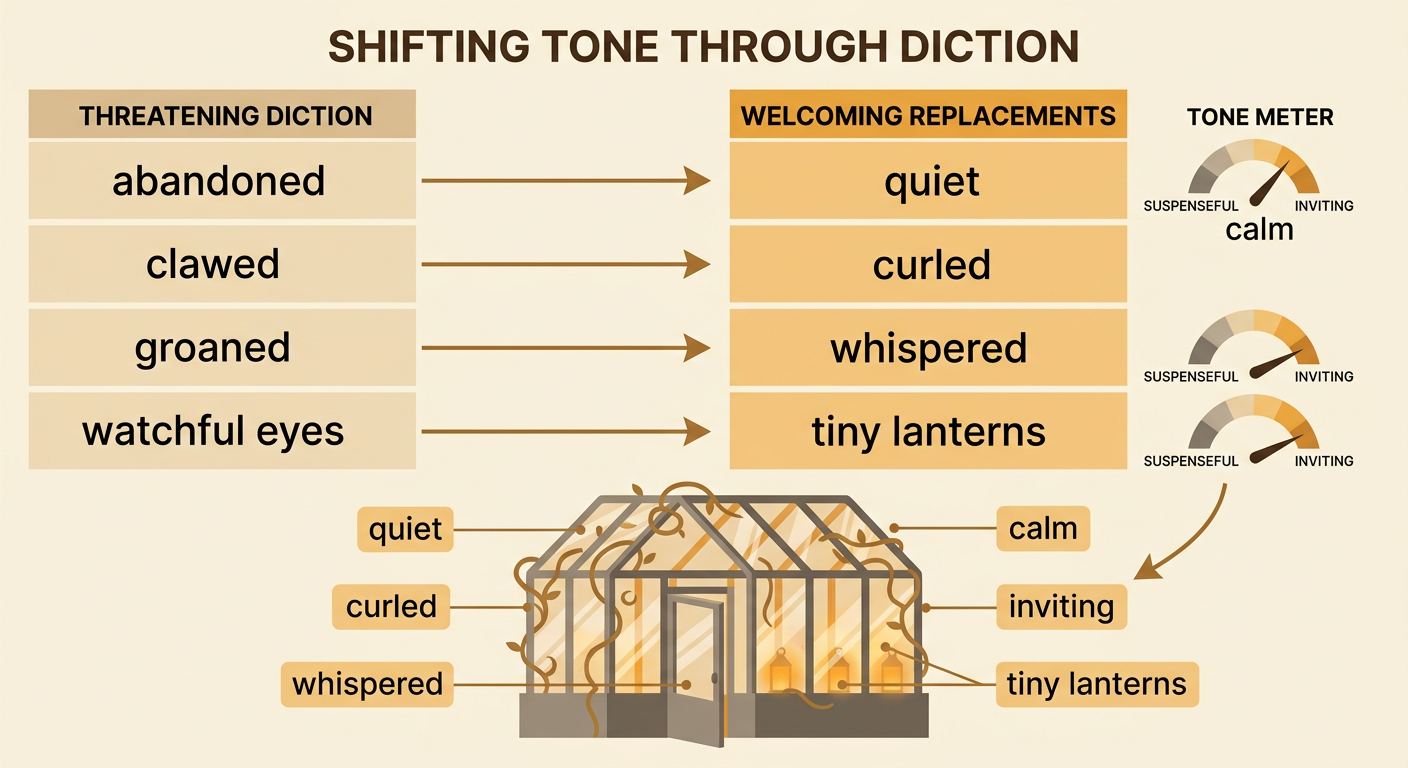
Changing diction can shift tone while keeping the basic characters, setting, and action. To make the greenhouse feel welcoming, replace threatening words with words carrying positive connotations. For example: “At dusk, Maya stood before the quiet greenhouse. Its glass panes held the last light like tiny lanterns. Vines curled around the doorframe, and the door whispered open in the breeze.” “Quiet” feels peaceful rather than deserted. “Curled” suggests gentle growth instead of attack, and “whispered” sounds softer than “groaned.” The lantern simile adds warmth rather than surveillance. The revised tone is calm, inviting, and slightly magical. When revising, change several related words so the new tone remains consistent. Then compare the versions and explain how each replacement changes the image or feeling without changing the central event of Maya approaching the greenhouse.
Write a Text-Based Analysis
A text-based analysis should make a claim, present evidence, and explain the effect of the author’s language. Begin with a precise claim about tone. Then quote one or two important words or phrases and analyze their connotations or figurative meanings. Example: “The author uses threatening diction and personification to create an uneasy, suspenseful tone. The vines ‘clawed’ at the doorframe, a verb associated with an animal’s attack. The greenhouse also ‘swallowed the path,’ making the building seem powerful enough to consume Maya’s escape route. These choices turn an ordinary setting into a hostile presence and emphasize the courage required for Maya to step forward.” Notice that the explanation does more than summarize events. It connects exact evidence to meaning and tone. Finish by checking that every quotation supports the claim and that the reasoning clearly answers how the language affects the passage.
