
Animal Adaptations: Built for Survival
Students analyze how animals’ internal and external structures help them survive, grow, and behave in particular habitats.
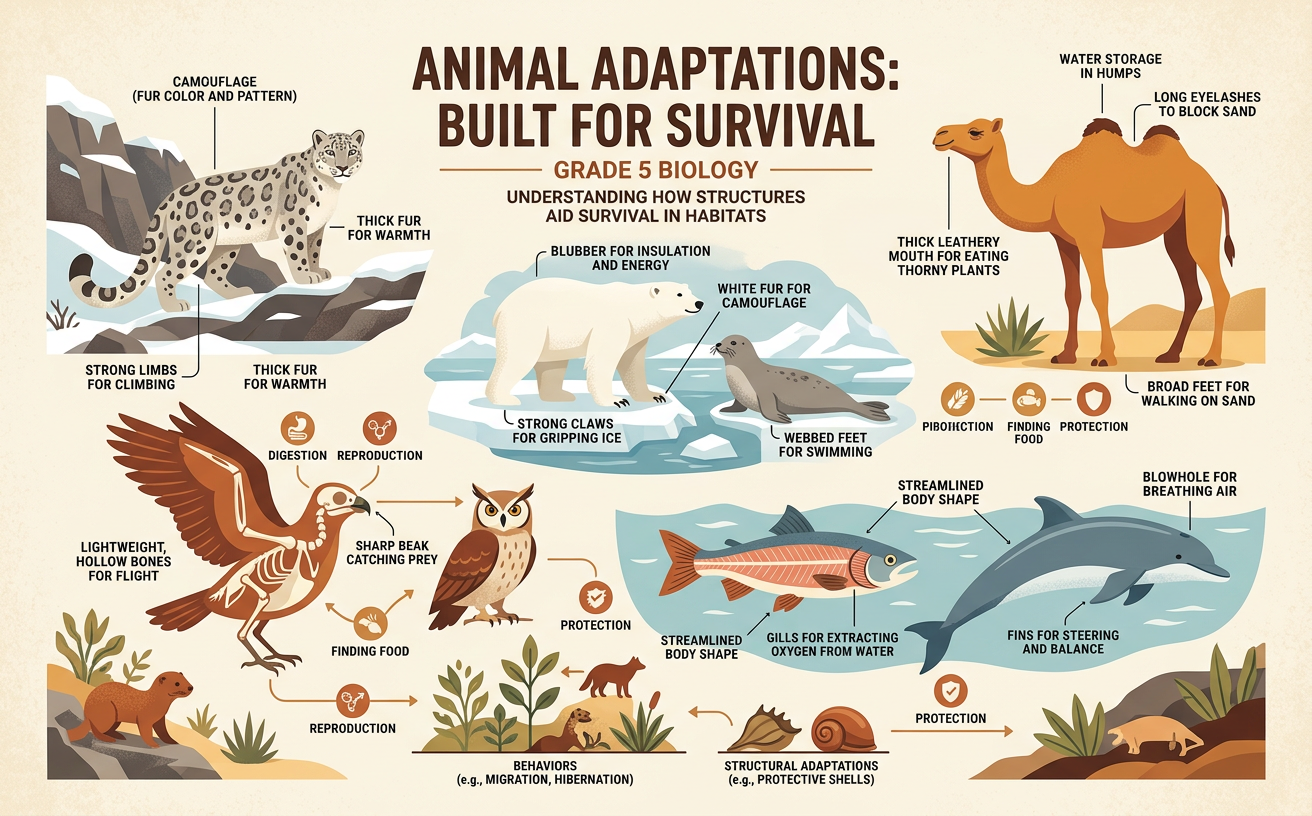
Illustrations are auto-generated and may be placeholders. They can be refreshed to match the narration.
What Is an Adaptation?
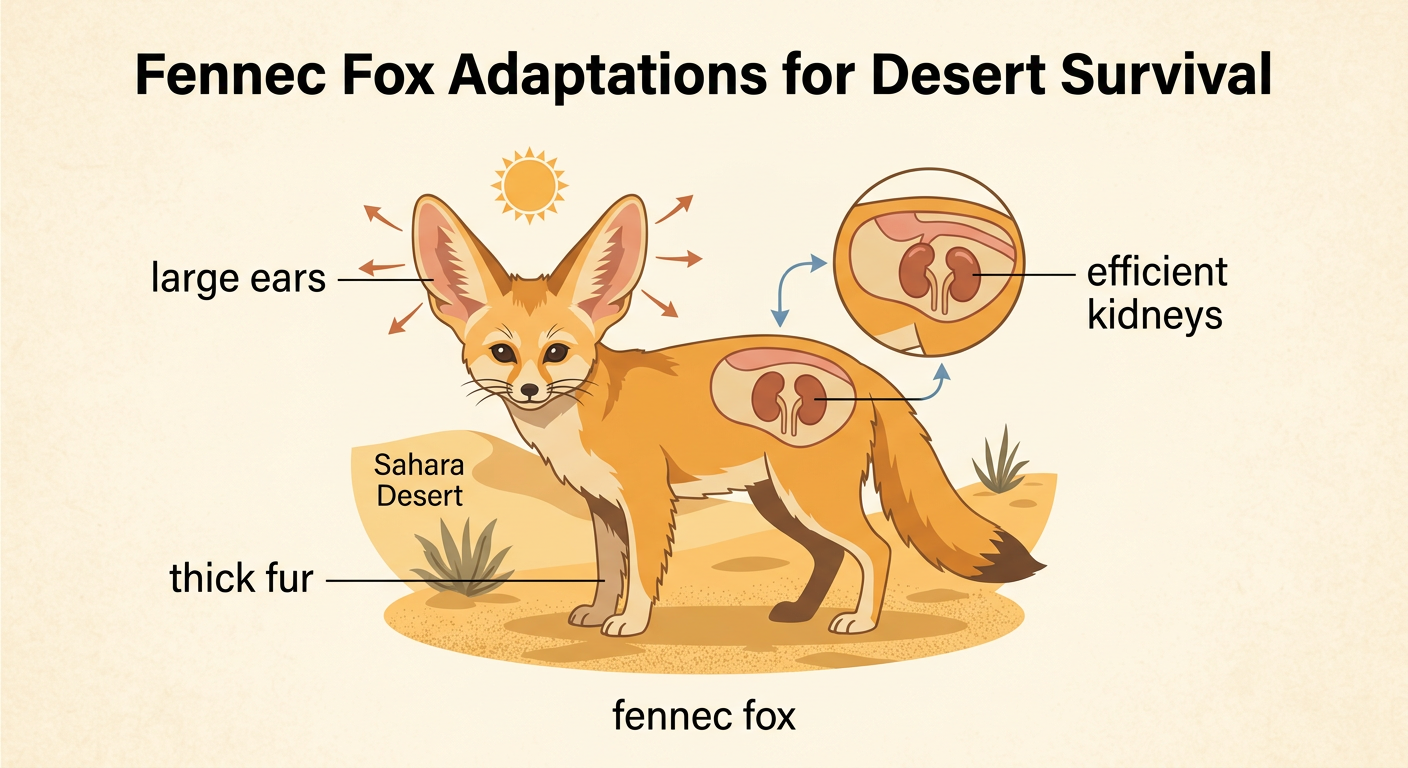
An adaptation is an inherited trait that helps a population survive and reproduce in a particular environment. Adaptations can be body structures, internal parts, or behaviors. They develop in populations over many generations; an individual animal does not choose or grow an adaptation simply because it needs one. For example, the fennec fox lives in the hot, dry Sahara Desert. Its large ears release body heat and help it detect small prey. Thick fur protects its feet from hot sand, while efficient kidneys help conserve water inside its body. These traits improve the fox’s chances of finding food, staying at a safe temperature, and surviving long enough to raise young. A trait is helpful only when it matches the conditions and challenges of the animal’s habitat.
Structures and Their Functions
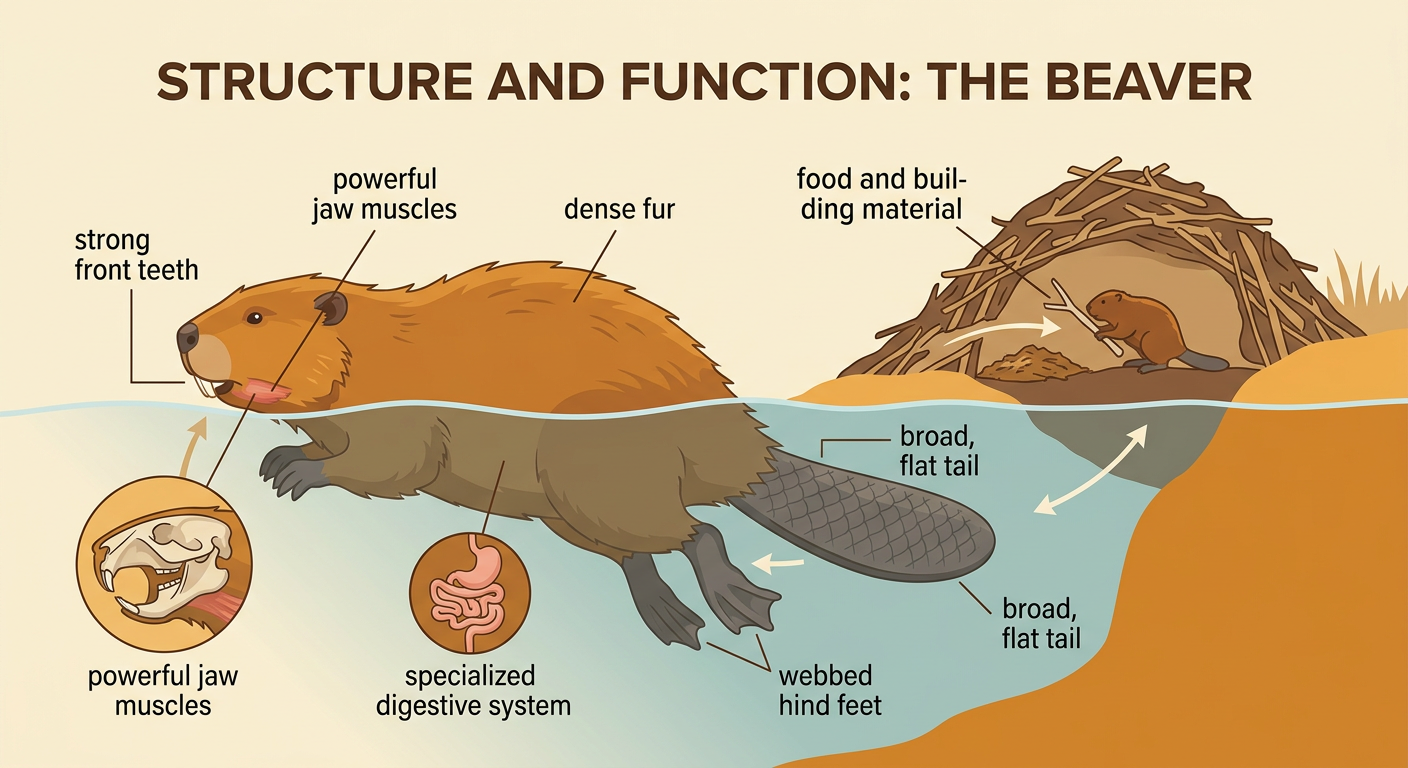
A structure is a body part, and its function is the job it performs. External structures are visible on the outside, while internal structures are inside the body. A beaver’s webbed hind feet push against water, and its broad, flat tail helps with steering and balance. Dense fur traps air near the skin, helping the beaver stay warm in cold water. Strong front teeth cut wood for food and lodge building. Inside the beaver, powerful jaw muscles move those teeth, and a specialized digestive system helps break down plant material. These structures work together. Cutting branches is a feeding behavior, but it also provides building material for a protected lodge. The lodge helps adult beavers and their young avoid predators and harsh weather.
Matching Animals to Habitats
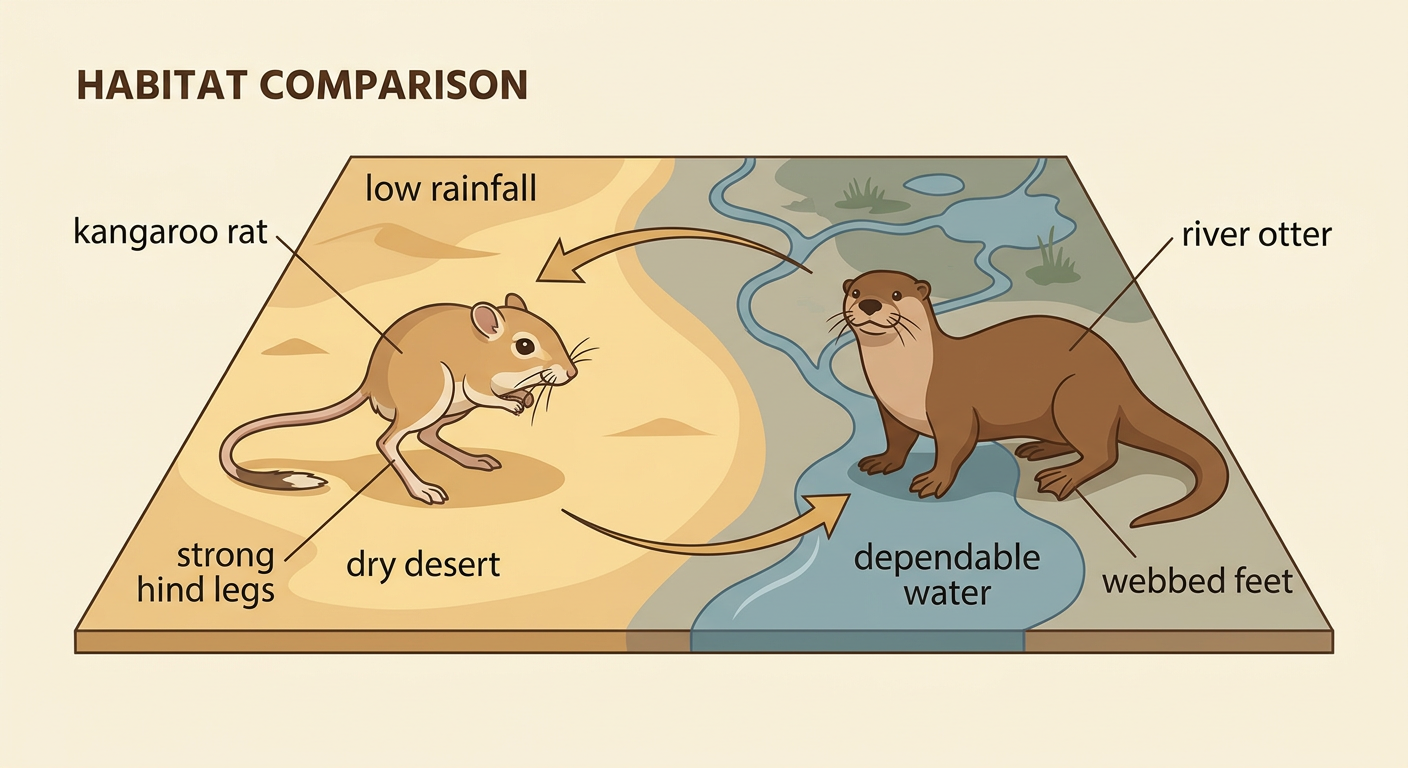
A habitat provides an animal with food, water, shelter, space, and suitable environmental conditions. Maps can show rainfall, temperature, landforms, rivers, and vegetation, allowing scientists to connect locations with animal adaptations. Consider a kangaroo rat and a river otter. A kangaroo rat fits a dry desert with sandy ground and little surface water. Its kidneys conserve water, and its strong hind legs help it escape predators. A river otter fits a habitat with streams, wetlands, or lakes. Its streamlined body, webbed feet, and closable nostrils support swimming and diving. On a rainfall map, the otter is more likely to occur near dependable water, while the kangaroo rat is more likely in an arid region. Matching requires evidence from both the animal’s structures and the habitat’s characteristics.
Analyzing Adaptation Data
Measurements can provide evidence about structures within an animal population. Suppose scientists measure the hind feet of eight snowshoe hares to the nearest one-fourth inch. The results are 5 1/2, 5 1/2, 5 3/4, 5 3/4, 5 3/4, 6, 6, and 6 1/4 inches. On a line plot, each X represents one hare. The most common measurement is 5 3/4 inches because it has three Xs. The difference between the longest and shortest measurements is 3/4 inch. Broad, furry hind feet spread a hare’s weight over snow, reducing how deeply it sinks. However, the measurements alone do not prove that one foot length is best. Scientists should combine the line-plot pattern with observations of movement, snow depth, and survival.
Make an Evidence-Based Survival Claim
A strong scientific argument includes a claim, evidence, and reasoning. The claim answers a question. The evidence comes from measurements, observations, maps, diagrams, or informational texts. The reasoning explains why the evidence supports the claim. For example, claim that an owl’s structures help it hunt at night. Evidence shows that large, forward-facing eyes gather light and help judge distance, while a facial disk directs sound toward the ears. Fringed flight feathers reduce flight noise, allowing the owl to approach prey quietly. The reasoning connects these facts: because the owl can detect, locate, and approach prey in dim conditions, it is more likely to obtain food. That food supplies energy for survival, growth, and raising young. Use precise evidence, explain cause-and-effect relationships, and avoid claims that the evidence does not support.