
Animal Mealtime Patterns
Students observe photographs, identify what different animals eat, and describe the shared pattern that all animals need food to survive.

Illustrations are auto-generated and may be placeholders. They can be refreshed to match the narration.
What Did the Animal Eat?
Animals eat many kinds of food. We can look closely at a photograph to find clues about an animal’s meal. First, name the animal. Next, notice the food near its mouth, paws, beak, or feeding place. A rabbit may nibble green grass. A robin may pull a worm from the soil. A squirrel may hold a nut in its front paws. Ask, “What did the animal eat?” Then answer with evidence from the picture. You might say, “The squirrel ate a nut because I see the nut in its paws.” Do not guess from the animal alone. Use details you can see. Even though these animals eat different foods, each animal gets food to help it live, grow, and move.

Observe Animal Mealtime Photos
Scientists observe carefully. Observe means to use your senses to gather information. Look at one animal mealtime photograph at a time. Notice the animal, its food, and the place around it. For example, a duck may dip its bill into a pond to find water plants. A giraffe may reach leaves high in a tree on a grassland. Ask questions such as, “What food do I see?” and “Where is the animal eating?” Answer by pointing to details in the photograph. Take turns speaking and listening to classmates. One classmate might notice the pond, while another notices a plant in the duck’s bill. Together, these observations show a relationship: animals find food in places where that food is available.

Sort Foods by Type
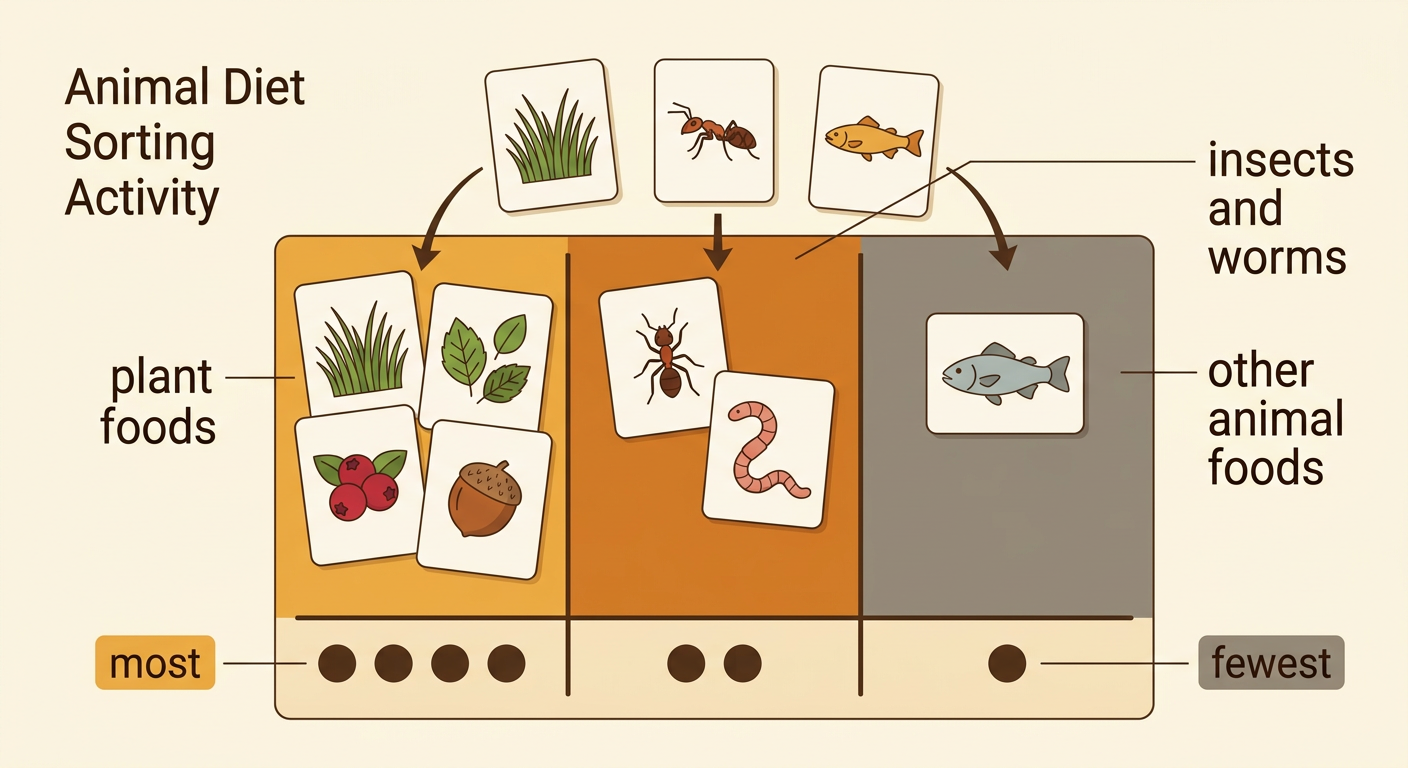
We can classify animal foods by putting similar foods into groups. Make three groups: plant foods, insects and worms, and other animal foods. Grass, leaves, berries, and nuts belong in the plant foods group. Ants, beetles, and worms belong in the insects and worms group. Fish and mice belong in the other animal foods group. Place each food picture in one group. Then count the pictures in every group. For example, if you sort four plant food pictures, two insect and worm pictures, and one other animal food picture, the plant group has the most. The other animal food group has the fewest. Sorting and counting help us notice that animals eat different kinds of food. Compare your groups with a classmate and explain where each picture belongs.
Find the Survival Pattern
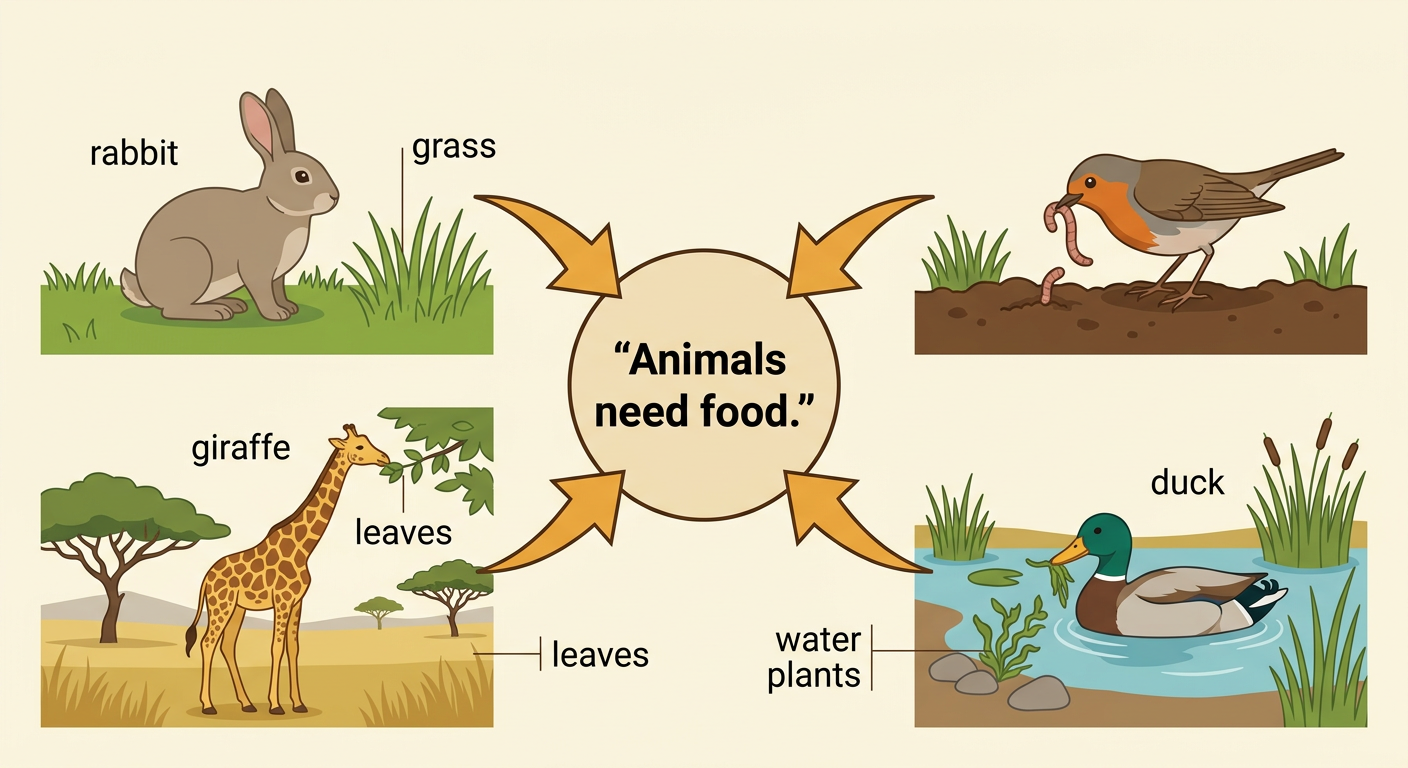
A pattern is something we notice again and again. Think about all the animal photographs. The rabbit eats grass. The robin eats a worm. The duck eats water plants. The giraffe eats tree leaves. Their meals are not the same, but one important pattern is repeated: every animal needs food to survive. Food gives animals materials and energy to live, grow, and move. Animals must find food in places that can provide it. A pond can provide food for some ducks, while a grassland with trees can provide leaves for giraffes. Food is not the only thing animals need, but it is one need shared by all animals. Point to each animal and its food. Say the pattern aloud: “Different animals eat different foods, and all animals need food to survive.”
Share an Evidence-Based Idea
An evidence-based idea uses observations as proof. Choose one animal photograph and make a claim about what the animal eats. Then give evidence from the photograph. For example, say, “I think the beaver eats tree bark because I can see it biting the bark beside the river.” The first part tells your idea. The second part tells what you observed. You can also explain how the place helps the animal find food: “Trees grow near the river, so the beaver can find bark there.” Share your idea with a partner or the class. Listen while others speak. Ask a helpful question, such as, “What detail did you notice?” You may agree, add another observation, or change your idea when new evidence is clear. Finish by connecting your example to the pattern that all animals need food to survive.
