
Animal Parts That Help Them Survive
Students observe animals, identify useful external body parts, and design a simple tool that copies how one animal part works.
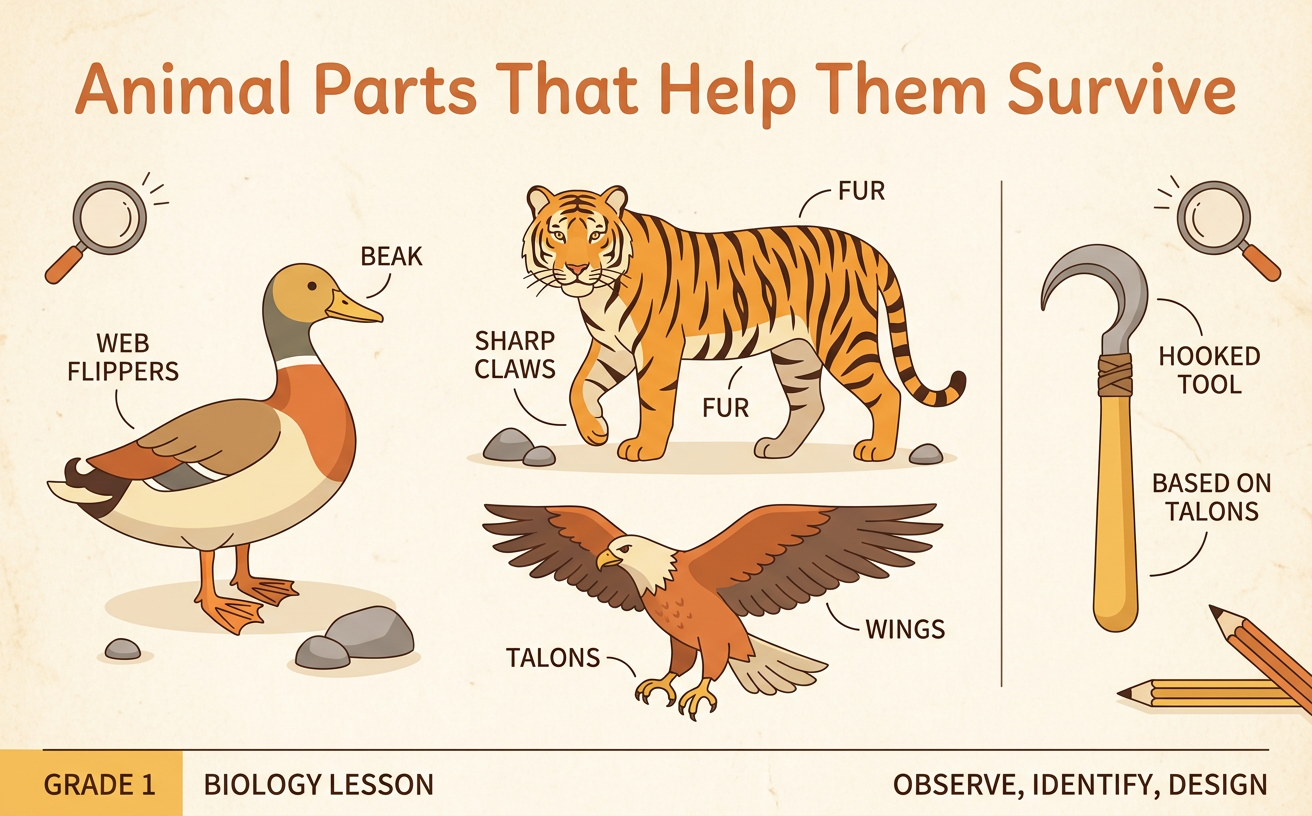
Illustrations are auto-generated and may be placeholders. They can be refreshed to match the narration.
Notice Animal Body Parts
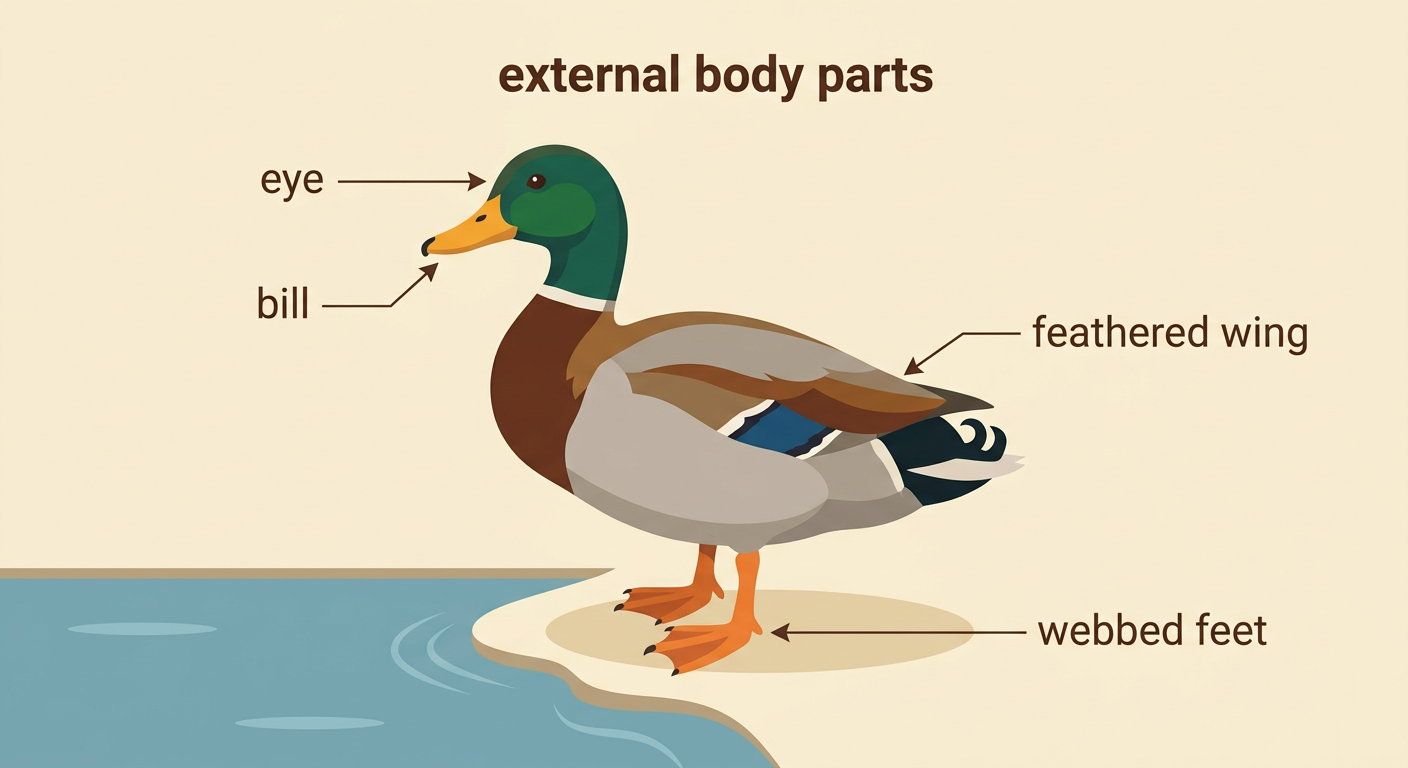
Look closely at an animal from head to tail. What parts can you see on the outside of its body? An animal may have eyes, ears, a mouth, legs, wings, fins, claws, fur, feathers, or scales. These are external body parts. Each part can help the animal live and grow. For example, a duck has a wide, flat bill. The duck uses its bill to gather food from water and mud. Its webbed feet push against the water as it swims. Observe a clear picture of a duck with a partner. Take turns naming one body part and describing its color, shape, size, or texture. Listen carefully when your partner speaks. You may notice something new by sharing your observations.
Match Parts to Jobs
Animal body parts do different jobs. Eyes help many animals see food, danger, and places to go. Ears help animals hear sounds. Legs may help an animal walk, run, jump, dig, or climb. A bird's wings help it fly, while a fish's fins help it swim and steer. The shape of a part often fits its job. For example, an eagle has strong, curved claws called talons. It uses them to grasp food and hold onto branches. Match each pictured body part to its job. Ask yourself, “How does this part work?” Explain your match to a partner using a complete sentence, such as, “A fish's tail fin pushes water and helps the fish move forward.” Some parts can do more than one useful job.

Sort and Count Animal Features
Scientists can sort observations into groups and count them. Look at picture cards showing a duck, eagle, trout, rabbit, turtle, and fox. Choose one feature to study, such as body covering. Place each animal in a category: feathers, fur, scales, or shell. Then count the cards in every group. Record the totals in a picture graph or a table. In this set, the duck and eagle have feathers, so the feather group has two animals. The rabbit and fox have fur, so the fur group also has two. The trout has scales, and the turtle has a shell. Compare the groups by asking which has more, fewer, or the same number. Remember that you are counting the animals in each category, not every feather, hair, or scale.

Connect Animals to Their Habitats
A habitat is the place where an animal lives and finds what it needs. Habitats provide food, water, shelter, and space. An animal's body parts often work well in its habitat. A fish lives in water. Its fins help it move and turn, and its gills take oxygen from the water. A snowshoe hare lives in forests where winters can be snowy. Its large, furry feet spread its weight over soft snow and help it move without sinking deeply. Study images or a simple map of a pond and a snowy forest. Place each animal in the habitat that fits its needs. Then explain the relationship between the place and one animal part. You might say, “The hare's wide feet help it travel across snow in its forest habitat.”

Design a Tool Inspired by an Animal
People can design tools that copy how animal parts work. First, choose one animal part and name its job. For example, a bird's beak can pick up small pieces of food. Your challenge is to make a simple grabber that acts like a beak. Use two craft sticks, a folded strip of cardboard, tape, and small pieces of sponge. Join the sticks at one end so they open and close. Add sponge pieces to the tips for a better grip. Test the grabber by moving soft pom-poms from one cup to another. Do not use it on people or animals. Notice what works and what needs to change. You might move the tape or reshape the tips. Draw your design before building, and use arrows to show how the parts move.

Share and Explain
Share your tool with a small group. Hold up your drawing and model so everyone can see them. Tell which animal part inspired you, what that part does, and how your tool copies its action. For example, say, “My grabber copies a bird's beak. Both open and close to pick up small objects.” Demonstrate one safe test and report what happened. You can organize the class results in categories such as worked well, worked a little, or needs a change. Count the designs in each category and compare the totals. Take turns speaking, listen without interrupting, and ask a helpful question. A classmate might ask, “Why did you add soft grips?” Use feedback to improve your design. Scientists and engineers explain evidence, learn from others, and make their solutions better.
