
Animal Structures Help Animals Survive
Students examine how animals use internal and external structures to move, find food, sense their surroundings, and survive in different habitats.
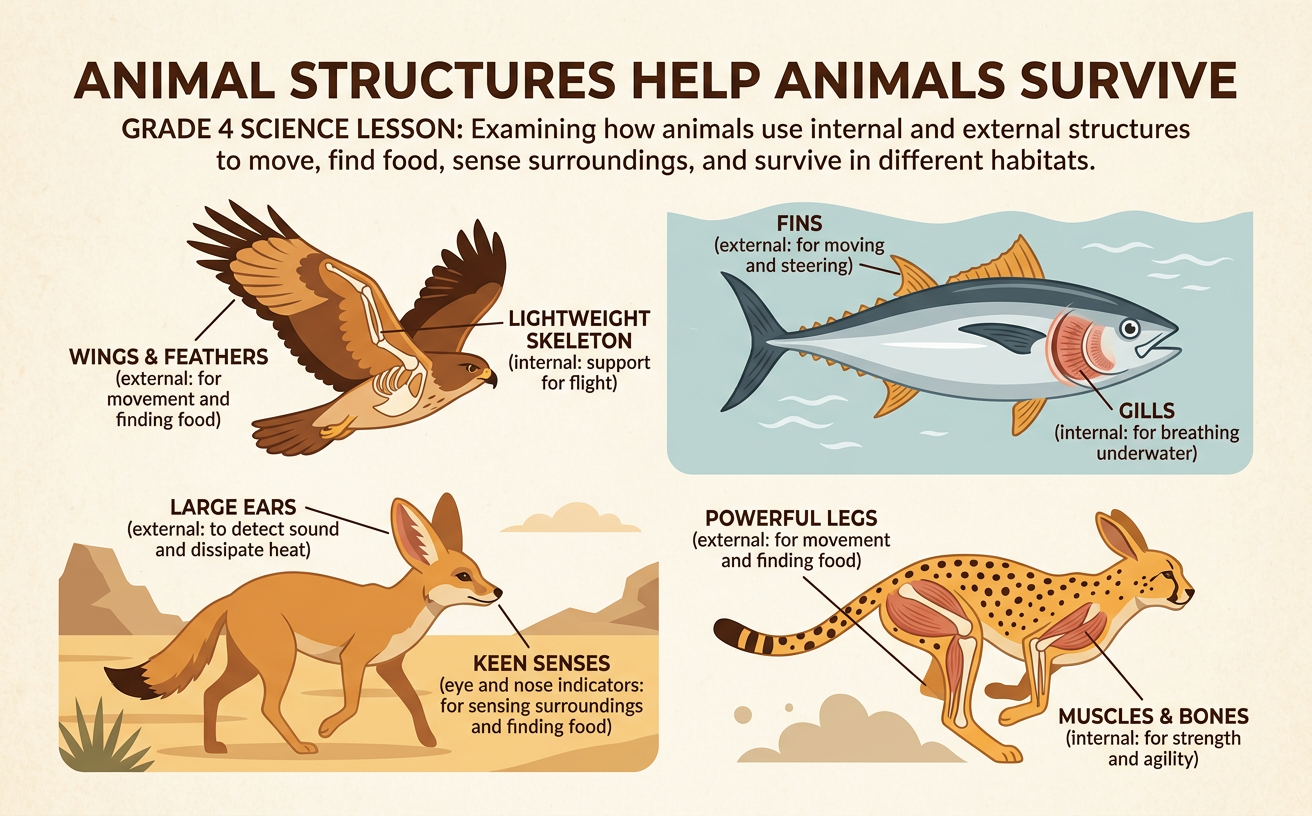
Illustrations are auto-generated and may be placeholders. They can be refreshed to match the narration.
What Are Animal Structures?
An animal structure is a body part with a particular job, or function. Structures help animals move, get food, sense their surroundings, stay safe, grow, and reproduce. Some structures are easy to see, while others are inside the body. Consider a duck. Its webbed feet push against water like paddles, helping it swim. Its broad bill helps it gather plants, insects, and other food from water and mud. Feathers cover and protect its body, and oily outer feathers help keep water away from its skin. The duck’s eyes and ears collect information about nearby food and danger. Each structure has a function, and several structures often work together. By observing what a structure looks like and what an animal does, scientists can explain how that structure supports survival.
Internal and External Structures
External structures are body parts on the outside of an animal, such as fur, claws, wings, scales, and antennae. Internal structures are inside the animal, such as bones, muscles, lungs, the heart, and the stomach. Both kinds of structures support survival. A rabbit’s fur helps it stay warm, while its strong hind legs help it leap away from danger. Inside, leg bones support the rabbit’s body, and muscles pull on the bones to create movement. The lungs take in oxygen, and the heart pumps blood throughout the body. The stomach and intestines help break down food and absorb nutrients for growth. Internal and external structures do not work alone. When a rabbit runs, its eyes detect danger, its brain processes the information, and its muscles, bones, heart, and lungs work together to help it escape.
Matching Structures to Functions
A structure’s shape, material, and location often provide clues about its function. To match a structure to its function, observe the structure closely and use evidence about the animal’s behavior. An owl has large forward-facing eyes that collect light and help it judge distance. Its curved, sharp talons grip prey, while its hooked beak tears food into smaller pieces. Broad wings create lift for flight. Special soft edges on many owl flight feathers reduce the sound of moving air, helping the owl approach prey quietly. These observations support explanations about how the owl hunts. Avoid deciding from appearance alone. Ask what the animal does, when it uses the structure, and what happens because of that structure. A strong explanation connects specific evidence, such as the talons’ curved shape, to a function, such as holding prey securely.
Animals and Their Habitats
A habitat is the place where an animal gets food, water, shelter, and space. Environmental characteristics such as temperature, rainfall, landforms, and vegetation affect which structures are useful there. Maps at different scales help us study these connections. A world map can locate the Sahara Desert in northern Africa. A closer regional map can show sandy areas, rocky ground, and scattered plants. The fennec fox lives in this hot, dry environment. Its large ears detect small prey and release body heat. Thick fur protects it from cold desert nights, while fur on the bottoms of its feet provides protection from hot sand. Its kidneys also help conserve water inside its body. Map evidence shows where the fox lives, and scientific observations explain how its structures function there. Together, location and body evidence help explain why the fox is suited to its habitat.
Build an Evidence-Based Explanation
An evidence-based explanation includes a claim, evidence, and reasoning. The claim answers a question about how a structure supports survival. Evidence includes facts from observations, diagrams, maps, or scientific texts. Reasoning explains why the evidence supports the claim. For example, consider the claim that a beaver’s external structures help it survive in ponds and streams. Evidence shows that its webbed hind feet push water, its flat tail helps with steering and balance in water, and its strong incisors cut wood for food and lodge building. Dense fur traps air near the skin and helps reduce heat loss in cold water. The reasoning connects these facts: because the beaver can swim, gather materials, and remain warm, it can find food and build shelter in its watery habitat. A complete explanation names specific structures, describes their functions, and explains how those functions support survival.