Animal Teams: How Groups Help Members Survive
Students examine evidence about animals that live in groups and explain how group behaviors help members find food, avoid predators, and care for young.

Illustrations are auto-generated and may be placeholders. They can be refreshed to match the narration.
Notice Animal Groups
Animals form many kinds of groups, including herds, packs, flocks, schools, and colonies. Begin by noticing what group members do. Look for animals moving together, sharing food, watching for danger, or staying near their young. Record only what you can see before explaining why it may help. For example, a photograph might show a herd of zebras standing close together while several zebras face different directions. That is an observation. A possible explanation is that more zebras can watch for lions at the same time. If one zebra notices danger and begins to run, the others can respond. Group behavior does not guarantee safety, but it can improve each member’s chance of surviving.

Read for Survival Evidence
Informational texts provide evidence about how animal groups survive. Ask questions before, during, and after reading: What does the group do? What danger or need does the behavior address? Which sentence supports the answer? Consider this example: African wild dogs hunt in packs. Pack members work together to chase prey, and adults may bring food back for pups and other pack members. If asked how the pack helps its members find food, answer by referring directly to the text: The text states that pack members work together to chase prey. This sentence is evidence because it describes a group action connected to getting food. Strong answers use details from the text instead of guesses or opinions.

Match Groups to Habitats
A habitat provides the food, water, shelter, space, and climate an animal needs. Maps, photographs, and satellite images can show how group behavior fits a habitat. For example, emperor penguins gather in large groups on cold Antarctic sea ice. They huddle closely and change positions, allowing different penguins to spend time in the warmer middle. A map shows that Antarctica surrounds the South Pole, while a photograph shows the icy, windy conditions there. Together, these representations help explain why huddling is useful in that location. Compare other habitats too. Fish may school in open water, and elephants may travel in herds across grasslands to reach scattered water sources. Always connect the group behavior to a specific environmental condition.

Build an Evidence Chart
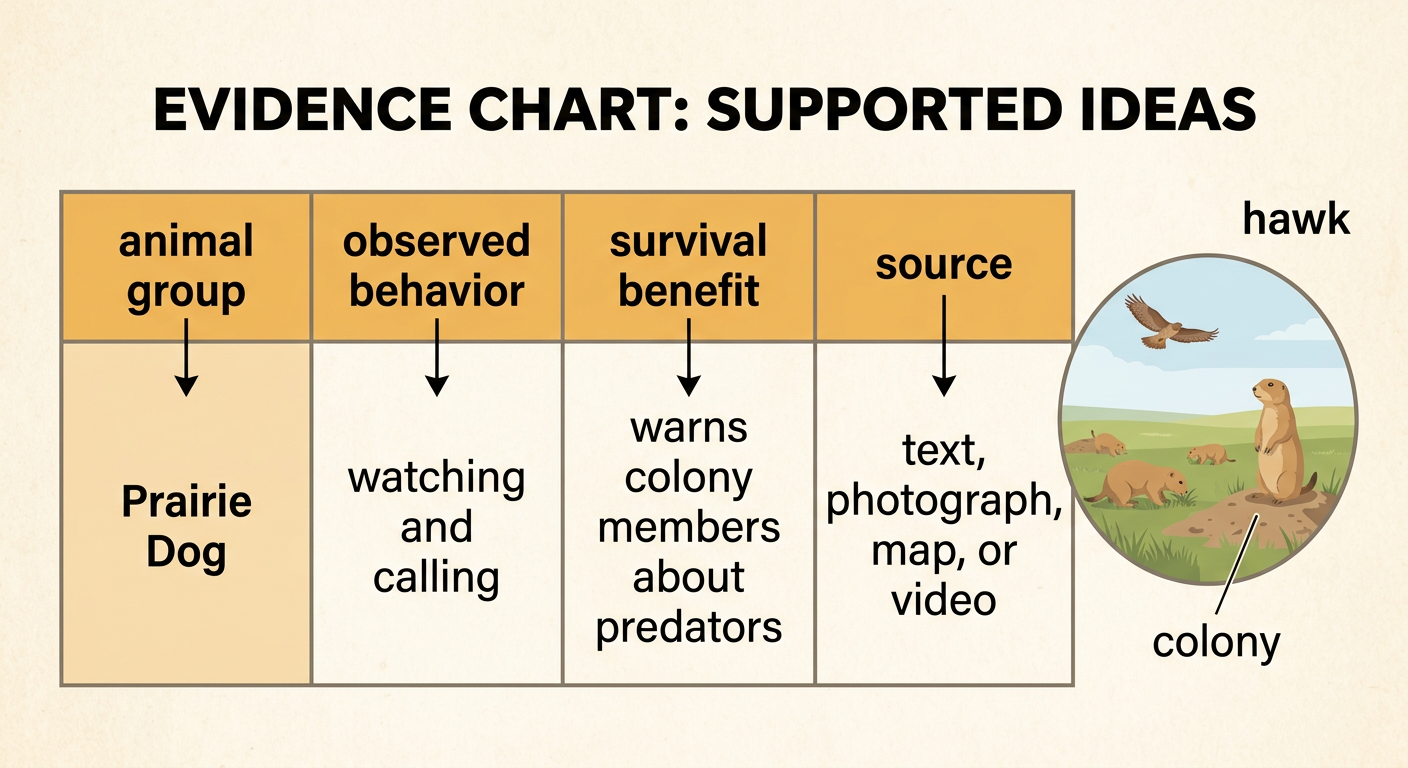
An evidence chart organizes facts so patterns are easier to see. Make columns for the animal group, habitat, observed behavior, and survival benefit. Use information from texts, photographs, maps, or videos. For example, prairie dogs live in colonies in open grasslands. Some prairie dogs watch for predators while others eat. A watcher may make an alarm call when a hawk, coyote, or other threat appears. In the chart, record “watching and calling” as the behavior and “warns colony members about predators” as the benefit. Do not write that prairie dogs call because they are kind; that idea is not supported by the observation. Add the source of each fact. Several clear pieces of evidence make the final explanation stronger.
Make a Survival Argument
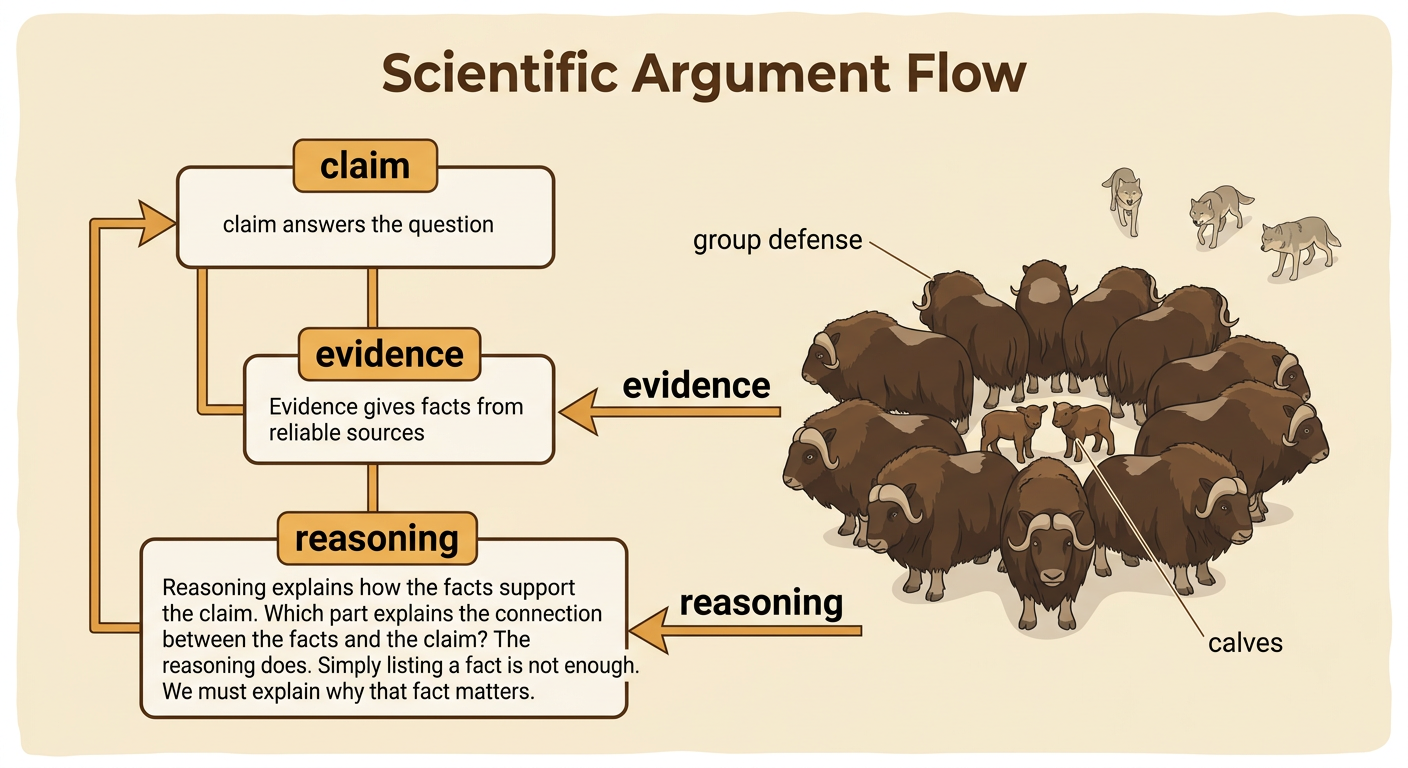
A scientific argument includes a claim, evidence, and reasoning. The claim answers the question. The evidence gives facts from reliable sources. The reasoning explains how those facts support the claim. For example, claim: Some musk oxen form groups that help members survive. Evidence: When threatened by wolves, adult musk oxen may stand together facing outward, with calves protected behind or among them. Reasoning: The adults’ horns and bodies create a group defense, making it harder for a predator to reach a calf. This evidence supports the claim that grouping can help musk oxen avoid predators and protect young. Check that every piece of evidence matches the claim. Then explain the connection clearly rather than simply listing facts.