
Antibiotic Resistance: Natural Selection in Action
Students analyze how variation, inheritance, and antibiotic exposure cause resistant bacteria to become more common over generations.
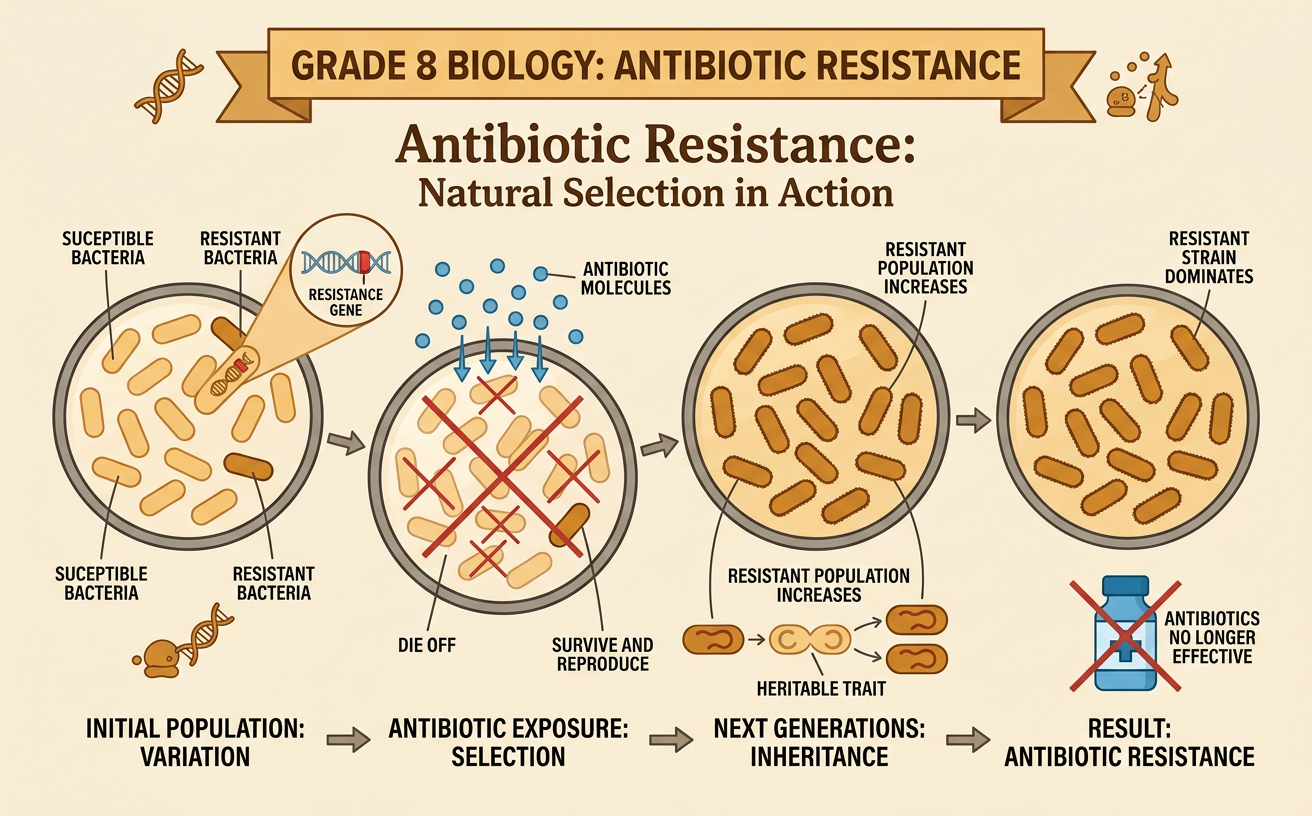
Illustrations are auto-generated and may be placeholders. They can be refreshed to match the narration.
Bacterial Variation
A bacterial population is not made of perfectly identical cells. Random changes in DNA, called mutations, can create genetic variation. Bacteria can also receive resistance genes from other bacteria. Some variations affect traits such as how a cell wall is built or how a bacterium responds to a drug. Before an antibiotic is used, a few bacteria may already carry a variation that gives resistance. The antibiotic does not cause bacteria to develop resistance because they need it. For example, in a population of 1,000 bacteria, perhaps five already have a gene that helps them survive a certain antibiotic. This variation may not matter until the environment changes. When that antibiotic appears, the resistant trait can affect which bacteria survive and reproduce.

How Antibiotics Apply Selection Pressure
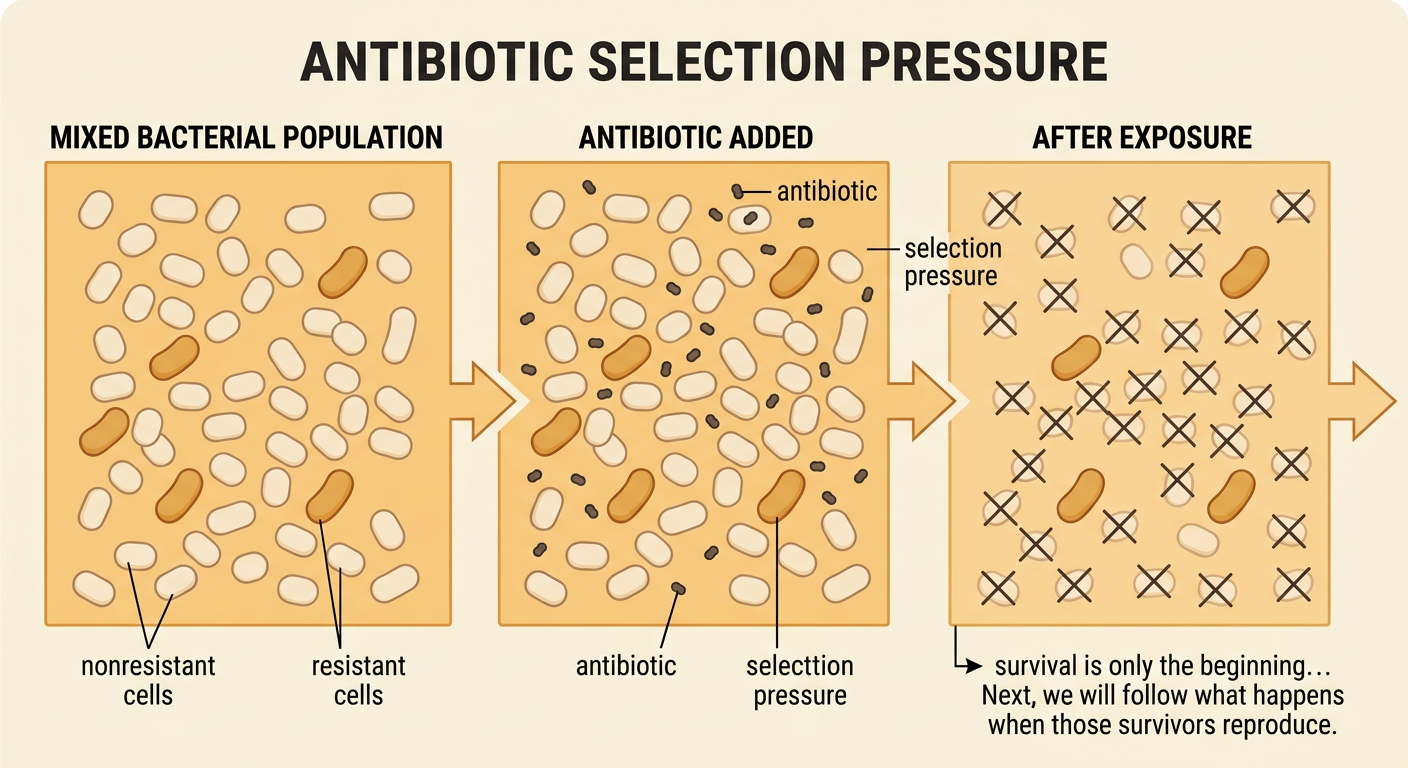
An antibiotic is an environmental factor that creates selection pressure on a bacterial population. A correctly chosen antibiotic kills bacteria or stops them from growing, but its effects can differ because the bacteria have genetic variations. Nonresistant bacteria are more likely to die, while bacteria with a helpful resistance trait are more likely to survive. Imagine a culture containing 100 bacteria, including four resistant cells. After antibiotic exposure, most of the 96 nonresistant cells die, but the four resistant cells survive. The antibiotic did not choose resistance on purpose or teach individual bacteria to change. Instead, it changed which existing traits were most useful in that environment. If no antibiotic were present, the resistant trait might offer little advantage and could sometimes require extra energy to maintain.
Survival and Reproduction
Natural selection changes populations across generations, not individual bacteria during their lifetimes. After antibiotic exposure, surviving resistant bacteria have access to space and nutrients that dead bacteria no longer use. Bacteria reproduce by binary fission, in which one cell divides into two cells. The daughter cells usually inherit copies of the parent’s resistance genes. For example, if four resistant bacteria survive and each population doubling produces twice as many cells, they can become 8, then 16, then 32 resistant bacteria. After many generations, resistant bacteria may make up most of the population. Their increasing frequency is evidence of natural selection: inherited variation affected survival and reproduction in a specific environment. New mutations can still occur, but reproduction mainly spreads the resistance traits already carried by the survivors.

Reading Resistance Data
Resistance data can show how a bacterial population changes over time. Suppose a laboratory measures the percentage of resistant bacteria after repeated antibiotic treatments. The results are 5% at generation 0, 20% at generation 5, 55% at generation 10, and 85% at generation 15. The median of these four percentages is 37.5%, found by averaging the two middle values, 20% and 55%. The range is 80 percentage points, from 5% to 85%. More importantly, the graph shows a strong upward trend: resistance increases by 80 percentage points over 15 generations. This evidence supports the explanation that resistant bacteria had a greater probability of surviving and reproducing in the antibiotic environment. The data show association and population change; researchers would use controlled studies to establish the antibiotic’s specific effects.

Why Resistance Spreads
Antibiotic resistance can spread in more than one way. Resistant bacteria reproduce and pass genes to their offspring, a process called vertical gene transfer. Bacteria can also exchange genetic material through horizontal gene transfer. For example, one bacterium may pass a small DNA ring called a plasmid to another bacterium, sometimes even one from a different bacterial species. If the plasmid carries a resistance gene, the receiving cell may gain resistance. People, animals, food, water, soil, and frequently touched surfaces can then help resistant bacteria move between places. International travel and trade can carry them across long distances. Not every contact causes infection, and resistance itself is not contagious like a cold. Rather, bacteria or their resistance genes spread, increasing the chance that some infections will be difficult to treat.

Using Antibiotics Responsibly
Responsible antibiotic use can reduce unnecessary selection pressure while protecting people who need treatment. Antibiotics treat certain bacterial infections, but they do not cure viral illnesses such as colds or influenza. Patients should use antibiotics only when prescribed, follow the directions, and ask a health professional what to do about missed doses or side effects. They should never share leftover medicine or pressure a clinician for an antibiotic. Hospitals can track resistant infections, improve sanitation, and choose drugs using laboratory test results. Farms can use veterinary guidance and disease-prevention practices, while communities can support vaccination, clean water, handwashing, surveillance, and research. These options have different costs and benefits, but coordinated action is strongest. For example, a school can teach handwashing and encourage families to seek qualified medical advice rather than requesting antibiotics for every sore throat.
