
Antibiotic Resistance: Natural Selection in Action
Students use evidence to explain how antibiotic use creates selection pressures that increase the frequency of resistant bacteria and consider how public policy can limit resistance.

Illustrations are auto-generated and may be placeholders. They can be refreshed to match the narration.
Variation in Bacterial Populations
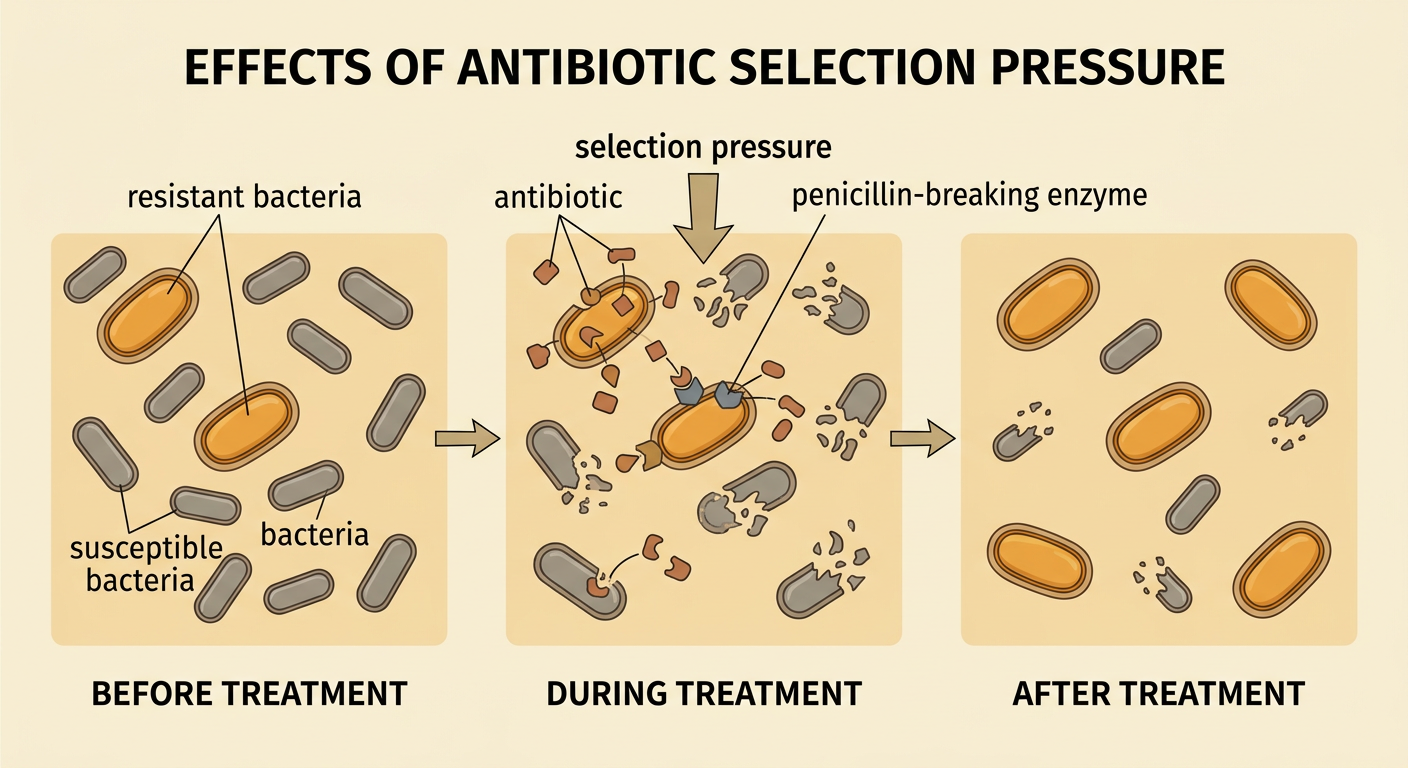
A bacterial population is not made of genetically identical individuals. Random mutations can create new traits as bacteria reproduce, and bacteria may also gain resistance genes through horizontal gene transfer. These changes occur before exposure to an antibiotic; the antibiotic does not cause bacteria to develop the specific mutations they need. For example, imagine a population of 1,000 Staphylococcus bacteria. Most are easily killed by an antibiotic, but a few already carry a gene that helps them survive it. Resistance may involve breaking down the drug, changing the drug’s target, or pumping the drug out of the cell. This inherited variation provides the raw material for natural selection. When environmental conditions change, some variants may survive and reproduce more successfully than others.

Antibiotics as a Selection Pressure
Antibiotics kill bacteria or slow their growth by interfering with essential processes, such as building cell walls or making proteins. When an antibiotic enters a varied bacterial population, it acts as a selection pressure. Susceptible bacteria are more likely to die, while bacteria with helpful resistance traits are more likely to survive. The antibiotic does not choose traits intentionally or make individual bacteria adapt. Instead, it changes which existing variants have greater reproductive success. For example, when penicillin is used against a mixed population, bacteria that produce a penicillin-breaking enzyme may survive while nearby susceptible bacteria die. If an antibiotic is used when it is not medically necessary, bacteria can still experience this selection pressure, increasing opportunities for resistant variants to become more common.
Survival and Reproduction of Resistant Bacteria
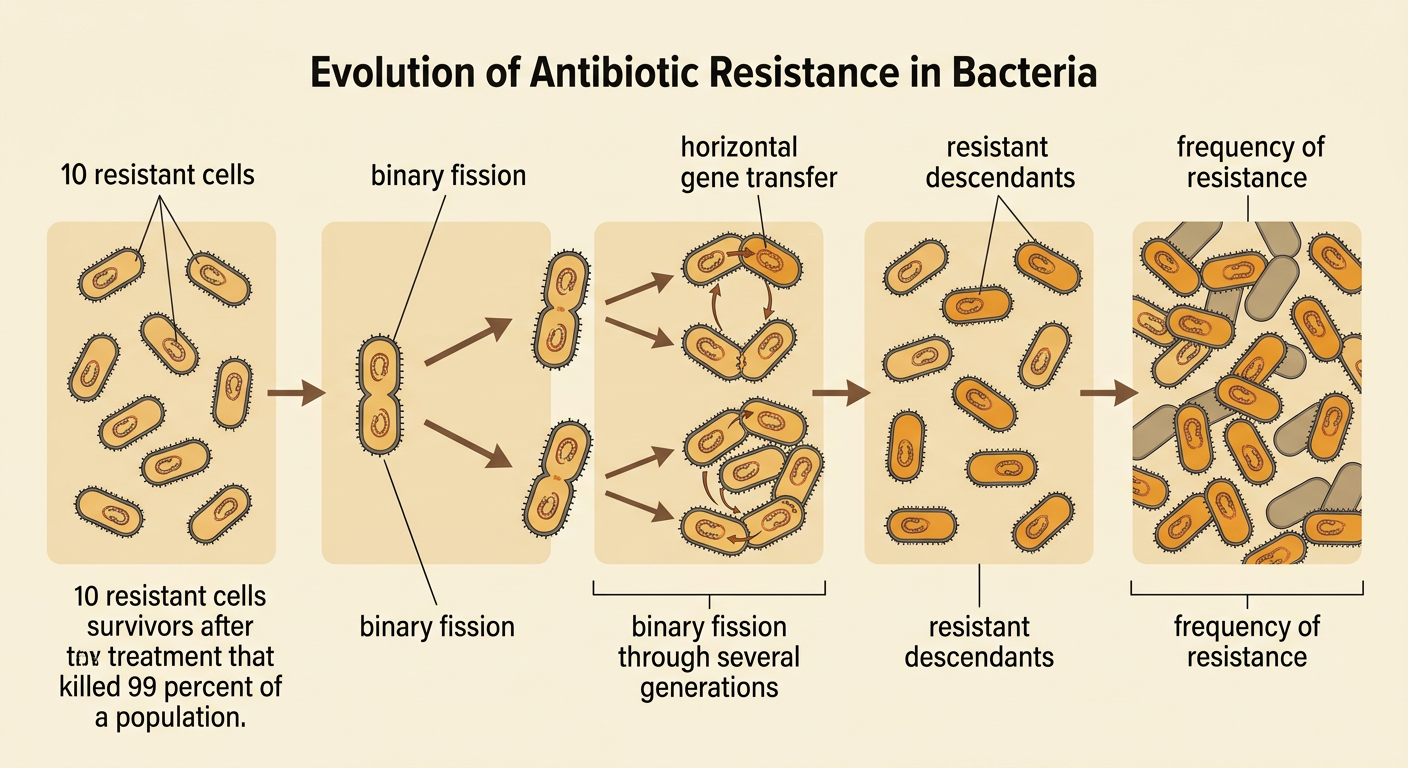
Natural selection continues after antibiotic exposure because surviving bacteria reproduce. Bacteria usually reproduce by binary fission, in which one cell divides into two genetically similar cells. A resistant survivor can therefore produce many resistant descendants in a short time when food and space are available. Resistance genes can also spread between some bacteria through horizontal gene transfer. For example, suppose treatment kills 99 percent of a bacterial population but leaves 10 resistant cells alive. If those cells divide repeatedly, their descendants may rebuild the population, now with a much higher frequency of resistance. The antibiotic did not strengthen every bacterium. Instead, resistant bacteria left more offspring than susceptible bacteria. This difference in survival and reproduction changes the genetic makeup of the population across generations.
Reading Evidence from Resistance Data
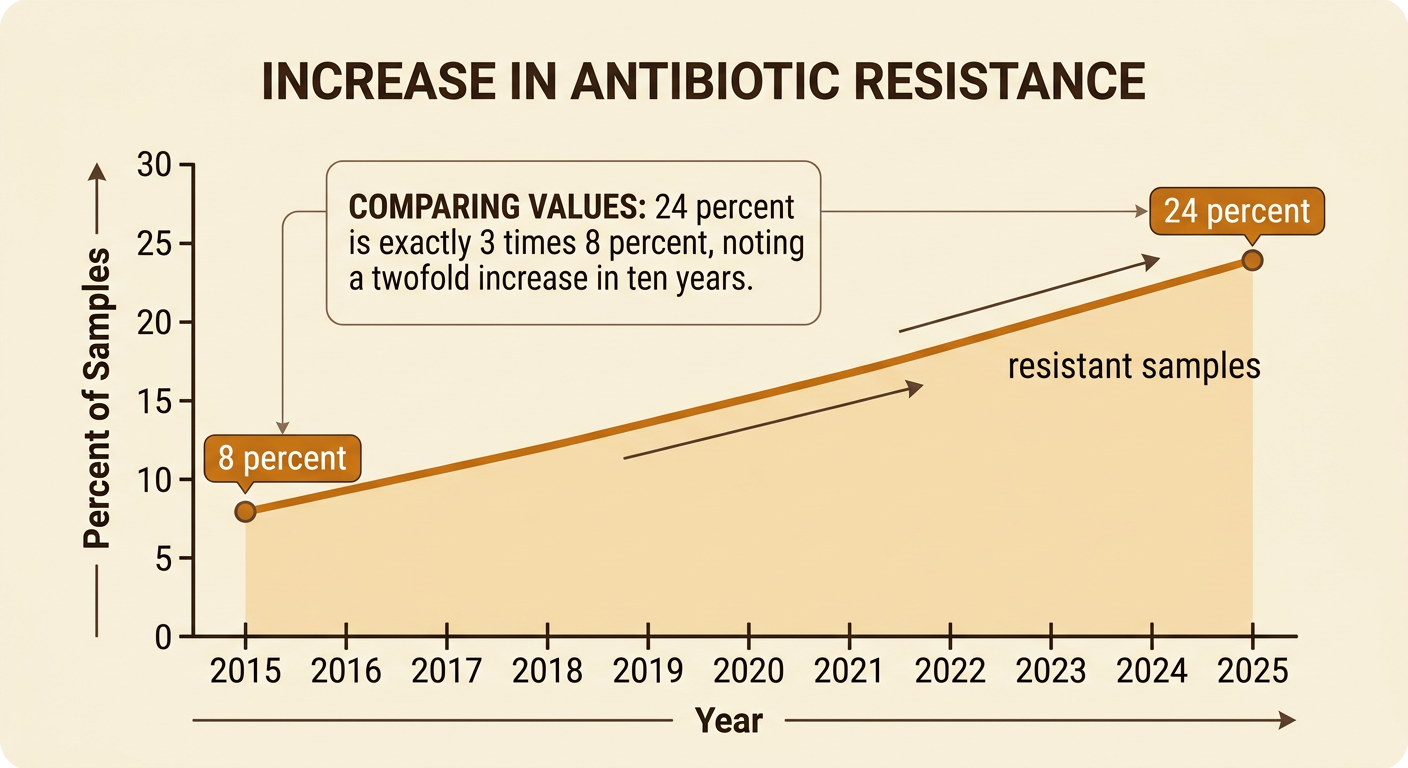
Scientists track resistance by testing bacterial samples and calculating the percentage that resist a particular antibiotic. To interpret a graph, first read the title, axes, units, dates, and legend. Then identify the trend and cite exact values as evidence. For example, a report might show that resistance in sampled infections rose from 8 percent in 2015 to 24 percent in 2025. A strong evidence statement would say, “The proportion of resistant samples tripled from 8 percent to 24 percent over ten years.” That result supports the claim that resistance became more frequent in the sampled population. However, the graph alone may not prove why the increase occurred. Scientists also examine antibiotic use, patient groups, sampling methods, and other possible causes before drawing a complete conclusion.
Explaining Adaptation by Natural Selection
An explanation of antibiotic resistance should connect variation, selection pressure, survival, inheritance, and population change. First, some bacteria possess heritable resistance before treatment. Second, the antibiotic kills or limits many susceptible bacteria. Third, resistant bacteria survive at higher rates and produce more descendants. Over generations, resistance genes increase in frequency, so the population becomes adapted to an environment containing that antibiotic. For example, repeated use of the same antibiotic in a hospital can favor strains that survive the drug, causing later infections to be harder to treat. Individual bacteria do not become resistant because they try or need to change. Adaptation describes a change in the population across generations. A strong explanation cites evidence, such as survival results or resistance percentages, and shows how that evidence supports each step of natural selection.

Public Health Policies and Antibiotic Stewardship
Antibiotic stewardship means using antibiotics only when needed and choosing the correct drug, dose, and treatment length. These practices reduce unnecessary selection pressure while still treating bacterial infections. Antibiotics do not cure viral illnesses such as influenza, so policies may require prescriptions, hospital review of antibiotic orders, resistance reporting, or limits on routine antibiotic use in agriculture. For example, a state could require health facilities to report certain resistant infections and maintain stewardship programs. Patients, physicians, farmers, pharmaceutical companies, and public officials may support or challenge such rules based on health, cost, access, or economic concerns. Students can evaluate a policy by asking whether evidence shows that it reduces misuse, protects individual patients, and slows community spread. Because resistant bacteria cross borders, local actions often work best alongside national and international cooperation.
