
Antibiotic Resistance: Natural Selection in Action
Students analyze bacterial population data to explain how antibiotic use drives natural selection and evaluate strategies for slowing antibiotic resistance.
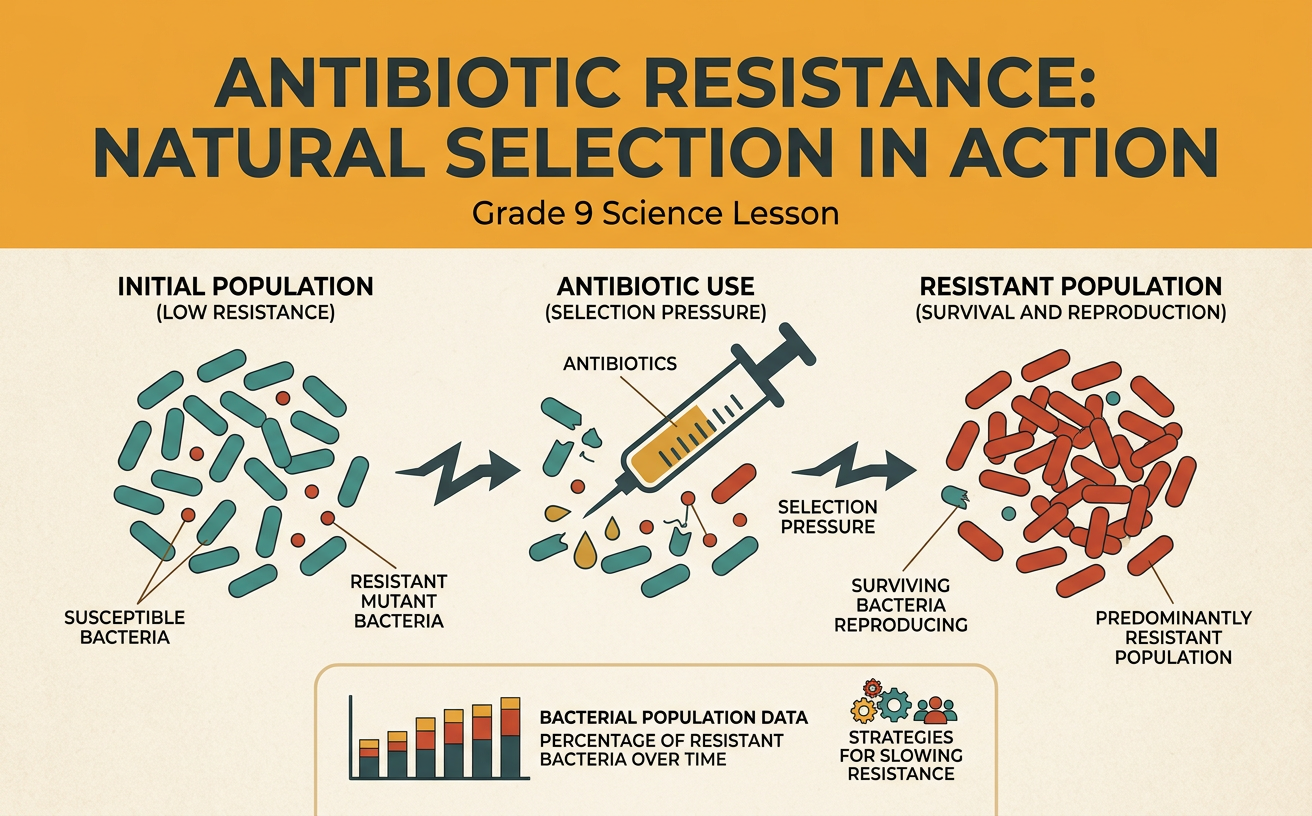
Illustrations are auto-generated and may be placeholders. They can be refreshed to match the narration.
Variation in Bacterial Populations
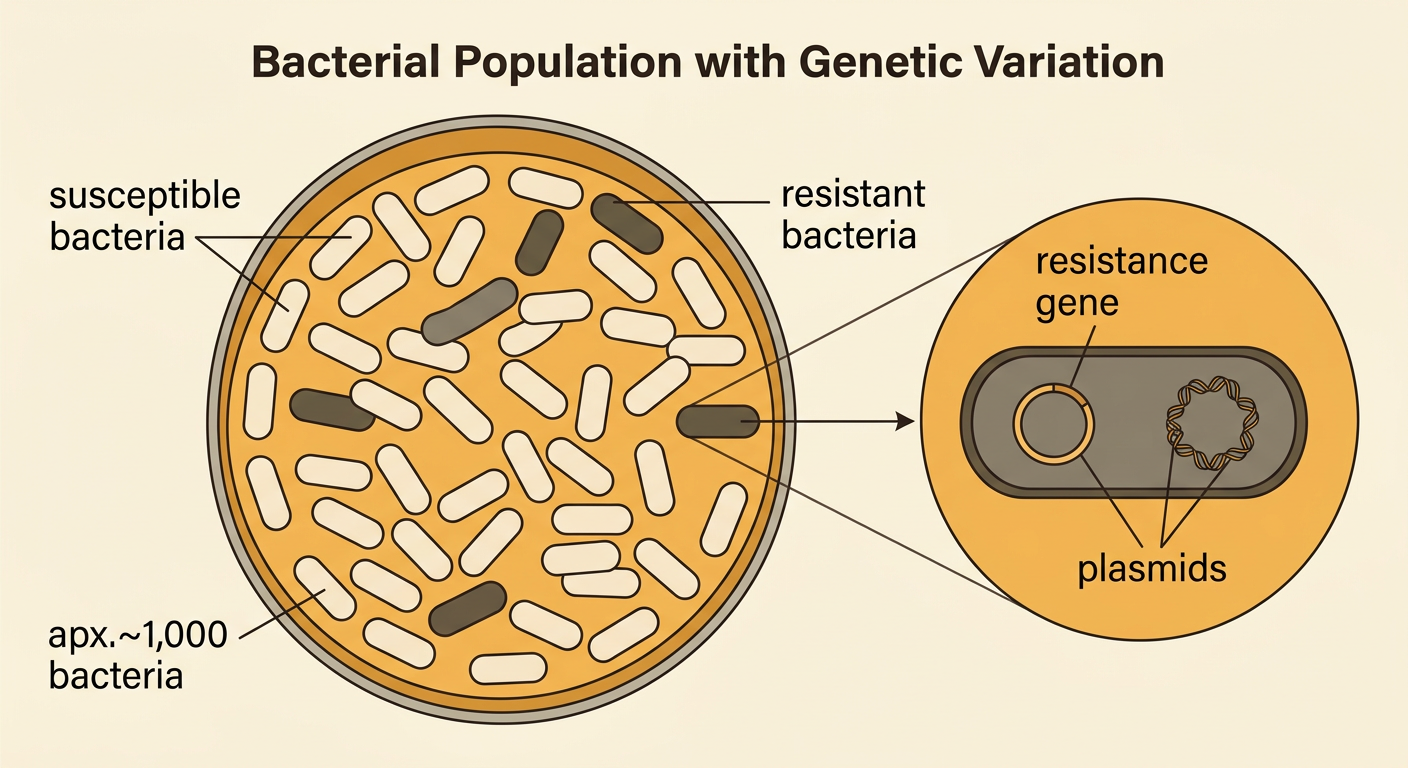
A bacterial population contains genetic variation. Random mutations during DNA copying can give some bacteria traits that others lack. Bacteria can also acquire resistance genes from other bacteria through small DNA molecules called plasmids. Some variations allow bacteria to survive a particular antibiotic. Importantly, the antibiotic does not create a needed mutation; resistant variants may already be present before treatment begins. For example, in a population of 1,000 bacteria, 990 might be susceptible to an antibiotic while 10 carry a resistance gene. The resistant bacteria are not necessarily stronger in every environment, but they have an advantage when that antibiotic is present. Because resistance traits can be inherited, the population has the raw material needed for natural selection.
How Antibiotics Create Selection Pressure
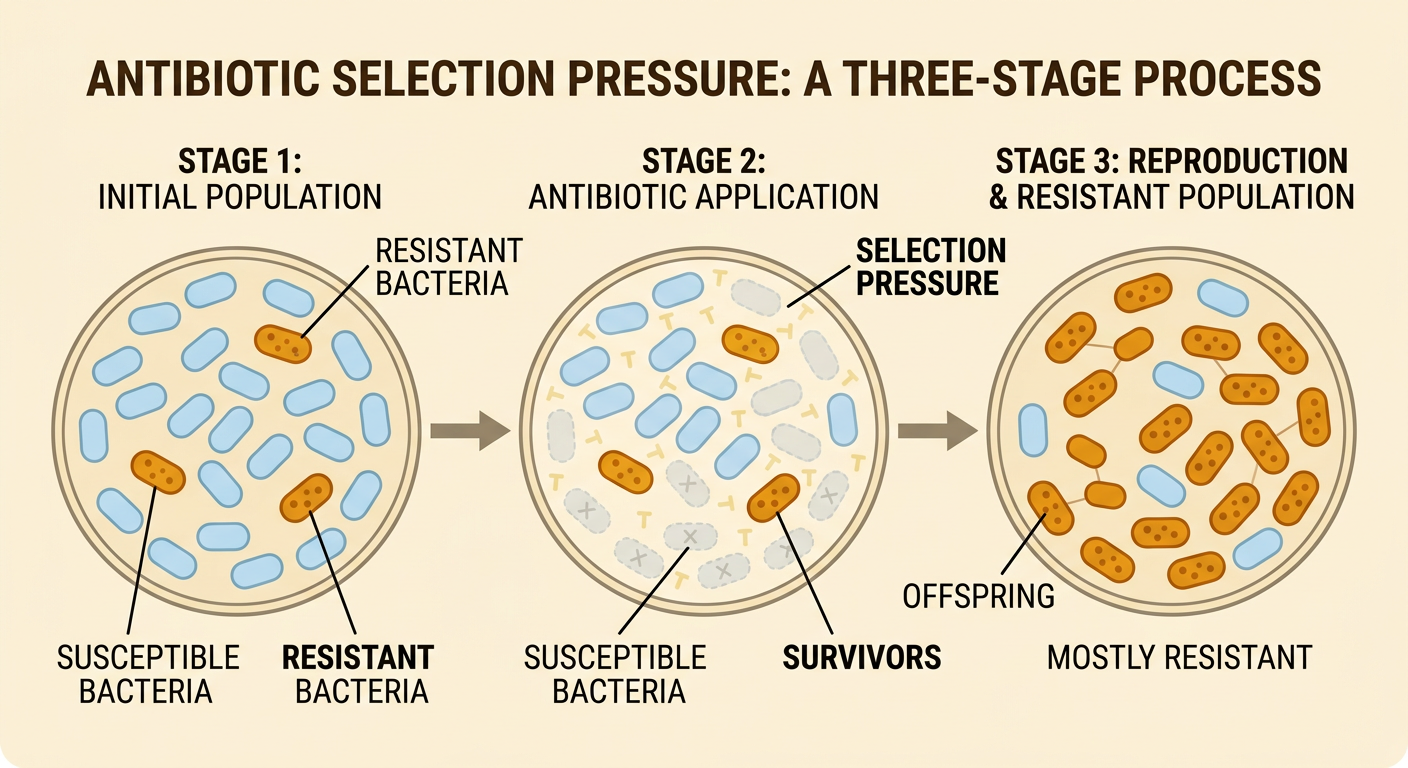
An antibiotic creates selection pressure by changing which bacteria are most likely to survive and reproduce. When a patient takes an effective antibiotic, susceptible bacteria are killed or prevented from reproducing. Bacteria with a resistance trait are more likely to survive. These survivors reproduce rapidly and pass resistance genes to their offspring, so resistance becomes more common in later generations. For example, suppose an infection begins with 990 susceptible bacteria and 10 resistant bacteria. Treatment might eliminate nearly all susceptible cells but leave several resistant cells alive. Those survivors can multiply until they form a new population dominated by resistance. The individual bacteria did not choose to adapt. Instead, antibiotic exposure changed the frequency of an inherited trait within the population.
Interpreting Resistance Data
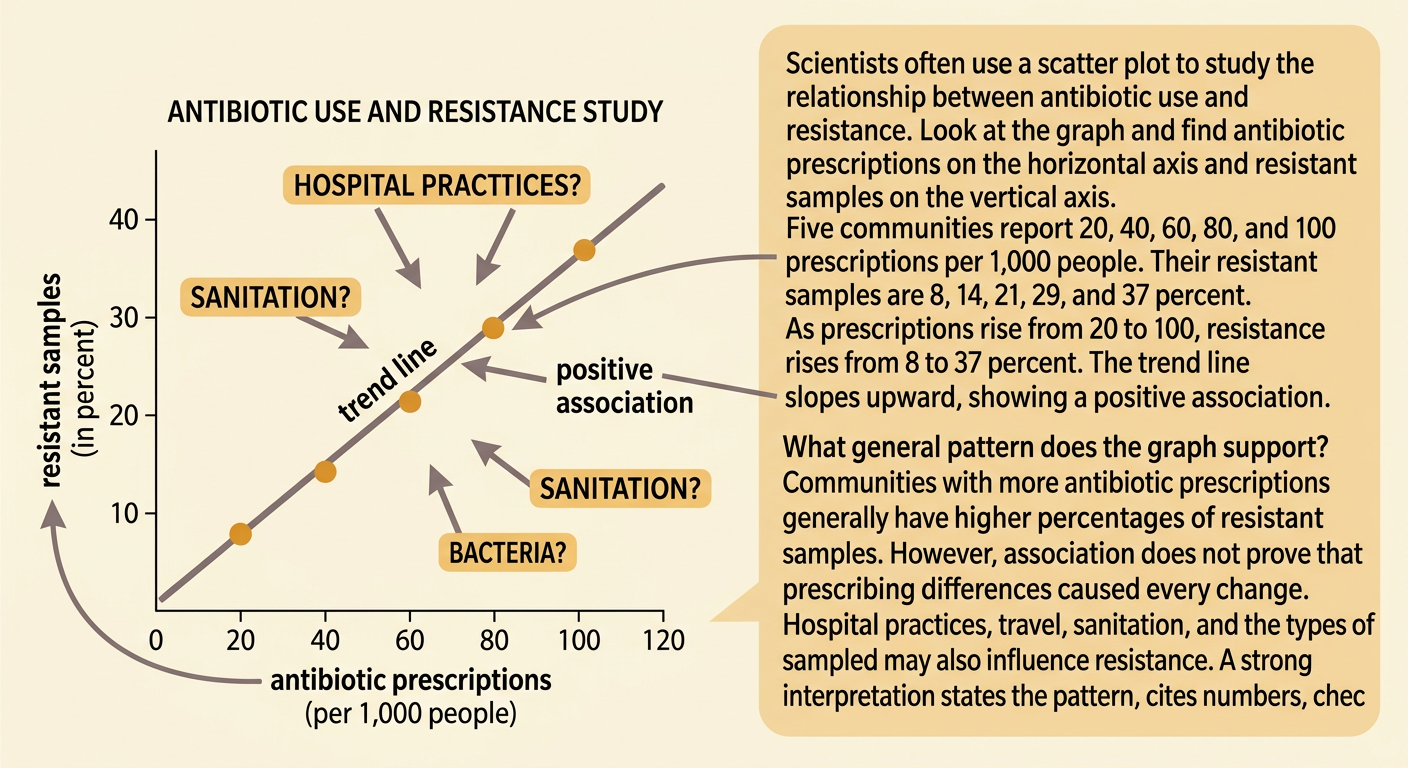
Scientists use graphs to examine relationships between antibiotic use and bacterial resistance. Imagine five communities reporting 20, 40, 60, 80, and 100 antibiotic prescriptions per 1,000 people. Their corresponding percentages of resistant bacterial samples are 8, 14, 21, 29, and 37 percent. A scatter plot of these data would show an upward trend: communities with more prescriptions generally have higher resistance percentages. A trend line can summarize the positive association between the two variables. However, association alone does not prove that prescribing differences caused every change in resistance. Hospital practices, travel, sanitation, and the types of bacteria sampled could also affect the results. A strong interpretation identifies the pattern, cites numerical evidence, considers unusual data points, and acknowledges possible additional variables.
Explaining Adaptation Through Natural Selection
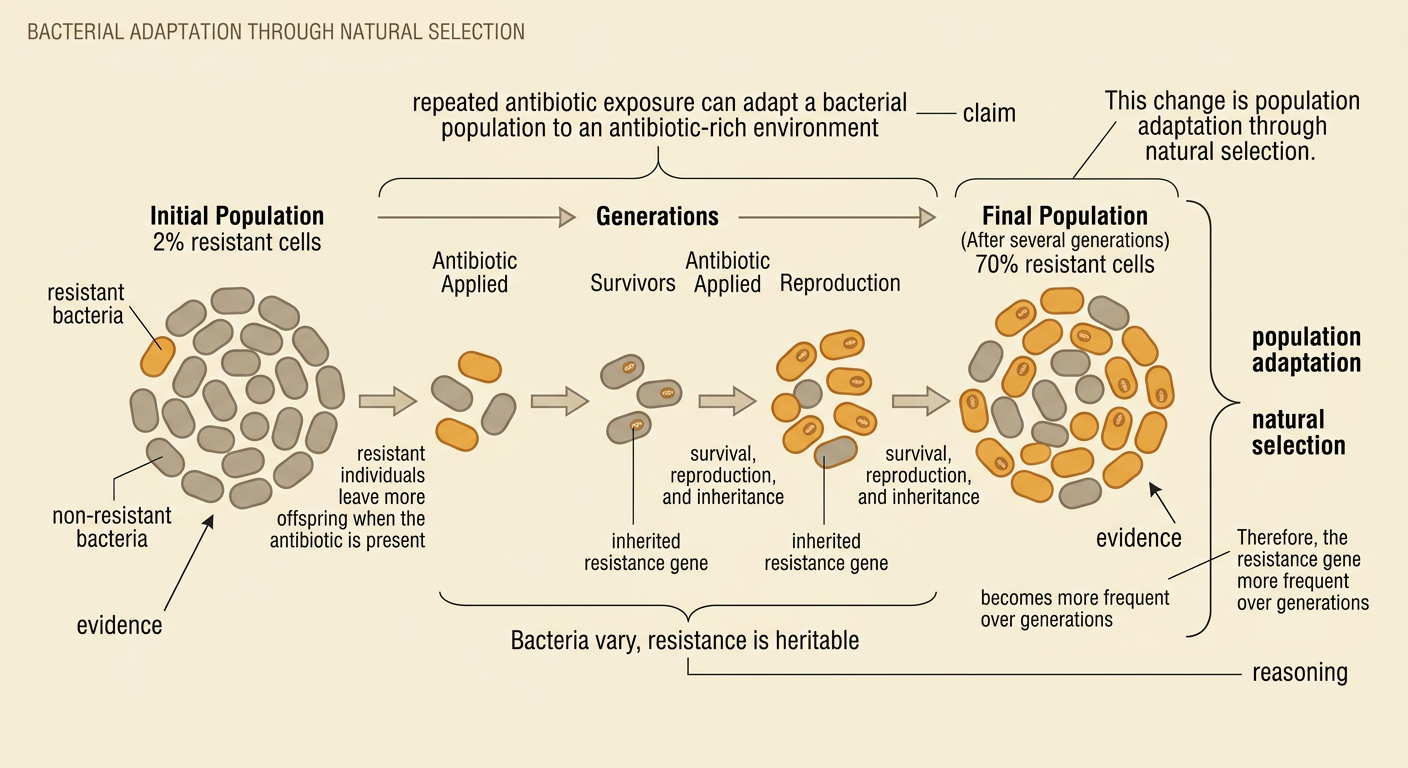
A scientific explanation should connect a claim to specific evidence and biological reasoning. A useful claim is that repeated antibiotic exposure can cause a bacterial population to become adapted to an antibiotic-rich environment. Evidence might show that resistance increased from 2 percent before treatment to 70 percent after several bacterial generations. Additional evidence from a scientific source could identify an inherited resistance gene in the surviving bacteria. The reasoning is that bacteria vary, resistance is heritable, and resistant individuals leave more offspring when the antibiotic is present. Over generations, the resistance gene increases in frequency. This is population adaptation through natural selection. It does not mean each bacterium changed because it needed protection. When citing a source, students should identify the exact finding or data that supports each part of the explanation.
Evaluating Antibiotic-Use Strategies
Strategies for slowing resistance should be evaluated using scientific evidence, public health benefits, costs, feasibility, and fairness. One strategy is antibiotic stewardship, which requires clinicians to prescribe antibiotics only when evidence suggests a bacterial infection and to select the narrowest effective drug. Other policies include preventing infections through vaccination and sanitation, tracking resistant strains, limiting routine antibiotic use in livestock, and funding new treatments. For example, a hospital might require testing before certain antibiotics are prescribed. If unnecessary prescriptions fall by 30 percent without increasing complications, the policy has evidence of benefit. Decision makers should also ask whether testing is affordable and available to all patients. No single policy eliminates resistance, but coordinated strategies can reduce unnecessary selection pressure while preserving access to lifesaving antibiotics for people who need them.
