
Antibiotic Resistance: Natural Selection in Action
Students analyze evidence showing how antibiotic use creates selective pressure and explain how resistant bacterial populations become more common over generations.
Illustrations are auto-generated and may be placeholders. They can be refreshed to match the narration.
Variation Within Bacterial Populations
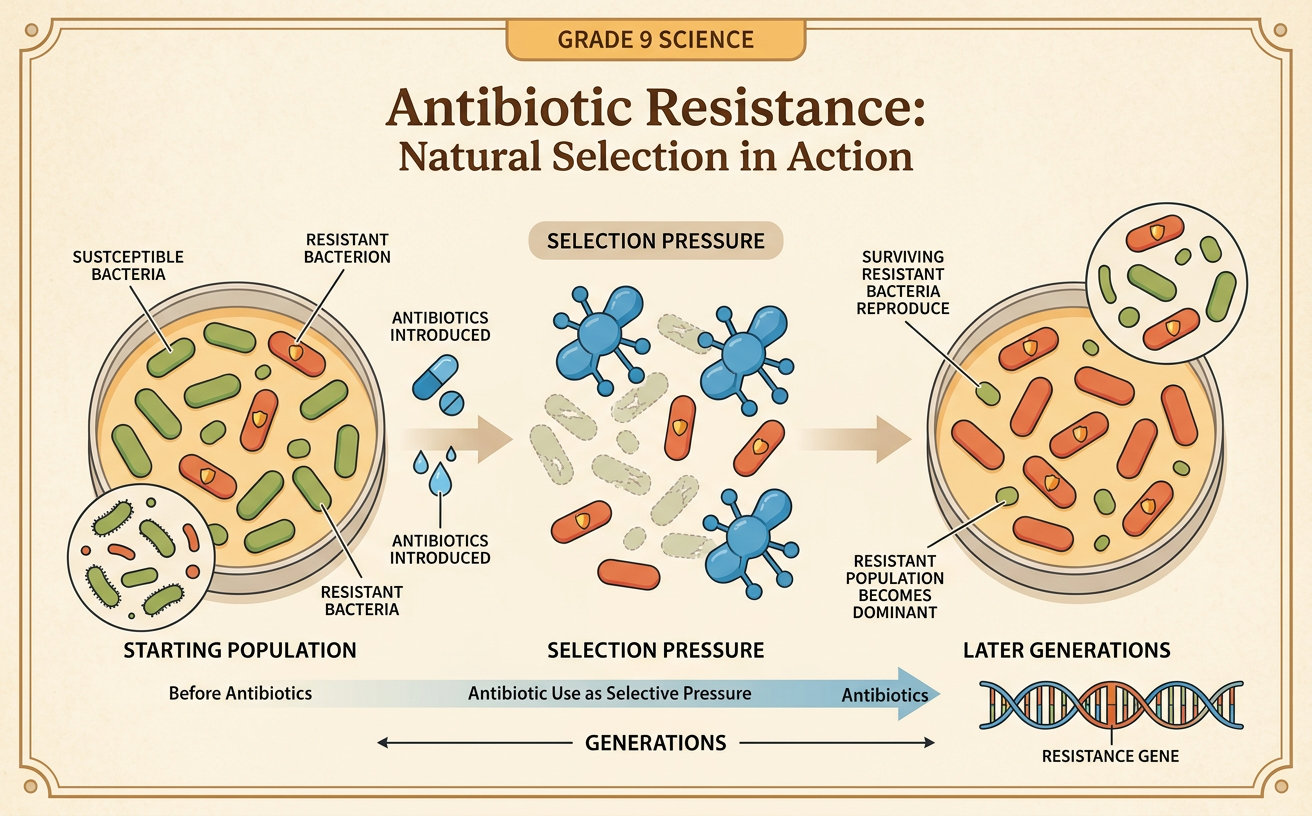
A bacterial population contains inherited variation, even when the bacteria look alike. Random mutations can occur as bacterial DNA is copied, and bacteria can also acquire genes through horizontal gene transfer. Some variations may affect antibiotic resistance, such as a gene that produces an antibiotic-destroying enzyme or changes the molecule targeted by a drug. These variations usually exist before antibiotic exposure; bacteria do not develop useful mutations because they need them. For example, in a population of one million E. coli cells, a few cells may already carry a resistance gene while most are susceptible. When cells reproduce, resistance genes can be passed to descendants. This heritable variation provides the raw material on which natural selection acts.
Antibiotics as a Selective Pressure
An antibiotic acts as a selective pressure by changing which bacteria are most likely to survive and reproduce. When a population is exposed to an antibiotic, susceptible cells are killed or prevented from growing. Cells with an effective resistance trait are more likely to survive. They reproduce and pass the trait to their descendants, increasing the proportion of resistant bacteria. For example, suppose a culture begins with 99 susceptible cells and one resistant cell. After treatment, most susceptible cells die, but the resistant cell survives and divides repeatedly. The antibiotic did not teach that cell to resist the drug or create resistance on purpose. Instead, the treatment selected an existing heritable variation. Repeated or unnecessary exposure can create more opportunities for resistant bacteria to outcompete susceptible bacteria.
Interpreting Resistance Data
Resistance data can reveal changes in a population across repeated antibiotic exposures. Imagine that researchers sample the same bacterial population after each treatment cycle. The percentage of resistant cells rises from 1 percent before treatment to 8 percent after cycle one, 35 percent after cycle two, and 78 percent after cycle three. These specific values support the claim that resistant bacteria became more common over time. However, the pattern alone does not prove that individual bacteria changed from susceptible to resistant. A stronger investigation would include an untreated control population, consistent antibiotic doses, equal sampling methods, and multiple trials. If resistance stays near 1 percent in the control but rises in the treated group, the comparison provides stronger evidence that antibiotic exposure acted as a selective pressure.
Explaining Population Change
A strong scientific explanation connects a claim, evidence, and reasoning. The claim is that natural selection caused the bacterial population to become adapted to an antibiotic. Evidence might show that resistance increased from 1 percent to 78 percent after three treatment cycles. The reasoning is that bacteria varied in inherited resistance, the antibiotic reduced the survival of susceptible cells, and resistant survivors produced more descendants. Over generations, the resistance trait therefore increased in frequency. The population changed; individual bacteria did not decide to adapt. For example, if resistant bacteria leave twice as many surviving offspring as susceptible bacteria during treatment, resistance will likely spread through later generations. Adaptation describes this population-level increase in a heritable trait that improves survival and reproduction in a particular environment.
Evaluating Antibiotic Stewardship Policies
Antibiotic stewardship policies aim to preserve effective treatments by reducing unnecessary or incorrect antibiotic use. Examples include requiring prescriptions, reviewing hospital antibiotic choices, limiting routine use in livestock, and educating patients that antibiotics do not treat viruses. An intended outcome is less selective pressure, which can slow the spread of resistance. Policies may also have unintended consequences. Strict approval rules could delay treatment for a patient with a serious bacterial infection, while agricultural restrictions could raise costs for farmers. To evaluate a policy, decision-makers should compare antibiotic use, resistance rates, patient outcomes, access to treatment, and economic effects before and after implementation. For example, a hospital review policy is effective if it reduces unnecessary broad-spectrum antibiotic use without increasing complications or treatment delays. Good stewardship balances individual medical needs with the long-term public benefit of effective antibiotics.