
App Permissions and Data Minimization
Students analyze app-permission data, compare privacy-focused design options, and recommend controls that limit unnecessary collection of personal information.

Illustrations are auto-generated and may be placeholders. They can be refreshed to match the narration.
What App Permissions Reveal
App permissions show which device features and personal information an app can access. Common permissions include location, contacts, camera, microphone, photos, and motion data. To inspect permissions accurately, follow a sequence: open the device settings, select the app, view its permissions, record each permission, and note whether it is always allowed, allowed only while in use, or denied. Then compare each request with the app’s stated purpose. For example, a map app may need location while giving directions, but a flashlight app does not need contacts or precise location. A permission request does not prove that an app misuses data, but it reveals what collection is possible. Reading permission descriptions and privacy notices helps users make informed choices before granting access.

Classifying Necessary and Optional Data
Data minimization means collecting only the information needed to provide a feature or meet a clear legal or safety requirement. Begin by identifying the app’s main function. Next, list every requested data type and explain how each one supports that function. Classify a data type as necessary if the feature cannot reasonably work without it. Classify it as optional if it improves convenience, advertising, personalization, or analytics but is not required. For example, a weather app may need an approximate location to show a local forecast, but it usually does not need a contact list. Precise location may also be optional if a city or ZIP code provides enough accuracy. Classification can depend on the feature, so students should support each decision with evidence rather than assuming that every requested permission is essential.

Building a Two-Way Frequency Table
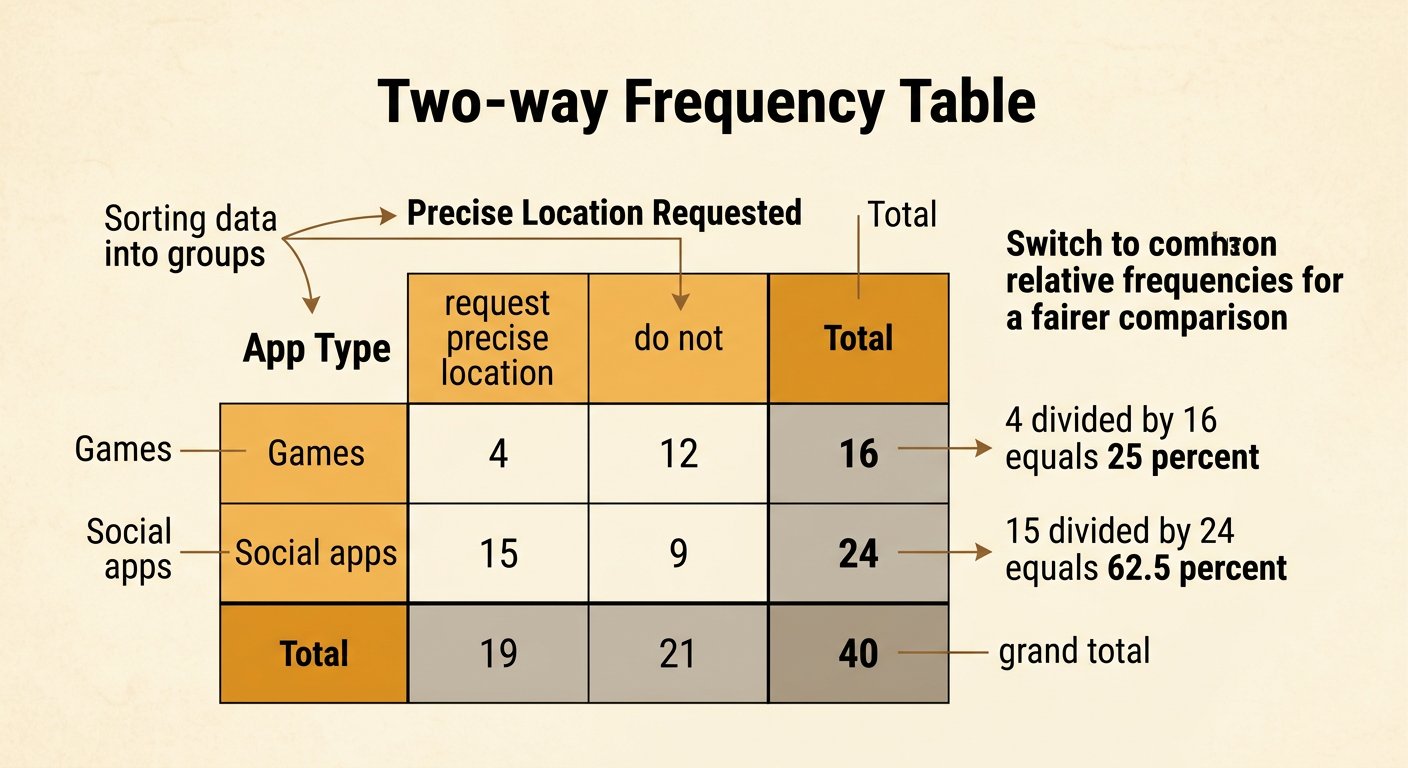
A two-way frequency table compares two categorical variables and helps reveal patterns. Suppose a class reviews 40 apps and records app type and whether each app requests precise location. Of 16 games, 4 request precise location and 12 do not. Of 24 social apps, 15 request it and 9 do not. Enter these frequencies in the correct cells, then calculate row totals, column totals, and the grand total. Next, find relative frequencies within each app type. For games, 4 divided by 16 equals 25 percent. For social apps, 15 divided by 24 equals 62.5 percent. The higher relative frequency shows that precise-location requests are more common among the reviewed social apps. This pattern describes the sample; it does not prove why the apps request location.
Comparing Privacy Design Options
Engineers compare design solutions using stated criteria and constraints rather than personal preference alone. Imagine three location designs for a school-events app: always collect precise location, request location only while the app is in use, or let users enter a ZIP code. Useful criteria include privacy protection, feature accuracy, ease of use, and user control. Constraints might include development cost, device compatibility, safety needs, and a deadline. Students can score each option from 1 to 4 for every criterion, apply agreed-upon weights, and calculate totals. The always-on option may provide accuracy but score poorly for privacy and control. ZIP-code entry may protect privacy but require extra effort. Access only while in use may offer the best balance. Any recommendation should explain the scores, trade-offs, and evidence.

Recommending a Data-Minimization Policy
A data-minimization policy turns privacy goals into enforceable rules. A strong recommendation identifies what data may be collected, why it is needed, when permission is requested, how long data is kept, who may receive it, and how users can delete it. For example, a school app policy might allow approximate location only while a student searches for nearby events, prohibit selling location data, delete search records after 30 days, and provide a clear opt-out. Students should also assess how rules and laws address the public problem of unnecessary data collection. Laws can establish minimum protections and penalties across many organizations, while school or company rules can add stricter local safeguards. Enforcement, audits, complaint procedures, and understandable notices matter because a rule is ineffective if no one checks compliance. The final recommendation should cite table patterns and design scores as evidence.
