
Applying the Laws of Integer Exponents
Students use patterns and exponent properties to generate equivalent expressions involving positive, zero, and negative integer exponents.

Illustrations are auto-generated and may be placeholders. They can be refreshed to match the narration.
Reviewing Positive Integer Exponents
A positive integer exponent tells how many times a base is used as a factor. In 2^4, the base is 2 and the exponent is 4, so 2^4 = 2 × 2 × 2 × 2 = 16. The exponent does not mean that 2 is multiplied by 4. Exponential notation is a shorter way to write repeated multiplication. Patterns help connect neighboring powers. For example, 2^1 = 2, 2^2 = 4, 2^3 = 8, and 2^4 = 16. Each time the exponent increases by 1, the value is multiplied by the base, 2. This pattern is the foundation for understanding exponent properties and for extending exponents to include zero and negative integers.

Discovering Zero and Negative Exponents
Exponent patterns continue when exponents decrease. Consider powers of 3: 3^3 = 27, 3^2 = 9, and 3^1 = 3. Each time the exponent decreases by 1, the value is divided by 3. Continuing the pattern gives 3^0 = 1, 3^-1 = 1/3, and 3^-2 = 1/9. For any nonzero number a, a^0 = 1. A negative exponent indicates a reciprocal: a^-n = 1/a^n. It does not make the value negative. For example, 4^-2 = 1/4^2 = 1/16, not -16. These rules require a nonzero base because division by zero is undefined. In particular, 0^0 is not assigned a value by this exponent rule, and negative powers of 0 are undefined.

Applying the Product and Quotient Rules
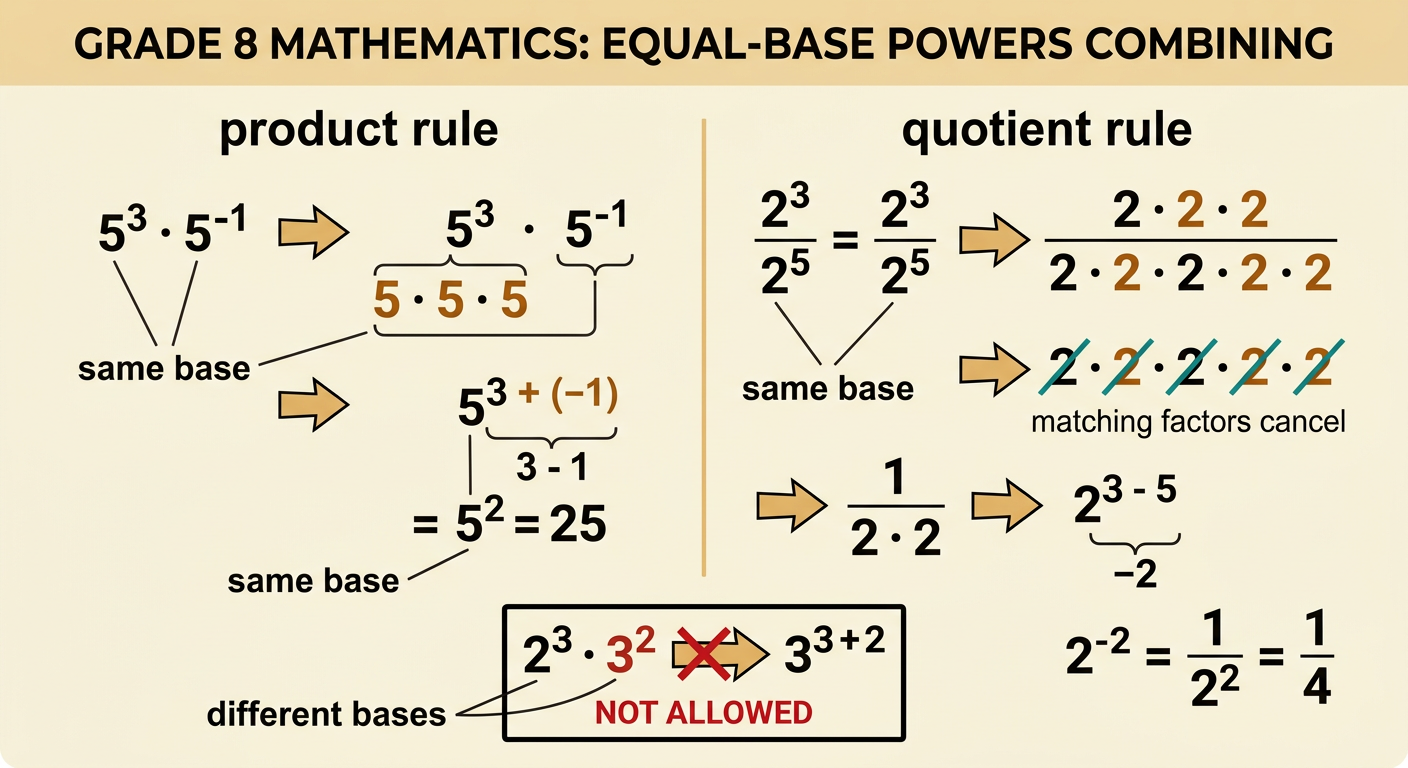
When powers have the same base, their exponents can be combined. The product rule states that a^m × a^n = a^(m+n). This works because the factors from both powers form one longer product. For example, 5^3 × 5^-1 = 5^(3 + -1) = 5^2 = 25. The quotient rule states that a^m ÷ a^n = a^(m-n), provided a is not zero. For example, 2^3 ÷ 2^5 = 2^(3-5) = 2^-2 = 1/4. These rules apply only when the bases are the same. An expression such as 2^3 × 3^2 cannot be combined by adding exponents because 2 and 3 are different bases.
Using the Power of a Power Rule
A power raised to another power represents repeated groups of the original power. The power of a power rule is (a^m)^n = a^(mn). Multiply the exponents rather than adding them. For example, (3^2)^4 means 3^2 × 3^2 × 3^2 × 3^2. Using the product rule gives 3^(2+2+2+2) = 3^8, which matches 3^(2 × 4). The rule also works with negative exponents. For example, (2^-2)^3 = 2^(-2 × 3) = 2^-6 = 1/64. Parentheses matter: (2^3)^2 equals 2^6, while 2^3 × 2 equals 2^4. Carefully identify the inner exponent and the outer exponent before multiplying them.

Checking Equivalent Expressions
Equivalent expressions have the same value, even when they look different. To check equivalence, simplify each expression using exponent rules and compare the results. Consider (5^3 × 5^-1) ÷ 5^2. First use the product rule: 5^3 × 5^-1 = 5^2. Then use the quotient rule: 5^2 ÷ 5^2 = 5^0 = 1. Therefore, the original expression is equivalent to 1. You can also check by evaluating: 125 × 1/5 ÷ 25 = 1. When checking work, confirm that bases match before combining powers, use addition for products, subtraction for quotients, and multiplication for a power of a power. Finally, rewrite negative exponents as reciprocals when a numerical value is needed.
