Applying the Properties of Integer Exponents
Students use the product, quotient, and power properties of integer exponents to generate equivalent numerical expressions.
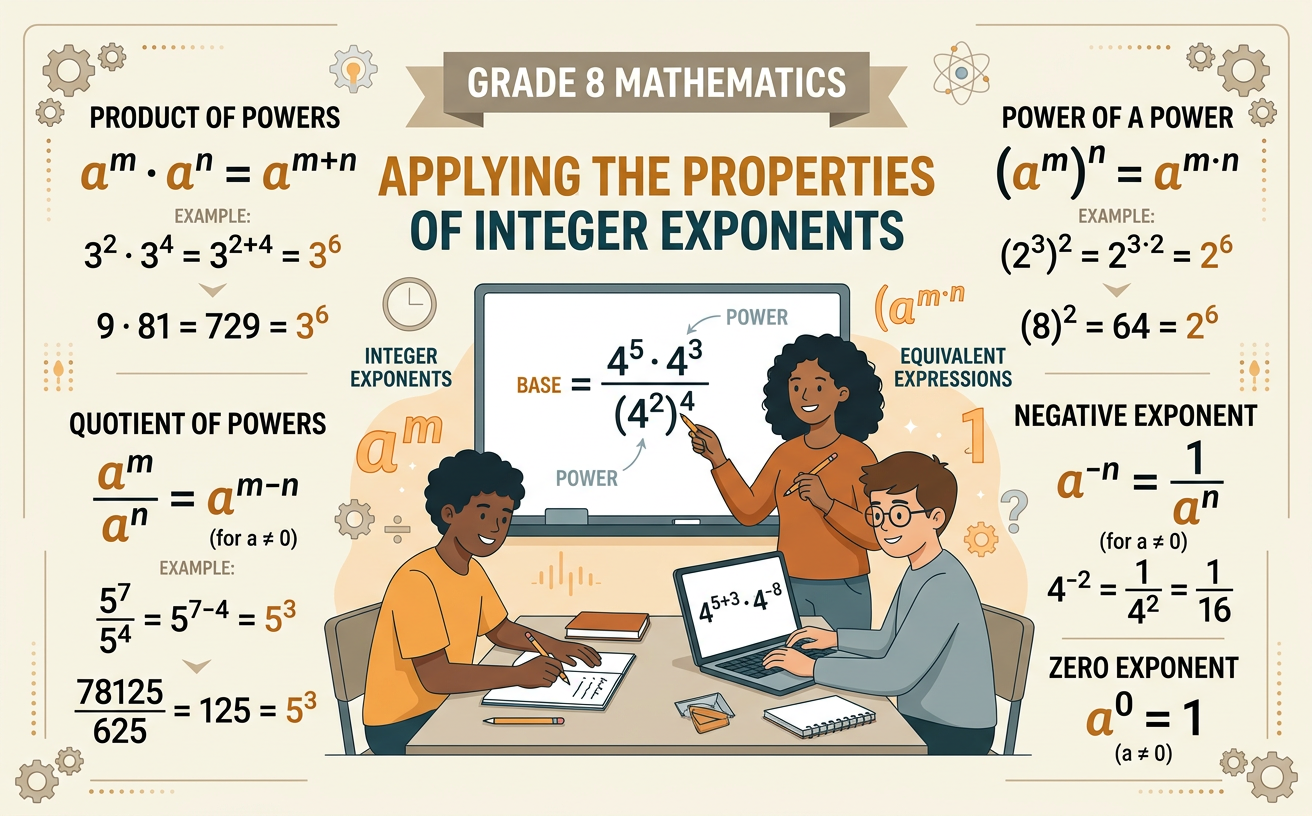
Illustrations are auto-generated and may be placeholders. They can be refreshed to match the narration.
Reviewing Exponents and Powers
An exponent tells how many times a base is used as a factor. In 3^4, the base is 3 and the exponent is 4. This power means 3 × 3 × 3 × 3, which equals 81. The exponent does not mean multiplication by the exponent, so 3^4 is not 3 × 4. Parentheses help show what belongs to the base. For example, (-2)^3 means (-2) × (-2) × (-2), which equals -8. In contrast, -2^2 means the opposite of 2^2, so it equals -4. When reading and rewriting powers, first identify the complete base and the exponent. Then use repeated multiplication when the exponent is a positive integer.

Discovering the Product and Quotient Properties
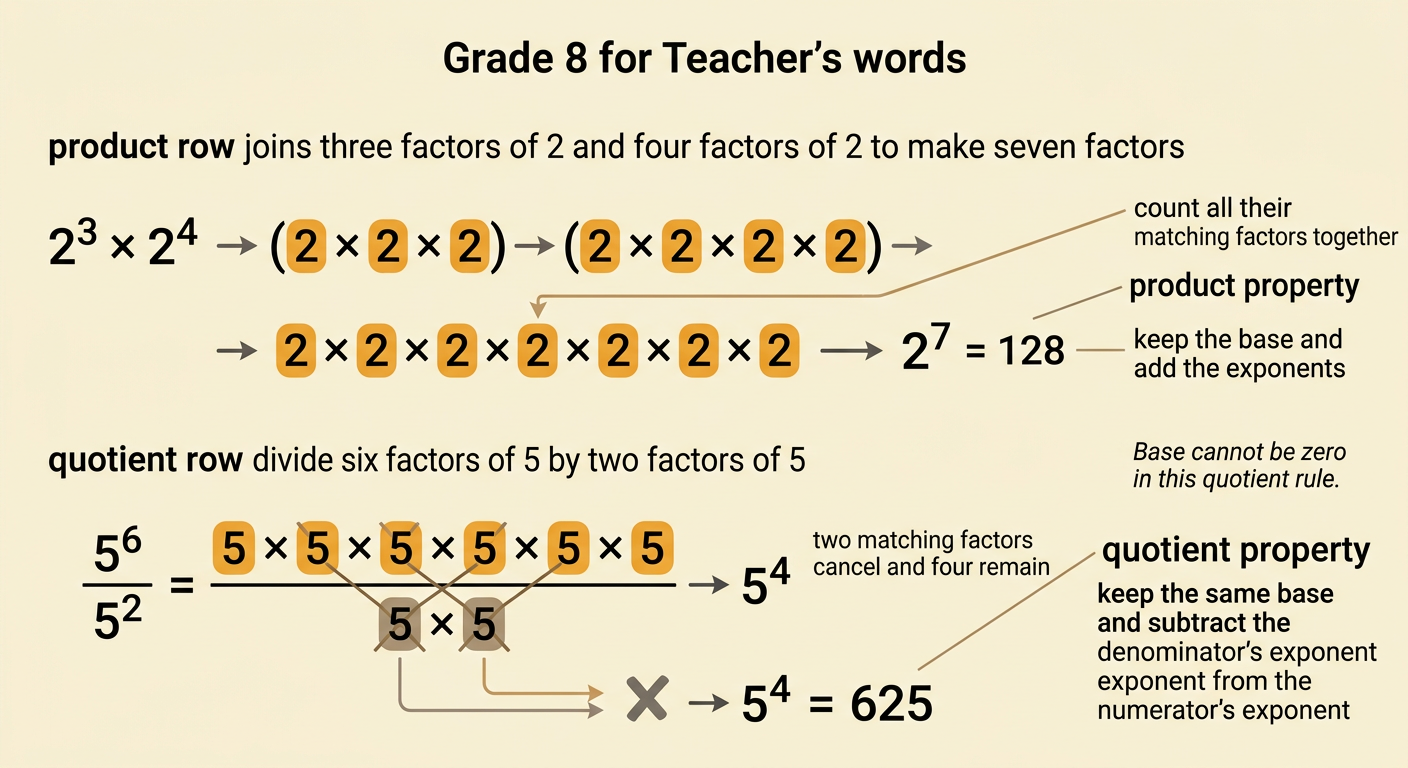
When powers have the same base, their exponents can be combined. The product property states that a^m × a^n = a^(m+n). For example, 2^3 × 2^4 contains three factors of 2 followed by four more factors of 2, giving seven factors: 2^7 = 128. The quotient property states that a^m ÷ a^n = a^(m-n), provided a is not zero. For example, 5^6 ÷ 5^2 = 5^(6-2) = 5^4 = 625. Four factors remain after two matching factors cancel. These rules apply only when the bases are the same. For instance, 2^3 × 3^3 cannot be simplified by adding the exponents because the bases differ.
Understanding Zero and Negative Exponents
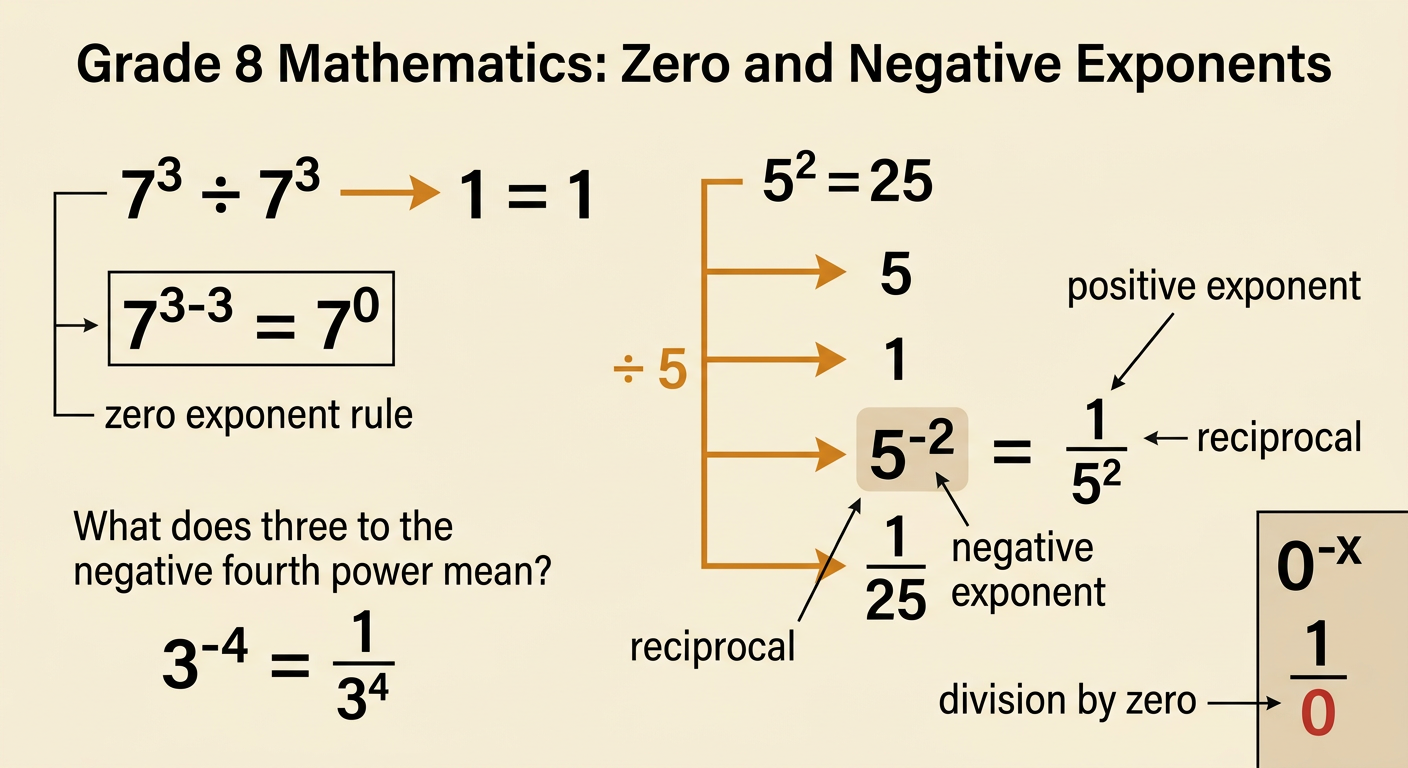
The zero and negative exponent rules follow from the quotient property. For any nonzero base a, a^0 = 1. For example, 7^3 ÷ 7^3 = 7^(3-3) = 7^0, but any nonzero number divided by itself is 1, so 7^0 = 1. A negative exponent means take the reciprocal: a^(-n) = 1/a^n when a is nonzero. For example, 5^(-2) = 1/5^2 = 1/25. The negative sign in the exponent does not make the value negative. It tells you to move the power across a fraction bar and use a positive exponent. Zero cannot be raised to a negative exponent because that would require division by zero, which is undefined.
Simplifying Exponential Expressions
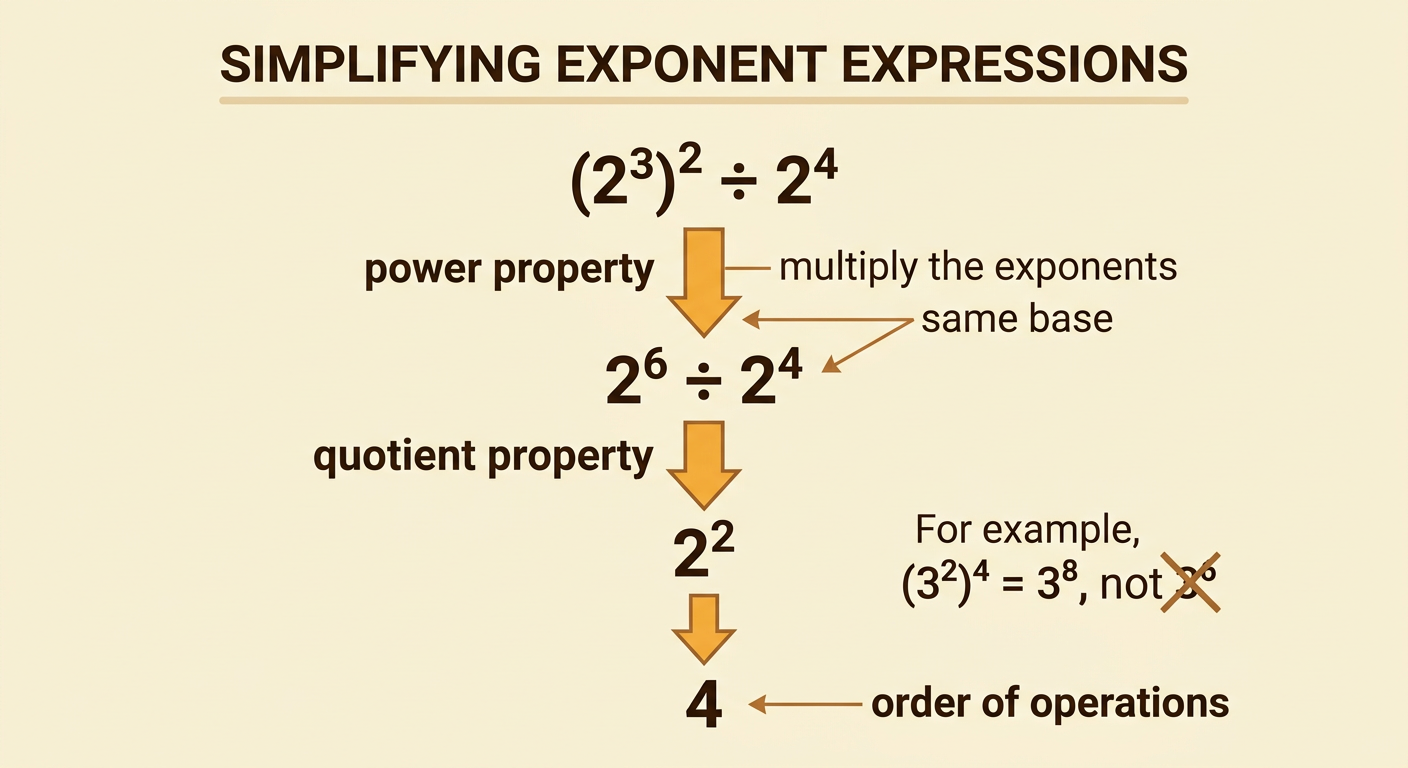
To simplify an expression with several exponent operations, apply each property carefully and follow the order of operations. The power property states that (a^m)^n = a^(mn), so exponents are multiplied when a power is raised to another power. Consider (2^3)^2 ÷ 2^4. First use the power property: (2^3)^2 = 2^(3 × 2) = 2^6. Next use the quotient property: 2^6 ÷ 2^4 = 2^(6-4) = 2^2. Finally, 2^2 = 4. Keeping the same base throughout makes the steps efficient. Do not add the exponents in a power of a power. For example, (3^2)^4 equals 3^8, not 3^6.
Checking Equivalent Expressions
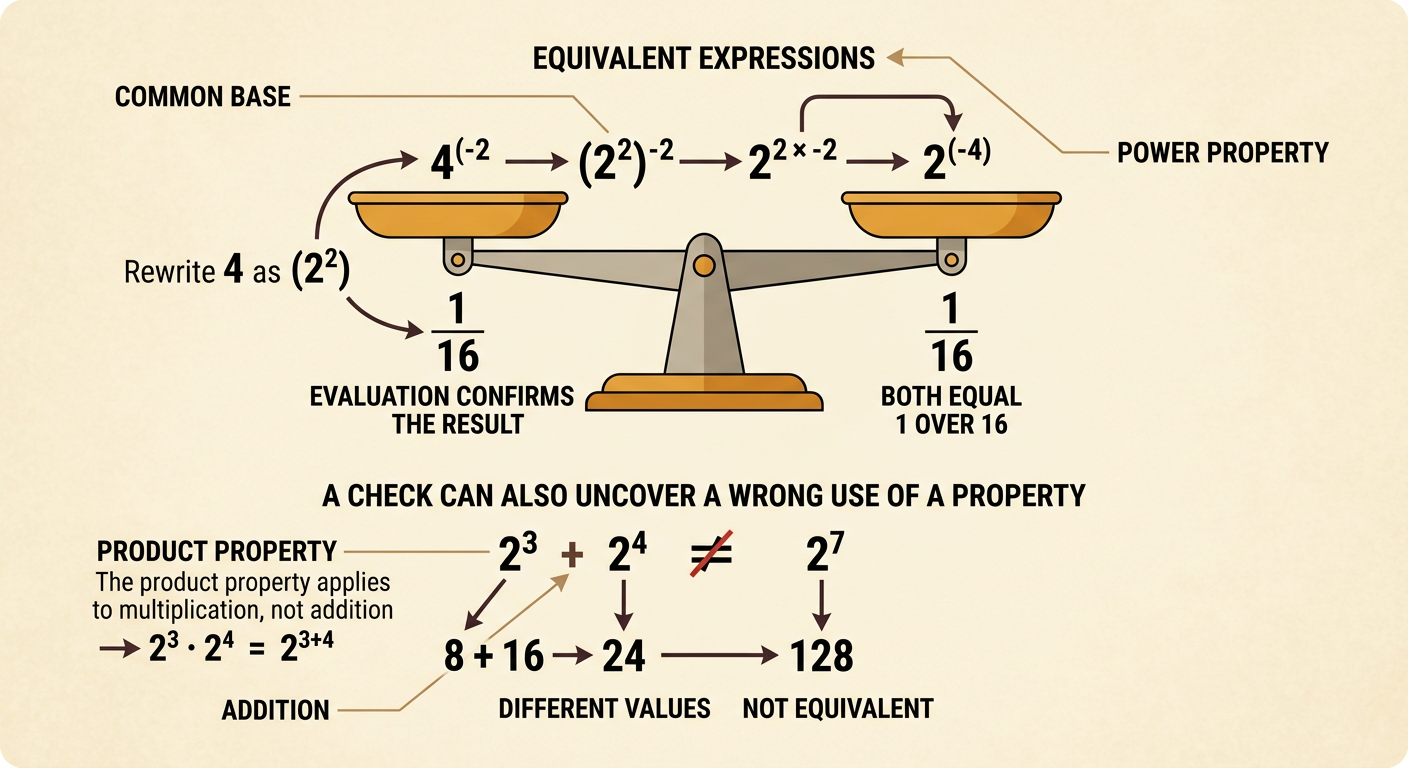
Equivalent expressions have the same value, even when they look different. You can check equivalence by rewriting both expressions with a common base or by evaluating them. For example, compare 4^(-2) and 2^(-4). Since 4 = 2^2, rewrite 4^(-2) as (2^2)^(-2). The power property gives 2^(-4), so the expressions are equivalent. Evaluating confirms this result: both equal 1/16. A check can also reveal errors. The expressions 2^3 + 2^4 and 2^7 are not equivalent because the product property does not apply to addition. Their values are 8 + 16 = 24 and 128. Always identify the operation before choosing an exponent property, and verify the result when possible.