Applying the Pythagorean Theorem
Students use the Pythagorean Theorem to find unknown side lengths in right triangles and solve real-world problems.
Illustrations are auto-generated and may be placeholders. They can be refreshed to match the narration.
Identify Right Triangles
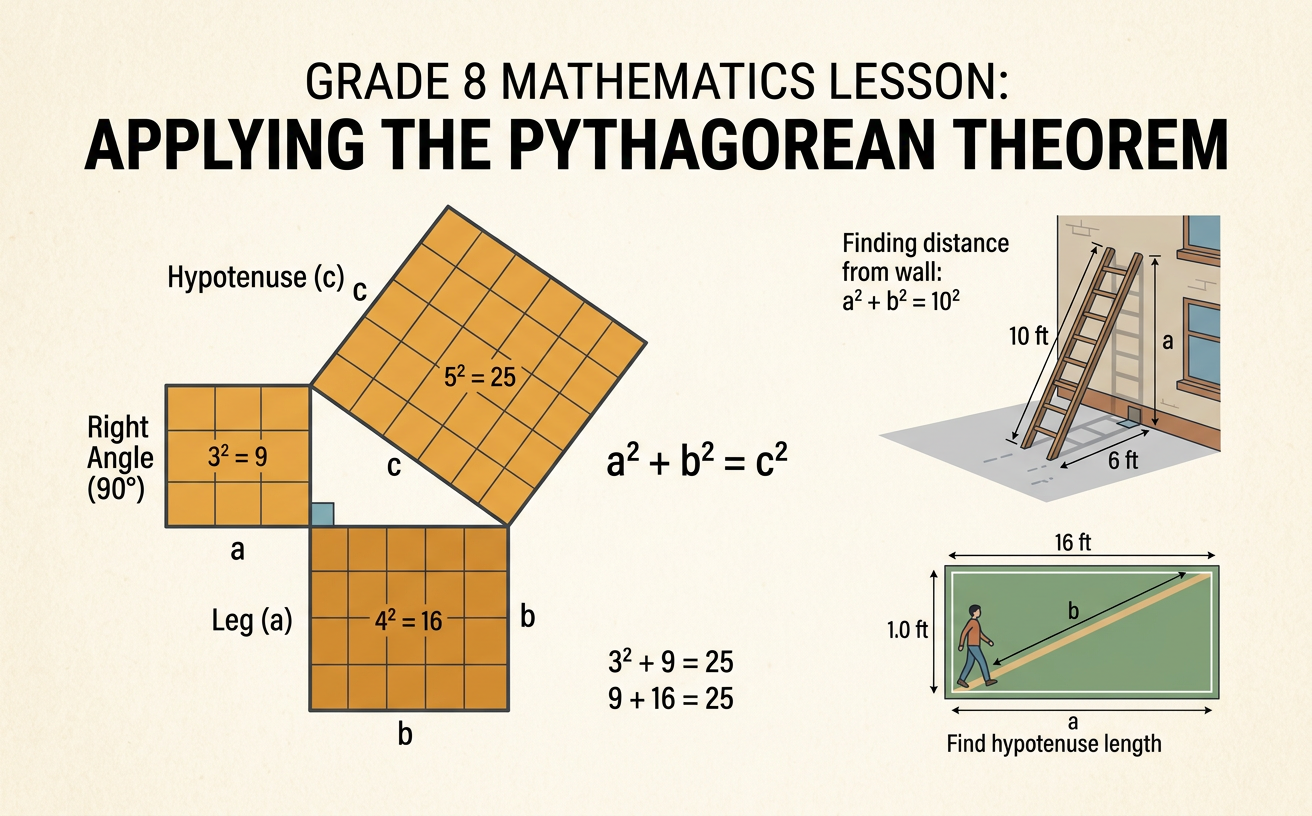
A right triangle has one angle that measures exactly 90 degrees. This angle is often marked with a small square. Before using the Pythagorean Theorem, confirm that the triangle contains a right angle. A triangle that only looks like a right triangle is not enough; the angle must be given, marked, or proved to be 90 degrees. For example, a triangle with side lengths 3 units, 4 units, and 5 units is a right triangle because 3 squared plus 4 squared equals 5 squared. Both sides equal 25. In real situations, right triangles appear where a vertical object meets level ground, at the corner of a rectangle, or inside a rectangular prism.

Label Legs and Hypotenuse
The two sides that meet to form the right angle are called the legs. The side across from the right angle is the hypotenuse. It is always the longest side of a right triangle. In the equation a squared plus b squared equals c squared, a and b represent the legs, while c represents the hypotenuse. The letters may change, but the side roles do not. For example, suppose a right triangle has sides measuring 5 centimeters, 12 centimeters, and 13 centimeters. The 5-centimeter and 12-centimeter sides meet at the right angle, so they are the legs. The 13-centimeter side is opposite the right angle, so it is the hypotenuse and should be labeled c.

Use the Pythagorean Theorem
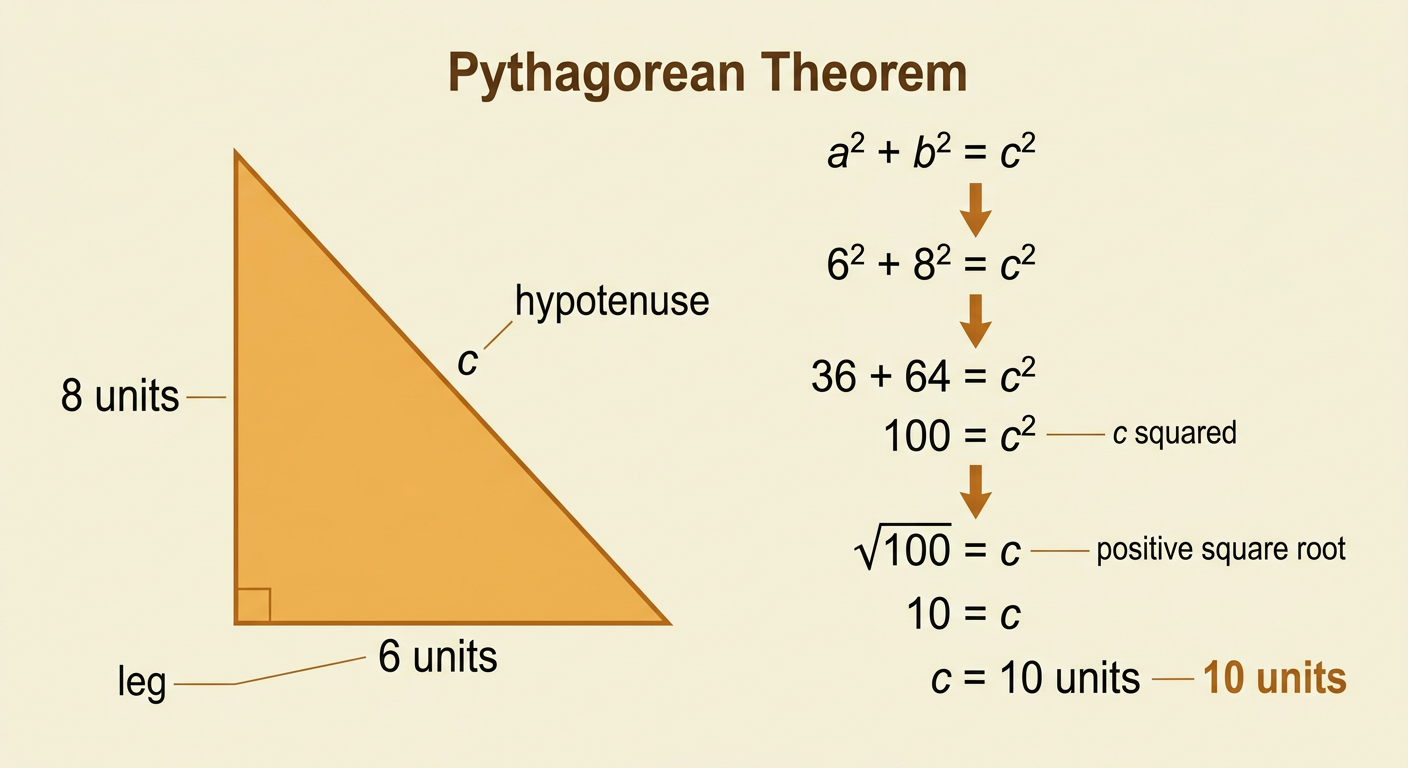
The Pythagorean Theorem states that a squared plus b squared equals c squared for every right triangle. The values a and b are the leg lengths, and c is the hypotenuse length. Squaring a length means multiplying it by itself. For example, consider a right triangle with legs of 6 units and 8 units. Substitute the values to get 6 squared plus 8 squared equals c squared. Calculate 36 plus 64 equals c squared, so 100 equals c squared. The positive square root of 100 is 10, so the hypotenuse is 10 units. Use the positive root because a side length cannot be negative. Always include the correct unit in the answer.
Find an Unknown Side Length
When a leg is unknown, begin with the same formula and isolate the missing squared term. Suppose a right triangle has a hypotenuse of 13 meters, one leg of 5 meters, and an unknown leg x. Write x squared plus 5 squared equals 13 squared. This becomes x squared plus 25 equals 169. Subtract 25 from both sides to get x squared equals 144. Then take the positive square root of both sides. Since the square root of 144 is 12, the unknown leg is 12 meters. Notice that subtraction is needed because the known hypotenuse value is on the other side of the equation. The resulting leg, 12 meters, is correctly shorter than the 13-meter hypotenuse.

Solve a Real-World Problem
The theorem can be used more than once to find a distance in three dimensions. Imagine a rectangular storage box that is 3 feet wide, 4 feet long, and 12 feet high. First find the diagonal across the bottom. Its length d satisfies 3 squared plus 4 squared equals d squared, so d equals 5 feet. Next, the bottom diagonal and the height form another right triangle whose hypotenuse is the interior diagonal D. Write 5 squared plus 12 squared equals D squared. Since 25 plus 144 equals 169, D equals 13 feet. Therefore, a straight rod up to 13 feet long can fit exactly from one bottom corner to the opposite top corner of the box.

Check and Explain the Solution
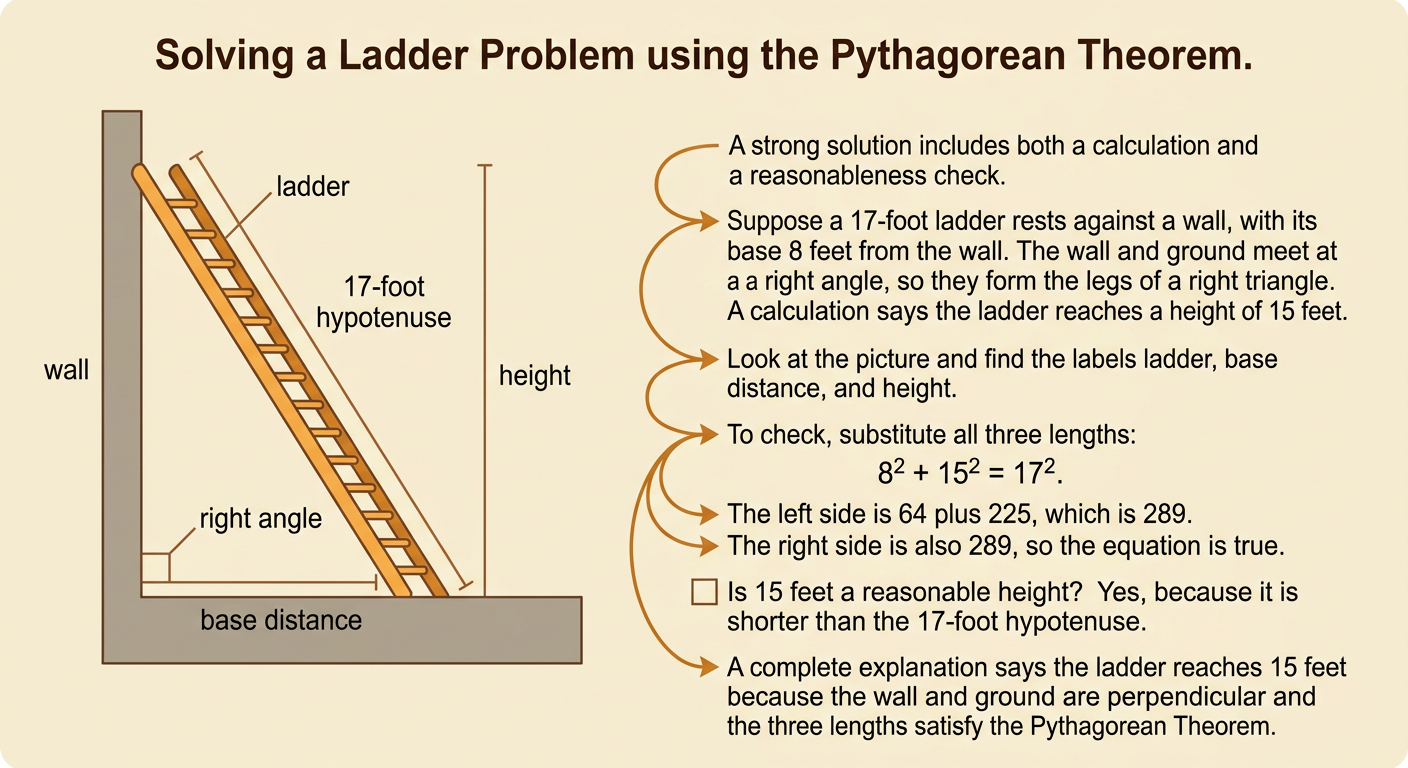
Check an answer by substituting all three side lengths into the Pythagorean equation and considering whether the result makes sense. Suppose a 17-foot ladder rests against a wall, and its base is 8 feet from the wall. A calculation gives a height of 15 feet. Check by writing 8 squared plus 15 squared equals 17 squared. The left side is 64 plus 225, or 289, and the right side is also 289. The equation is true. The answer is also reasonable because 15 feet is shorter than the 17-foot hypotenuse. A complete explanation is: The ladder reaches 15 feet up the wall because the wall and ground form perpendicular legs, and 8 squared plus 15 squared equals 17 squared.