
Area of Triangles and Composite Figures
Students derive and apply area formulas for triangles, quadrilaterals, and composite figures in real-world settings.
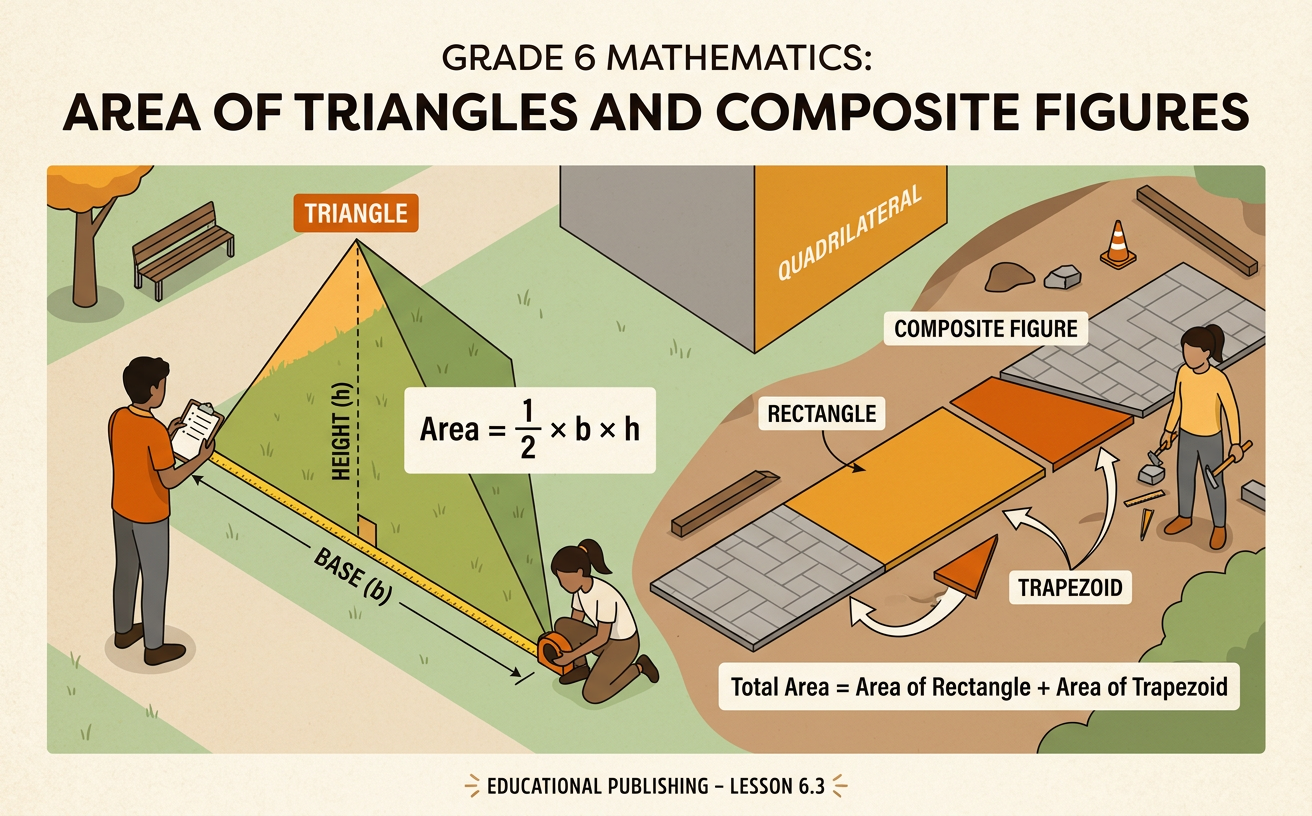
Illustrations are auto-generated and may be placeholders. They can be refreshed to match the narration.
Review Rectangle Area
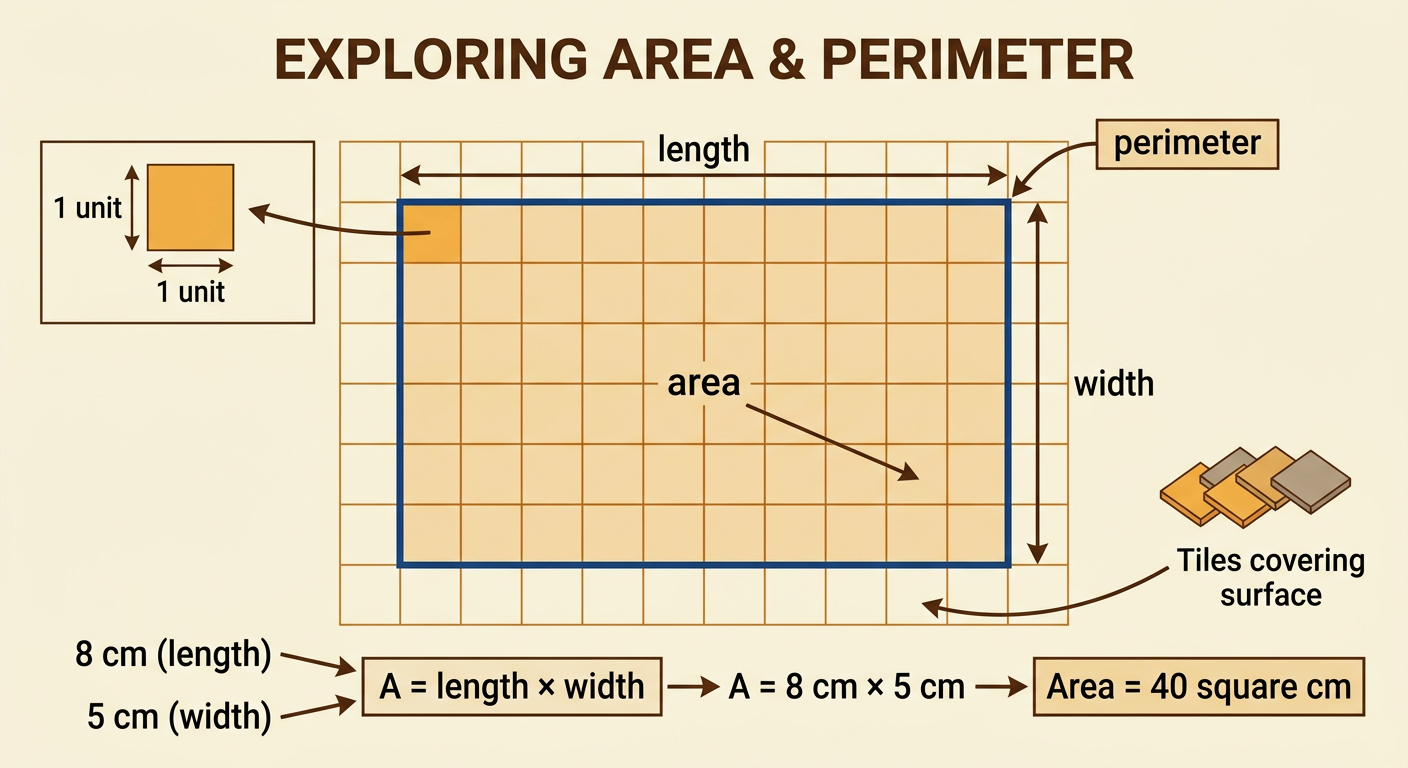
Area measures the number of square units needed to cover a flat region without gaps or overlaps. For a rectangle, multiply its length by its width: A = l × w. This works because the rectangle can be arranged in equal rows and columns of unit squares. For example, a rectangle that is 8 centimeters long and 5 centimeters wide contains 5 rows of 8 square centimeters. Its area is 8 × 5 = 40 square centimeters. Always write area with square units, such as cm², m², or ft². Do not confuse area with perimeter. Perimeter measures the distance around a figure, while area measures the surface inside it.
Derive the Triangle Formula
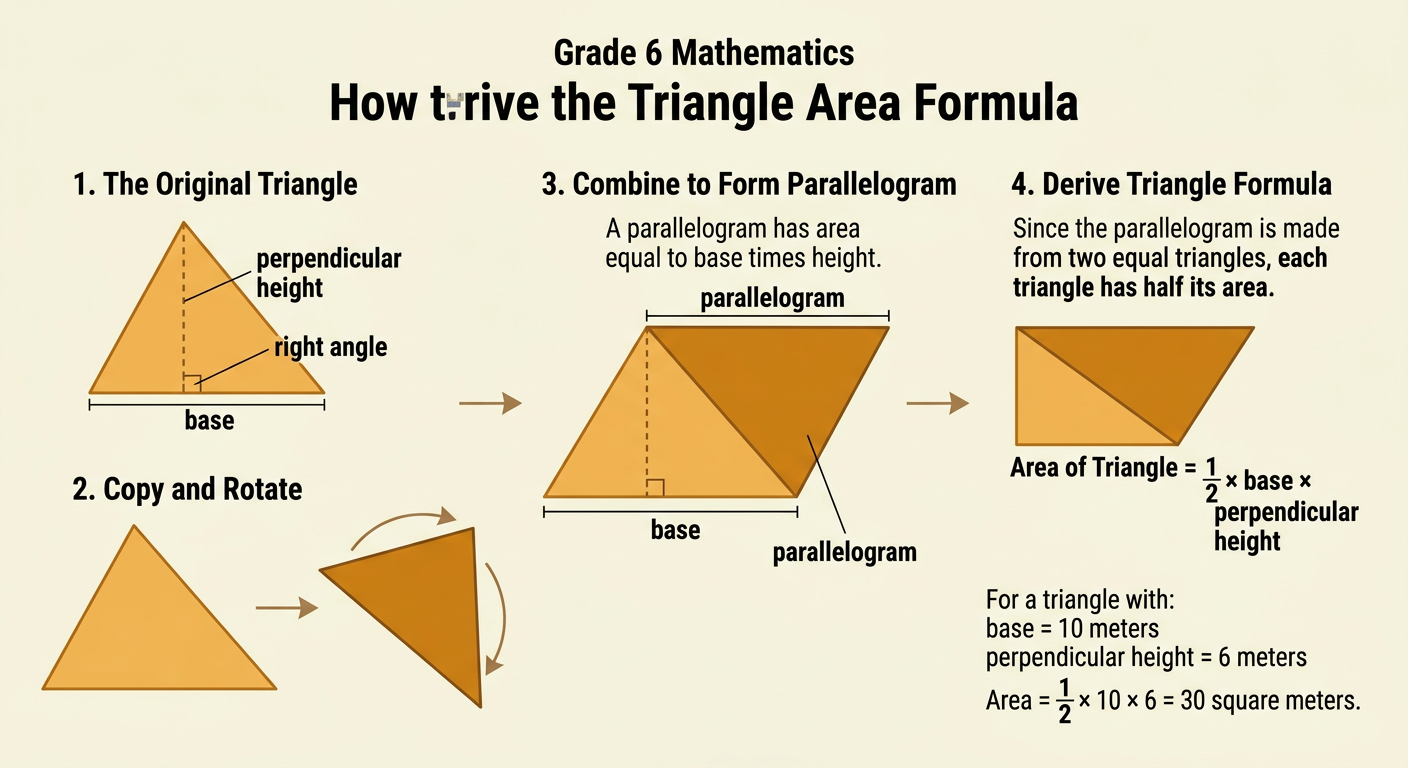
A triangle’s area can be derived by using a shape whose area is already known. Make a copy of a triangle and rotate the copy so the two triangles form a parallelogram. The parallelogram has the same base b and perpendicular height h as the original triangle. Its area is b × h. Because the two matching triangles divide the parallelogram into equal halves, one triangle has area A = ½bh. The height must meet the base at a right angle; a slanted side is not always the height. For example, a triangle with a base of 10 meters and a perpendicular height of 6 meters has area ½ × 10 × 6 = 30 square meters.
Find Quadrilateral Areas
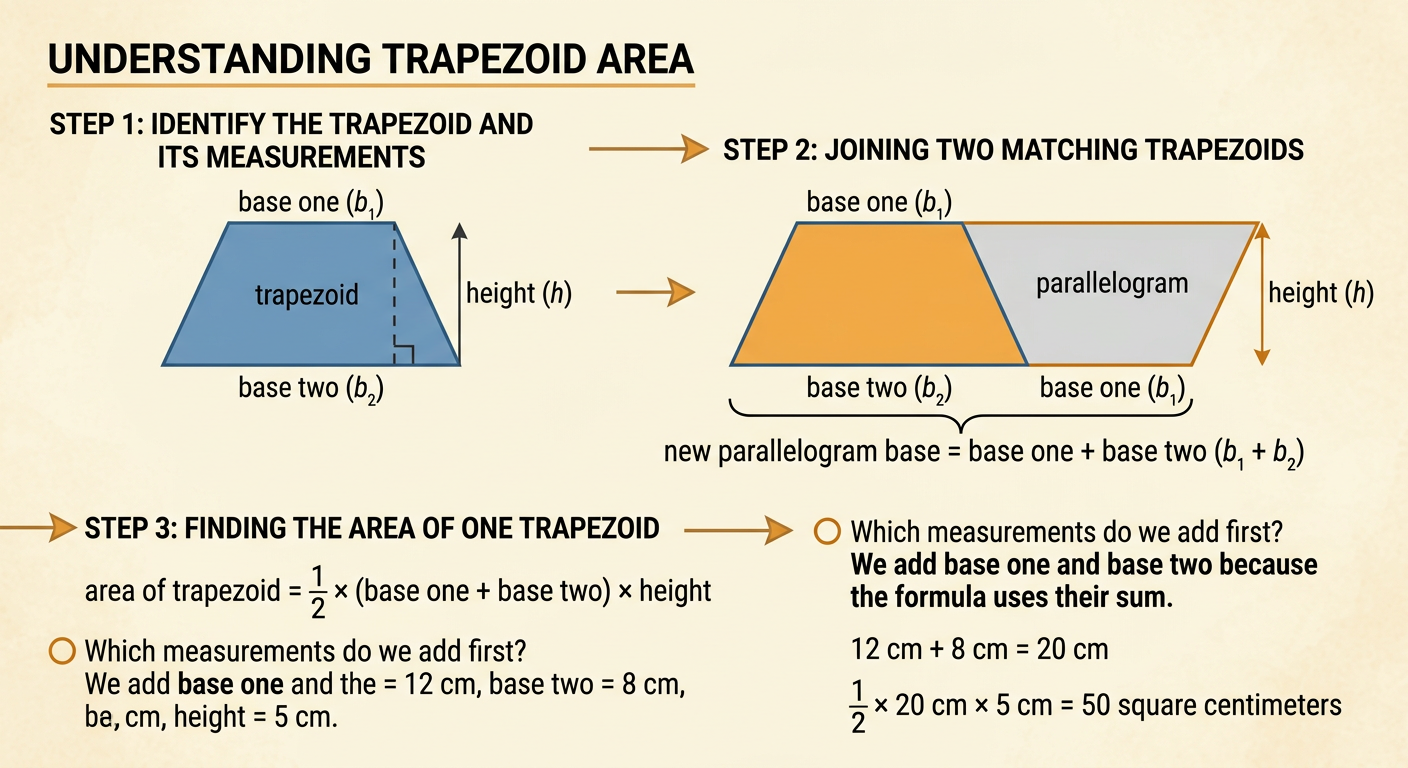
A quadrilateral is a polygon with four sides. Rectangles and squares use length times width, while a parallelogram uses A = bh, where h is the perpendicular height. A trapezoid has exactly one pair of parallel sides called bases. Its area is A = ½(b₁ + b₂)h because two matching trapezoids can form a parallelogram whose base is b₁ + b₂. Suppose a trapezoid has bases of 12 centimeters and 8 centimeters and a height of 5 centimeters. Its area is ½(12 + 8) × 5 = ½ × 20 × 5 = 50 square centimeters. For any quadrilateral, you may also draw a diagonal or divide the figure into rectangles and triangles, then add their areas.
Decompose Composite Figures
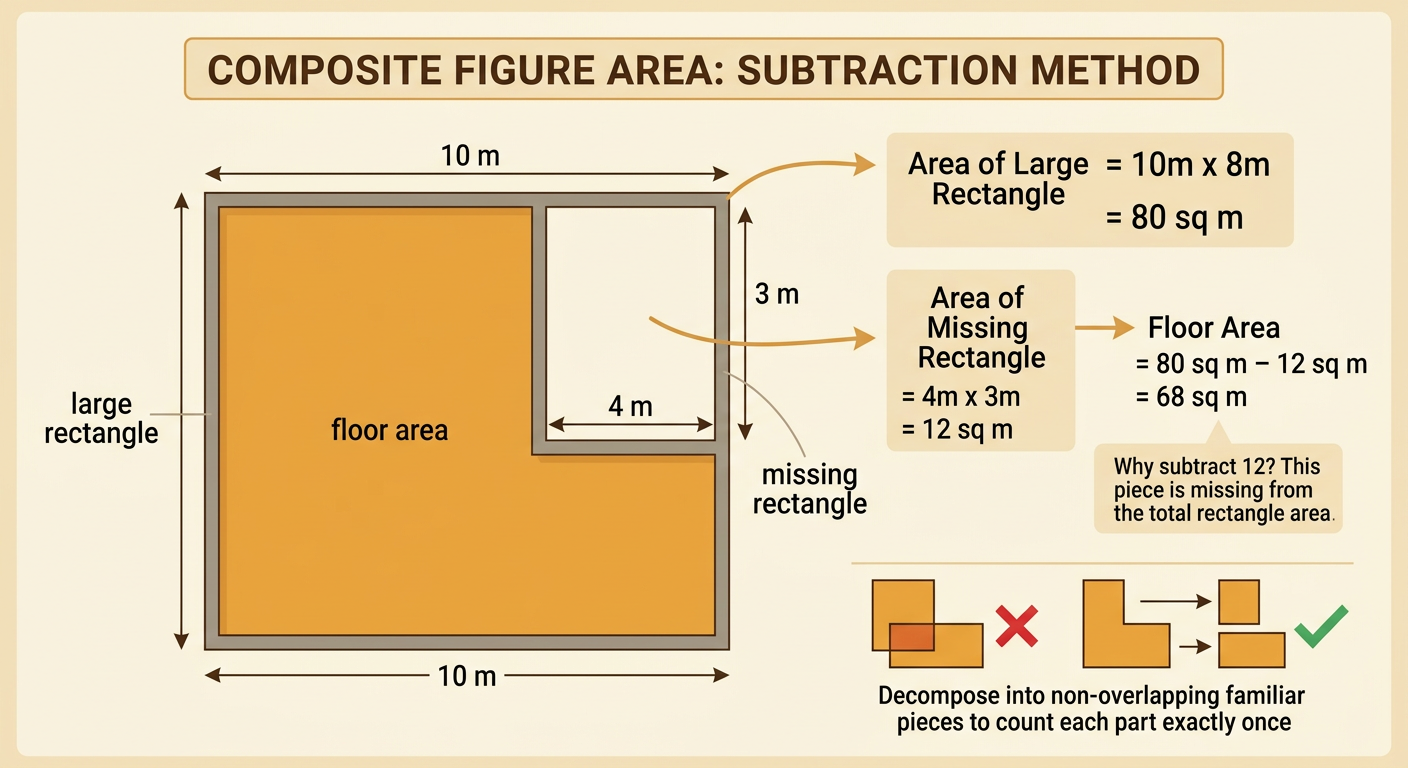
A composite figure is made from two or more simpler shapes. To find its area, decompose it into rectangles, triangles, or other familiar polygons. Add the areas of pieces that make the figure, or subtract the area of a missing piece from a larger shape. Consider an L-shaped floor that fits inside a 10-meter by 8-meter rectangle. A 4-meter by 3-meter rectangular corner is missing. The large rectangle has area 10 × 8 = 80 square meters, and the missing rectangle has area 4 × 3 = 12 square meters. Therefore, the floor’s area is 80 − 12 = 68 square meters. Check that pieces do not overlap and that every part is counted exactly once.
Solve Measurement Problems
Area formulas help solve real-world measurement problems involving floors, walls, gardens, and signs. Begin by sketching the region, labeling measurements, and choosing how to compose or decompose it. Then calculate each area, combine the results, and use square units. Suppose a wall is an 8-meter by 3-meter rectangle topped by a triangular gable with base 8 meters and height 2 meters. The rectangle’s area is 24 square meters, and the triangle’s area is ½ × 8 × 2 = 8 square meters. A 2-meter by 1.5-meter window covers 3 square meters. The paintable area is 24 + 8 − 3 = 29 square meters. If one can covers 10 square meters, three cans are needed because two cans are not enough.