Arithmetic and Geometric Sequences: Recursive and Explicit Models
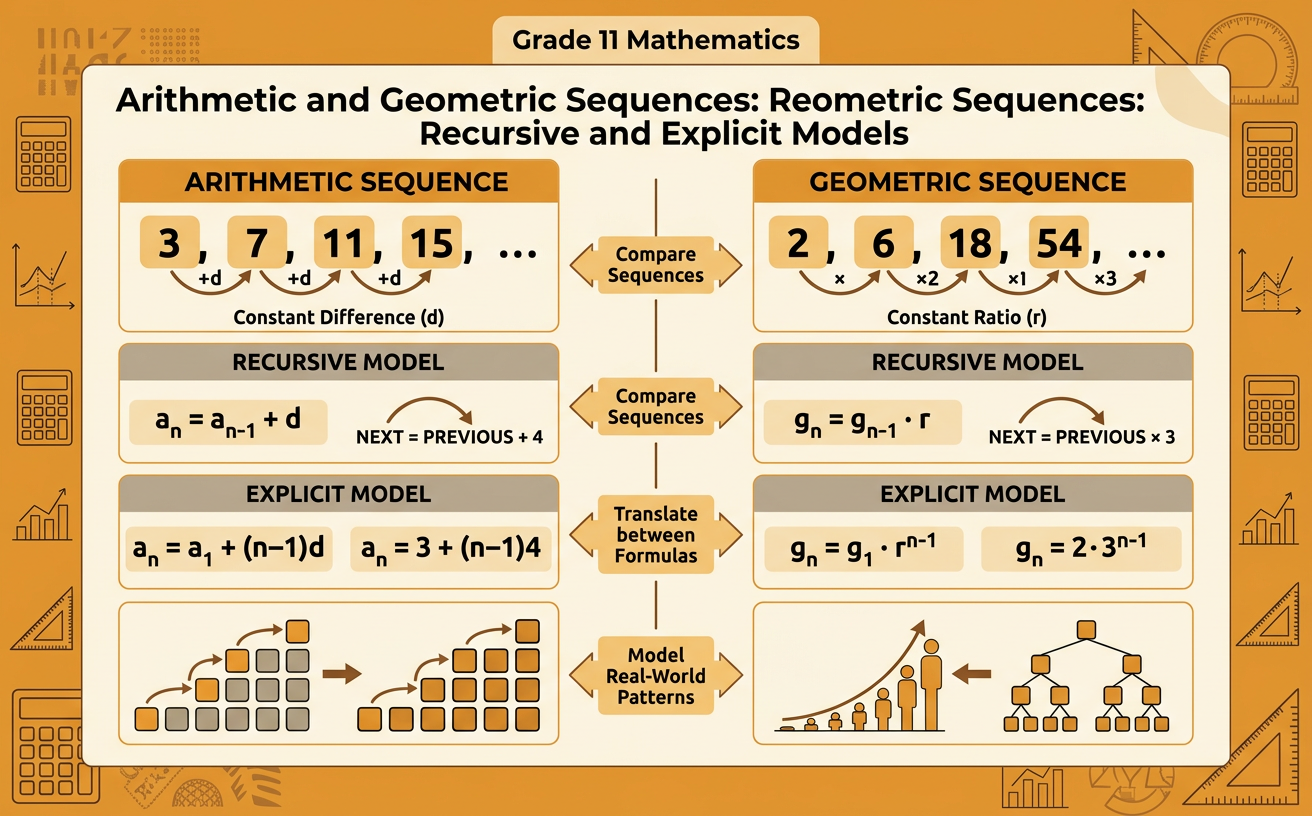
Students compare arithmetic and geometric sequences, translate between recursive and explicit formulas, and use each representation to model discrete real-world patterns.
Illustrations are auto-generated and may be placeholders. They can be refreshed to match the narration.
Recognizing Sequence Patterns
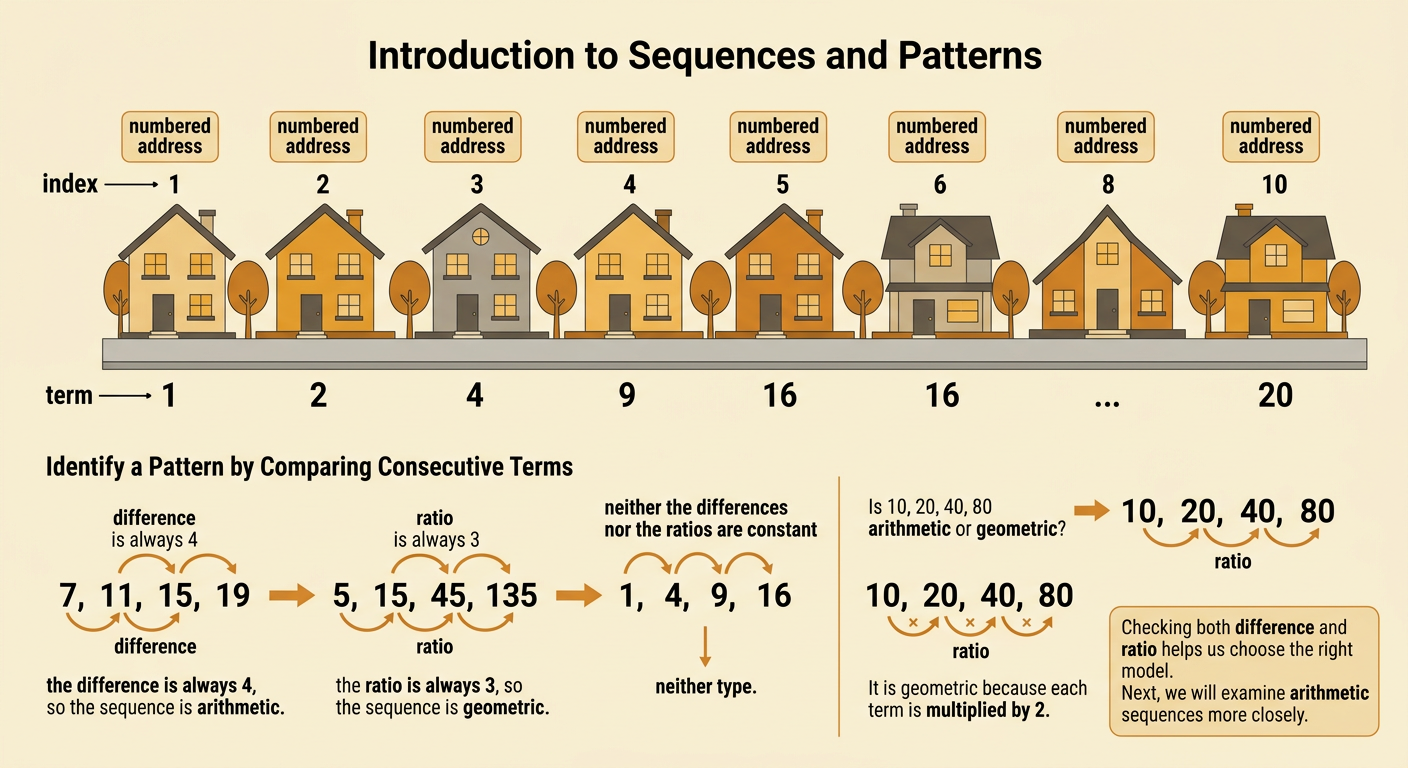
A sequence is an ordered list of numbers called terms. Each term has a position, or index. To recognize a pattern, compare consecutive terms. If the same number is added or subtracted each time, the sequence is arithmetic. For example, 7, 11, 15, 19, ... is arithmetic because each term increases by 4. If each term is multiplied by the same nonzero number, the sequence is geometric. For example, 5, 15, 45, 135, ... is geometric because each term is multiplied by 3. A sequence such as 1, 4, 9, 16, ... is neither arithmetic nor geometric because its differences and ratios are not constant. Examining both differences and ratios helps identify the correct model before writing a formula.
Arithmetic Sequences and Common Differences
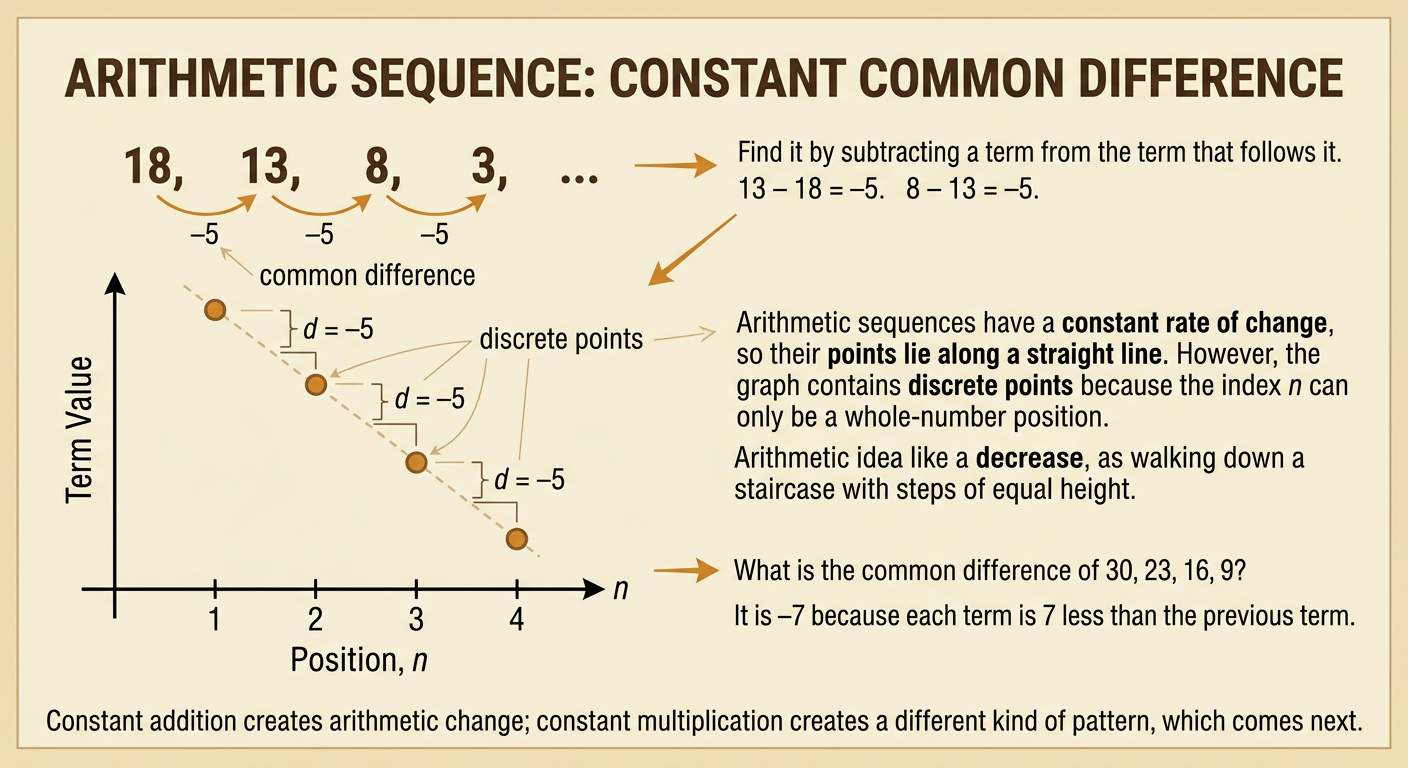
An arithmetic sequence has a constant difference between consecutive terms. This value is called the common difference, d. Find it by subtracting any term from the term that follows it: d = aₙ − aₙ₋₁. In the sequence 18, 13, 8, 3, ..., the common difference is −5 because 13 − 18 = −5 and 8 − 13 = −5. A negative difference means the terms decrease. Starting with a₁ = 18, each new term is found by adding −5. Arithmetic sequences have a constant rate of change, so their plotted points lie on a straight line. However, a sequence is discrete: only whole-number term positions such as n = 1, 2, 3, and 4 belong to its graph.
Geometric Sequences and Common Ratios
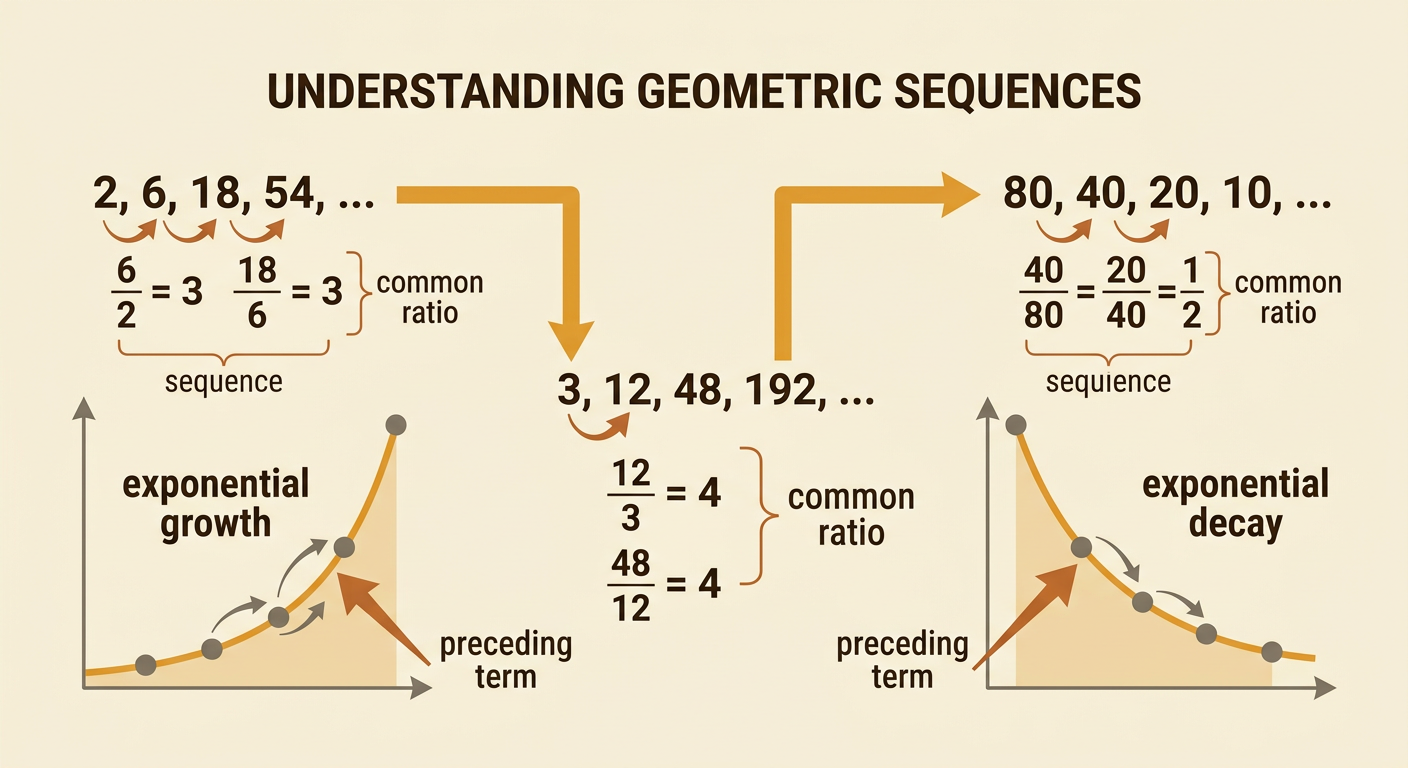
A geometric sequence has a constant ratio between consecutive nonzero terms. This value is called the common ratio, r. Find it by dividing a term by the preceding term: r = aₙ ÷ aₙ₋₁. In the sequence 2, 6, 18, 54, ..., the common ratio is 3 because 6 ÷ 2 = 3 and 18 ÷ 6 = 3. Each term is three times the previous term, so the sequence shows exponential growth. If 0 < r < 1, the terms show exponential decay. For example, 80, 40, 20, 10, ... has r = 1/2. Unlike an arithmetic sequence, a geometric sequence usually changes by unequal differences because multiplication produces increasingly large or small changes.
Writing Recursive Formulas
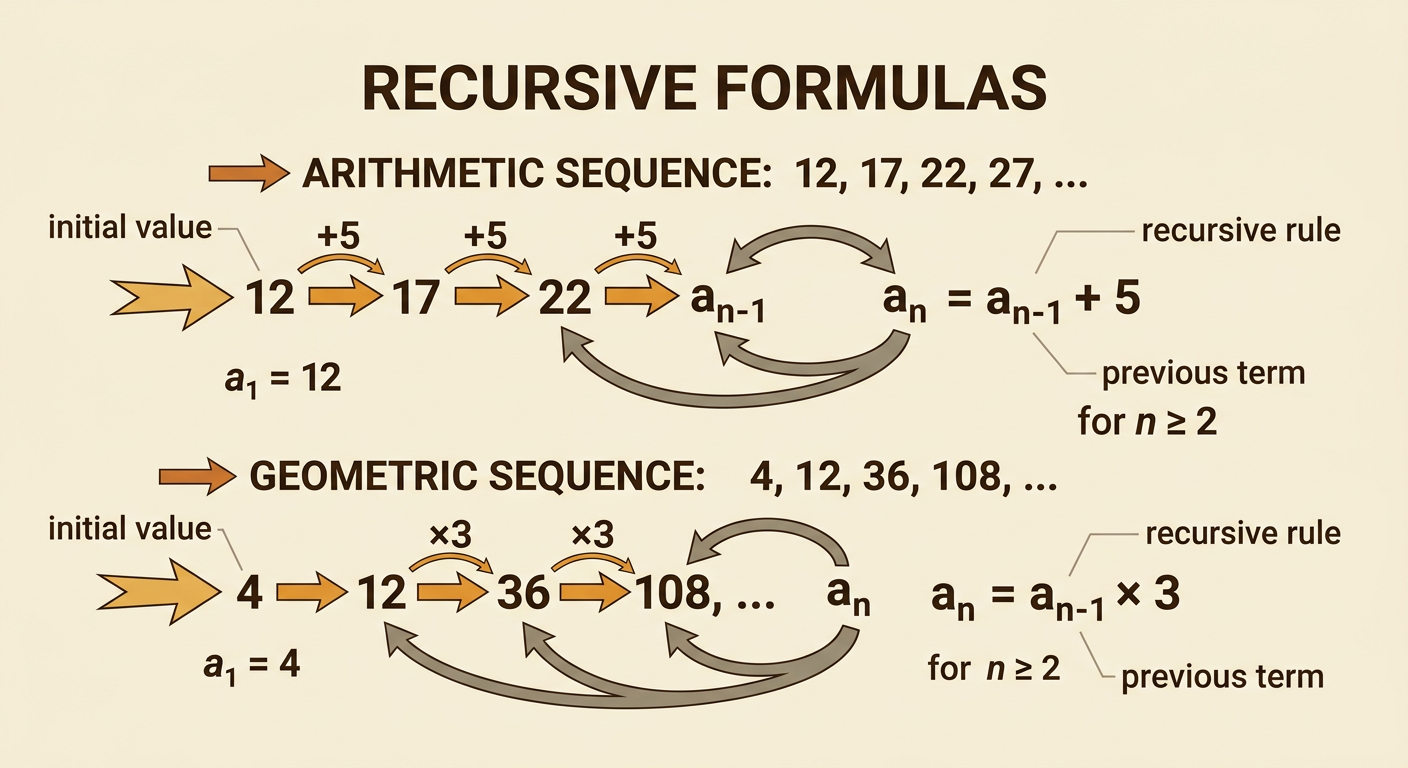
A recursive formula defines each term using one or more earlier terms. It must include an initial value so the sequence has a starting point. An arithmetic sequence is written a₁ = initial term and aₙ = aₙ₋₁ + d for n ≥ 2. For 12, 17, 22, 27, ..., the recursive formula is a₁ = 12 and aₙ = aₙ₋₁ + 5. A geometric sequence is written a₁ = initial term and aₙ = r·aₙ₋₁ for n ≥ 2. For 4, 12, 36, 108, ..., the formula is a₁ = 4 and aₙ = 3aₙ₋₁. Recursive rules clearly show how a pattern continues, but finding a distant term requires calculating all preceding terms in order.
Writing Explicit Formulas
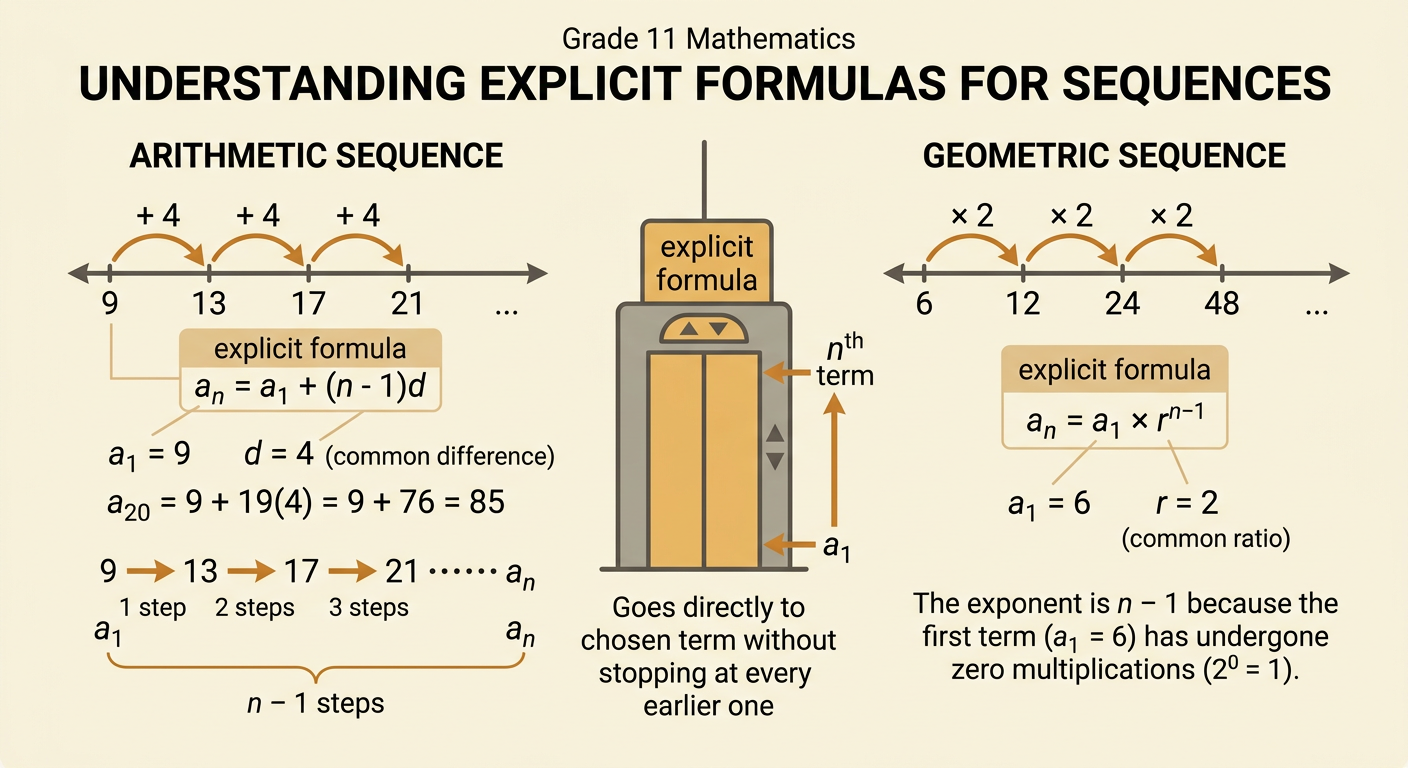
An explicit formula gives the value of a term directly from its position n. For an arithmetic sequence, the formula is aₙ = a₁ + (n − 1)d. The factor n − 1 counts the number of equal steps from the first term. For 9, 13, 17, 21, ..., a₁ = 9 and d = 4, so aₙ = 9 + 4(n − 1). Thus a₂₀ = 9 + 4(19) = 85. For a geometric sequence, the explicit formula is aₙ = a₁rⁿ⁻¹. For 6, 12, 24, 48, ..., a₁ = 6 and r = 2, so aₙ = 6·2ⁿ⁻¹. An explicit formula is especially useful for finding distant terms without generating every earlier term.
Modeling and Comparing Discrete Situations
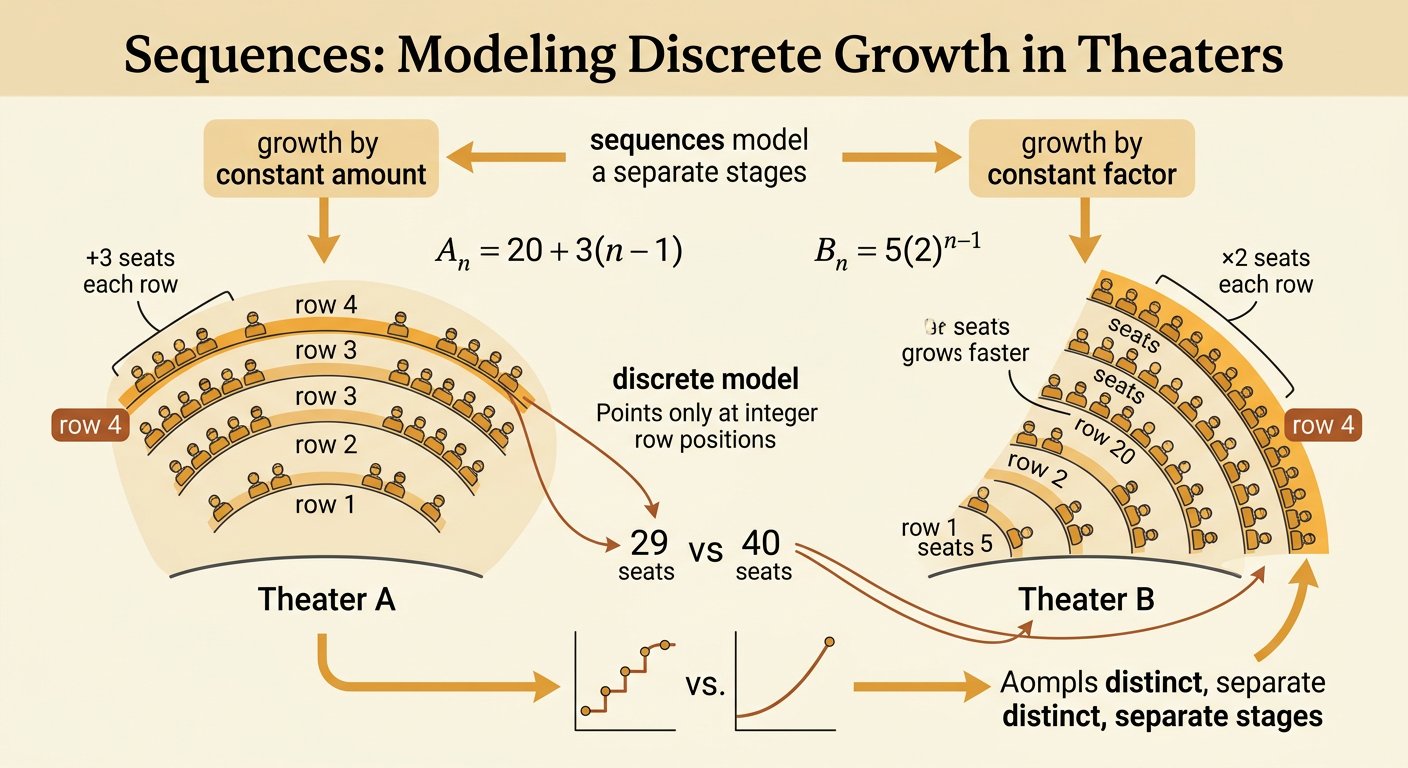
Sequences model quantities measured at separate, evenly spaced stages, such as years, payments, or rows of seats. Suppose Theater A has 20 seats in the first row and adds 3 seats per row. Its model is arithmetic: Aₙ = 20 + 3(n − 1). Theater B has 5 seats in the first row and doubles the number in each row. Its model is geometric: Bₙ = 5·2ⁿ⁻¹. At row 4, A₄ = 29 while B₄ = 40. Theater A grows by a constant amount, but Theater B grows by a constant factor and eventually becomes much larger. Because row numbers are whole numbers, only discrete input values make sense. Comparing tables, graphs, and formulas reveals both the starting value and the type of change.