
Ask and Answer Questions About a Story
Students use who, what, where, when, why, and how questions to find and discuss important information in a story.

Illustrations are auto-generated and may be placeholders. They can be refreshed to match the narration.
Introduce Question Words
Question words help us learn important details in a story. Who asks about a person or animal. What asks about an action or thing. Where asks about a place. When asks about a time. Why asks for a reason. How asks about the way something happens. Imagine a story that says, “On Monday, Maya found a wet puppy under the park bench. She carried it home in her red wagon.” We can ask, “Who found the puppy?” The answer is Maya. We can ask, “Where was the puppy?” It was under the park bench. We can also ask, “How did Maya take the puppy home?” She used her red wagon. Each question word points us toward a different key detail.

Listen to a Read-Aloud
When someone reads a story aloud, get your mind and body ready to listen. Face the reader, keep your voice quiet, and think about what is happening. Listen for the characters, setting, and important events. Here is a short example: “Ben planted a sunflower seed in the school garden. Every morning, he gave it water. In June, a tall yellow flower opened.” As you listen, picture Ben caring for the plant. Remember the key details: Ben is the character, the school garden is the setting, and watering the seed is an important event. If you miss a detail, you can ask the reader to repeat that part. Careful listening helps you understand the story and prepare good questions.

Ask Questions Before and During Reading
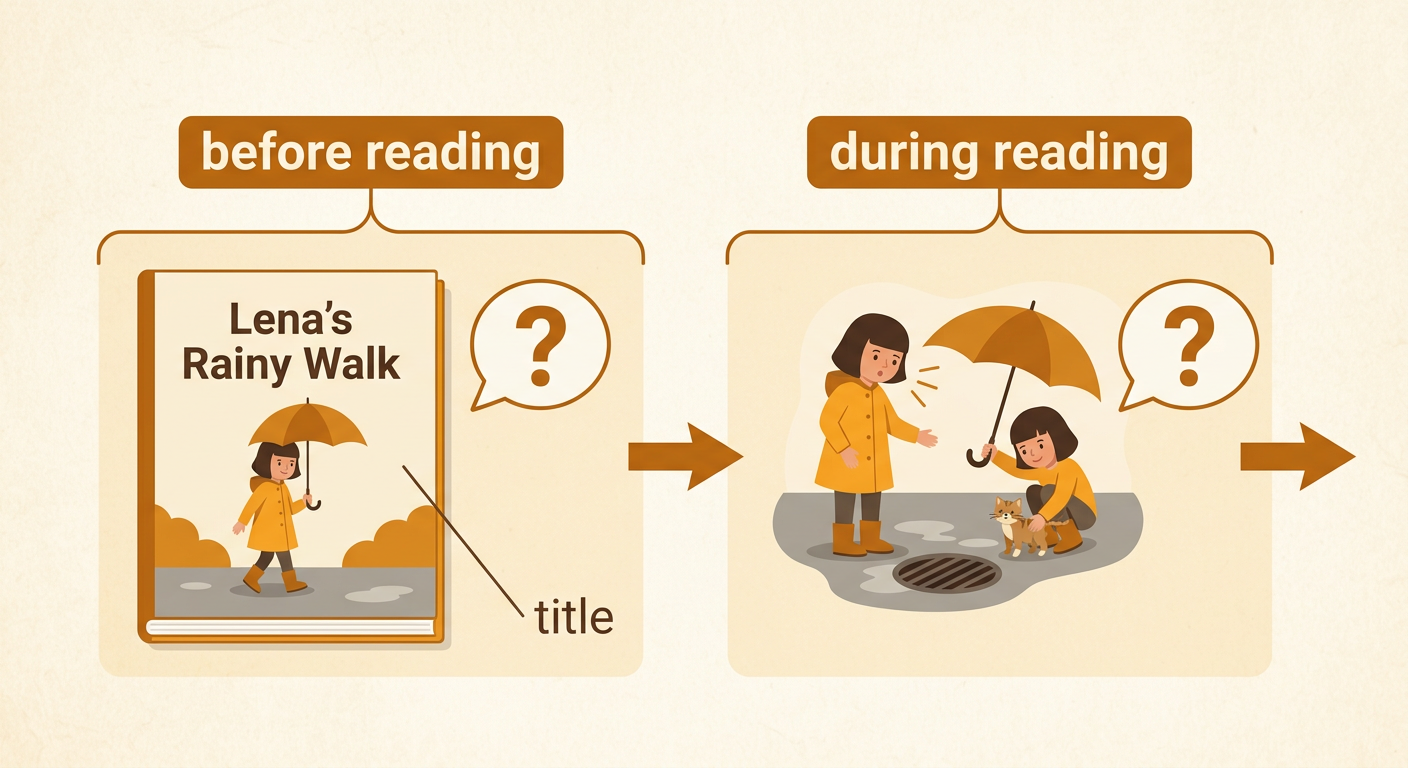
Before reading, look at the title and pictures. Ask questions about what you think you may learn. If a book is titled “Lena’s Rainy Walk,” you might ask, “Where will Lena go?” or “What will happen in the rain?” During reading, pause when you are curious or confused. Suppose the story says, “Lena heard a tiny sound near a drain.” You could ask, “What made the sound?” Then keep listening for an answer. New details may also lead to new questions. If a picture shows Lena holding an umbrella over a kitten, ask, “Why is she helping the kitten?” Questions keep your brain active. It is fine if the story answers a question later or if your first idea changes.
Find Answers in the Story
Good readers return to the story to find answers. The answer may be stated in the words or shown in a picture. Read or listen to the important part again. Suppose the story says, “The kitten cried because it could not climb out of the drain. Lena called her father, and together they lifted it to safety.” For the question “Why did the kitten cry?” the answer is that it could not climb out. For “How did Lena help?” the story tells us that she called her father and helped lift the kitten. Point to the words or picture that supports your answer. Do not guess when the story gives a clear detail. If the answer is not given yet, say, “I will keep reading to find out.”

Share Questions and Answers
Readers can share questions and answers with a partner or the class. Speak clearly and listen without interrupting. Begin with a question word, such as, “Who helped the kitten?” Your partner can answer in a complete sentence: “Lena and her father helped the kitten.” Then ask, “What detail supports your answer?” Your partner might say, “The story says they lifted the kitten to safety.” Take turns being the asker and the answerer. If you disagree, look back at the story together and talk kindly about the evidence. You may also add to a classmate’s idea by saying, “I noticed another detail.” Sharing helps everyone understand the characters, setting, and events. A strong answer matches the question and uses information from the story.
