
Ask and Answer Questions About a Story
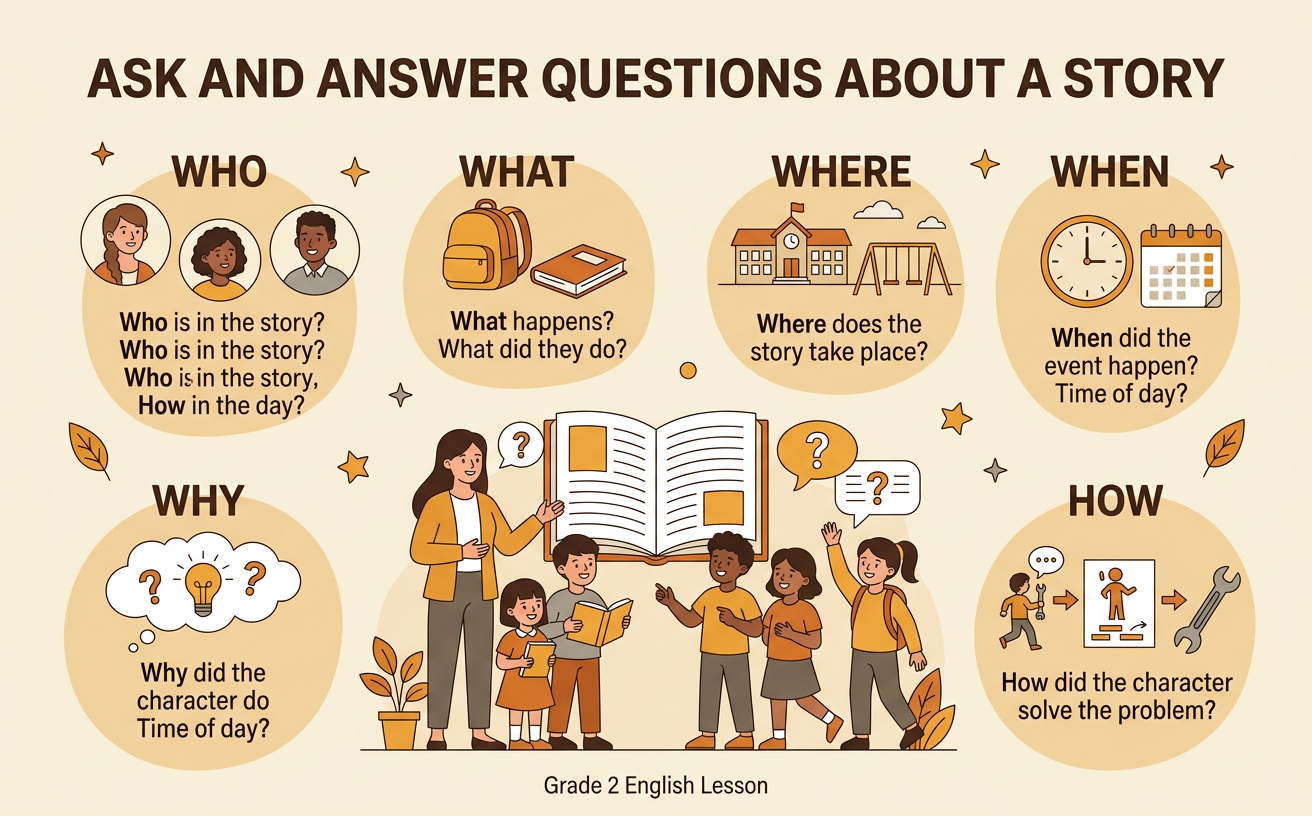
Students use who, what, where, when, why, and how questions to demonstrate understanding of important story details.
Illustrations are auto-generated and may be placeholders. They can be refreshed to match the narration.
Introduce Question Words
Good readers use question words to find important details in a story. Who asks about a person or character. What asks about an action, event, or thing. Where asks about a place. When asks about a time. Why asks for a reason. How asks about the way something happens. Imagine a story about Maya finding a lost mitten. You might ask, “Who lost the mitten?” The answer is Maya. You could also ask, “Where did she find it?” The answer might be near the playground fence. Each question word points to a different kind of detail. Before answering, think about what the question is asking. Then look or listen for that detail in the story.
Teacher Read-Aloud
Listen as your teacher reads this short story: “On a cold Monday morning, Maya wore her red mittens to school. At recess, she built a small snow rabbit near the playground fence. When the bell rang, Maya hurried inside. She soon noticed that her left mitten was missing. Her friend Eli walked back outside with her. They looked beside the snow rabbit and found the mitten under loose snow.” As you listen, picture the characters, setting, and events. Ask yourself: Who is in the story? Where does it happen? What problem does Maya have? The key details tell us that Maya loses a mitten at the playground and that Eli helps her find it near the snow rabbit.
Ask Before and During Reading
Questions can help you think before and during reading. Before reading, study the title and cover. Ask what the story might be about. For a story called “Maya’s Lost Mitten,” you might ask, “Why is the mitten lost?” This question gives you a reason to read. During reading, pause when you learn something new or become curious. After Maya notices her bare hand, ask, “Where will she look?” Keep reading to check your thinking. You may also ask questions when something is confusing. If you wonder why Maya returns to the playground, look for a detail that explains her choice. She had worn the mitten there while building the snow rabbit, so the playground was a sensible place to search.
Answer With Text Details
A strong answer uses details from the story. First, listen to or read the question carefully. Next, find the part of the story that answers it. Then say the answer in a complete sentence. If the question is “Where did Maya find her mitten?” do not answer only, “Outside.” Use the exact story detail: “Maya found her mitten under loose snow beside the snow rabbit.” For the question “How did Maya solve her problem?” answer, “Maya returned to the playground with Eli and looked near the snow rabbit.” These answers show understanding because they name actions and places from the text. Do not add details that the author did not give. Check that every answer matches what happened in the story.
Partner Question Practice
Work with a partner to practice asking and answering questions. Partner A asks one question about the story using who, what, where, when, why, or how. For example, Partner A might ask, “Why did Maya return to the playground?” Partner B answers, “Maya returned because she had worn her mitten there at recess.” Partner B should point to or name the detail that supports the answer. Then switch roles. Partner B asks a new question, such as, “Who helped Maya search?” Partner A answers, “Eli helped Maya search.” Listen carefully, take turns, and speak in complete sentences. If an answer does not match the story, kindly say, “Let’s check the text.” Together, find the correct detail and improve the answer.