
Ask, Predict, Test, and Share
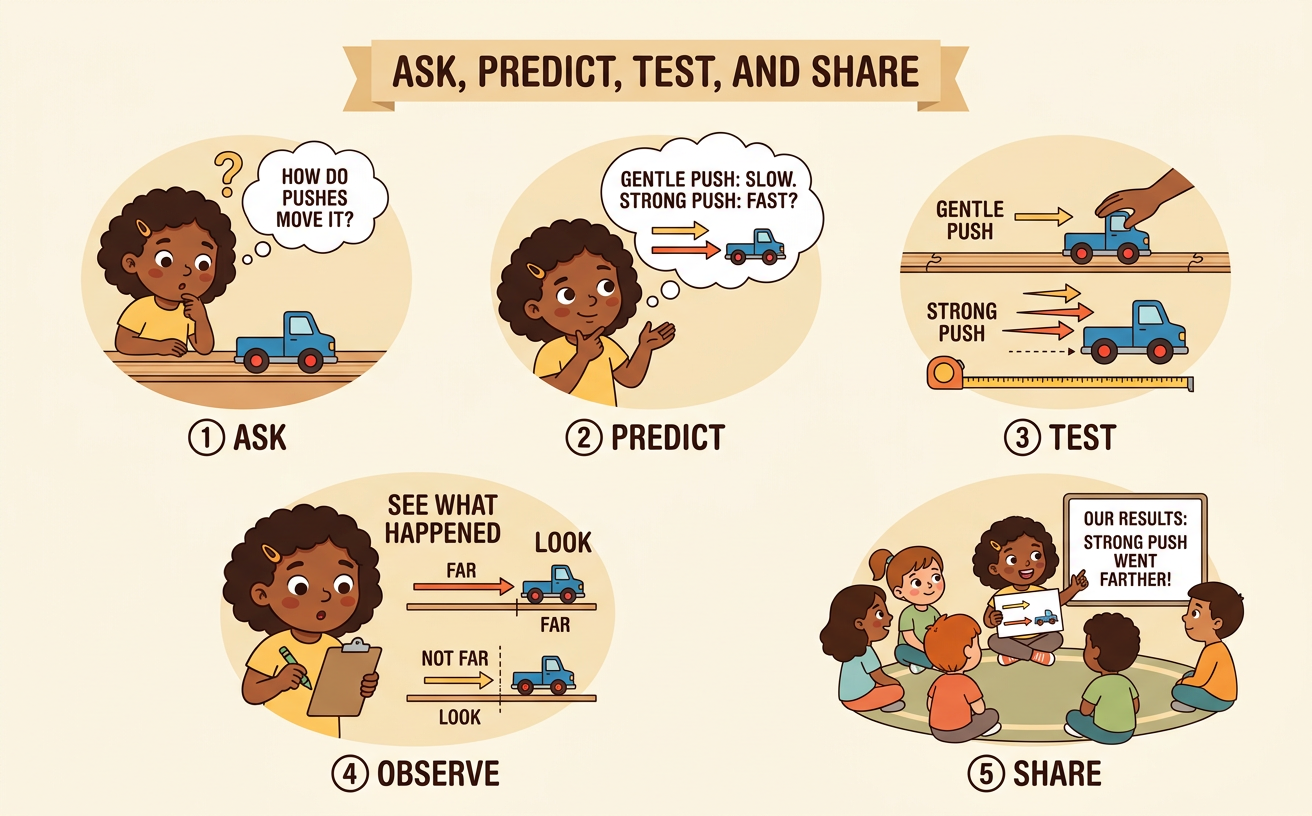
Students explore how gentle and strong pushes move a toy object while practicing a kindergarten-friendly investigation cycle: ask, predict, test, observe, and share.
Illustrations are auto-generated and may be placeholders. They can be refreshed to match the narration.
Notice and Ask a Question
Scientists begin by noticing what happens and asking a question. Place a toy car on a smooth, flat floor. Give it a gentle push and watch it move. You may notice that the car rolls forward and then stops. What do you wonder? You might ask, “Will a strong push make the car travel farther than a gentle push?” This question can be tested because you can push the same car in two ways and compare the distances. Look closely, but wait for your turn to touch the car. Listen when classmates share what they notice. Their ideas may help you think of a new question. Agree on one class question before beginning the investigation.
Make a Prediction
A prediction tells what you think will happen before you test. It is not a random guess. Use what you have seen or learned to help you decide. Think about the class question: “Will a strong push make the car travel farther than a gentle push?” You might predict, “I think the strong push will make the car travel farther because it gives the car a bigger change in motion.” Another student may predict that both pushes will move the car the same distance. Different predictions are welcome. Point to or draw your choice, then tell a partner why you chose it. Listen without interrupting when your partner speaks. After the test, you will compare the actual results with your prediction.

Plan a Fair Test
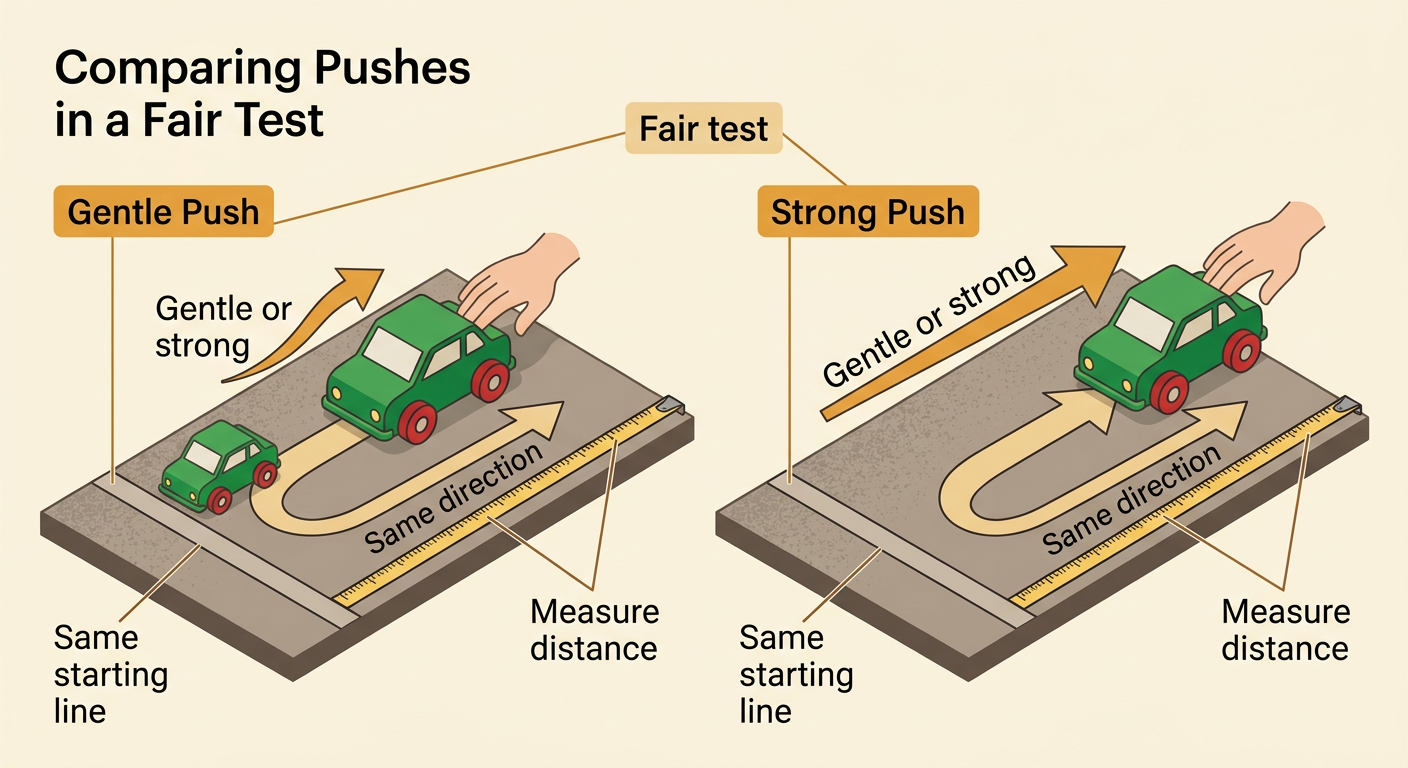
A fair test changes one thing and keeps other important things the same. In this investigation, change only the strength of the push: gentle or strong. Use the same toy car, the same smooth path, the same starting line, and the same direction each time. One student can push, one can mark where the car stops, and one can count connecting cubes to measure the distance. Switch jobs so everyone can help. Agree that the pusher will use one quick push and will not keep touching the car. Clear objects and people away from the path. Before starting, say the steps together: place the car, push it, let it stop, mark the stopping point, and measure. A careful plan makes the comparison more useful.
Try Gentle and Strong Pushes
Now conduct the test. Set the toy car at the starting line. First, use one gentle push in the forward direction. Take your hand away and let the car roll until it stops. Place a paper marker beside the front of the stopped car. Return the same car to the starting line. Next, use one strong push in the same direction. Again, let the car stop by itself and mark its stopping place. For a clearer comparison, repeat each kind of push more than once. Take turns safely and keep hands and feet out of the car’s path. A push can start an object moving or change how it moves. In this test, the gentle and strong pushes may cause the car to travel different distances.

Observe and Compare Results
Observe where the car stopped after each push. Measure from the starting line to the stopping point. You can place equal connecting cubes end to end along the path, with no spaces or overlaps. Count the cubes for each distance. For example, the gentle push might move the car 5 cubes, while the strong push moves it 11 cubes. Since 11 is more than 5, the strong-push distance is longer in this example. Record each result with a number, drawing, or sticker. Then compare repeated trials. Did the strong pushes usually move the car farther? Results may not match perfectly because people cannot make every push exactly alike. Describe only what the observations show, and ask for help if a measurement seems unclear.

Share What We Learned
Scientists share a claim and support it with observations. A claim tells what you learned. Evidence tells what happened in the test. You might say, “The strong push usually moved our toy car farther than the gentle push. In one trial, the gentle push moved it 5 cubes, and the strong push moved it 11 cubes.” Tell whether the results matched your prediction. Speak clearly, take turns, and look toward the person who is talking. Respond kindly by saying, “I agree because…” or “I noticed something different…” Ask a question if you need more information. The class can also discuss how the test could improve, such as repeating more trials. Working together and following discussion rules helps everyone learn from the investigation.
