
Ask, Test, Observe: Which Material Absorbs Water Best?
Students ask a testable question, make a prediction, conduct a fair comparison of materials, record observations, and use evidence to explain which material absorbs the most water.
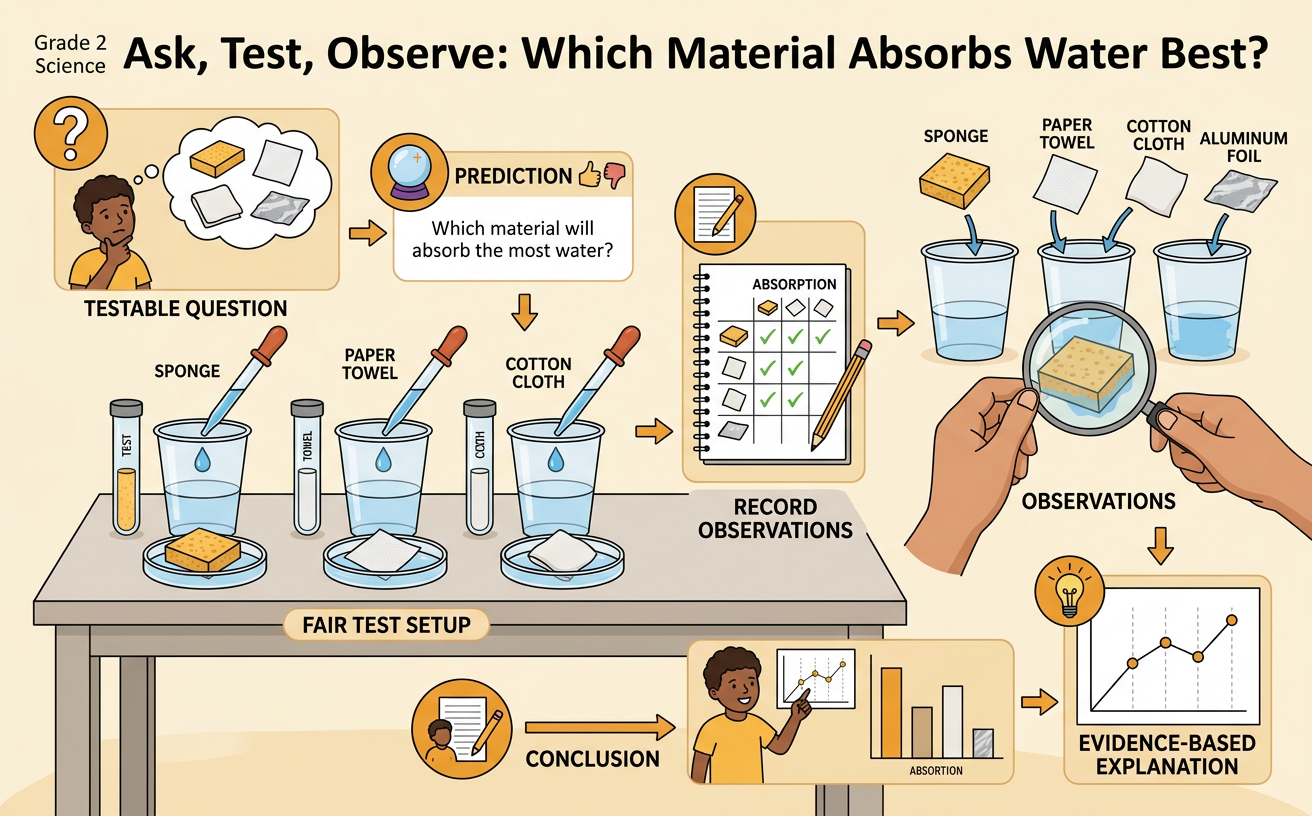
Illustrations are auto-generated and may be placeholders. They can be refreshed to match the narration.
Ask a Testable Question
A testable question can be answered by making observations or measurements during a safe investigation. It names what will change and what will be measured. Here, the changed item is the kind of material. The measured property is how much water each material absorbs. Ask, “Which equal-size material absorbs the most water: sponge, paper towel, cotton cloth, or wax paper?” This question is testable because you can give each sample the same amount of water and compare the amount it holds. A question such as “Which material is nicest?” is not as useful because “nicest” is an opinion. Before testing, gather helpful information from direct observation, a package label, or a teacher-provided book. Notice properties such as texture, thickness, and tiny spaces where water might enter. Do not decide the answer yet.
Predict What Will Happen
A prediction tells what you think will happen before the test. It is not simply a random guess. Use something you have observed, read, or learned to give a reason. For example, you might predict, “I think the sponge will absorb the most water because it has many tiny spaces that can hold water.” Another student might predict that the cotton cloth will absorb the most because its fibers soak up spills. Both predictions are acceptable before the investigation. The evidence from the test will show which prediction is better supported. Write your prediction before touching the water or changing any materials. You can use this sentence frame: “I predict that the _____ will absorb the most water because _____.” A prediction does not have to be correct to be useful. Scientists learn by comparing predictions with results.
Plan a Fair Comparison
A fair comparison changes only one main thing: the kind of material. Cut one 10-centimeter square from each material and place each sample in an identical shallow tray. Use one layer of each material. Measure 20 milliliters of water for every sample. Let each material sit in the water for 30 seconds. Then lift it with tongs, hold it above its tray for 10 seconds so loose drops return, and measure the water left in the tray. Keep the sample area, starting water, tray, soaking time, lifting method, and dripping time the same. Use separate dry trays so one sample does not affect another. A partner can operate the timer while another student measures. Work over a protected table, wipe spills right away, and never taste the test water. This plan makes the results easier to compare.
Test and Record Observations
Follow the plan one material at a time and record what you see and measure. First, pour 20 milliliters of water into the tray with the sponge. After 30 seconds, lift the sponge with tongs and let it drip over the tray for 10 seconds. Measure the water left. Repeat the same steps for the other materials without squeezing them. Find the absorbed amount by subtracting the water left from the 20 milliliters you started with. In one example, the sponge absorbed 17 milliliters, the paper towel absorbed 12 milliliters, the cotton cloth absorbed 8 milliliters, and the wax paper absorbed 1 milliliter. Also record observations in words. The wax paper may have water beading on its surface, while the sponge may feel heavy and wet. Careful notes are useful evidence.
Compare the Evidence
Evidence includes the measurements and observations collected during the test. Compare the absorbed amounts, not just how wet each sample looks. A bar graph can make the pattern easy to see. Put the kinds of material along the bottom and the amount of water absorbed in milliliters along the side. In the example, the sponge bar reaches 17 milliliters, the paper towel reaches 12, the cotton cloth reaches 8, and the wax paper reaches 1. The tallest bar shows the greatest amount absorbed. The sponge absorbed 5 milliliters more than the paper towel because 17 minus 12 equals 5. The wax paper absorbed the least, and most water remained in its tray. Check that every result came from the same fair procedure before deciding what the evidence shows.
Share an Evidence-Based Conclusion
A strong conclusion answers the question and uses results from the investigation. Begin with a claim that names the material that absorbed the most water. Then give numerical evidence and explain how it supports the claim. For example, write, “The sponge absorbed the most water. It absorbed 17 milliliters, while the paper towel absorbed 12, the cotton cloth absorbed 8, and the wax paper absorbed 1. Because 17 milliliters is the greatest amount, the evidence supports my claim.” You may add that the sponge’s tiny spaces helped it hold water. Say whether your prediction was supported, but do not change your original prediction. Results can differ if materials have different sizes or thicknesses, so describe exactly what you tested. Repeating the investigation can show whether the result happens again.