Asking and Answering Questions About a Story
Students ask and answer who, what, when, where, why, and how questions while citing details from a story to support their responses.

Illustrations are auto-generated and may be placeholders. They can be refreshed to match the narration.
Review Question Words
Question words help us learn different kinds of information about a story. Who asks about a person or character. What asks about an action, event, or thing. When asks about time. Where asks about a place. Why asks for a reason. How asks about the way something happens. For example, imagine a story in which Mia plants a seed in the school garden on Monday because she wants to grow a sunflower. We can ask, “Who plants the seed?” The answer is Mia. We can also ask, “Where does she plant it?” The answer is the school garden. To answer “Why does Mia plant the seed?” we explain that she wants to grow a sunflower. Choose the question word that matches the information you want to discover.

Read the Story
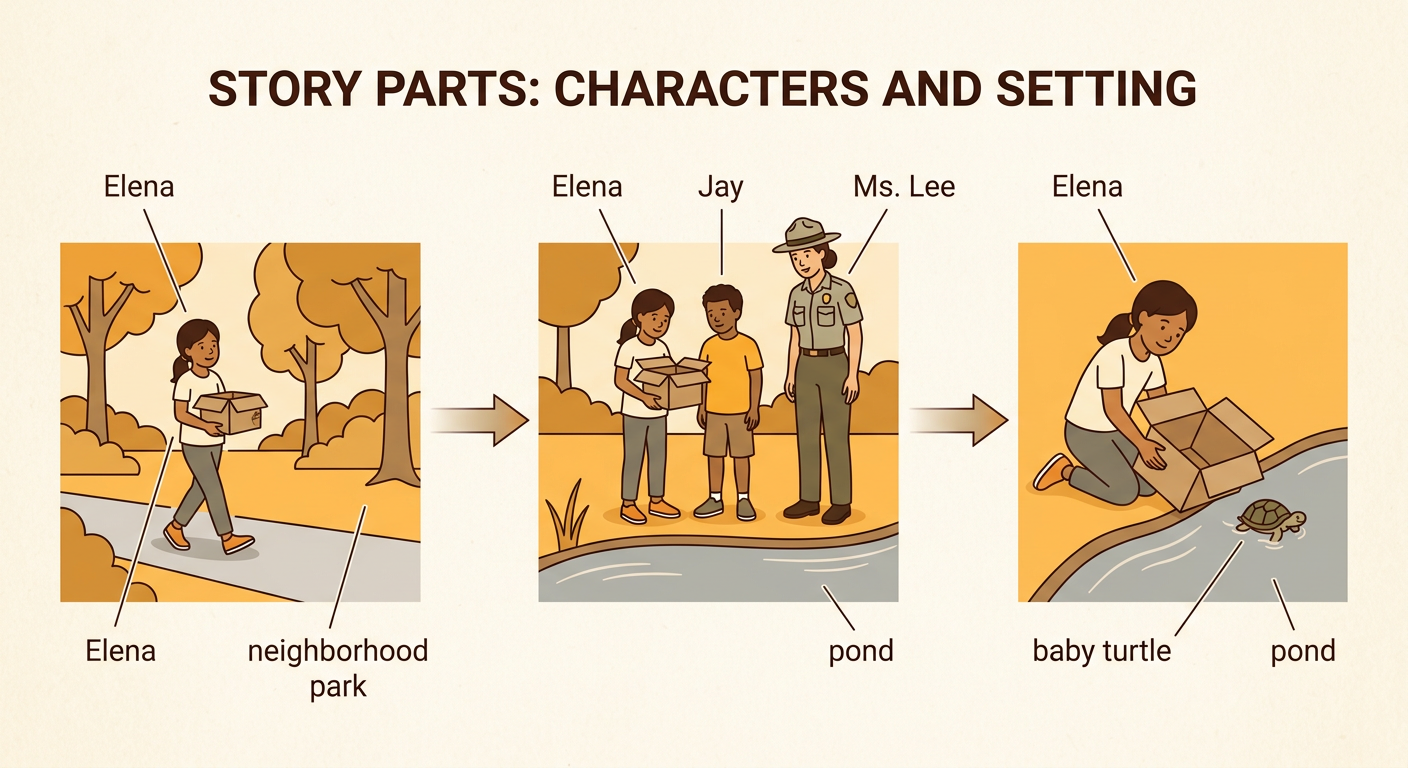
Read this short story carefully. On Saturday morning, Elena carried a small box to the neighborhood park. Her friend Jay waited beside the pond. “I found this baby turtle near the road,” Elena explained. She had placed the turtle in the box to keep it safe from cars. Jay called the park ranger, Ms. Lee, and told her what had happened. Ms. Lee checked the turtle and said it was healthy. She showed Elena and Jay a quiet, safe place near the pond where they could release it. Elena gently tipped the box, and the turtle crawled toward the water. Elena smiled because the turtle was safe in its natural home. As you read, notice the characters, setting, events, problem, solution, and reasons for the characters’ actions.
Ask Before, During, and After Reading
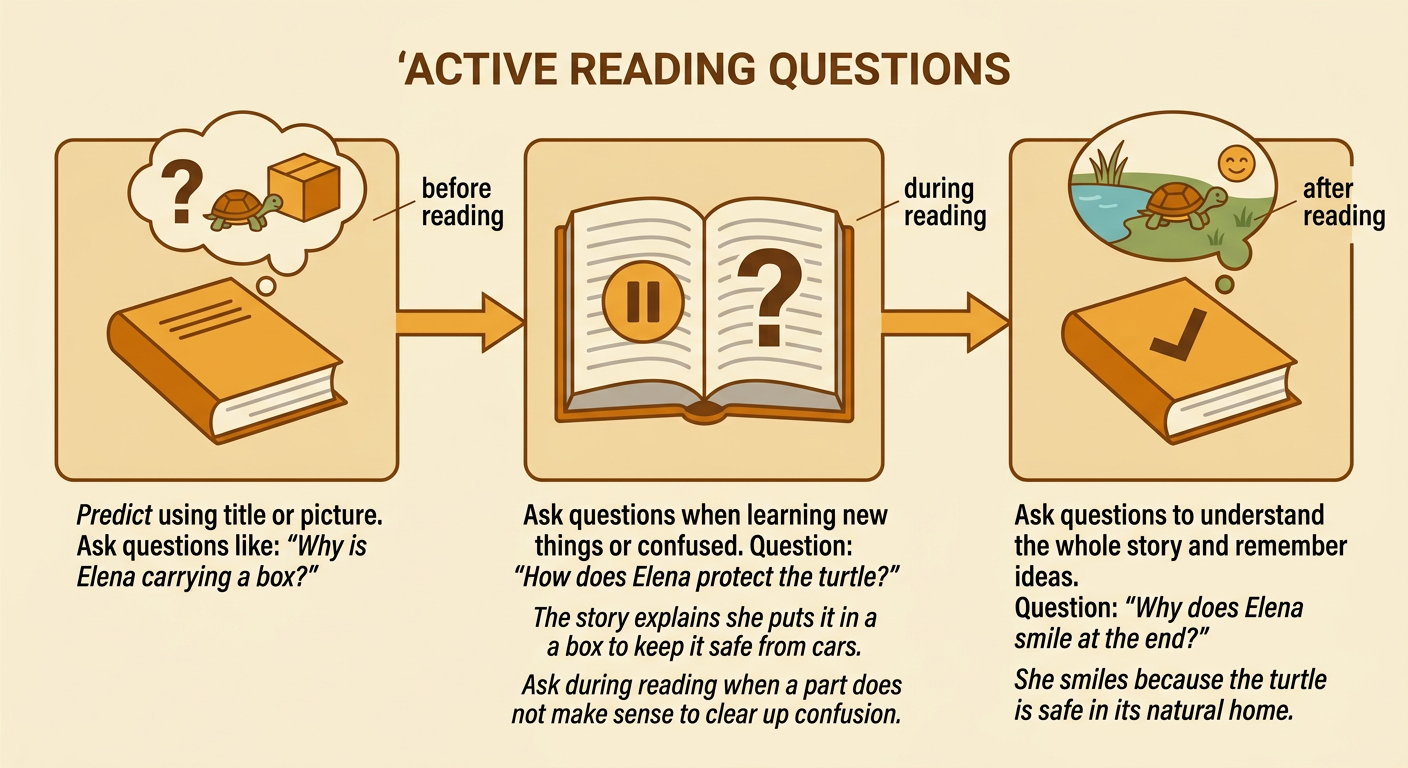
Good readers ask questions at different times. Before reading, look at the title or pictures and ask what you think the story may be about. Before the turtle story, you might ask, “Why is Elena carrying a box?” During reading, pause when you learn something new or feel confused. You could ask, “How does Elena protect the turtle?” After reading, ask questions that help you check your understanding and think about the whole story. For example, ask, “Why does Elena smile at the end?” Then return to the story to confirm your idea. Her smile shows that she is happy because the turtle is safe. Questions before reading help you predict, questions during reading help you understand, and questions after reading help you remember and explain important ideas.
Find Evidence in the Text
Text evidence is a word, sentence, or detail from the story that supports an answer. First, read the question and decide what information it asks for. Next, return to the story and find the part that gives the answer. For the question “How did Elena keep the turtle safe from cars?” the story says, “She had placed the turtle in the box to keep it safe from cars.” This sentence is strong evidence because it directly explains Elena’s action. You can point to it by saying, “The text states that Elena placed the turtle in a box.” Do not answer only from a guess or from your own experience. Use details that the author actually included. If needed, reread the sentences before and after the evidence to make sure you understand it correctly.

Answer Using Complete Sentences
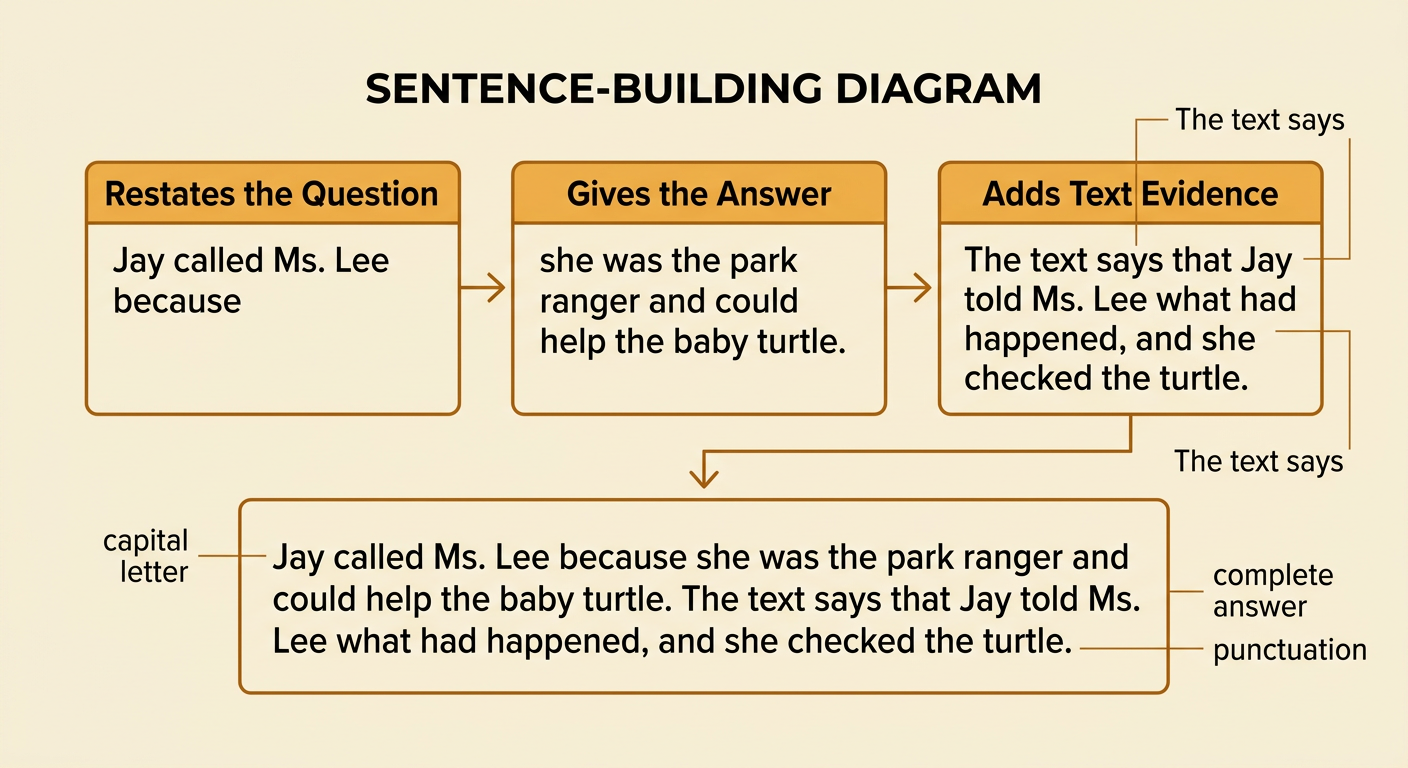
A complete answer makes sense by itself and includes evidence from the story. Begin by restating the important words from the question. Then give the answer and add a supporting detail. Suppose the question is, “Why did Jay call Ms. Lee?” A weak answer is, “Because of the turtle.” It does not clearly explain what happened. A stronger answer is, “Jay called Ms. Lee because she was the park ranger and could help the baby turtle.” You can add explicit evidence: “The text says that Jay told Ms. Lee what had happened, and she checked the turtle.” Check that your sentence begins with a capital letter, expresses a complete thought, and ends with punctuation. Useful phrases include “According to the story,” “The text says,” and “In the story.”